



Most small galleries operate somewhere between organized chaos and actual chaos. The founder handles sales, curation, marketing, and probably unclogging the toilet. Your assistant manages everything from Instagram posts to insurance paperwork. Maybe there's a part-timer who shows up Thursdays through Saturdays.
This setup works until it doesn't. Usually around month 18, when you've got your first semi-major show coming up, two artists asking why their work hasn't sold, and a collector who swears they emailed about that piece three weeks ago but you can't find the message anywhere.
The breaking point hits differently for each gallery, but the pattern stays consistent. What started as a passion project with manageable complexity suddenly becomes an operational maze where every decision affects three other things you hadn't considered. Your WhatsApp messages blend with Instagram DMs, email threads get lost, and that Excel sheet tracking consignments hasn't been updated since last Tuesday because who had time?
The standard advice about "systematizing your operations" falls apart when your entire team could fit in a Honda Civic. You don't need elaborate workflows designed for Gagosian. You need minimalist structures that actually match your reality.
Why small galleries fail operationally (not artistically)
Gallery failures rarely come from bad taste or poor curation. They come from operational breakdowns that compound over time. You miss following up with a collector who was genuinely interested. An artist pulls their work because communication went dark for two months. Your best assistant quits because they're drowning in undefined responsibilities.
The operational challenge for small galleries is particularly brutal because you're managing artists who need constant communication and validation, collectors who expect concierge-level service, physical inventory that needs tracking and photographing, events that require weeks of coordination compressed into scattered hours, plus financial complexity around consignments, sales, and commissions.
Each of these areas contains dozens of micro-processes that seem simple individually but create chaos collectively. When you're switching between negotiating with an artist, updating your website, planning next month's opening, and trying to remember if you invoiced that sale from last week, things slip through cracks that become canyons.
The standard advice about "systematizing your operations" falls apart when your entire team could fit in a Honda Civic. You don't need elaborate workflows designed for Gagosian. You need minimalist structures that actually match your reality.
The minimalist SOP approach that actually works
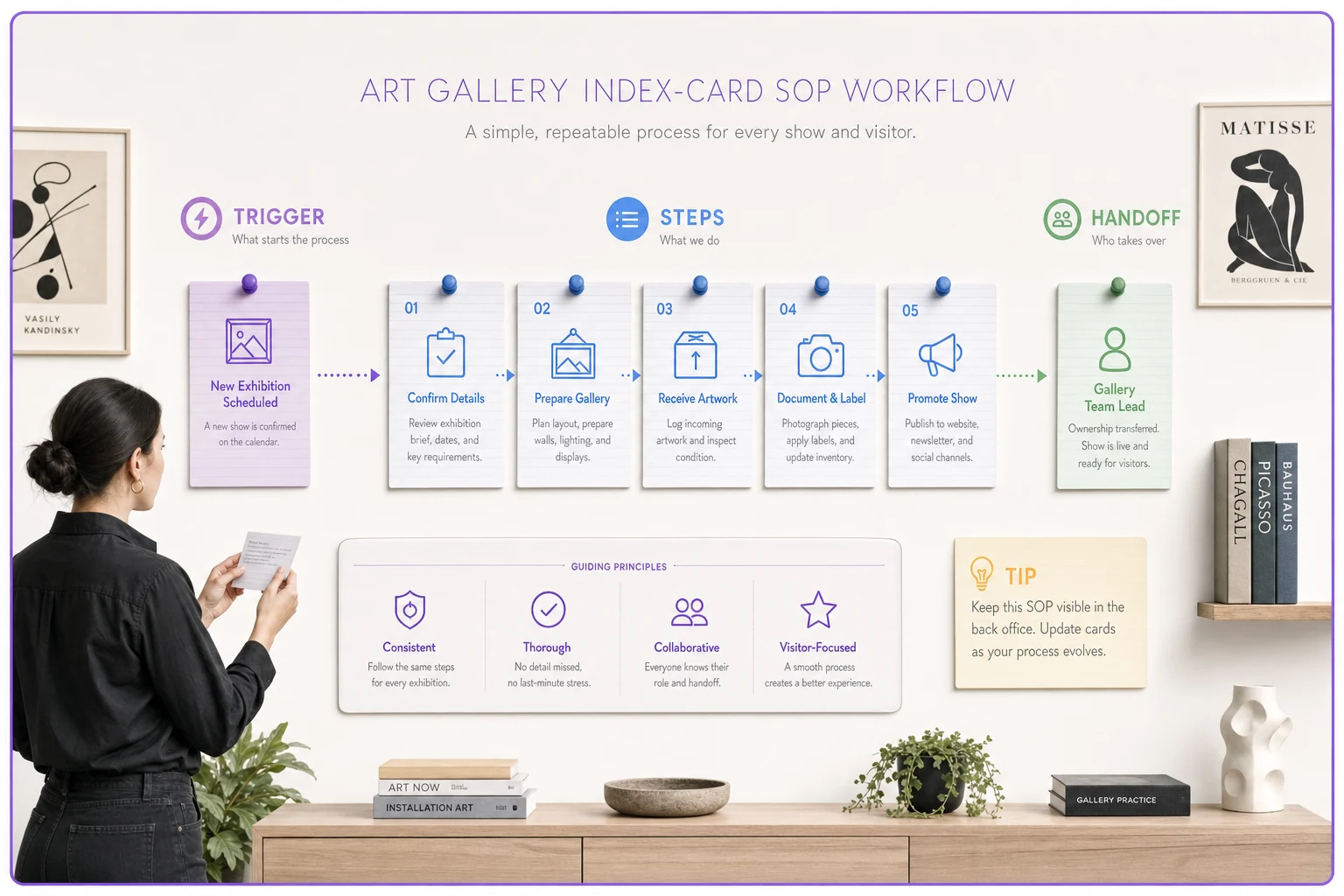
Forget 50-page operation manuals. Small galleries need what I call "index card SOPs" — procedures simple enough to fit on a 3x5 card but specific enough to prevent mistakes.
Works best when every critical process gets documented in under 200 words with three components: the trigger (what starts this process), the steps (maximum 7, each one sentence), and the handoff (where it goes next or how it ends).
Trigger: Artist delivers work or emails about consignment
Steps:
-
Photograph work immediately (before anything else happens)
-
Create inventory entry with artist name, title, medium, dimensions, price
-
Send artist the consignment agreement template
-
Add to "pending consignment" folder until agreement signed
-
Once signed, move to active inventory
-
Schedule for website upload (Tuesday batch)
-
Text artist confirmation photo showing work in gallery
Handoff: Added to monthly artist update list
This entire process takes maybe four minutes to execute once documented, versus the usual 20-minute scramble trying to remember what you usually do. More importantly, anyone can follow it — your assistant, your part-timer, even you when you're exhausted after an opening.
When you've got these index card SOPs for your ten most common processes, that new assistant doesn't need three weeks of training. They need an afternoon with your stack of cards.
A simple visual of the index-card SOP workflow can help the team adopt it faster.
When you've got these index card SOPs for your ten most common processes, that new assistant doesn't need three weeks of training. They need an afternoon with your stack of cards.
Keep the index-card SOPs visible in the workspace so new hires can find them instantly.
When you've got these index card SOPs for your ten most common processes, that new assistant doesn't need three weeks of training. They need an afternoon with your stack of cards.
Priority matrices for resource-starved teams
Every gallery task feels urgent until you realize treating everything as urgent means nothing gets done well. Small galleries need brutal prioritization, and the standard important/urgent matrix doesn't cut it when you're juggling artist egos and collector expectations.
Instead, use what I call the Gallery Impact Matrix:
| Category | Revenue Impact | Relationship Risk | Time to Complete | Do When |
|---|---|---|---|---|
| Hot collector follow-up | High | High | 15 min | Immediately |
| Artist check-in (no issues) | Low | Medium | 5 min | Weekly batch |
| Instagram post | Medium | Low | 20 min | Daily morning |
| Inventory reconciliation | Low | Low | 2 hours | Monthly |
| Opening night logistics | High | High | 8 hours | 3 weeks before |
| Website updates | Medium | Medium | 1 hour | Weekly batch |
| Email newsletter | Medium | Low | 90 min | Biweekly |
| Commission invoicing | High | Medium | 30 min | Same day |
The key insight: relationship risk often matters more than revenue impact in the gallery world. A frustrated artist can poison three other relationships. An ignored collector might not complain but definitely won't come back.
This matrix becomes your daily decision filter. When everything feels urgent, you check the matrix. Hot collector follow-up beats Instagram post every time. Opening night logistics three weeks out beats inventory reconciliation.
Delegation patterns that don't require mind reading
Small gallery teams fail at delegation because the founder assumes everyone understands the subtle dynamics of the art world like they do. They don't. Your assistant doesn't intuitively know that when Mrs. Henderson asks about "something blue for the bedroom," she means she's ready to spend $8,000 but needs to feel like she discovered the piece herself.
Effective delegation requires context rules, not just task assignments:
Task: Respond to collector inquiries
-
Collectors asking about specific pieces
respond within 2 hours with photos, dimensions, and "happy to arrange viewing"
-
General inquiries ("looking for abstract work")
respond within 24 hours with 3-4 options
-
Price inquiries
always add "happy to discuss" never just state the price
-
Unknown inquiries
forward to owner, don't guess
Task: Artist communication
-
Weekly update requests
send standard stats (views, inquiries, foot traffic mentions)
-
Complaints about placement/promotion
acknowledge same day, forward to owner
-
Delivery coordination
handle completely, just update calendar
-
Price/commission discussions
always forward to owner
Task: Event coordination
-
Vendor communications
full authority under $500
-
Guest list questions
add everyone, we'll figure out capacity later
-
Artist requests for opening
say yes unless physically impossible
-
Collector VIP requests
always accommodate, notify owner
These context rules eliminate 80% of the "quick questions" that interrupt your day. Your team knows enough to act independently within boundaries that protect relationships and revenue.
Low-cost tools that solve actual gallery problems
Galleries love buying expensive art fair booths but run their operations on sticky notes. The realistic toolstack costs less than one month's rent and actually reduces chaos:
Core inventory and sales: Square for Retail or Lightspeed Not the fanciest, but integrates inventory, sales, and basic customer tracking for under $100/month. Works on tablets during openings when your laptop is nowhere to be found.
Communication hub: Shared WhatsApp Business Everyone hates email. Artists text, collectors DM, and you're drowning in different inboxes. WhatsApp Business lets multiple team members see and respond to messages, with labels for "artist," "collector," "vendor," and "inquiry."
Task coordination: Physical kanban board Digital project management tools become graveyards for small teams. A simple board with columns for "This Week," "In Progress," "Waiting," and "Done" keeps everyone aligned without another login to remember.
Document templates: Google Workspace Five documents handle 90% of gallery paperwork: consignment agreement, sale invoice, loan agreement, condition report, exhibition checklist. Create templates once, copy for each use. Total cost: $12/month per user.
Event and viewing scheduling: Calendly Stop the back-and-forth emails about studio visits and private viewings. One link, automated scheduling, everyone's calendar stays updated.
You don't need specialized art-world software from day one. You need basic tools that everyone can actually use without a manual.
The onboarding checklist that prevents three-month disasters
New team members typically get thrown into the deep end with verbal instructions like "just watch what I do." Three months later, you discover they've been telling artists completely wrong commission structures or promising collectors discounts you'd never approve.
Day 1-2: Context and access
-
Gallery origin story and mission (why we exist)
-
Artist roster walkthrough (who they are, what they make, their personalities)
-
Collector categories (regulars, prospects, VIPs, browsers)
-
Physical space orientation (storage, supplies, emergency contacts)
-
Tool access (email, WhatsApp, calendar, inventory system)
Day 3-4: Basic operations
-
Opening/closing procedures
-
Inquiry response templates and context rules
-
Inventory locations and handling rules
-
Phone and walk-in greeting scripts
-
Price inquiry protocol (never quote without checking)
Day 5: Shadow and practice
-
Shadow owner for half day
-
Practice inquiry responses (owner reviews before sending)
-
Solo gallery sitting with owner available by phone
-
End-of-day debrief on questions and confusion
Week 2: Gradual release
-
Handle inquiries with spot-checking
-
Manage social media with approval
-
Coordinate one small task independently
-
Daily check-ins reduce to 15 minutes
This structured start seems like overkill for a small team, but it prevents months of correction and relationship repair. Every hour spent on proper onboarding saves roughly 10 hours of fixing problems later.
Real scenario: How one gallery went from chaos to (relative) calm
A gallery in Chicago's West Loop operated in permanent crisis mode. Three people — owner, full-time assistant, weekend associate. They represented 12 artists, averaged 15 sales monthly, and everyone was miserable.
Their daily reality looked like this: The owner spent mornings answering emails that the assistant could have handled with proper context. The assistant spent afternoons hunting for information that should have been documented. The weekend associate basically guarded the space and apologized for not knowing answers. Artists complained about communication. Collectors received inconsistent follow-up.
The transformation took about six weeks and started with documenting their ten most common processes on index cards. Nothing fancy — literally handwritten cards taped to the wall in the back office. Suddenly the assistant could handle artwork intake without interrupting the owner every time.
They created context rules for communication. The assistant learned when to handle things independently versus when to loop in the owner. Response time improved from 48 hours average to same-day for most inquiries.
They set up a simple priority matrix visible to everyone. The constant "what should I do next?" questions disappeared. Everyone knew hot collector follow-ups beat Instagram posts.
All communication moved to WhatsApp Business. No more checking five different platforms for messages. Artists appreciated faster responses. The team could cover for each other.
They implemented structured onboarding for their next hire. Instead of the usual trial-by-fire approach, the new person was functional within a week and confident within three.
The results after three months: sales increased by about 30% (better follow-up, not better art), artist complaints dropped to nearly zero, the owner reclaimed 15 hours per week for actual gallery growth, the assistant stopped job hunting, and weekend coverage became reliable instead of apologetic.
They still operate with three people. They still face resource constraints. But the constant operational fires stopped, replaced by predictable workflows that anyone could execute.
When systematization becomes another problem
There's a temptation, especially after things start working, to systematize everything. Don't. Galleries succeed through relationships and serendipity, not process optimization. Over-systematization kills the spontaneous conversations that lead to major sales and the flexibility that makes artists feel valued.
The goal isn't to become a perfectly efficient machine. It's to eliminate the repetitive failures that waste energy and damage relationships. Your SOPs should handle the mundane so you can focus on the meaningful. Your priority matrix should clarify decisions, not dictate them. Your delegation patterns should empower judgment, not eliminate it.
Keep the human elements human. Systematize the administrative elements. That's the balance that lets small galleries punch above their weight without losing their soul.
Building your own playbook (starting Monday)
The playbook that works for your gallery won't look exactly like anyone else's. Your artist roster has specific needs. Your collectors have particular expectations. Your team has unique strengths and gaps.
-
List your five most painful recurring problems
-
Pick the easiest one to solve
-
Create an index card SOP for it
-
Test it for a week
-
Adjust and move to the next problem
Don't try to fix everything at once. Gallery operations improve through small, consistent changes that compound over time. One documented process becomes two. Two becomes five. Five becomes a functioning system that doesn't require your constant intervention.
The galleries that survive and thrive aren't necessarily the ones with the best art or biggest budgets. They're the ones that build sustainable operations allowing them to focus on what matters: supporting artists, developing collectors, and creating cultural value in their communities.
Your gallery doesn't need to run like MoMA. It needs to run smoothly enough that you remember why you started it in the first place. That's what a good small-gallery playbook delivers — not operational perfection, but operational peace that lets you get back to the art.