

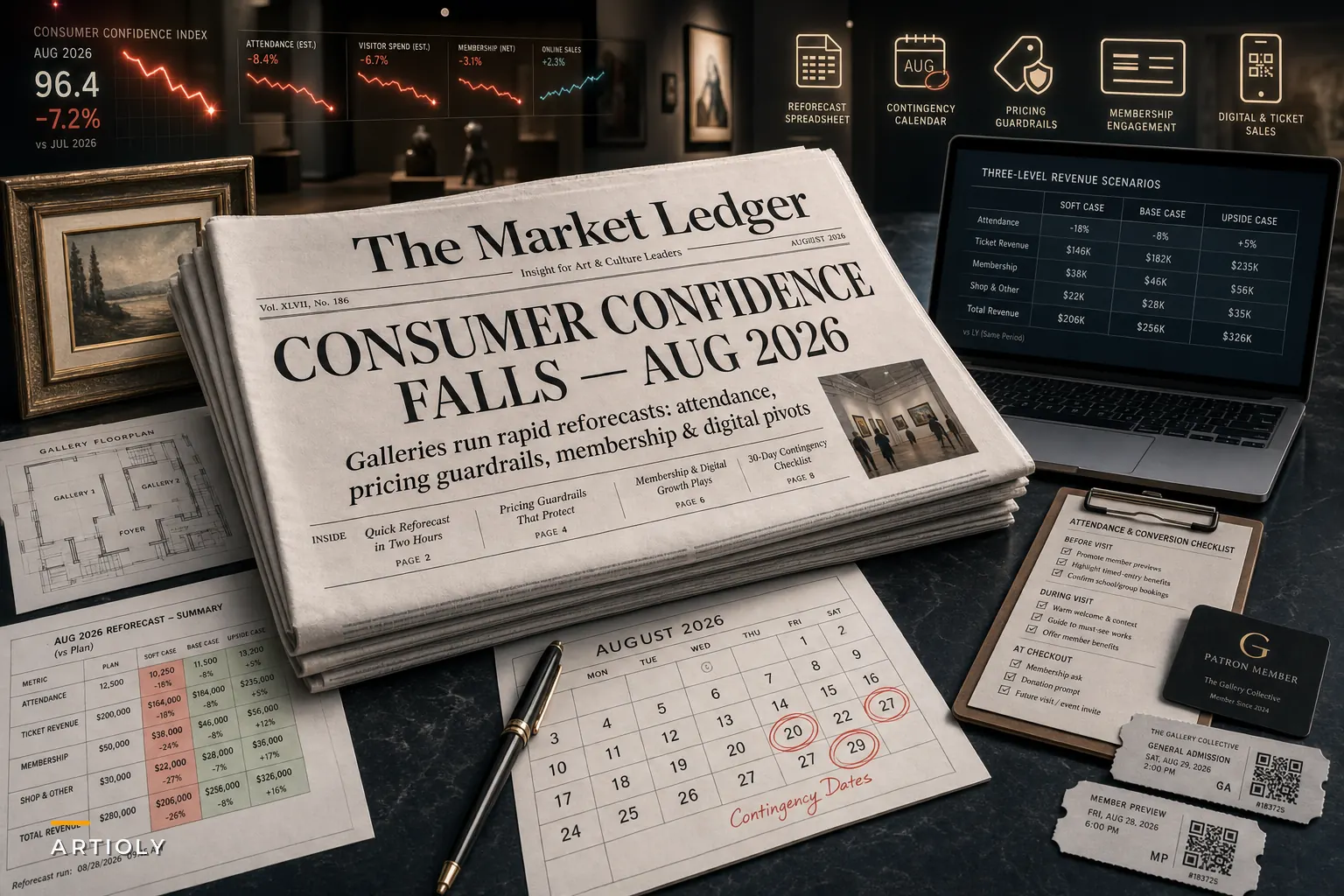

The Conference Board's Consumer Confidence Index dropped to 89.4 in August 2026, its weakest reading in several months, with the Conference Board flagging a sharper decline in how households are feeling about the months ahead. Reuters connected the drop to worsening expectations around jobs and inflation — which is the part that actually matters if you're running a gallery.
Confidence indexes are lagging-ish signals for most retail categories. For galleries they tend to behave more like an early warning. Art purchases — especially in the $3k–$25k range where most small galleries operate — are pure discretionary, emotionally driven, and easy to defer. When a collector starts feeling uncertain about their income or portfolio, they don't cancel. They just... wait. And that "waiting" is the quiet killer, because it doesn't show up as a hard no. It shows up as a slower fall, a softer opening, a viewing room full of browsers who never close.
This post isn't really about the index. It's about what you do in the next few weeks so a softer consumer environment doesn't quietly eat your exhibition margin.
The real exposure isn't sales — it's committed cost against uncertain revenue
By late August, your fall program is already locked. Framing ordered, shipping booked, printer deposit paid, opening catering confirmed — maybe you've committed to loan fees or an artist's travel too. Your costs are 70–90% committed while your revenue is still entirely a forecast.
A confidence dip doesn't touch your cost base. It only touches the revenue side — the least certain part. So the exposure isn't just "we'll sell less." It's "we've already spent based on last year's pace, and that assumption just got weaker."
The galleries that handle this well don't panic-cut. They re-run the math with softer assumptions and find out which shows still clear break-even at 70% of expected sales and which ones don't. That single exercise — a fast reforecast — is worth more than any marketing push, because it tells you where to defend and where to pull back before you've burned cash.
Step one: the two-hour reforecast (do this first)
You don't need a new model. You need to stress-test the one you already have. If you don't have an exhibition-level break-even model at all, that's the actual emergency — the exhibition financial model and break-even playbook is the foundation this whole exercise sits on.
Assuming you have per-show numbers, here's how to work through it:
-
Pull committed vs. uncommitted cost for each fall show. Split every line into "already spent / contractually owed" and "still cancellable." This gives you a real flexibility map.
-
Re-forecast revenue at three levels base case, a soft case at roughly 75% of base sales, and a bad case at around 55%. Work in unit sales, not just dollars — a slowdown usually shows as fewer works sold, not lower prices.
-
Find each show's break-even in the soft case. How many works need to sell to cover committed cost? If that number sits uncomfortably close to your soft-case volume estimate, that show is fragile.
-
Flag your contingency gates. For any show more than 30 days out, mark the last date you can cut cancellable costs — framing, catering, printing, travel — without penalty. Get those dates on a calendar. Miss them and your options disappear.
-
Rank shows by margin resilience, not excitement. The show you're most enthusiastic about might be the one you can least afford to run at full spend right now.
Here's a quick visual of the two-hour reforecast workflow.
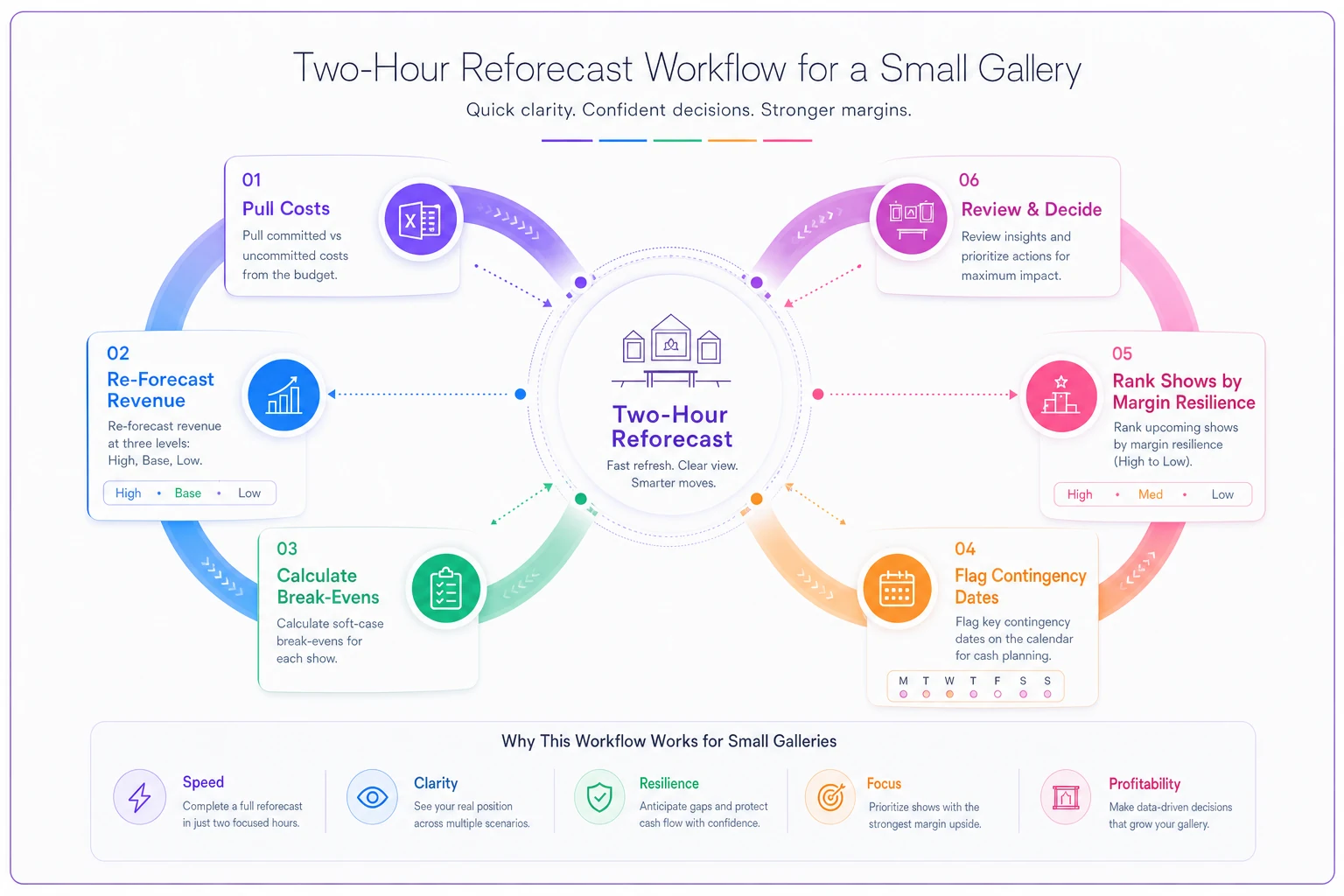
The output isn't a decision to cancel anything. It's a ranked list: which shows are safe, which need a leaner version, and which need a hard conversation.
A quick way to read your fragility
Here's a simplified version of what that reforecast output tends to look like for a small gallery running three fall shows:
| Show | Committed cost | Soft-case sales needed to break even | Realistic soft-case volume | Verdict |
|---|---|---|---|---|
| Emerging solo (A) | ~$4,800 | 3 works | 4–5 likely | Safe — proceed |
| Group show (B) | ~$11,000 | 7 works | 5–6 likely | Fragile — trim capex |
| Loaned/curated (C) | ~$18,500 | 9 works + fees | 6–8 uncertain | High risk — restructure |
Show C is the classic problem: high fixed cost, revenue dependent on a handful of high-ticket closes that a cautious buyer is most likely to defer. The move isn't to cancel it. It's to reduce committed spend — smaller loan footprint, local artists instead of shipped-in work, leaner install — so break-even drops to something the soft case can actually hit.
Adjust pricing and discount rules *before* you're negotiating on the floor
The worst discounting happens in the moment. A collector hesitates, your director panics, and suddenly there's a 15% "just for you" concession that nobody planned and that quietly compresses margin across the whole season.
-
Decide your maximum discount per tier in advance. For example
0% under $5k, up to 10% for works $5k–$15k, case-by-case above that with owner sign-off.
-
Trade discount for commitment, not just for a sale. A 5% concession in exchange for a deposit today beats a 12% walk-out save.
-
Protect the artist split explicitly. Decide whether discounts come out of the gallery's share, the artist's, or split — and put it in writing before the show opens, not during a heated close.
-
Use holds strategically. In a soft market, a generous but time-boxed hold ("we'll hold it 72 hours") reduces the "let me think about it" that quietly becomes never.
When galleries skip this step, discounting drifts upward all season because every decision gets made under pressure. Setting the ceiling in advance is probably the cheapest margin protection available.
Shift the mix toward lower-capex and local programming
When the revenue side gets shaky, the smart lever is the cost side of programming. A soft season can actually make your calendar healthier if you use it that way.
-
Local and regional artists (no shipping, no travel, faster install)
-
Works-on-paper and editions alongside bigger pieces, giving hesitant buyers an accessible entry point
-
Existing inventory and back-room works re-presented in a fresh curatorial frame
-
Collaborative or member-driven shows that spread cost and bring their own footfall
When this makes sense: if your reforecast shows one or more fragile shows, swapping a shipped-in, high-fee exhibition for a strong local one protects cash without going dark.
When it's a bad idea: if a big show is already the anchor of your year, has committed press, or is contractually locked with penalties that exceed the savings. Cutting the wrong show to save capex can cost more in reputation and collector pipeline than you save on framing.
Don't wait for on-site sales — pull revenue forward through membership and retention
Opening-night on-site sales are exactly what softens first when buyers get cautious. The galleries that stay steady tend to have revenue that doesn't depend on a good night at the opening.
-
Push membership renewals and upgrades early. A member who's already committed is footfall and goodwill locked in regardless of the broader mood.
-
Work your warmest collectors directly, before the public opening. Private previews and first-look offers convert far better in a nervous market than broad announcements.
-
Reactivate lapsed buyers with a reason, not a blast. A specific work that fits their known collection will outperform a generic "come see our fall show" every time.
In a soft market, depth beats reach. Ten warm relationships worked properly will out-earn a thousand cold impressions.
A real scenario
A two-person contemporary gallery — roughly $480k in annual sales, mostly in the $4k–$18k range — went into a similar soft patch with three fall shows already locked. Their instinct was to cut marketing spend.
Instead they ran the reforecast. It showed marketing wasn't the problem. Their loaned, shipped-in October show needed 9 works sold to break even in the soft case, and their honest estimate was 5–6. That gap was the entire risk.
They didn't cancel. They restructured: dropped two shipped loans, replaced them with two strong regional artists, trimmed the install and catering, and moved the opening to a members-first preview night. Committed cost fell from around $18k to roughly $11k, pulling break-even down to 5–6 works. They also set a firm 10% discount ceiling for the season and offered 72-hour time-boxed holds.
Total unit sales across the fall were down modestly from the prior year — the soft market was real — but margin held, the October show cleared break-even comfortably, and the members-preview format brought in about a dozen renewals they'd otherwise have chased in January. The slowdown still happened. It just didn't cost them money.
Where systems quietly make or break this
The reforecast, the discount rules, the contingency dates — none of it is complicated math. The hard part is keeping it current when three shows, an artist calendar, and a dozen collector conversations are all moving at once. Most small galleries lose the thread here: the plan gets made in a spreadsheet in August and never revisited as reality drifts away from it.
Keep committed-cost dates, soft-case break-evens, and collector activity in one shared place and review it weekly so you spot trouble early.
The galleries that stay disciplined tend to keep their exhibition costs, break-even thresholds, collector activity, and contingency dates in one connected place rather than scattered across a spreadsheet, an inbox, and someone's memory. When committed-cost dates and soft-case break-evens sit next to actual sales as they come in, you can see a show drifting toward trouble weeks before it becomes a crisis — early enough to trim capex or work a few more collectors. Whether that's a proper operational platform or a well-maintained shared workbook matters less than the habit: one source of truth, reviewed weekly, so decisions get made at the gate instead of at the panic point.
A dip in consumer confidence doesn't decide your season. Your committed-cost position and your reforecasting discipline do. The gallery that runs the soft-case math this week, sets its discount ceiling before the floor, and pulls revenue forward through its warmest relationships will get through a cautious fall with margin intact — even if unit sales dip. The gallery that assumes last year's pace and finds out in November is the one that gets hurt.
You can't control how confident buyers feel. You can absolutely control how exposed you are when they hesitate. Spend the two hours. Reforecast now.