

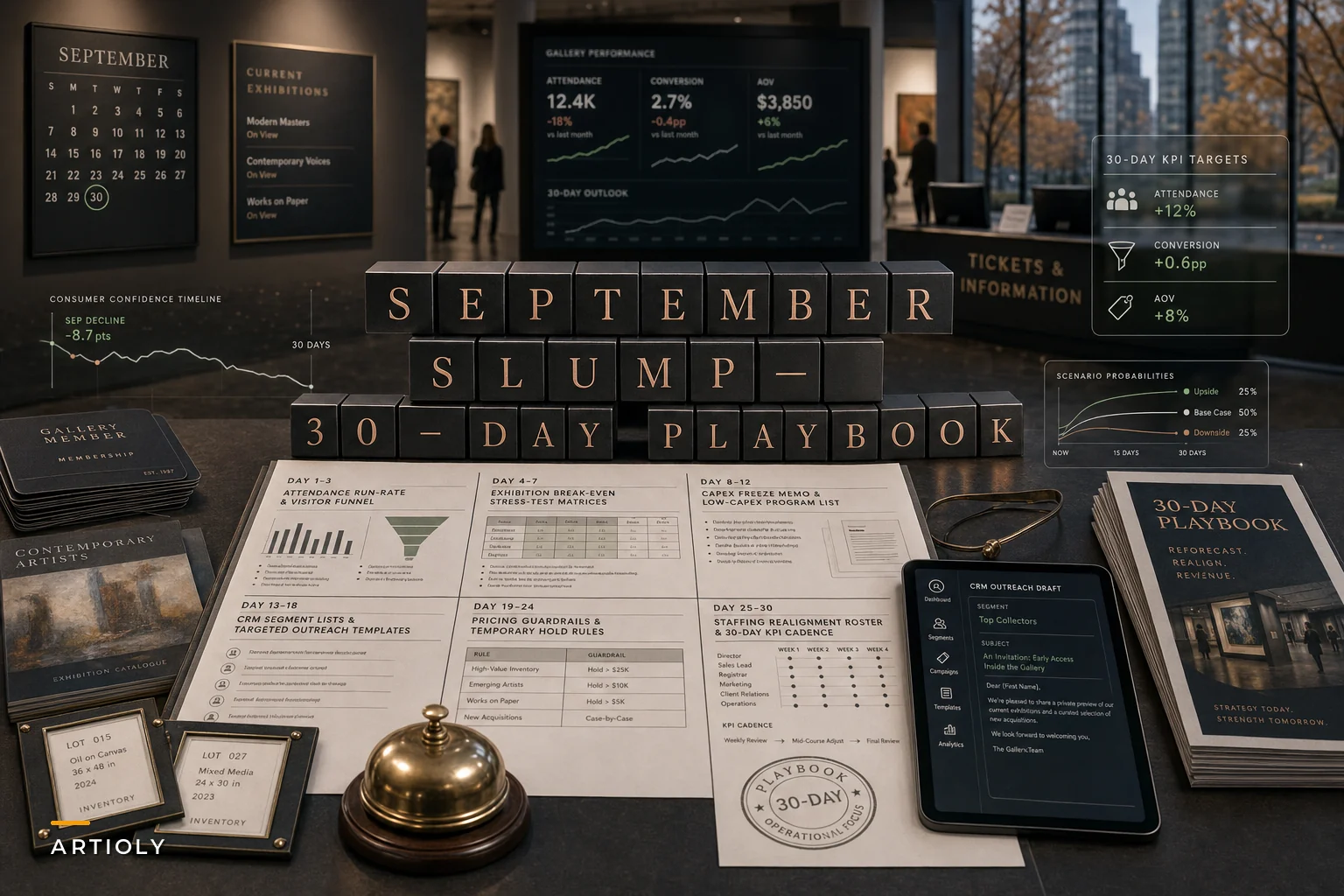

The Conference Board reported that its Consumer Confidence Index dropped 6.7 points to 81.9 in September 2026, the weakest reading since April 2014. CNBC framed it plainly: optimism is sliding as households worry about prices and jobs, with weaker near-term spending plans already baked in.
For a gallery, this isn't abstract macro data. Discretionary spending is the first thing people cut, and art sits near the top of the "can wait" list for all but your most committed collectors. The problem is that most small galleries build an exhibition budget three to six months out, lock in framing, shipping, and opening costs, and then discover — around week two of a show — that the attendance and conversion numbers they planned around no longer hold.
This isn't about panic. It's about running a disciplined 30-day reforecast so you stop defending stale numbers and start steering with current ones.
Start by admitting your forecast is already wrong
The sales projection you built for your fall program assumed a consumer who no longer exists this quarter. That's not a judgment — it's just timing. A 6-point confidence drop doesn't hit evenly. It barely touches your top three or four collectors, but it meaningfully softens the middle of your buyer base: the people who were "thinking about it," the first-time buyers at the $2k–$6k level, the opening-night impulse purchases.
In practice, this usually shows up as a conversion gap rather than a footfall gap. People still come to the opening. They still enjoy the work. They just hold. A show that would normally convert 8 of every 100 engaged visitors into inquiries drops to 4 or 5, and because margins on a single show are thin, that difference is the gap between a profitable exhibition and one that quietly eats your reserve.
So the first move is mechanical: pull your last three to four shows and separate the two numbers you usually blend together — attendance and conversion. You need to know which one is actually moving before you cut anything.
The 30-day reforecast, in order
The sequence matters. Galleries that reforecast badly tend to start by slashing marketing, which is exactly the lever you want to keep pulling when the middle of your buyer base is hesitating.
Never miss a key exhibition detail again.
Artioly helps you organize, promote, and manage every exhibition effortlessly.
- Unified exhibition scheduling
- Artist and visitor notifications
- Inventory and sales tracking
No credit card required
-
Days 1–3
Rebuild your attendance→inquiry→sale ratios using only the last 90 days.
Ignore last year. Last year's holiday numbers will lie to you right now. -
Days 4–7
Stress-test every upcoming show's break-even against two scenarios
— a mild softening (conversion down ~20%) and a sharp one (down ~40%). You're not predicting; you're bracketing. -
Days 8–12
Freeze non-essential programming CAPEX.
Elaborate builds, premium framing on speculative inventory, catalog printing you can defer — pause what isn't committed. -
Days 13–18
Shift marketing spend from reach to conversion.
Fewer awareness posts, more direct outreach to warm contacts who've inquired in the last 18 months. -
Days 19–24
Introduce pricing and hold guardrails
so your team isn't improvising discounts under pressure (more on this below). -
Days 25–30
Lock a revised staffing and contractor plan
for the next two shows based on the bracketed scenarios, not the original optimistic one.
The ordering is deliberate — you need to understand your real ratios before you touch budgets. Cutting first and measuring later is how galleries accidentally kill the channel that was still working.
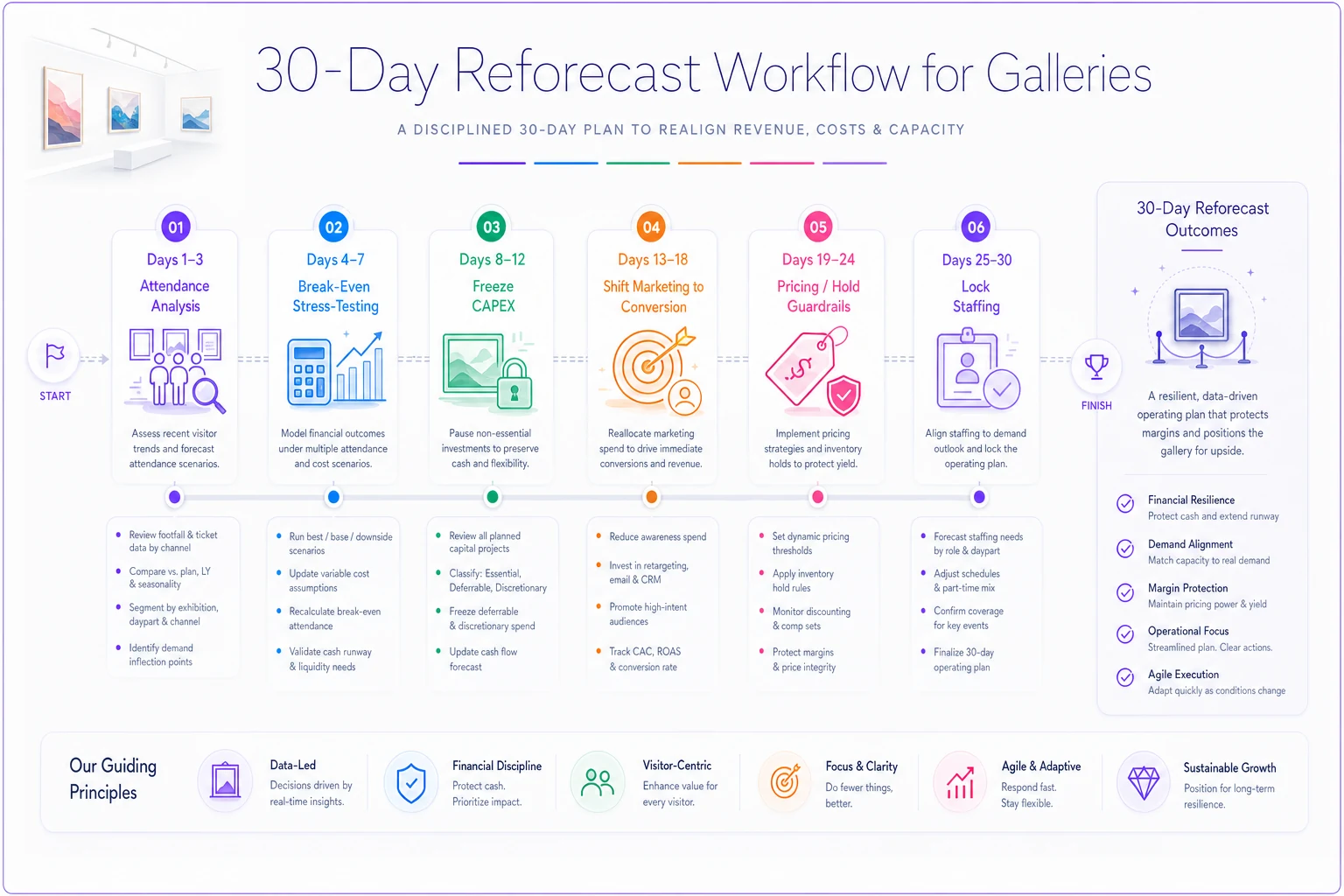
This visual summarizes the 30-day sequence and decision points.
Where the money actually leaks during a demand dip
A sudden confidence drop exposes something that's been there the whole time: most small galleries can't see their revenue by channel in real time. They know the quarter total. They don't know, on day 10 of a show, whether the viewing room is outperforming the floor, or whether membership renewals are quietly covering the shortfall from slower walk-in sales.
| Channel | Typical behavior in a dip | Response speed | Priority during slump |
|---|---|---|---|
| Opening-night floor sales | Soft, especially mid-tier works | Slow to recover | Protect, don't over-invest |
| Viewing-room / private sales | More resilient (committed buyers) | Fast | Push hard |
| Membership / recurring income | Sticky if stewarded | Steady | Accelerate renewals |
| Image licensing & rentals | Largely uncorrelated | Steady | Underrated cushion |
| Secondary-market placements | Collector-dependent | Variable | Opportunistic |
The pattern worth noticing: the channels that hold up best in a dip are the ones that don't depend on impulse. That's the whole argument for revenue that doesn't ride on footfall.
A real scenario
A mid-size commercial gallery running roughly six to seven shows a year built its fall exhibition around an expected ~7% opening-conversion rate and about 180 opening-night attendees. Break-even sat near $34k in sales per show once framing, shipping, the opening, and contractor hours were counted.
When sentiment dropped, attendance barely moved — around 165 came through. But inquiries fell from the expected dozen-plus down to seven, and only three converted. That's roughly $18k–$22k in sales against a $34k break-even.
What saved the quarter wasn't a heroic last-minute sale. They'd reforecast early. By week two they'd shifted budget toward direct viewing-room outreach to eight warm collectors, deferred a planned catalog print (~$3k), and pushed membership renewals two months ahead of schedule. The viewing-room push landed two placements the floor never would have, and recurring membership income — close to $4k that month — absorbed most of the gap. The show still underperformed, but it didn't bleed into the reserve. That's the realistic win: not avoiding the dip, but refusing to let one soft show cascade.
Pricing and hold guardrails (so your staff stops improvising)
When sales slow, the instinct is to discount. The danger is uncontrolled, inconsistent discounting that trains your collectors to wait and quietly resents your artists. These rules need to be decided before the pressure hits.
-
Define who can authorize a discount and at what thresholds. Front-of-house offering 15% off on their own is a margin and trust problem.
-
Set a maximum hold duration (5–7 days is reasonable) so "I'm thinking about it" doesn't tie up inventory indefinitely.
-
Decide which works are never discounted — new primary works from artists who'd be undercut by it.
-
Pre-agree payment-plan terms so you can offer structure instead of price cuts. A 3-month plan often closes a hesitant mid-tier buyer without touching the number.
-
Log every exception so you can see, after the show, whether discounting actually moved anything or just gave away margin.
In a confidence dip, flexibility on terms converts better than flexibility on price. Buyers aren't rejecting the value — they're nervous about cash flow and timing. A payment plan answers the real objection without devaluing the work.
Using the systems you already have to run this live
None of this works if you're reconstructing numbers from memory and email threads. The galleries that reforecast well are the ones whose inventory, CRM, and exhibition data live somewhere they can actually query mid-show.
In practical terms: your exhibition schedule holds the break-even target per show. Your CRM tags which collectors inquired and where they sit in the funnel. Your inventory system flags what's on hold and for how long. When those three talk to each other, you can look at a show on day 10 and answer a real question — are we tracking to break-even, and if not, which channel do we lean on? — instead of guessing.
Tag inquiries with the show name and week so you can filter quickly during a reforecast.
Lightweight automation earns its place quietly here. Renewal reminders that fire before a membership lapses. A nurture sequence that re-engages warm-but-cold inquiries the week a relevant show opens. Alerts when a hold passes your guardrail window. You're not replacing the curatorial or relationship work — you're making sure mechanical follow-through doesn't fall through the cracks exactly when you're understaffed and distracted. A platform that centralizes inventory, collector records, and exhibition performance in one place turns a 30-day scramble into something you can repeat every time sentiment wobbles, without rebuilding the process from scratch each time.
When aggressive reforecasting is the wrong call
This discipline isn't free, and there are situations where leaning too hard into cuts backfires.
If a significant share of your revenue comes from a handful of committed collectors largely insulated from a confidence dip, gutting your programming budget to chase a middle-market softening you don't actually depend on is a mistake. You'd be protecting against a problem you don't have while damaging the shows your core buyers expect.
Similarly, if you're mid-build on a flagship exhibition that anchors your gallery's reputation and pipeline for the next year, slashing it to save one quarter's margin can cost far more in standing and future placements. Short-term reforecasting should protect the reserve, not sacrifice the strategy.
The reforecast is a steering tool, not a blanket austerity program. Read your own channel mix first.
The deeper problem a dip exposes
Every confidence slump reveals the same structural weakness in small galleries: too much revenue depends on a single, impulse-sensitive moment — the opening — and too little comes from channels that keep paying regardless of the news cycle.
A gallery with healthy membership income, steady licensing or rental revenue, and a disciplined viewing-room practice barely feels a 6-point sentiment drop. A gallery that lives show-to-show feels every point of it. That's not really about the September number — the next dip will come, and the one after that.
If this slump has you reforecasting in a hurry, treat it as a signal to build the kind of income base that makes the next reforecast boring. Our breakdown on how to lower exhibition risk with predictable income through a revenue diversification portfolio walks through which channels to layer in and in what order — so a confidence dip becomes a line-item adjustment instead of a fire drill.
The gallery that survives soft quarters isn't the one with the best taste. It's the one that can see its numbers clearly, move its budget faster than its competitors, and lean on income that doesn't flinch when consumers do.
Ready to elevate your gallery operations?
Join 500+ galleries using Artioly to streamline operations, boost visitor engagement, and increase art sales.