

Most galleries run on a single, brutal math problem: the exhibition either sells or it doesn't. When it sells, everyone breathes. When it doesn't, you're eating fixed costs for six to eight weeks with nothing to offset them. That volatility is the real enemy — not any individual bad show.
The galleries that survive long enough to build a real reputation aren't the ones with better taste. They're the ones who stopped letting exhibition sales be the only thing standing between them and rent. That's what gallery revenue diversification actually means in practice: building enough independent income streams that no single failure sinks the quarter.
This post treats diversification as a portfolio problem, the way a fund manager would. Each stream has a different risk profile, a different margin, a different staffing cost, and a different correlation to exhibition performance. The goal isn't to chase every possible revenue idea. It's to assemble a mix where the reliable, boring money covers your break-even floor — and exhibition sales become upside instead of survival.
Why single-stream galleries break at the worst possible time
The failure pattern is pretty predictable. A gallery does six to eight shows a year. Two or three carry the whole operation. The rest hover around break-even or slightly below. Owners tell themselves the strong shows "average out" the weak ones — and on paper across a full year, they sometimes do.
The problem is cash timing, not annual averages. A weak spring show followed by a slow summer can drain three or four months of runway before the fall program has a chance to recover. Galleries don't die from bad years. They die from bad sequences — two soft shows back to back with fixed rent, insurance, and payroll grinding underneath the whole time.
What makes this worse is correlation. When the economy softens, exhibition sales, art fair traffic, and new collector acquisition all dip together. If every revenue line moves in the same direction, you don't have diversification — you have one big bet wearing four costumes. Real diversification means building income that doesn't move with your primary sales cycle. Membership dues, venue rentals, licensing fees, and education programs keep paying whether or not the current show is landing.
If you haven't already built a clean picture of what your shows actually cost to run, the diversification math won't mean much. Worth pairing this with a proper exhibition financial model and break-even playbook so you know the exact floor each stream needs to cover.
The portfolio: seven streams by risk and reliability
Not all revenue is equal. Some streams pay whether or not you do anything that month. Some require heavy labor every single time. Some correlate tightly with exhibition sales, which makes them poor diversifiers even if they're profitable on paper.
Never miss a key exhibition detail again.
Artioly helps you organize, promote, and manage every exhibition effortlessly.
- Unified exhibition scheduling
- Artist and visitor notifications
- Inventory and sales tracking
No credit card required
| Revenue stream | Reliability | Gross margin | Staffing load | Correlates with show sales? |
|---|---|---|---|---|
| Primary exhibition sales | Low / spiky | High (after artist split) | High | — |
| Paid membership dues | Very high | Very high | Low once running | No |
| Venue / corporate rentals | Medium-high | High | Medium (event-day heavy) | No |
| Image & IP licensing | Medium | Very high | Low | Weak |
| Education / workshops | Medium | Medium | High | Weak |
| Secondary market / resale | Low | Medium | Medium | Partial |
| Framing / advisory services | Medium | Medium-high | Medium | Partial |
The thing most owners miss: your best diversifiers are often your least glamorous. Membership dues and venue rentals are the two streams that most reliably pay during a dead exhibition month, precisely because collectors and event bookers don't care what's currently on the walls. Licensing sits close behind — a strong image keeps earning long after the show comes down.
When each stream actually makes sense
-
Membership makes sense once you have a mailing list you're already nurturing and at least a modest recurring events calendar. It's a bad idea if you can't deliver on tier promises — a half-fulfilled membership churns fast and poisons goodwill.
-
Venue rentals make sense if your space photographs well and you can protect the program from event damage. It's a bad idea if you don't have restoration SOPs and a hard rule about walls near hung work.
-
Licensing makes sense if you already produce sale-ready, high-resolution images and have clear rights agreements with artists. Vague artist contracts around reproduction will create disputes.
-
Education makes sense if someone on your team genuinely wants to teach. As a pure revenue play, half-hearted workshops read as filler and burn staff.
Resale and advisory feel like sophisticated gallery activities, but they tend to rise and fall with your primary market. They're profitable. They're just weak insurance against the specific risk you're trying to hedge.
What breaks as you add streams: the coordination tax
Nobody really warns you about this part. Diversification solves your revenue-risk problem and immediately creates an operational one. Every new stream adds a new set of deadlines, a new type of customer, a new payment schedule, and a new place for things to fall through the cracks.
-
Membership renewals and tier fulfillment on a rolling monthly basis
-
Rental inquiries, contracts, deposits, and event-day logistics
-
Licensing approvals, usage windows, and invoicing
This is usually where diversification quietly fails. Not because the streams don't earn — because the two-person team can't hold all the threads. A membership renewal gets missed. A rental deposit isn't chased. A licensing invoice sits unsent for two months. Each miss is small; together they erase the margin the streams were supposed to add.
The galleries that make diversification work treat operational coordination as seriously as the revenue idea itself — centralizing schedules, payment tracking, and contact records so nothing depends on someone remembering.
A typical scenario looks like this: a gallery adds venue rentals and books around $14k–$18k in event income over a year. Sounds solid. But two events cause minor wall damage that costs roughly $900 to fix, one client disputes a deposit that never got documented properly, and staff burn evenings resetting the space instead of doing collector follow-up. The net income is real, but a meaningful chunk evaporated into coordination failures that better systems would have caught.
More streams mean more money and more surface area for mistakes. The galleries that make diversification work treat operational coordination as seriously as the revenue idea itself — centralizing schedules, payment tracking, and contact records so nothing depends on someone remembering.
A staffing model that grows with the portfolio
You don't hire a person per stream. You assign ownership per stream, and let the structure evolve as revenue justifies it.
Stage one — founder-run (1–2 people, roughly under $200k revenue): Everything runs off one shared calendar and one contact list. Membership and licensing are handled by whoever owns admin. Rentals are handled ad hoc. The rule at this stage is ruthless simplicity — only add a stream if you can automate the repetitive parts of it, because there's no slack to absorb manual work.
Stage two — first key hire (2–4 people): Split the portfolio into "recurring revenue" and "event/project revenue." One person owns membership, licensing invoices, and the nurture cadence. Another owns exhibitions plus rentals. This is where you stop letting streams share the same mental space and give each a named owner with clear handoffs.
Stage three — layered team (5+): Streams get real process owners. Membership becomes a retention role. Rentals get a bookings role with restoration checklists. Licensing gets a rights-and-approvals workflow. At this size the risk flips — the danger is no longer missed tasks but silos, where the rentals person doesn't know a licensing deal used the same image.
At every stage, the constraint isn't money, it's coordination. Adding a stream you can't operationally support doesn't diversify your income — it just spreads attention thinner and makes every stream slightly worse.
Implementation checklist: adding a stream without wrecking the program
Before launching any new revenue line, run it through this:
-
[ ] Break-even contribution defined — how much does this stream need to earn monthly to justify the staff hours it consumes?
-
[ ] Named owner assigned — one person accountable, not "the team"
-
[ ] Correlation checked — does this income move with or against exhibition sales? Prioritize streams that pay during slow shows
-
[ ] Payment workflow mapped — deposits, invoices, and due dates tracked in one place, not in someone's inbox
-
[ ] Fulfillment SOP written — what exactly gets delivered, by when, and by whom
-
[ ] Program-protection rules set — how does this stream avoid damaging the exhibition schedule or the artwork?
-
[ ] Cancellation / dispute terms documented — the deposit you can't prove you're owed is money you don't have
-
[ ] Reporting line established — this stream shows up in your monthly numbers as its own line, not buried in "other income"
The checklist looks obvious. It matters because galleries usually launch streams emotionally — a collector suggests a workshop, a friend wants to rent the space — and skip the boring governance. Six months later the stream is earning a little and costing a lot in unmanaged chaos.
How the streams actually lower break-even risk: three scenarios
Numbers make this concrete. Assume a small gallery with fixed monthly costs around $12k (rent, insurance, base payroll, utilities). That's roughly $144k a year that has to be covered before a single dollar of profit.
Scenario A — single stream (exhibitions only): Six shows, wildly uneven. Two strong shows net around $95k combined after artist splits. The other four net maybe $40k total. Annual net from exhibitions: ~$135k against $144k fixed. The gallery is underwater on fixed costs and survives only on advisory scraps and owner sweat. One weak show anywhere in the sequence and it's a cash crisis.
Scenario B — two diversifiers added (membership + rentals): Membership brings in roughly 90 members at mixed tiers, producing around $2,800–$3,400 a month — call it $38k a year, mostly predictable. Rentals add another $14k–$16k. Now roughly $52k–$54k of reliable income lands before exhibitions factor in. Exhibition sales only need to cover about $90k of the fixed base instead of all $144k. The two strong shows now leave real profit, and a weak sequence stops being an emergency.
Scenario C — full portfolio (add licensing + education): Layer in licensing at maybe $9k–$12k a year and a modest workshop program at $10k–$14k. Non-exhibition income now covers close to half of fixed costs on its own. At that point the break-even question inverts: exhibitions become the profit engine rather than the survival mechanism. A soft show is an annoyance, not a threat.
The exact figures will differ for every gallery. The shape of the change is the point. Each stream you add pulls the exhibition break-even down, so each show carries less of the total risk.
A real scenario: the two-person gallery that stopped white-knuckling every show
A founder-run contemporary gallery, two full-time staff, was doing about $175k a year almost entirely from exhibitions. Two soft shows in a row nearly closed them — they missed a rent cycle and had to defer an artist payment, which strained a key relationship.
They didn't add anything glamorous. They launched a modest membership program off the collector list they were already emailing, and started renting the space for evening events two to three times a month. First year, membership settled around 70–80 members and rentals landed a little under $15k.
The combined effect was roughly $45k–$50k of income that showed up regardless of what was on the walls. It didn't make them rich. What it did was change the cash flow and the psychology at the same time. The next weak show came and went without a rent scare. Because the recurring income covered a chunk of the fixed base, the owners could hold firm on pricing instead of discounting in a panic — which, over the year, probably protected more margin than the new streams earned directly.
The unglamorous streams did the boring, essential job: they lowered the floor everyone was trying to clear.
Making the portfolio manageable instead of overwhelming
Most galleries don't diversify because they correctly sense the coordination burden and decide it's not worth the chaos. That instinct is right — if you're running everything out of email threads and a shared spreadsheet.
The fix is centralization. Every stream needs to live in one operational view: who owes what, what's due when, which artwork is committed to which use, which contacts belong to which stream. This is exactly where an AI-assisted operational platform earns its place — not by doing anything futuristic, but by quietly tracking renewals, flagging unsent invoices, chasing deposits, and keeping the membership nurture cadence running without a human having to remember every step.
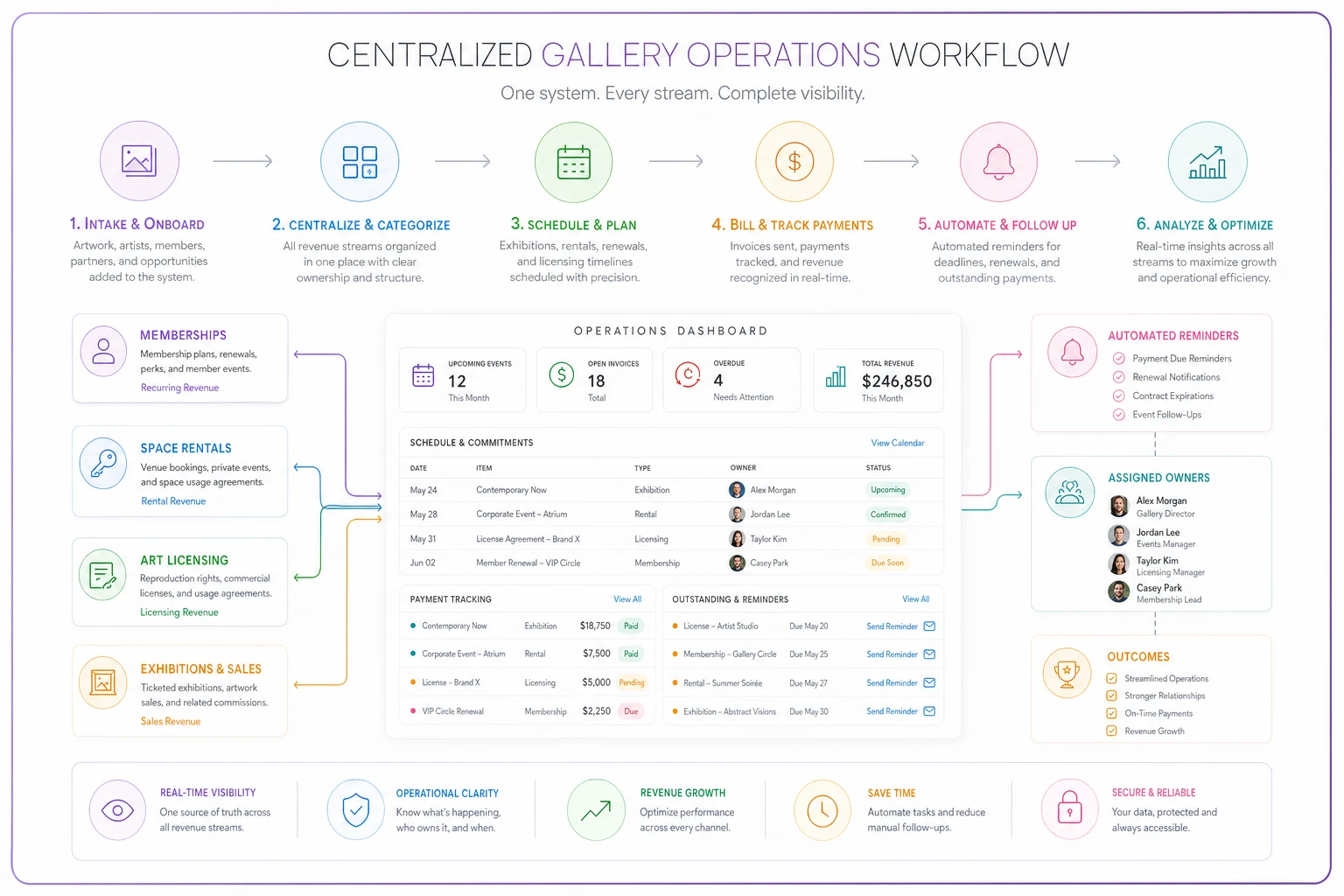
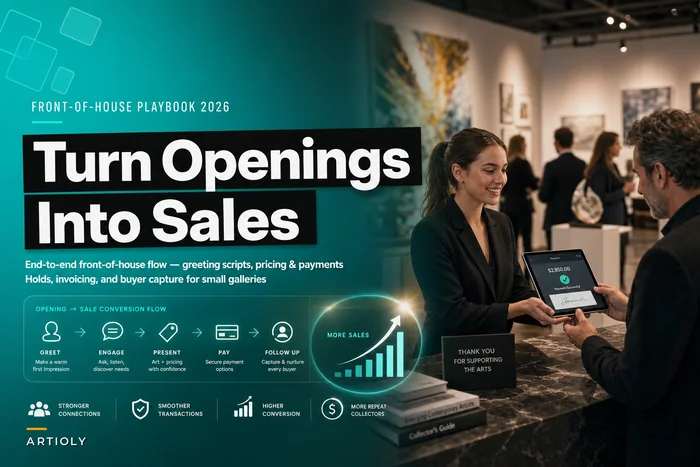
The value isn't automation for its own sake. It's that diversification only works when the operational surface area doesn't grow faster than your team. When the software absorbs the repetitive tracking, adding a fourth revenue stream stops feeling like adding a fourth part-time job. Your membership stream ties naturally into the same collector relationships you're already managing — worth reading alongside the collector lifecycle governance framework — and rental and event income can feed the same on-site conversion habits you'd build during any opening, which the front-of-house conversion playbook covers in detail.
When the software absorbs the repetitive tracking, adding a fourth revenue stream stops feeling like adding a fourth part-time job. Your membership stream ties naturally into the same collector relationships you're already managing, and rental and event income can feed the same on-site conversion habits you'd build during any opening.
Where to start
Don't build the whole portfolio at once. Pick the one stream that best hedges your specific risk — for most single-stream galleries, that's membership, because it's the most reliable and correlates least with show performance. Get it running cleanly, with a named owner and a real fulfillment SOP, before adding the next one.
Then work down the reliability column. Add venue rentals once you have restoration rules. Add licensing once your images and artist rights are clean. Let each stream lower your exhibition break-even a little more, so that over a year or two, no single show can threaten the whole operation.
The galleries that last aren't gambling less on their exhibitions. They've built enough boring, predictable income underneath the program that they can afford to take real curatorial risks — because the rent is already covered before the show even opens. That's what diversification actually buys: not more money in the best month, but a floor solid enough that the worst month can't take you out.
Ready to elevate your gallery operations?
Join 500+ galleries using Artioly to streamline operations, boost visitor engagement, and increase art sales.