



Gallery consignment governance isn't really about trust—it's about operational clarity. Having built software for galleries ranging from 800 square feet in Brooklyn to 12,000 square foot spaces in LA, the pattern is consistent: consignment disputes come from poor documentation and broken payment workflows, not bad intentions.
The worst part? Most galleries don't realize their consignment framework is broken until after a major dispute blows up. By then you're dealing with an angry artist, damaged relationships, potential legal fees, and months of frozen cashflow sorting through incomplete records.
Why consignment governance breaks down
Consignment agreements start simple. You shake hands with an artist, agree on a 50/50 split, maybe send a basic email confirmation. The work sells six months later, and suddenly there's confusion about shipping costs, framing expenses, promotional materials, insurance deductibles, and who paid for the champagne at the opening.
The artist remembers one conversation. You remember another. Your gallery assistant has notes that contradict both versions. Meanwhile, $42,000 worth of artwork sits in limbo because nobody can agree on the actual payout structure.
This happens because galleries treat consignments as relationship agreements instead of operational contracts. The relationship matters, absolutely. But without clear operational governance, that relationship deteriorates fast when money gets involved.
What makes it worse at scale: as you add more artists and more complex shows, informal agreements compound into an administrative mess. One gallery I worked with in Chelsea had 47 active consignment relationships and couldn't produce standardized documentation for any of them. Their bookkeeper quit after trying to reconcile payments for three months straight.
The risk tier framework that actually works
Not all consignments carry equal risk. A $2,000 piece from an emerging local artist requires different governance than a $180,000 installation from an established international name. Most galleries apply the same loose framework to everything, which either over-complicates simple deals or under-protects complex ones.
Never miss a key exhibition detail again.
Artioly helps you organize, promote, and manage every exhibition effortlessly.
- Unified exhibition scheduling
- Artist and visitor notifications
- Inventory and sales tracking
No credit card required
| Tier | Range | Description |
|---|---|---|
| Tier 1: Low-risk standard consignments | $0 - $15,000 per piece | Bread-and-butter consignments. Emerging artists, smaller works, straightforward sales. The governance here focuses on clarity and speed—simple terms both parties understand without legal consultation. Payment triggers automatically at sale, with predetermined deduction schedules. |
| Tier 2: Medium-risk consignments | $15,001 - $75,000 per piece | Mid-career artists, larger installations, works requiring special handling. These need additional checkpoints around condition reporting, insurance requirements, and exhibition costs. Payment structures get more complex here—installment sales, corporate commissions, or museum loans can all affect the timeline. |
| Tier 3: High-risk complex consignments | $75,000+ or special circumstances | Estate works, fragile installations, international artists, anything with complex provenance. These require full documentation packages, multiple approval stages, and often involve lawyers. The governance here protects the artwork's market value and the artist's career trajectory, not just the gallery. |
The mistake most galleries make: applying Tier 3 governance to Tier 1 consignments, which kills deals and frustrates artists. Or worse, applying Tier 1 governance to Tier 3 consignments and creating massive liability exposure.
The clause library that prevents most disputes
Payment and commission clauses
Standard commission split:
"Gallery receives [X]% commission on the retail price. Retail price defined as the final amount paid by purchaser, excluding sales tax but including any buyer's premium. Commission calculated before any deductions."
Discount authority:
"Gallery may offer discounts up to [10]% without Artist approval. Discounts between [10-20]% require written Artist consent within 48 hours. Discounts exceeding 20% require advance written approval. Commission splits adjust proportionally to any approved discount."
Why this matters: one Manhattan gallery lost a $95,000 sale because they couldn't reach the artist for discount approval in time. The collector walked. Clear discount parameters prevent that.
Expense allocation clauses
Exhibition costs:
"Gallery covers: wall preparation, standard lighting, opening reception (up to $[X]), basic promotional materials, press releases, standard insurance. Artist covers: special installation requirements, custom framing beyond gallery standards, shipping to gallery, artist-requested promotional materials exceeding $[amount]."
Shipping and insurance:
"Outbound shipping (to buyers): paid by buyer or gallery, never deducted from artist payout. Return shipping (unsold works): gallery pays if exhibition period exceeds 6 months, artist pays if requesting early return. Insurance: gallery maintains minimum coverage of [X]% of retail value."
Timeline and payment clauses
Payment timeline:
"Payment due within [30] days of cleared funds receipt. For installment sales: artist receives proportional payment as gallery receives funds. For institutional sales exceeding 90-day payment: gallery provides bridge payment of 50% within 30 days."
Inventory rotation:
"Works may be rotated to storage after [90] days of floor exhibition. Artist notification required for storage exceeding [6] months. Annual inventory reconciliation required every December."
The negotiation scripts that maintain relationships
For commission negotiations
When an artist pushes back on your commission rate, don't defend the percentage—itemize the value: "Our 50% covers roughly $3,200 in exhibition costs per show, 140 hours of sales effort per quarter, promotional reach to 3,400 collectors, and payment processing for international transactions. Would you prefer to handle those elements independently with a reduced commission structure?"
For expense disputes
Don't argue about past expenses. Forward-solve instead: "I understand the framing costs were higher than expected. For future exhibitions, let's establish a pre-approval threshold of $[X]. Anything above that, we'll confirm in writing before proceeding."
Then document it immediately.
For payment timeline pushback
Artists often want faster payment. Address the operational reality directly: "Our standard 30-day payment allows for check clearing, potential returns, and accounting reconciliation. We can offer 15-day payment with a 5% administrative fee to cover the additional processing. Which would you prefer?"
Most choose the standard timeline once they understand the trade-off.
The payment workflow that prevents cashflow disasters
Sale notification and confirmation
-
Buyer name (or "confidential" if necessary)
-
Sale price and any discounts applied
-
Expected payment date
-
Any special terms (installments, contingencies)
This prevents the "I heard you sold my piece three months ago" conversation.
Payment calculation checkpoint
-
Confirm the documented commission split
-
Verify any approved deductions
-
Check for outstanding artist debts to gallery
-
Confirm work was returned if sale was cancelled
-
Document any payment adjustments with reason codes
A gallery in Miami lost $38,000 because they paid out an artist before a corporate buyer's check cleared. The verification step would have caught it.
The escrow protocol for high-value sales
-
Funds held for 10 business days post-receipt
-
Artist notified of sale with escrow timeline
-
Payment released automatically unless flagged
-
Clear dispute resolution process if issues arise
Here's a simple visual of the payment workflow.
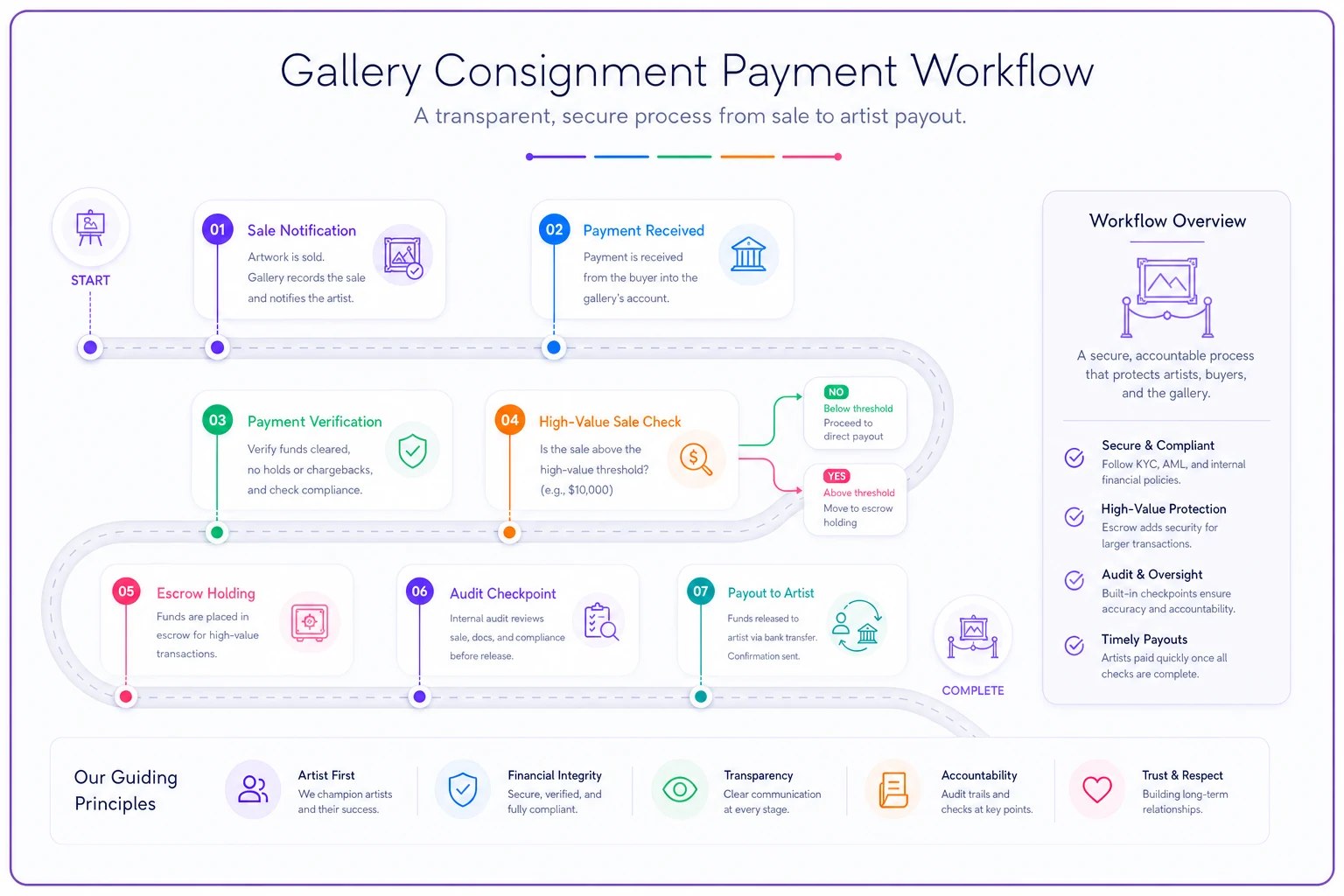
Automate sale confirmations and verification checkpoints to reduce human error and speed reconciliations.
This protects both parties without slowing down standard transactions.
Audit checkpoints that catch problems early
Most galleries discover problems during year-end reconciliation—far too late. Build these checkpoints into your regular operations:
Monthly reconciliation:
-
Works sold vs. payments made
-
Consignment terms vs. actual agreements
-
Inventory on-hand vs. consignment records
-
Pending payments aging report
Quarterly artist check-in:
-
Current inventory on consignment
-
Recent sales and payments
-
Upcoming exhibition plans
-
Any term adjustments needed
Annual consignment review:
-
Outdated pricing
-
Expired consignment periods
-
Changed contact information
-
Updated insurance values
-
Market condition adjustments
One Seattle gallery cut disputes by around 70% just by implementing quarterly statements. Artists appreciate the transparency, and discrepancies get caught while they're still fixable.
Technology integration without the overhead
Gallery consignment governance doesn't require complex enterprise software, but it does need systematic tracking. The galleries that manage this well use operational platforms that centralize consignment data, automate payment calculations, and trigger audit checkpoints without someone having to remember to do it manually.
This is where AI-powered operational software makes a real difference. Instead of maintaining spreadsheets that inevitably drift from reality, galleries can use platforms that automatically track consignment terms, calculate payments based on actual sale data, and flag discrepancies before they turn into disputes. The better platforms also integrate directly with your accounting system, which eliminates the manual reconciliation that causes most payment errors.
The key isn't finding software with the most features—it's finding something that enforces your governance framework automatically. When payment calculations, audit triggers, and notification workflows happen without manual intervention, consignment disputes drop dramatically.
The real-world impact
A 4,000 square foot gallery in Boston implemented this governance framework after a $127,000 dispute nearly destroyed their relationship with their top-selling artist. Within six months:
-
Payment disputes dropped from monthly occurrences to zero
-
Artist satisfaction improved across the board
-
Administrative time on consignment management dropped by roughly 60%
-
They onboarded 12 new artists without adding staff
The gallery director said the biggest change wasn't the documentation—it was the operational confidence. "We stopped tiptoeing around money conversations. Everything is clear, documented, and systematic. Artists actually trust us more now, not less."
Building your implementation roadmap
Week 1-2: Draft your tier definitions and assign current artists to tiers
Week 3-4: Create your standard clauses for Tier 1 consignments
Week 5-6: Implement basic payment workflow and notification system
Week 7-8: Roll out quarterly statements to existing artists
Week 9-12: Gradually migrate all relationships to the new framework
As you implement, you'll find which elements need adjustment for your specific operation. The framework should evolve with your gallery, not constrain it.
For galleries just starting to formalize their operations, consignment governance can feel overwhelming. But every major gallery started with handshake deals and evolved toward systematic governance. The ones that survived did it before a crisis forced them to.
Gallery consignment governance isn't about creating bureaucracy or making artist relationships more formal than they need to be. It's about building operational systems that protect everyone involved while keeping the flexibility that makes galleries work.
The galleries that last aren't necessarily the ones with the best artists or the biggest collector lists. They're the ones with operational frameworks solid enough to handle growth, clear enough to prevent disputes, and flexible enough to adapt when markets shift.
Your consignment framework is the foundation of your gallery's operational integrity. Build it right, and everything else—artist relationships, collector confidence, financial stability—strengthens naturally. Build it wrong, or skip it entirely, and you're always one dispute away from crisis.
Invest in governance now, or pay for disputes later. The galleries still operating successfully after 20 years made that choice early.
Ready to elevate your gallery operations?
Join 500+ galleries using Artioly to streamline operations, boost visitor engagement, and increase art sales.