


Most small galleries treat their CRM like a junk drawer. Business cards from openings, email addresses scrawled on guest books, CSV files from art fairs—everything gets dumped in there. Then you blast the same "new exhibition opening" email to your entire list every six weeks, wondering why nobody responds.
The damage happens slowly. Your actual collectors—people who've spent real money over multiple years—get buried in the same mass emails as the student who showed up for free wine once. They miss pieces they'd actually buy. They stop feeling valued. Eventually they go elsewhere.
A Chelsea gallery owner I know realized their top collector had unsubscribed six months earlier. His reason? "I was getting three emails a week about artists I've never shown interest in." Meanwhile, their CRM had 3,400 contacts, zero organization, and a 9% open rate on exhibition announcements.
The solution isn't rocket science. Three segments based on actual behavior. Automated sequences that match where people are in their collecting journey. Basic metrics that show what's working. No fancy tech required—just clear thinking about who your contacts actually are.
Why gallery CRM segmentation breaks down
Gallery owners know they should segment. They start with good intentions—create a "VIP" list, tag people by artist preferences. Then reality hits. You're coordinating installations, dealing with shipping delays, updating websites. Maintaining detailed CRM segments becomes another impossible task.
After an opening, you have 40 new contacts to add. Some bought work, some showed serious interest, others just signed your guest book while grabbing cheese and wine. You're exhausted from the event, so everyone gets bulk-imported with a generic "March 2024 Opening" tag. Six months later, you can't remember who actually mattered from that group.
Art fairs make it worse. You return with 150 business cards and vague memories of conversations. Everything becomes "Miami Basel 2024" contacts. The person who spent an hour discussing a $50,000 piece gets identical follow-up as someone who speed-walked past your booth.
Your email platform doesn't help. Most galleries use Mailchimp or Constant Contact, which technically support segmentation but make it painful to maintain. You end up with overlapping lists, duplicate contacts, and tags that made sense years ago but now mean nothing. One gallery had 47 different tags including gems like "maybe interested in sculptures???" and "husband of important person."
You can feel the missed opportunities. Collectors saying "I would have bought that piece if I'd known about it" or someone who spent $30,000 last year suddenly going quiet. But fixing the mess feels overwhelming when you're already working 60-hour weeks just to keep the doors open.
Three segments that actually matter for small galleries
Forget complex buyer personas. For galleries doing under $2 million annually, you need three segments that cover 95% of your contacts.
Never miss a key exhibition detail again.
Artioly helps you organize, promote, and manage every exhibition effortlessly.
- Unified exhibition scheduling
- Artist and visitor notifications
- Inventory and sales tracking
No credit card required
First-time buyers (closing the confidence gap)
People who bought their first piece from you in the last 18 months. They're testing the waters, not collectors yet. Maybe they bought a $1,200 print at your summer group show or a small work on paper. They like art but aren't sure if they're "collector material."
This segment needs education and confidence building. They want to understand pricing differences, how to start a collection, what proper framing means. They're worried about looking stupid or getting ripped off. Push a $25,000 painting too early and they'll retreat to buying posters online.
Communicate like a gallery director personally guiding them deeper into the art world. Share artist stories, explain techniques, invite them to studio visits. Build their confidence before pushing bigger purchases.
Lapsed collectors (the profitable win-back)
Anyone who bought from you 18+ months ago but hasn't engaged recently. These people already trust you, understand art buying, have wall space and budget. They've just gotten distracted or started buying elsewhere.
This is your highest-ROI segment. A collector who spent $40,000 two years ago then disappeared is easier to reactivate than finding a new $40,000 buyer. They already like your taste, know your artists, trust your pricing.
Make lapsed collectors feel missed, not marketed to. Acknowledge the relationship: "We haven't seen you since you acquired that beautiful Chen piece in 2022. He's been experimenting with new techniques you might find interesting."
Active prospects (momentum builders)
People who've shown clear interest in the last 90 days but haven't bought yet. They've attended multiple openings, spent real time looking at work, asked about prices, joined your list voluntarily. They're not wine-and-cheese tourists—they're genuinely considering purchases.
This segment needs gentle momentum. They're interested but something's holding them back—price, confidence, spouse approval, waiting for the right piece. Maintain visibility without being pushy through regular touchpoints about new work, payment plans, pieces similar to what they've viewed.
The beauty? These segments are based on behavior, not demographics. You don't need net worth or job titles. Their actions tell you everything: did they buy? How recently? Are they engaging? That's it.
Automated sequences that don't feel robotic
Most galleries think automation means sending the same canned emails forever. Real automation means thoughtful sequences that trigger based on behavior, then quietly convert prospects while you focus on other things.
First-time buyer sequence (long-term education journey)
First week: Personal thank you acknowledging their specific piece. Include care instructions and framing recommendations. Mention you'll send periodic updates about the artist.
Three weeks later: Artist spotlight. Share the story behind their work—training, technique, what drives their practice. Include images of pieces in collectors' homes. Make them feel part of something bigger.
Around month two: "How to start a collection" guide. Not pushy, just helpful. Talk about mixing mediums, considering scale, building around themes. Include examples from other collectors.
Three to four months in: Exclusive event invitation—studio visit, curator talk, collector breakfast. Even if they can't attend, the invitation makes them feel like insiders.
Six months: Check in about their piece. Ask for installation photos. Share what the artist has been working on. Soft mention of new available works.
Nine months: Feature their artist in a group context—"Three artists exploring texture" or similar. Shows curatorial vision, validates their purchase.
Around the one-year mark: Anniversary email. "It's been a year since you acquired [piece]." Share artist news—exhibitions, awards, press. Mention if the market has strengthened.
Later: Payment plan introduction. Many first-time buyers don't know galleries offer these. Present as FYI, not sales pitch.
Each email provides value whether they buy again or not. You're building relationships, not just pushing sales.
Lapsed collector reactivation (quick win-back)
Early contact: "We miss you" email from gallery director. Personal tone, acknowledge previous purchases by name. Mention significant updates since their last visit.
Soon after: VIP preview of upcoming exhibition. First access to images and prices before public announcement. Include pieces chosen based on their purchase history.
Mid-sequence: Exclusive offer. First dibs on new acquisitions, collector dinner invitations, or studio pieces not in the gallery. Make it genuinely exclusive.
Final attempt: Personal outreach trigger. If they haven't engaged, trigger notification for direct contact. Quick text or call: "Wanted to make sure you're still receiving our updates."
After six weeks, they either re-engage or stay dormant for another cycle.
Active prospect nurture (conversion focus)
Quick follow-up on specific work they viewed. Additional images, dimensions, installation shots. Casual payment plan mention.
Related works soon after. "Since you were interested in [piece], you might like these." Show 3-4 similar works or same artist.
Artist deep-dive around week three or four. Detailed content about whose work they viewed. Practice progression, upcoming exhibitions, recent recognition.
Gentle urgency mid-sequence. "We've had several inquiries about [piece they viewed]." Honest communication about interest level, not fake scarcity.
Payment plan spotlight with real numbers. "$4,800 piece = $800/month for 6 months, no interest."
Event invitation. Seeing art in person often closes deals.
Personal check-in trigger for gallerist outreach if needed.
These sequences run simultaneously. While you're installing shows, your CRM nurtures fifteen first-time buyers, reactivates eight lapsed collectors, and warms up twenty prospects—all with messages timed to their specific situation.
Measuring what matters (skip the vanity metrics)
Galleries love meaningless numbers. Email open rates, Instagram likes, website visitors—none pay rent. For gallery CRM segmentation that actually drives sales, track four metrics that connect directly to revenue.
Segment conversion velocity
How long between purchases? First-time buyers might average 14 months for their second acquisition. Active prospects might convert in 3-4 months. Lapsed collectors could reactivate in 6-8 weeks.
If first-time buyers take 24+ months, your nurture sequence needs work. If active prospects aren't converting within 90 days, you're losing momentum somewhere.
One gallery found first-time buyer conversion was happening around month 20—two months after their sequence ended. They extended it and saw purchases accelerate to month 16.
Revenue per segment member
Average revenue per person over time. Lapsed collectors might generate $12,000 per reactivated member. First-time buyers might average $3,500 in year two. Active prospects might convert around $8,000 for initial purchases.
This tells you where to focus effort. If reactivating one lapsed collector equals finding four new first-time buyers, priorities become clear.
Sequence engagement decay
Track engagement at each step. Email 1 might get 50% opens, email 4 drops to 30%, email 8 hits 15%. Normal decay—but watch for cliff drops indicating problematic messages.
If engagement suddenly drops from 35% to 12% at email 6, that specific message kills interest. Fix that one email and the entire sequence improves.
Segment movement rate
How many people graduate between segments? What percentage of first-time buyers become repeat collectors? How many active prospects convert? How many lapsed collectors reactivate?
These are your real health metrics. A gallery with 100 first-time buyers should see 20-30 become repeat collectors within 18 months. If you're only converting 5, your nurture isn't working.
| Metric | Description |
|---|---|
| Segment conversion velocity | How long between purchases? First-time buyers might average 14 months for their second acquisition. Active prospects might convert in 3-4 months. Lapsed collectors could reactivate in 6-8 weeks. |
| Revenue per segment member | Average revenue per person over time. Lapsed collectors might generate $12,000 per reactivated member. First-time buyers might average $3,500 in year two. Active prospects might convert around $8,000 for initial purchases. |
| Sequence engagement decay | Track engagement at each step. Email 1 might get 50% opens, email 4 drops to 30%, email 8 hits 15%. Watch for cliff drops indicating problematic messages. |
| Segment movement rate | How many people graduate between segments? What percentage of first-time buyers become repeat collectors? How many active prospects convert? How many lapsed collectors reactivate? |
Check these four numbers monthly, adjust based on what you see, get back to running your gallery.
Small gallery considerations for sustainable segmentation
Running a small gallery means seventeen hats while trying to keep lights on. Your segmentation needs to work within these constraints or it'll collapse.
Time batching works. Don't update segments daily. Set aside two hours every second Tuesday for CRM work. Process all new contacts from previous weeks, update purchase records, move people between segments. Done in batches takes less mental energy than constant small updates.
Use exhibition schedules as forcing functions. Before each opening, spend an hour reviewing who gets early access (lapsed collectors), personal invitations (active prospects), and general announcements (everyone else). Your existing exhibition calendar becomes CRM maintenance schedule.
Accept that perfection kills progress. Your segments won't be perfect. Some first-time buyers might actually be serious collectors new to your gallery. Some "active prospects" might just really like free wine. 80% accuracy with consistent execution beats 100% accuracy that never happens.
Set aside two hours every second Tuesday for CRM maintenance to keep segments current without daily work.
Protect high-value relationships from automation. If someone spends over $25,000 annually, they shouldn't be in automated sequences. They get personal communication only. Set clear thresholds above which people get white-glove treatment.
Document sequences before automating. Write all your first-time buyer emails before setting up automation. This forces you to think through the journey and makes adjustments easier. Plus if your platform dies, you don't lose the strategy.
Small gallery advantage is agility. Test new sequences on ten people and adjust within weeks. Personally call anyone slipping away. Pivot entire approaches based on learning. Corporate galleries with compliance departments can't do that.
Common segmentation failures to avoid
Over-segmenting too early is expensive. A gallery with 500 contacts doesn't need 15 segments. You'll spend more time managing systems than selling art. Start with three core segments, run them for months, then consider complexity.
Avoid "VIP inflation." When everyone becomes VIP to avoid hurt feelings, nobody is actually VIP. Be ruthless about criteria. If VIP means $10,000+ annual spend, stick to it. Exclusivity is what makes it valuable.
Don't let data paralysis stop you. You don't need three years of purchase history to begin segmentation. Start with what you know today—even just "bought something" versus "hasn't bought yet." Add nuance as you learn.
Never fake urgency or scarcity. "Only 2 pieces left!" when you have ten destroys trust instantly. Collectors talk to each other. One dishonest email ruins relationships built over years. Real urgency—"We've had three inquiries"—is more powerful than manufactured pressure.
Stop segmenting by demographics. Age, profession, neighborhood don't matter. What matters is behavior: do they buy art? How often? How recently?
The integration problem kills more strategies than anything. Your email platform, CRM, inventory system, and accounting software probably don't talk to each other. Accept this reality and build simple processes rather than waiting for perfect integration that never comes.
Implementation priority checklist
Month 1: Foundation
Export your contact list to spreadsheet. Add columns for "Last Purchase Date," "Total Purchase Amount," and "Last Engagement Date." This becomes your working document.
-
Month 1
Foundation
-
Month 2
Automation Setup
-
Month 3
Full Deployment
-
Months 4-6
Optimization
Review sales from the past 18 months or so. Tag every buyer with purchase date and amount. This creates first-time buyer and lapsed collector segments immediately.
Review email opens and event attendance for recent months. Anyone engaging multiple times without buying becomes active prospect.
Write your first-time buyer sequence. Subject lines included. Save in Google Doc before touching automation tools.
Month 2: Automation Setup
Choose one segment to automate first—probably first-time buyers since that's the longest sequence. Set up full sequence in your email platform.
Test automation with your own email. Go through entire sequence checking timing, spelling, formatting.
Launch with your backlog—first-time buyers from recent months who haven't bought again. Monitor closely for a couple weeks.
Write lapsed collector reactivation sequence. Keep it shorter.
Month 3: Full Deployment
Launch lapsed collector sequence with anyone who bought 18+ months ago without recent engagement.
Set up active prospect nurture sequence. This can be more flexible since contacts are varied.
Create simple tracking spreadsheet for four key metrics. Google Sheets works fine.
Schedule bi-weekly CRM maintenance time. Put it in calendar as recurring event.
Months 4-6: Optimization
Review segment performance monthly. Which sequences work? Where do people drop off?
A/B test subject lines on highest-volume segment. Small improvements compound.
Interview successful conversions. Ask what made them buy. Use their language in sequences.
Consider one level of complexity—maybe splitting first-time buyers by price point or medium. Only if basic system runs smoothly.
When to evolve beyond basic segments
Your three-segment system will carry you pretty far. Eventually patterns suggest it's time for sophistication.
With 1,000+ contacts you actually know, segment by preference. Photography collectors need different communication than abstract painting obsessives. But this only works with enough people in each micro-segment to justify separate sequences.
If you're doing multiple exhibitions annually, consider artist interest segments. Collectors following specific artists get deeper practice content, early work access, studio visit invitations. Requires diligent tagging after exhibitions based on who showed interest in which artists.
Payment behavior could become trigger once you have data. Collectors who pay immediately have different needs than those always using payment plans. Former might appreciate investment-grade pieces; latter needs flexible terms highlighted.
Geographic segmentation makes sense only if you're truly multi-city. Running spaces in New York and LA? Sure, segment by location. But if everyone's within driving distance, geographic segments add complexity without value.
Ready for more segments when you can clearly articulate how each segment's communication strategy differs and have bandwidth to maintain differences. If you're sending everyone slightly different versions of same message, you're not ready.
Building this with AI-powered operational platforms
Most gallery CRMs are expensive, clunky databases built for $10+ million operations. You pay $400 monthly for features you'll never use while basic stuff—like maintaining segments—requires constant manual work.
Modern operational platforms handle tedious parts that kill segmentation efforts. Instead of manually tagging contacts after openings, systems read guest lists, match against existing contacts, automatically update segments. When someone makes their second purchase, they graduate from "first-time buyer" to "repeat collector" without you touching anything.
Just like tracking actual curation metrics matters more than gut feelings, your CRM needs to track behavior patterns, not just store contact information. The right platform watches engagement across email, events, and purchases, then adjusts segment membership accordingly.
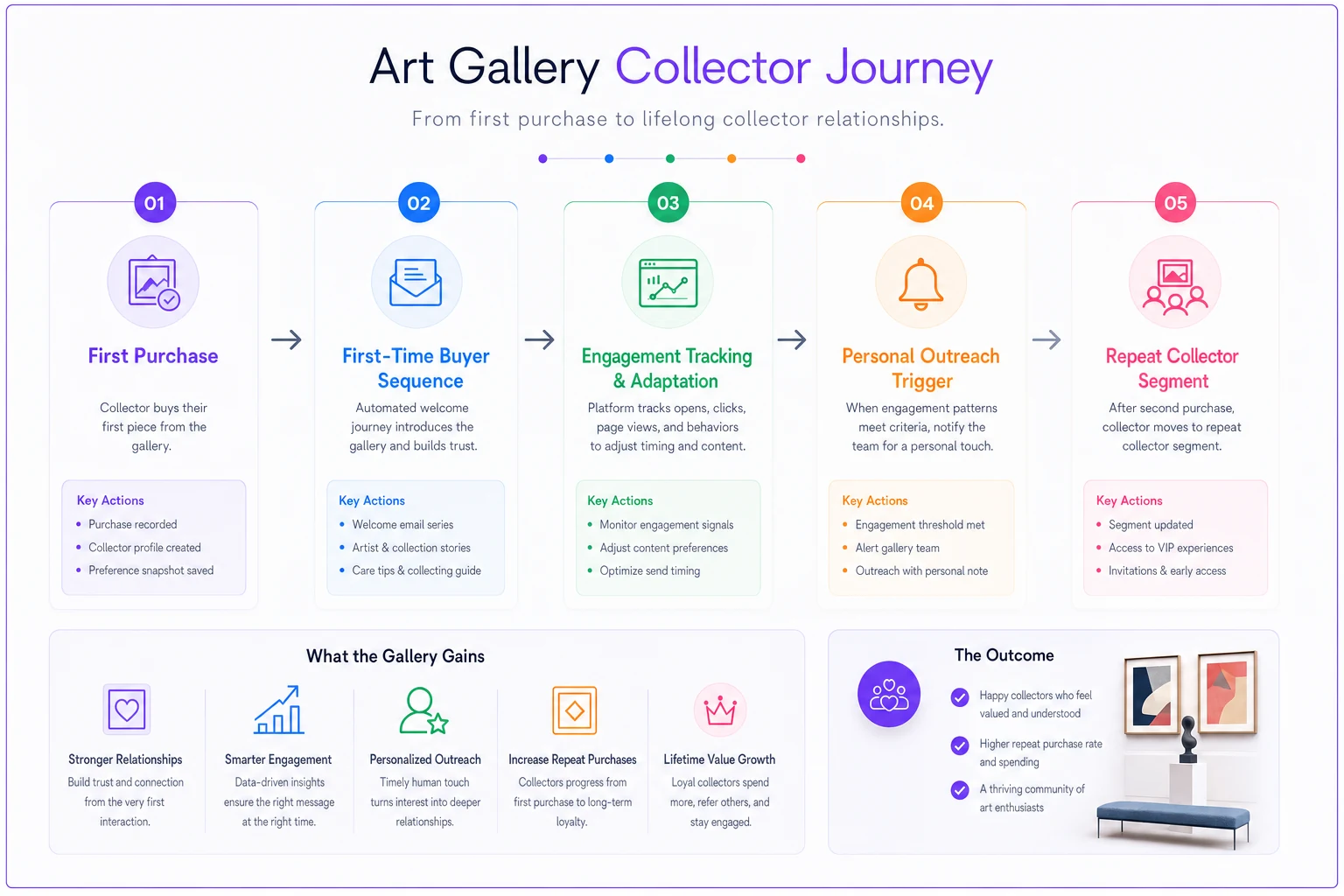
The workflow: Collector buys first piece → automatically enters first-time buyer sequence → system tracks engagement → adjusts message timing based on behavior → notifies you when personal outreach is needed → moves them to repeat collector segment after second purchase. You set rules once, then focus on relationship building while the system handles administrative orchestration.
Here's a simple illustration of that workflow.
For lean gallery operations, this isn't about fancy technology—it's about sustainability. Maintain sophisticated segmentation with two hours monthly instead of daily. Systems prevent decay that kills most CRM strategies before they show results.
For lean gallery operations, this isn't about fancy technology—it's about sustainability. Maintain sophisticated segmentation with two hours monthly instead of daily. Systems prevent decay that kills most CRM strategies before they show results.
Ready to elevate your gallery operations?
Join 500+ galleries using Artioly to streamline operations, boost visitor engagement, and increase art sales.