

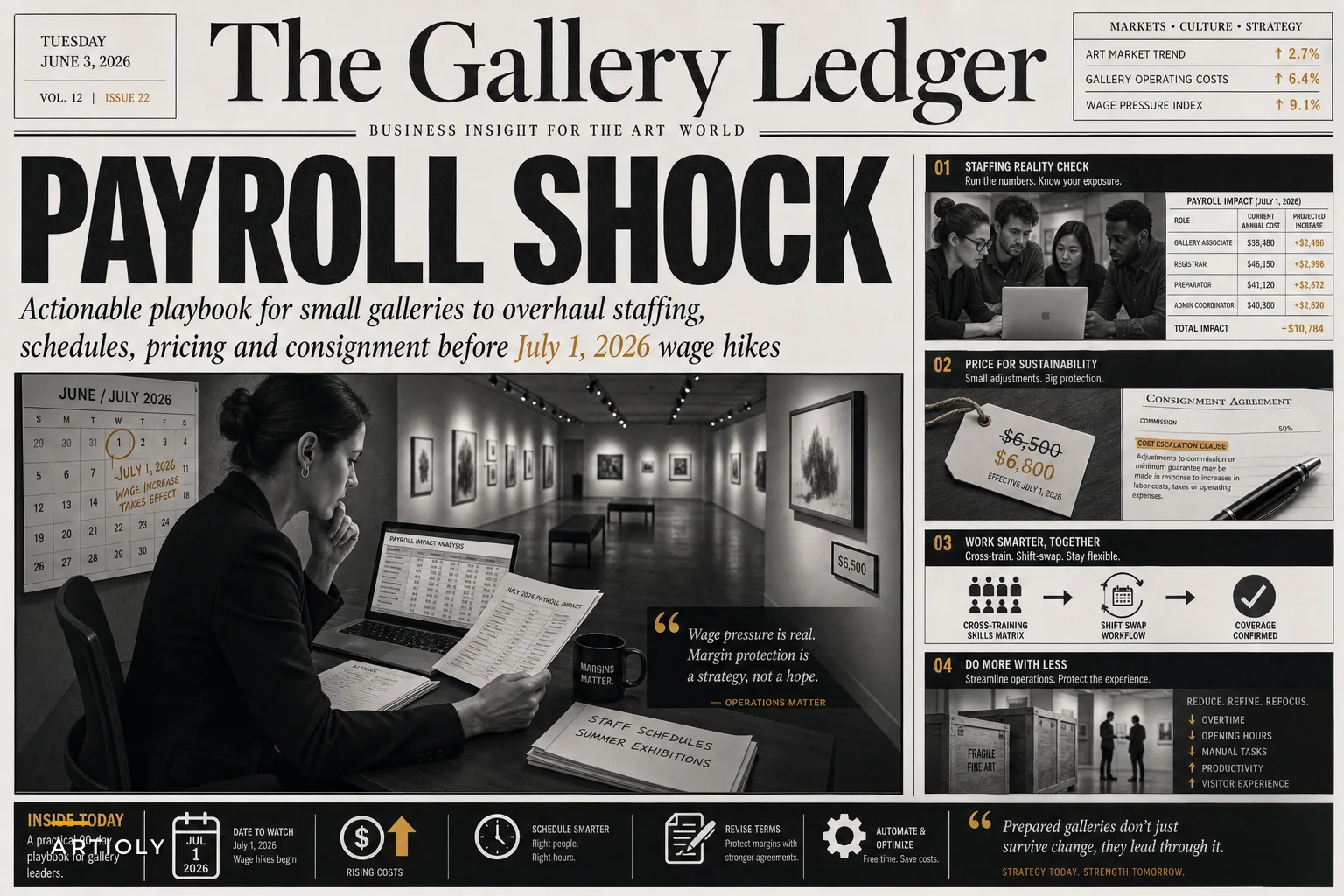

Starting July 1st, more than 20 states and cities are raising minimum wages, with some jurisdictions jumping by $1.50 or more per hour. For galleries operating on 8–12% margins, a bump from $15 to $16.50 means your weekend docent shifts just got $96 more expensive per day. Multiply that across install crews, event staff, and front desk coverage for a summer exhibition season, and you're looking at thousands in unplanned costs—hitting exactly when visitor traffic peaks.
The math hurts when you're already running lean
The timing is genuinely rough. July kicks off heavy exhibition rotation for most small galleries—outdoor sculpture installations, summer group shows, tourist season programming. These minimum wage increases July 2026 galleries are facing land right when labor needs spike and budgets are already locked into artist payments, shipping, and marketing committed months ago.
What actually breaks operations isn't just the hourly rate. When your base wage goes up, the whole pay structure shifts. That assistant curator making $19/hour suddenly sees new hires coming in at $16.50. Your experienced preparator at $22 feels compressed. The compensation ladder tightens, and you either deal with turnover or bump everyone up—neither option fits in the budget you finalized last December.
Why galleries absorb labor costs differently than retail
Most minimum wage analysis focuses on restaurants or retail, where you can adjust pricing weekly or cut hours without destroying the customer experience. Galleries don't have that flexibility. You can't add $5 to admission when you're donation-based or free entry. You can't reduce gallery hours when collectors fly in specifically for Saturday appointments. And you definitely can't skimp on art handlers when you're installing a $200,000 sculpture.
Never miss a key exhibition detail again.
Artioly helps you organize, promote, and manage every exhibition effortlessly.
- Unified exhibition scheduling
- Artist and visitor notifications
- Inventory and sales tracking
No credit card required
The deeper issue is that gallery revenue doesn't scale with labor hours. A coffee shop serves more customers by adding staff. A gallery shows the same exhibition whether two or five people work the floor. Revenue ties to sales cycles, not hourly throughput. That fundamental mismatch is why wage increases hit differently here than almost anywhere else.
What tends to happen is galleries absorb costs through owner time. The director starts covering desk shifts. The curator handles their own installs. It works for a few months before quality drops and bigger problems surface. The galleries that get through these transitions build flexibility into operations before the crisis hits—not by cutting staff, but by restructuring how work actually gets done.
Restructure roles before July hits
The standard gallery staffing model—dedicated roles for visitor services, preparator, registrar, programs—assumes stable wage ratios. When minimum wage jumps 10% but senior staff stays flat, that model strains.
Start by mapping tasks, not positions. Break down every operational requirement by skill level and timing flexibility:
Level 1 (Minimum wage eligible):
-
Basic visitor greeting
-
Gallery monitoring during open hours
-
Simple data entry
-
Event setup/breakdown (tables, chairs, basic equipment)
-
Social media posting from approved content
-
Basic cleaning and maintenance
Level 2 (Minimum + $3–5):
-
Artwork condition checking
-
Collector inquiry responses
-
Installation assistance under supervision
-
Database management
-
Donor acknowledgments
-
Educational program support
Level 3 (Specialized/higher rate):
-
Curatorial decisions
-
Complex installations
-
Collector relationship management
-
Grant writing
-
Financial management
-
Press and media relations
Once you have this breakdown, you can restructure around the new wage reality. Maybe your registrar spends less time on data entry and more on conservation planning. Maybe installations happen Tuesday through Thursday when your preparator is on-site, rather than spreading work across the week.
The counterintuitive move is to actually reduce hours for minimum-wage positions while bumping the rate above minimum. Instead of three people at $16.50 for 20 hours each, you might run two at $18 for 25 hours. Better retention, lower training costs, simpler scheduling. It's not obvious at first glance, but it often pencils out.
Consider offering slightly higher hourly rates for fewer, longer shifts to improve retention and reduce scheduling churn.
It's not obvious at first glance, but it often pencils out.
Hidden costs multiply faster than the wage increase
When galleries budget for minimum wage increases, most calculate the hourly difference times scheduled hours. This misses roughly 40% of the actual cost increase.
Payroll taxes scale with wages—every dollar increase adds 7.65% in employer FICA contributions. Workers' comp premiums are percentage-based, so they rise proportionally. If you provide any benefits tied to income, those go up too. That $1.50 hourly bump actually costs closer to $1.75 per hour worked.
Then there's overtime. Oregon's minimum wage schedule shows increases ranging from $14.70 to $15.95 depending on county. Overtime at time-and-a-half means your installation weekend just jumped from $22.05 to $23.93 per hour for anyone past 40 hours. During peak installation periods, this compounds fast.
Training costs spike too, though less obviously. Higher wages mean higher turnover costs when someone leaves, and experienced staff are more likely to get poached by larger institutions. Each new hire costs somewhere around 20% of annual wages in training time, mistakes, and reduced productivity during ramp-up.
The scheduling inefficiencies are probably the biggest friction point. When labor costs more, you schedule tighter. But galleries need coverage flexibility—someone needs to be there if a collector walks in at 4:45pm. That tension between cost control and service quality creates constant operational friction that's hard to see on a spreadsheet but very visible day to day.
Schedule engineering: the 4-10 model and exhibition cycles
Traditional gallery scheduling follows a 5-day pattern with scattered coverage. This made sense when labor was cheaper and you optimized for maximum open hours. At higher wage rates, you need to optimize for labor efficiency without sacrificing quality.
-
Reduces daily setup/shutdown labor by roughly 20%
-
Eliminates one day of opening/closing procedures
-
Allows deep work blocks for installations
-
Reduces commute burden for staff—a practical retention tool
-
Creates three-day weekends that staff genuinely value
You might run Tuesday through Friday 10am–7pm, capturing both lunch visits and after-work appointments. Or Wednesday through Saturday if weekend traffic drives sales. Consistency matters more than the specific days—collectors and visitors adapt quickly to predictable schedules.
For exhibition installations, batch the work into sprint periods rather than spreading across weeks. Instead of partial installations every afternoon for two weeks, dedicate three full days with all hands on deck. This reduces coordination overhead and lets you bring in specialized contractors for defined periods rather than maintaining higher ongoing staff levels.
Some galleries run "dark weeks" between exhibitions—closed to the public but fully operational for changeover. This eliminates the complexity of installing while open, reduces insurance risks, and lets you use contract labor without the added layer of customer service requirements. Not every gallery can pull this off, but if your schedule allows it, the operational simplicity is worth it.
Contractor vs. employee: the classification trap
When labor costs spike, the temptation is to convert employees to contractors. This rarely works for galleries, and the risks are real.
The IRS and state labor departments are increasingly focused on misclassification, particularly in industries with traditionally low wages. If someone works regular hours, uses your equipment, follows your procedures, and isn't working for other galleries simultaneously, they're almost certainly an employee regardless of what your agreement says.
The penalties are severe—back payroll taxes, interest, potential lawsuits. One audit can genuinely destroy a small gallery's finances. Galleries have been hit with $50,000+ bills for misclassifying just two workers over three years.
Where contractors actually make sense:
-
Specialized installations requiring specific expertise
-
One-off events (photographer for an opening, musician for an event)
-
True freelance curators developing specific exhibitions
-
Marketing consultants creating campaigns
-
Grant writers on a project basis
The contractor must genuinely control their work method, timing, and tools. They should invoice you, carry their own insurance, and work for multiple clients. If you're directing their daily activities, they're employees. The line isn't always obvious, but when in doubt, classify conservatively and talk to an employment attorney before restructuring anything significant.
Build cost recovery into exhibition models
Exhibitions drive costs but also create revenue opportunities. Galleries that successfully manage higher labor costs build recovery mechanisms directly into their exhibition planning.
| Recovery Mechanism | Example Structure | Rough Target |
|---|---|---|
| Artist agreements | Artist covers specialized installation | Varies by project |
| Installation sponsorship | Local business covers install crew | ~$2,500 |
| Opening night sponsorship | Business covers event staffing | ~$1,500 |
| Education program sponsor | Business covers workshop instructors | ~$3,000 |
| Space rental | Evening corporate or private events | $500+ net per event |
Artist agreements: Structure contracts to share installation labor costs. Many artists will cover specialized fabrication or installation if it's negotiated upfront. Instead of your staff spending three days installing complex video work, the artist provides their technician.
Sponsor packages: Local businesses increasingly support arts programming. Create packages that specifically offset operational costs. Name recognition matters less than cost recovery for these operational sponsorships—a lot of businesses just want the association, not a banner.
Rental optimization: Your space has value beyond exhibition hours. Corporate events, private tours, photo shoots—each generates revenue with minimal additional labor. Price these to include full cost recovery plus margin.
Membership restructuring: Instead of competing on membership price, compete on access. Preview nights, curator talks, studio visits cost almost nothing extra but add real perceived value. Raise membership levels 20–25% while adding experiential benefits rather than physical ones.
Layering these mechanisms takes time to set up, but once they're running they change the economics meaningfully.
Technology cuts work, not workers
The solution isn't replacing people with software—it's eliminating work that shouldn't exist in the first place. Galleries create enormous administrative burden through poor information systems.
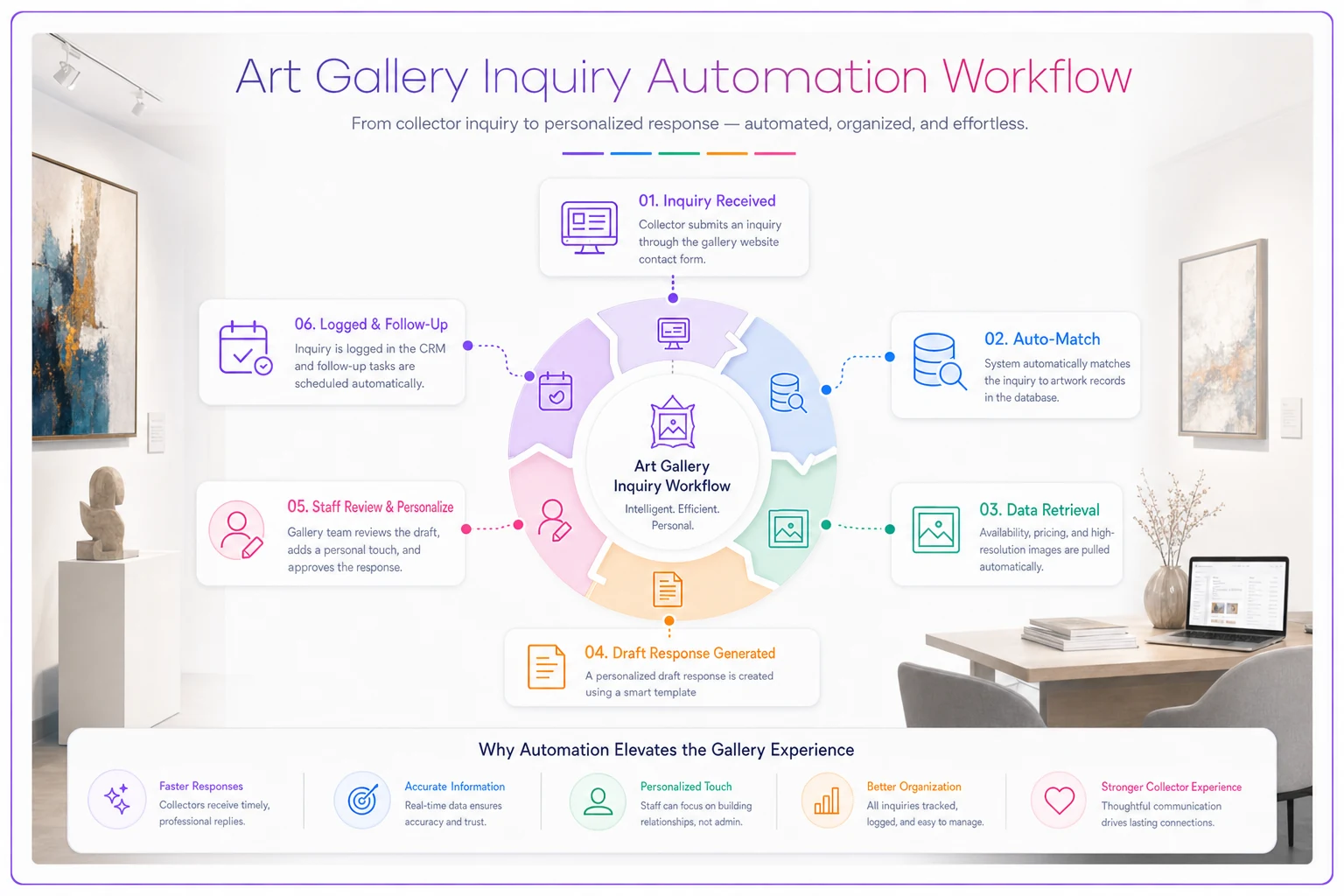
Take artwork inquiry management. The typical flow: email arrives, someone checks availability, logs into the database, searches the artist, finds the work, checks status, drafts a response, sends the email, logs the communication, follows up later. Total time: 25-30 minutes per serious inquiry. At 15 inquiries a week, that's six or more hours of staff time on a task that's mostly clicking through the same steps.
With properly configured operational software, that same inquiry auto-populates from your website form directly into your database. The system knows availability, has approved images ready, uses templates for responses, and triggers follow-up sequences automatically. Staff time drops to about 5 minutes to personalize and send. That's 20 minutes saved per inquiry—roughly five hours weekly freed up without cutting anyone.
[Collector submits inquiry via website] ↓ [Operational software auto-matches to database record] ↓ [Availability, pricing, and images pulled automatically] ↓ [Draft response generated from template] ↓ [Staff reviews, personalizes, sends — ~5 minutes] ↓ [Inquiry logged, follow-up scheduled automatically]
The same logic applies across operations—automated condition report scheduling based on exhibition rotation, consignment reconciliation without manual spreadsheet work, visitor data capture through digital sign-ins, invoice generation from sales records. These aren't sophisticated AI solutions. They're basic workflow automations that eliminate repetitive tasks. The mistake galleries make is trying to automate complex judgment calls instead of just clearing the simple, repetitive ones out of the way first. The cumulative time savings across a full week are real.
Below is a visual workflow for that inquiry automation.
The mistake galleries make is trying to automate complex judgment calls instead of just clearing the simple, repetitive ones out of the way first. The cumulative time savings across a full week are real.
Where to cut without bleeding quality
Not all gallery costs are equal. Some directly impact visitor experience or sales potential. Others are mostly internal habit. When minimum wage increases July 2026 galleries force hard choices, cut strategically.
Cut these first:
-
Printed materials beyond basic needs (digital catalogs work fine)
-
Shipping frequency (batch shipments monthly)
-
External maintenance services you could bring in-house
-
Redundant software subscriptions
-
Premium supply vendors (generic packing materials are adequate)
-
Unnecessary travel (virtual studio visits are normalized now)
-
Traditional advertising (social and digital outperform print for most galleries)
Protect these always:
-
Opening night quality (first impressions drive sales)
-
Artwork handling standards (reputation risk is too high)
-
Core visitor hours (consistency matters more than maximum hours)
-
Artist payments (relationships are everything)
-
Insurance coverage (one claim could end you)
-
Database and records management (institutional memory)
The cuts that actually improve operations:
-
Reduce exhibition frequency but increase quality and duration
-
Fewer artists but deeper relationships
-
Smaller staff but better paid and more capable
-
Less programming but more focused and memorable
Sometimes constraints force better decisions. That monthly event series stretching your team thin might be doing less than one strong quarterly program—and costing significantly more to run.
Early warning metrics for labor stress
Before your gallery hits crisis mode, certain patterns emerge. Track these monthly to spot problems before they compound.
Staffing stability indicators:
-
Hours worked by owner/director (should stay under 50)
-
Overtime hours as a percentage of total (keep under 5%)
-
Gaps between time-off requests (increasing gaps signal burnout)
-
Installation issues or damage incidents (tired people make mistakes)
-
Response time to inquiries (delays indicate overload)
Financial stress signals:
-
Days payables outstanding (stretching payment terms)
-
Credit card utilization (using cards for operating expenses)
-
Deferred maintenance tasks (pushing off necessary work)
-
Marketing spend reductions (early budget casualty)
-
Artist payment delays (relationship damage indicator)
When two or more indicators trend negative for two consecutive months, act. Don't wait for crisis.
Quick interventions that tend to work:
-
Institute "Focus Fridays"—no meetings, deep work only
-
Implement 2-week installation sprints with recovery weeks after
-
Create "summer hours" reducing weekly coverage
-
Pause one program to redistribute resources
-
Bring in temporary help for specific projects
Small adjustments early prevent dramatic cuts later. Most gallery directors wait too long because the indicators feel ambiguous in isolation—it's the combination and the trend that matters.
Managing the team conversation
Your team already knows the wage increases are coming. They're seeing the news, doing the math, wondering what it means for them. Address it directly before anxiety builds into something harder to manage.
Frame the conversation around sustainability, not scarcity. "We're restructuring to build a gallery that can pay fair wages long-term" lands differently than "we need to cut costs." Include the team in problem-solving—they often have better operational ideas than management does, especially on scheduling.
Be specific about what changes and what doesn't:
-
Yes, schedules will shift to 4-10s
-
No, we're not cutting positions
-
Yes, some roles will evolve
-
No, exhibition quality won't suffer
-
Yes, we'll need flexibility during the transition
-
No, the gallery isn't in danger
Create clear metrics for success that the team can actually track: visitor numbers, sales targets, exhibition goals. When people understand what they're working toward and can see progress, they show up differently than when they're just waiting for the next announcement.
The compensation conversation is harder. If you can't give raises to match market rates, offer other real value: professional development budget, flexible scheduling, additional time off, title advancement, portfolio-building opportunities, connections to collectors and artists. Young gallery professionals often value career development over marginal pay differences. Invest in their growth and most will invest back in yours.
Build toward sustainable operations
The galleries that come through wage increases in decent shape share a few things in common. They run lean but not understaffed. They invest in systems rather than just headcount. They maintain quality through focus rather than volume. Most importantly, they treat operational problems as things worth solving rather than just costs to absorb. Operational excellence isn't about perfection—it's about consistency and continuous improvement.
This wage increase is one of many economic pressures small galleries will keep facing. Building resilient operations now means you'll handle whatever comes next without reinventing everything from scratch.
That means creating genuine efficiency through better workflow design—every hour saved through smarter systems is an hour you don't have to pay for at higher rates. It means developing multiple revenue streams beyond traditional sales: rentals, programs, memberships, sponsorships. It means building deeper relationships with fewer stakeholders. Twenty committed collectors outperform 200 casual visitors, and they're a lot easier to maintain relationships with.
The galleries panicking about July are the ones still operating like it's 2015. Map your roles, analyze your workflows, have honest conversations with your team. July arrives whether you're ready or not—the only real question is whether these minimum wage increases become a crisis or a reason to finally build something more durable.
Ready to elevate your gallery operations?
Join 500+ galleries using Artioly to streamline operations, boost visitor engagement, and increase art sales.