
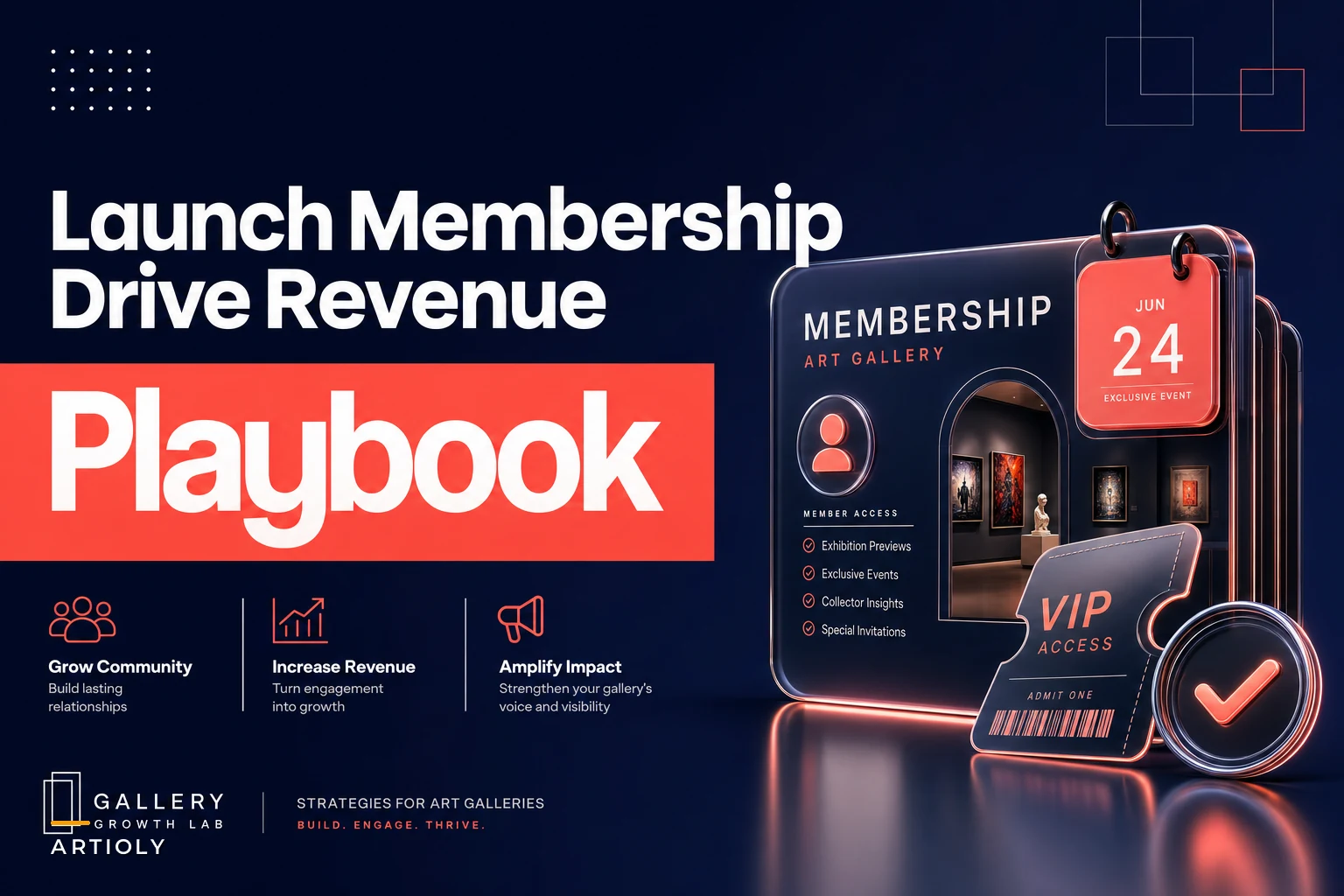

Most gallery membership programs quietly lose money. Not because members won't pay, but because the benefits promised on the signup page cost more to fulfill than the membership brings in — and nobody's tracking the gap. A $250 "Patron" tier that includes two catered previews, a discount on purchases, and a limited-edition print sounds generous until you add up the wine, the print production, the staff hours at each preview, and the margin you gave away on a $6,000 painting. Suddenly your "membership revenue" is basically a rounding error against fulfillment cost.
This is a fulfillment and design problem, not a marketing problem. You can sell more memberships and still lose money if the underlying math and operational cadence aren't built right. So this guide skips the "why memberships matter" pep talk and gets into the part galleries actually get wrong: designing tiers that hold margin, building fulfillment SOPs so benefits don't eat your staff alive, and running a retention cadence that gets people to renew without your director personally chasing every lapsed member.
Start with the fulfillment cost, not the price
The mistake almost every gallery makes: they pick a price first — usually a round number that "feels right" — then stuff benefits in until the tier looks worth it. That's backwards. You end up promising things you can't fulfill at scale, and the more members you add, the worse your unit economics get.
| Benefit | Real cost driver | Scales badly when… |
|---|---|---|
| Members preview hour | Staff time + catering per head | Attendance grows but staff doesn't |
| Purchase discount (%) | Direct margin loss on every sale | A few members buy expensive works |
| Annual limited print | Production + fulfillment + shipping | Print costs aren't locked in advance |
| Free catalogues | Print run + storage + mailing | You over-order and eat unsold stock |
| Studio visits / artist dinners | Artist goodwill + coordinator hours | Demand outpaces artist availability |
| Guest passes | Marginal — mostly goodwill | Rarely, this is the safe one |
The pattern worth noticing: the benefits members say they want most — discounts, exclusive access, physical goods — are almost always the ones with the worst fulfillment economics. The benefits that cost you close to nothing — early access to viewing rooms, name recognition on a wall, first-look emails, guest passes — tend to be underused because they don't "feel" premium. Good tier design leans hard on cheap-to-fulfill benefits and rations the expensive ones.
A tier structure that actually holds margin
Three tiers is the sweet spot for a small gallery. Two feels thin; four confuses people and multiplies your fulfillment overhead. The trick is keeping each tier's cost to fulfill well below its price, and making the jump between tiers feel worth it without loading the top tier with money-losing perks.
Never miss a key exhibition detail again.
Artioly helps you organize, promote, and manage every exhibition effortlessly.
- Unified exhibition scheduling
- Artist and visitor notifications
- Inventory and sales tracking
No credit card required
Friend — roughly $75–$95/year. First-look exhibition emails, two guest passes per show, name in the annual supporter list, early access to online viewing rooms. Fulfillment cost is close to nothing — it's all digital plus a bit of goodwill. This tier exists to build the base and feed your CRM with warm contacts.
Collector — roughly $250–$350/year. Everything above, plus a members preview hour before each opening, one artist talk or studio visit per year, and a members-priced catalogue. This is your workhorse tier. Note there's no blanket purchase discount — instead, "collector priority" on new works, which costs you nothing and actually helps sales.
Patron — roughly $1,000–$2,500/year. Everything above, plus a private annual dinner with a featured artist, one commissioned viewing or advisory session, and acknowledgment on exhibition signage. Cap this tier. Twelve to twenty patrons is plenty for a small gallery, and capping it protects the artist goodwill and staff time these benefits burn.
Cap Patron tiers to protect artist goodwill and staff time.
Two design decisions that matter more than they look:
First, drop the automatic discount at every tier. Replace it with priority access. Serious collectors care far more about seeing good work first than about a 10% cut. The discount trains them to expect it forever and quietly torches your margins; priority access costs you a well-timed email.
Second, make the expensive benefits scarce and scheduled, not on-demand. "One studio visit per year" is manageable. "Studio visits for members" with no cap turns into a scheduling nightmare and burns out your artists. Scarcity also makes the benefit feel more valuable, which is a nice side effect.
Build the benefit catalogue before you build the calendar
Most galleries improvise fulfillment show by show, which is exactly why it feels chaotic. The fix is boring but powerful: write a benefit catalogue — one document listing every benefit, exactly what it includes, who fulfills it, what it costs, and when it triggers.
For each benefit, you want:
-
Trigger — what event kicks it off (new member joins, show opens, quarter starts)
-
Owner — the one person responsible for it happening
-
Fulfillment steps — the actual to-do list
-
Cost ceiling — the max you'll spend per member or per event
-
Lead time — how far ahead it needs to start
Benefits fail silently. Nobody notices when a preview hour goes smoothly, but everybody notices when a Patron's promised print never arrives, or when a member gets the "first-look" email after the public one because someone forgot the send order. Those small failures are what kill renewals — not price.
> Benefit: Members preview hour > Trigger: 6 days before each opening > Owner: Front-of-house lead > Steps: Segment members list → send invite (T-6) → send reminder (T-1) → staff the door → check-in against member list → log attendance > Cost ceiling: 1 staff hour + $40 refreshments per event > Lead time: invite must go 6 days before, reminder 1 day before
Here's a quick workflow to turn benefits into an operational system.
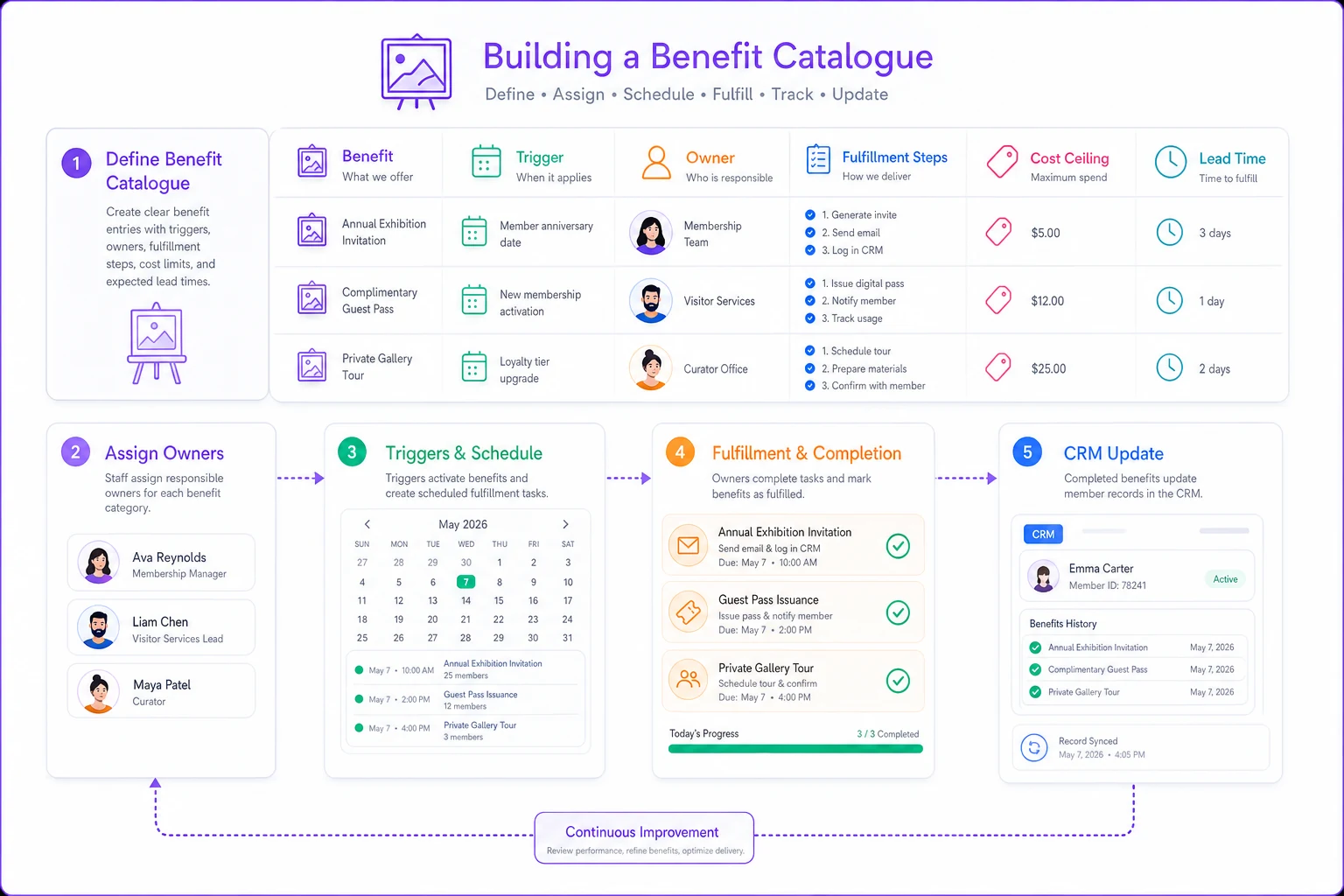
Do this for all ten or twelve benefits and you've turned a vague promise into an operational system anyone on staff can run.
An example benefit calendar for the year
Once each benefit has an owner and a trigger, you can lay the whole year onto a calendar so nothing collides and nothing gets forgotten. Here's a realistic quarter-by-quarter shape for a gallery running roughly six shows a year:
-
Q1 - Renewal push for members who joined last Q1 (see cadence below) - Show 1 preview hour + first-look email - Annual supporter list published (Friend+ recognition)
-
Q2 - Show 2 preview hour + first-look email - Collector-tier artist talk (one of two annual) - Patron advisory sessions scheduled
-
Q3 - Show 3 + Show 4 preview hours - Members-priced catalogue for the summer show - Studio visit round for Collector tier
-
Q4 - Show 5 + Show 6 preview hours - Patron annual dinner - Limited print fulfillment (order locked in Q3, delivered Q4) - Year-end renewal wave + a "here's what you got this year" recap
That last item — the year-end recap — is one of the most underused retention tools galleries have. Members forget what they received. Reminding them, plainly, of every preview, talk, and perk they used makes the renewal ask feel almost automatic.
Retention cadence: renewals don't happen by accident
For most small membership programs, first-year renewal sits somewhere in the 40–60% range with no deliberate retention effort. That means half your hard-won members vanish every year and you're stuck re-acquiring just to stay flat. Acquisition is expensive; renewal is cheap. The cadence below is where the money actually is.
-
T-45 days (before expiry) Value recap email — "Here's everything your membership included this year." No ask yet, just reminding them it was worth it.
-
T-30 days Renewal invite with a one-click renew link. Frame it around what's coming next year, not just "please pay again."
-
T-14 days Gentle reminder, ideally personalized for Collector and Patron tiers — a short note from the director carries real weight here.
-
T-3 days Final reminder with a soft deadline.
-
T+7 days (lapsed) Win-back — "We noticed your membership lapsed," offer to reinstate benefits, maybe a small extension.
-
T+30 days Final win-back, then move them to a "lapsed member" segment for a lighter re-engagement track.
Programs that renew well treat renewal as a sequence that starts before expiry, not a single email sent when the card fails. And they segment by tier — a Patron paying $2,000 should never get the same automated blast a $75 Friend gets. That's where a lot of galleries fumble, because their contact data is a mess and they can't segment cleanly in the first place. If your member records are scattered across a spreadsheet, an email tool, and someone's memory, fixing that comes first — there's more on untangling that in this piece on segmentation and nurture sequences.
Where this connects to your CRM
A membership program is only as good as the data underneath it. The integration points that matter aren't complicated, but they have to exist:
-
Member tier as a field on every contact record, so you can segment invites, priority access, and renewal messaging by tier.
-
Join date and expiry date stored and reliable, because your entire renewal cadence keys off them.
-
Benefit usage tracking — did this member actually attend the preview, take the studio visit, claim the print? This tells you which benefits drive renewals and which are dead weight.
-
Renewal status pipeline — active, expiring soon, lapsed, won-back — so nobody falls through the cracks.
That benefit-usage data is the quiet gold. When you can see that members who attend at least two preview hours renew at close to 80% while members who never show up renew at half that rate, your whole strategy sharpens: get people using benefits, especially the cheap ones. Membership isn't really about the perks list — it's about how connected someone feels to your program, and attendance is the proxy for connection.
This ties directly into the broader work of managing collectors as they move from casual attendee to committed buyer. Membership tiers map neatly onto lifecycle stages, and if you're thinking about how the two systems reinforce each other, the framework in collector lifecycle governance is worth reading alongside this.
Whatever platform you use — a proper CRM, a membership tool, or an operational system that ties member records to your event and sales data — the point is that tiers, expiry dates, and benefit usage all live in one place and can trigger the right message automatically. When those fields are connected, the retention cadence above runs largely on its own instead of depending on someone remembering to send a dozen different emails at exactly the right moment. That's the difference between a program that scales and one that stalls at fifty members because the founder can't keep track anymore.
A real scenario
A gallery running about seven shows a year had a two-tier membership doing roughly $9k in annual dues — but they were quietly losing money on it. The higher tier included a blanket 10% purchase discount, and two members had each bought works in the $8k–$12k range that year, so the discount alone gave back more than the entire tier's dues combined. Fulfillment was improvised: previews were staffed ad hoc, the "annual print" arrived late twice, and nobody was tracking who used what. Renewal was running around 45%.
They rebuilt it as three tiers, killed the automatic discount in favor of collector priority, capped the top tier at fifteen patrons, and wrote out a benefit catalogue with owners and cost ceilings. Then they set the renewal cadence to trigger off join dates and added a year-end recap.
Over the next cycle, dues rose to somewhere around $16k–$18k — partly from the new mid-tier, partly from a handful of Patron upgrades — but the bigger change was on the cost side. Killing the discount stopped the margin bleed entirely, and locking print costs in advance ended the late-delivery problem. Renewal climbed into the mid-60s percent, and the year-end recap alone recovered several members who'd been about to lapse. Nothing dramatic month to month — it just stopped leaking and started compounding.
When a paid membership program makes sense — and when it doesn't
It makes sense when you already have a recurring audience of thirty-plus warm contacts who show up to openings, when you run enough shows a year to give members regular reasons to engage, and when you have at least one person who can own fulfillment consistently. Membership rewards consistency more than scale.
It's a bad idea when you're running one or two shows a year — you won't have enough touchpoints to justify dues, and members will feel they paid for nothing. It's also a mistake if your contact data is a mess, because you literally can't run tier-based fulfillment or a renewal cadence without reliable member records. Fix the data first.
Who should not do this yet: a brand-new gallery with no established audience. Memberships convert existing relationships into recurring revenue — they don't create relationships from scratch. Spend your first year building the audience and the CRM discipline, then layer membership on top of a base that already trusts you.
The part nobody wants to hear
A membership program is an operational commitment, not a revenue trick. The galleries that make real money from it aren't the ones with the flashiest benefit list — they're the ones who costed every benefit before pricing it, wrote down who fulfills what, and ran a renewal cadence that started before anyone's card expired. Everything expensive is rationed; everything cheap is used heavily; every member's tier and expiry date lives somewhere reliable.
Get those three things right — margin-safe tier design, documented fulfillment, and a real retention cadence — and membership stops being a break-even side project and becomes one of the few genuinely predictable revenue lines a small gallery has. Skip them, and you'll do a lot of work to lose money slightly slower than before.
A membership program is an operational commitment, not a revenue trick. The galleries that make real money from it aren't the ones with the flashiest benefit list — they're the ones who costed every benefit before pricing it, wrote down who fulfills what, and ran a renewal cadence that started before anyone's card expired. Everything expensive is rationed; everything cheap is used heavily; every member's tier and expiry date lives somewhere reliable.
Get those three things right — margin-safe tier design, documented fulfillment, and a real retention cadence — and membership stops being a break-even side project and becomes one of the few genuinely predictable revenue lines a small gallery has. Skip them, and you'll do a lot of work to lose money slightly slower than before.
Ready to elevate your gallery operations?
Join 500+ galleries using Artioly to streamline operations, boost visitor engagement, and increase art sales.