

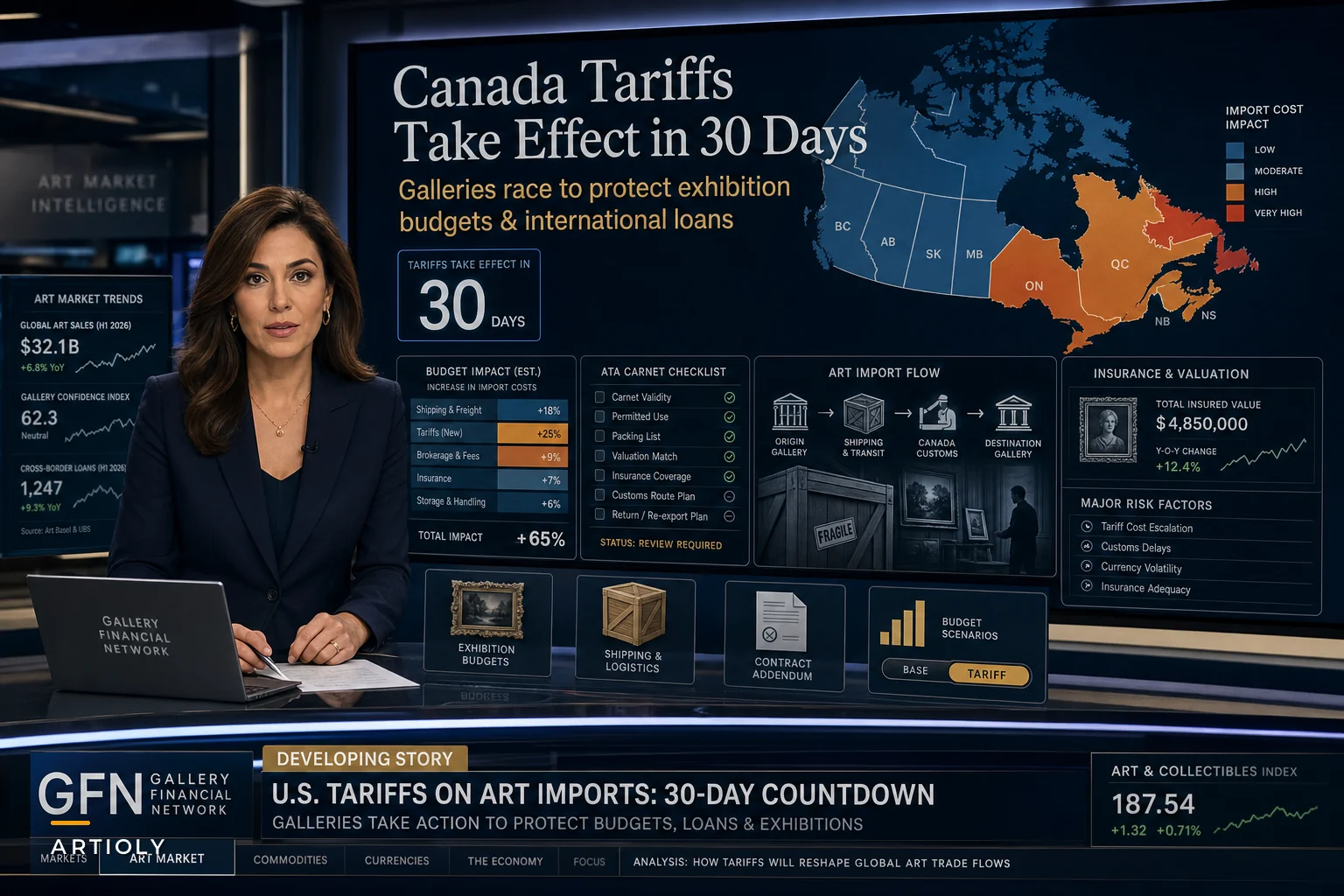

Last week's announcement caught most galleries off-guard. The White House confirmed new 50% tariffs on Canadian imports starting August 19th, creating a genuine operational mess for galleries already deep into fall exhibition planning.
If you source frames from Quebec, use Toronto-based art handlers, or have loans scheduled from Canadian institutions, your landed costs just jumped by half. That traveling exhibition from the National Gallery of Canada you've been promoting for three months? Your break-even calculation is already wrong.
What makes this particularly brutal for galleries is that you can't just adjust pricing overnight. You're locked into exhibition commitments, loan agreements, and collector expectations set months ago. A 50% cost increase doesn't translate into a 50% ticket price hike — it just eats your margin.
The hidden multiplier effect most galleries miss
Galleries tend to focus on the obvious when tariffs hit — the direct cost of importing artwork. What gets missed is how Canada tariffs ripple through gallery operations in ways nobody budgeted for.
A mid-sized contemporary gallery in Seattle learned this during the 2018 steel tariffs. They calculated the impact on their Canadian sculpture imports, budgeted around $12,000 extra, and figured they were covered. What actually happened: their Vancouver-based crating company raised prices 35% to cover their own material costs, their preferred shipper added a tariff adjustment fee of 8%, and insurance premiums crept up because declared shipment values increased. The real number wasn't $12,000 — it landed closer to $31,000 once everything downstream got factored in.
This round is worse. The tariffs cover broader categories and they're hitting right as galleries finalize fall programs. Your Canadian frame supplier isn't just raising prices — they're probably reassessing whether small US gallery orders are worth the paperwork. Conservation-grade packing material from Ontario? Lead times just doubled because suppliers are prioritizing larger institutional clients.
Why the obvious mitigation tactic will probably fail
Most galleries are rushing to place advance orders before August 19th. Lock in pre-tariff pricing, seems logical. Except everyone else is doing the same thing, which means Canadian suppliers are overwhelmed, freight capacity is tight, and you're competing with museums that have procurement departments and standing purchase orders.
Never miss a key exhibition detail again.
Artioly helps you organize, promote, and manage every exhibition effortlessly.
- Unified exhibition scheduling
- Artist and visitor notifications
- Inventory and sales tracking
No credit card required
The deeper problem isn't even cost — it's timing uncertainty. When a shipment gets held at the border for additional documentation (which happens noticeably more often during tariff implementations, based on what freight forwarders are telling clients), your exhibition schedule falls apart. Artwork supposed to arrive two weeks before opening now shows up three days before. Maybe.
Expedited shipping won't necessarily save you either. Express carriers face the same customs bottlenecks, and their "guaranteed" delivery dates have fine print exclusions for regulatory delays. One gallery director put it plainly: "FedEx International Priority from Toronto to Chicago normally takes 2 days. Last week it took 11, and no one could explain why."
The ATA Carnet complexity nobody's talking about
This is where things get genuinely complicated for galleries managing international loans. According to CNBC's analysis, the tariffs apply to "imports" — but the definition around temporary imports for cultural exchange remains unclear. Your ATA Carnets might not protect you the way you're assuming.
Customs officers have wide discretion in interpreting "temporary importation." If they decide your six-month loan exhibition doesn't qualify, you're suddenly paying duties on the full declared value of borrowed artworks — potentially hundreds of thousands of dollars you haven't budgeted for. Even if you eventually get it resolved and refunded, you need that cash upfront to clear customs.
Galleries managing loans from Canadian institutions need to revisit their customs and ATA Carnet procedures immediately. The standard playbook assumes stable trade conditions. These aren't stable conditions.
The seven moves that actually matter
1. Renegotiate force majeure clauses by Thursday
Your existing loan agreements probably have force majeure language, but most don't explicitly cover tariffs. Contact your Canadian lenders this week — not next week — and get written amendments specifying who bears tariff costs. Museums are generally willing to split unexpected costs, but only if you approach them before the tariffs take effect. After August 19th, they'll reasonably argue you should have anticipated this.
Draft language that works: "In the event of government-imposed tariffs or duties affecting the cost of transportation, packing, or insurance for loaned artworks, both parties agree to meet within 5 business days to negotiate a proportional sharing of increased costs, not to exceed 25% over the original budgeted amount for either party."
2. Build your domestic supplier backup network
Every gallery needs at least three US-based alternatives for their Canadian suppliers lined up by August 15th. Not just names — actual relationships with pricing, lead times, and sample orders placed.
For framing: Place small test orders now even if you don't need them. You're buying the relationship, not just the frames.
For crating: US crating costs typically run 20–30% higher than Canadian options even without tariffs. But reliability matters more than cost when you're trying to open a show. Get quotes for your fall exhibitions now, even if you plan to stick with your Canadian vendor.
3. Restructure payment terms before the deadline
If you must continue working with Canadian suppliers, change how you pay. Instead of paying on delivery (when tariffs apply), negotiate to pay 60% upfront before August 19th as a deposit and 40% on delivery. That alone cuts your tariff exposure significantly.
Some suppliers will push back on cash flow grounds. Offer a 2% early payment discount on the deposit portion as a counterpoint. You're still ahead compared to paying tariffs on the full amount.
4. Create tariff-adjusted exhibition budgets
Your fall exhibition budgets need at least three scenarios:
-
Base case — no tariffs, normal operations
-
Tariff case — 50% duties plus roughly 20% operational friction costs
-
Worst case — tariffs plus 30-day delays plus emergency shipping
For a typical traveling exhibition with $40,000 in Canadian-sourced components, the tariff case adds around $30,000 in direct and indirect costs. Worst case might reach $45,000 when expedited shipping and replacement suppliers enter the picture.
5. Shift loan timelines strategically
Contact every Canadian institution you're borrowing from and propose one of two things: accelerate the loan to begin before August 19th, or delay until spring 2027. Most institutions actually prefer delay over acceleration — their own conservation and registrar teams are already scrambling.
The conversation script: "Given the new import duties taking effect August 19th, we're reviewing all international loans to make sure we can maintain our insurance and security commitments. Would you prefer we accelerate the loan to begin August 15th, or would spring 2027 work better for your institution?"
6. Document everything for insurance claims
Your fine arts policy might cover some tariff-related costs under "government action" clauses, but only with proper documentation. Starting today, create a dedicated file for:
-
All Canadian supplier communications about price changes
-
Freight forwarder notices about delays or added fees
-
Customs documentation showing duties paid
-
Email threads showing your mitigation efforts
One gallery recovered around $18,000 from their insurer after proving tariff-related delays forced them into emergency shipping before an opening. It took four months and a lot of documentation. Start the paper trail now.
7. Communicate strategically with stakeholders
Your artists, collectors, and board need to know what's happening, but the framing matters. Don't create panic, but don't obscure it either.
For artists with work in affected exhibitions: "New trade regulations may affect the timing of your work's return from Canada. We're working with our shipping partners to minimize any delays and will keep you updated weekly."
For collectors expecting Canadian acquisitions: "Due to new import duties effective August 19th, we're reviewing the most cost-effective delivery options for your acquisition. We may recommend consolidating shipments in September to reduce fees."
For board members: "The new Canada tariffs will impact our Q3/Q4 exhibition costs by approximately $X. We've identified mitigation strategies that could reduce this by around 40%, but we need approval for emergency operational adjustments by August 14th."
| Move | Title |
|---|---|
| 1 | Renegotiate force majeure clauses by Thursday |
| 2 | Build your domestic supplier backup network |
| 3 | Restructure payment terms before the deadline |
| 4 | Create tariff-adjusted exhibition budgets |
| 5 | Shift loan timelines strategically |
| 6 | Document everything for insurance claims |
| 7 | Communicate strategically with stakeholders |
The seven moves above outline immediate operational and contractual steps to reduce exposure and preserve exhibition schedules.
The operational reality check
Galleries handling this well are treating it as an operational crisis, not just a pricing adjustment. They've pulled someone off regular duties to focus on tariff mitigation for the next two weeks. They're calling suppliers daily instead of waiting on email. They're placing backup orders they may never use, just to have options in hand.
Pro-tip: assign one staffer to coordinate tariff mitigation and supplier communications to keep actions consistent and avoid duplicated efforts.
A gallery in Detroit restructured their entire fall program in 48 hours. They moved their Canadian photography exhibition to March 2027, accelerated a local artist showcase to fill the slot, and negotiated a virtual exhibition component for the Canadian work to keep the relationship alive. It wasn't a clean solution, but it worked.
The galleries that will struggle are the ones treating this like a typical price increase — updating spreadsheets, sending a few emails, hoping things settle down. The operational complexity of cross-border art movement just multiplied. Acknowledging that reality early is the difference between a disrupted season and a genuinely damaging one.
What happens after August 19th
Once the tariffs kick in, galleries will quickly divide into two groups: those who prepared and those who didn't. Prepared galleries will have higher costs but maintained schedules. Unprepared ones will have higher costs and blown deadlines, frustrated artists, and unhappy collectors.
The real damage tends to show up in Q4, when galleries realize their holiday exhibition costs destroyed annual margins. If you have a major Canadian exhibition planned for December and haven't reworked the financial model, you may be looking at a five-figure loss before the show even opens.
Smarter galleries are already planning 2027 on the assumption that Canada tariffs affecting art galleries stick around. They're building regional supplier networks, establishing US-based conservation partnerships, and reducing cross-border dependencies in their exhibition programs. Not pessimism — just operational adaptation.
Making hard program decisions now
Some exhibitions won't make financial sense anymore. That's a difficult thing to accept, but far better to face it in July than bleed money through September.
Run the calculation: take your exhibition budget, add 50% to all Canadian-sourced components, add around 20% for operational friction, then check whether you can still break even at realistic attendance levels. If not, cancel or postpone now while you can still fill the calendar slot with something viable.
A contemporary gallery in Buffalo just cancelled their October Canadian emerging artists showcase after running these numbers. The cost increase would have required selling an additional 15 works just to break even — not realistic for emerging artists. They pivoted to a local showcase that will actually be profitable.
Your reputation takes less damage from a transparent cancellation in July than from a financial disaster in October. Most partners understand that trade regulations create genuinely impossible situations. The ones who don't weren't going to be easy to work with regardless.
The systematic fix that scales
Beyond the immediate crisis response, galleries need structural changes to handle this kind of disruption without it consuming the whole team. Tracking supplier alternatives, cost scenarios, and compliance documentation across scattered spreadsheets and email threads gets overwhelming fast — especially for small teams already stretched thin.
This is where operational software actually earns its keep. Centralized supplier tracking, automated alerts for documentation deadlines, real-time budget adjustments as costs shift. AI-powered operational platforms can monitor regulatory updates, flag affected exhibitions, and surface supplier alternatives based on your specific situation — reducing the manual scramble that typically eats two weeks of staff time.
The galleries that come out of this strongest won't just be the ones with good lawyers or deeper pockets. They'll be the ones who built more systematic responses to complexity — workflows that track compliance, platforms that manage multi-supplier scenarios, and tools that catch regulatory changes before they become crises. When the next trade disruption hits, and it will, they'll adapt in days rather than weeks.
That said, systematic fixes only work if you survive the immediate situation. Get through August first. Stabilize the fall program. Then build the infrastructure that prevents this scramble next time.
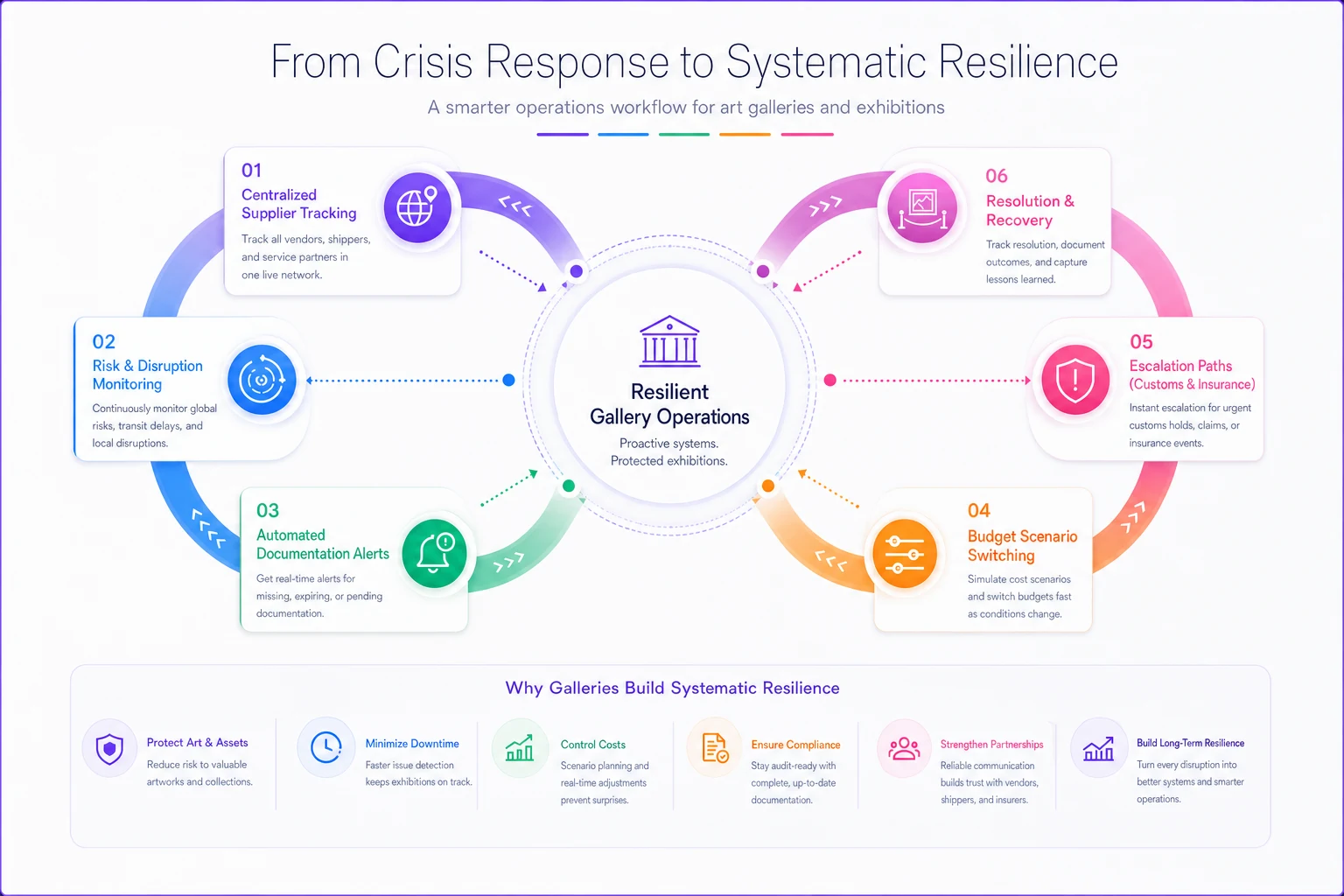
Use this simple workflow as a starting point to map roles, trigger points, and tools for operational resilience.
The Canada tariffs are probably just the beginning of a more volatile trade environment for galleries. The ones who adapt their operations now — not just their pricing — will be better positioned for whatever comes next.
The Canada tariffs are probably just the beginning of a more volatile trade environment for galleries. The ones who adapt their operations now — not just their pricing — will be better positioned for whatever comes next.
Ready to elevate your gallery operations?
Join 500+ galleries using Artioly to streamline operations, boost visitor engagement, and increase art sales.