

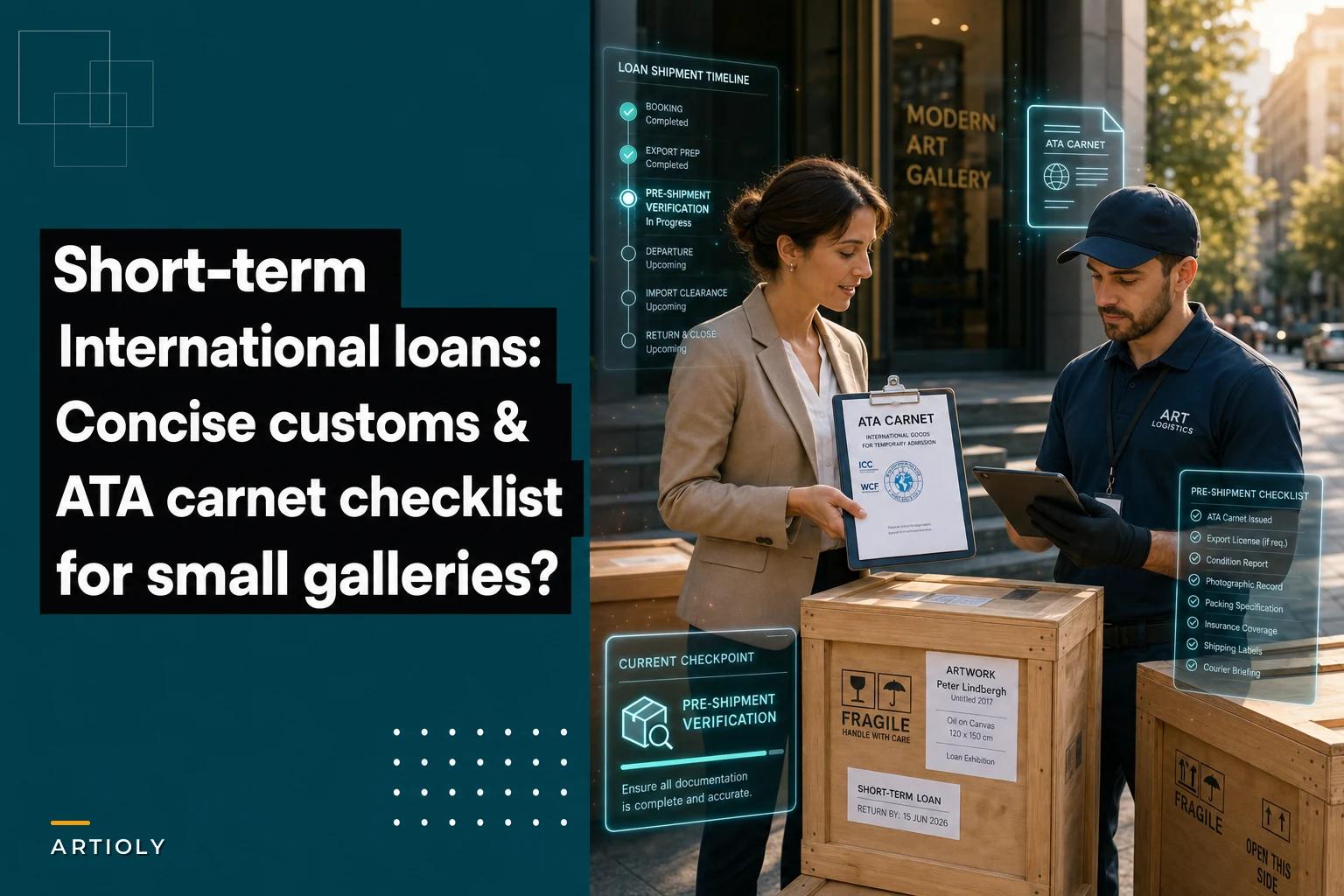

Gallery owners shipping artwork internationally face a brutal operational reality: customs can destroy your exhibition timeline with a single missing document. The international loan checklist gallery teams need isn't theoretical—it's about preventing the specific failures that turn short-term loans into logistical disasters.
Most galleries learn this through expensive mistakes. A Berlin gallery lost €12,000 when their loaned Richter prints got stuck in Swiss customs for four months because their ATA carnet listed "mixed media" instead of "oil and graphite on canvas." The exhibition went ahead without their centerpiece works. The relationship with the partnering institution never fully recovered.
The operational challenge runs deeper than paperwork. Small galleries typically handle maybe 3–4 international loans per year—never quite practiced enough to feel confident, but the stakes remain catastrophically high every time. One wrong HS code, one expired document, one mismatched valuation, and suddenly your artwork sits in a customs warehouse while your exhibition opens with empty walls.
HS codes: the classification nightmare that breaks exhibitions
HS codes feel like they were designed to confuse art handlers. The Harmonized System wants you to classify a contemporary sculpture as either 9703.00 (original sculptures) or potentially 8306.29 (other ornaments of base metal) depending on materials and intent. Get it wrong, and you're looking at duty charges that shouldn't exist under cultural exemptions.
The real problem emerges with mixed exhibitions. A photography show might include:
-
Digital prints (HS 4911.91)
-
Original film negatives (HS 3705.90)
-
Video installations (HS 8521.90)
-
Artist books (HS 4901.99)
Each category triggers different customs treatment. Digital prints might breeze through while your video installation gets flagged for technology export controls nobody warned you about. The classification determines not just duties but which government agencies get involved in your shipment.
What makes this particularly painful for small galleries: commercial shippers often default to generic codes like 9701.10 (paintings) for everything, assuming it's close enough. Then customs opens your crate in Frankfurt, finds a bronze sculpture, and suddenly you're explaining why your documentation doesn't match your contents.
The working solution is to build a classification matrix before you even agree to the loan. Map every piece to its specific HS code, including a materials breakdown. When a collector offers to loan their "mixed media installation," you need to know whether that means:
-
Paper and ink (relatively simple)
-
Electronics and sensors (export control nightmare)
-
Organic materials (agricultural inspection required)
-
Cultural artifacts (completely different regulatory framework)
The working solution is to build a classification matrix before you even agree to the loan.
ATA carnets: the temporary export tool everyone uses wrong
ATA carnets should theoretically make international loans simple—a passport for your artwork, no duties, no taxes, just temporary movement for exhibition purposes. The reality plays out differently.
Never miss a key exhibition detail again.
Artioly helps you organize, promote, and manage every exhibition effortlessly.
- Unified exhibition scheduling
- Artist and visitor notifications
- Inventory and sales tracking
No credit card required
Galleries consistently trip up on three things:
Valuation disconnects. Your carnet lists insurance value at $450,000, but your commercial invoice shows $380,000 fair market value. Customs sees the discrepancy and freezes everything while demanding an explanation. All documentation needs to align—insurance docs, carnet, commercial invoice, condition reports, all showing identical valuations.
Re-export timing. Carnets have strict validity periods, typically 12 months. If your exhibition extends by even one week, your carnet might expire before re-export. Barcelona customs won't care that the extension was approved last-minute. They'll treat your artwork as a permanent import, triggering massive duty payments.
Partial shipment chaos. You obtain a carnet for 15 works. Two pieces sell during the exhibition. Now you're re-exporting 13 works on a carnet listing 15. Customs wants to know where the other two went. Without proper documentation of the sales and any applicable duty payments, your remaining 13 pieces get held.
The carnet process that actually works starts months before shipping:
-
Valuation consistency across every single document
-
Buffer time built into validity periods—never cut it close
-
Clear procedures for handling deviations from the original manifest
-
Backup documentation for every plausible scenario
Small galleries often skip the carnet entirely for EU-to-EU movement, relying on cultural goods exemptions. This works until it doesn't—usually when contemporary works don't immediately read as cultural goods to a customs inspector.
Pre-shipment checklist that prevents most holds
The pre-shipment phase determines whether your loan moves smoothly or becomes a crisis. Most galleries treat it as an administrative checkbox. The ones who avoid customs disasters treat it as operational risk management.
Essential pre-shipment verification should happen 6–8 weeks before shipping:
Documentation alignment. Every document must tell the same story:
-
Condition reports matching exact titles on invoices
-
Insurance valuations matching carnet declarations
-
Shipping manifests matching loan agreements
-
Materials descriptions consistent across all paperwork
Regulatory pre-clearance. Contact the destination country's customs office directly. Yes, actually call them. Email their cultural goods department your documentation and ask whether anything will cause a problem. They'll often identify issues weeks before they'd emerge at the border.
Power of attorney precision. Your shipping agent needs power of attorney to clear customs on your behalf. Generic POAs often lack the specific language customs wants. The POA must explicitly authorize customs clearance, duty payments if required, and document amendments.
Photography documentation. Customs increasingly wants visual proof that artworks match descriptions. Pre-shipment photos should show:
-
Overall views of each work
-
Detail shots of signatures or marks
-
Back and verso documentation
-
Packaging progression photos
Frankfurt customs once held an entire exhibition because the condition report described "minor foxing to edges" but the inspector saw what they considered significant deterioration. Photos would have prevented four weeks of arguments.
A simple visual workflow can help teams standardize the sequence of pre-shipment checks.
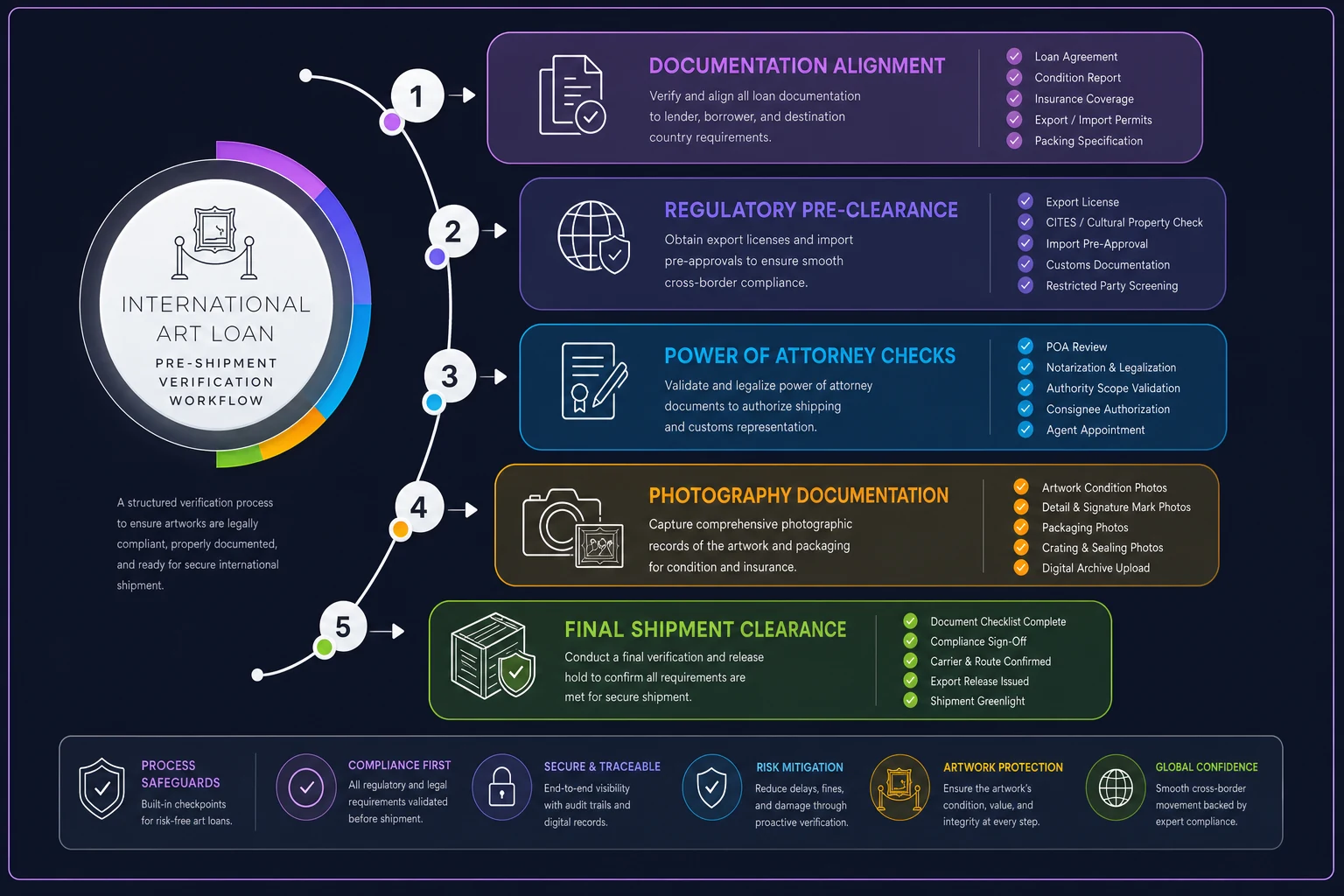
Always photograph packaging progression with timestamps to resolve condition disputes quickly.
Frankfurt customs once held an entire exhibition because the condition report described "minor foxing to edges" but the inspector saw what they considered significant deterioration. Photos would have prevented four weeks of arguments.
Common customs holds and immediate responses
When customs holds your shipment, every hour matters. The typical scenarios and what to do:
Valuation disputes. Customs thinks your $200,000 sculpture is undervalued for duty avoidance. Provide comparable sales records, recent auction results, and gallery invoices showing consistent market pricing. Don't argue about artistic value—show transaction evidence.
Materials inspection. Your "bronze and marble" sculpture contains ivory components you forgot to declare. Provide CITES permits if applicable, or documentation proving pre-1947 manufacture. If you can't, prepare for potential seizure.
Documentation mismatches. Carnet says 12 works, manifest shows 13. Send amended documentation within 4 hours explaining the discrepancy. If it's a counting error, provide a detailed inventory reconciliation. If it's an actual additional work, prepare duty payment immediately to release the rest.
Technology controls. Your video installation includes encrypted software or transmission capabilities. Provide export licenses from your origin country and import licenses for the destination. If you don't have them, you'll need emergency filings with the relevant commerce departments.
The response timeline typically runs like this:
| Timeframe | Action Required |
|---|---|
| Hours 1–4 | Initial response with explanation |
| Hours 4–12 | Supporting documentation submission |
| Days 2–3 | Formal amendment filing if required |
| Days 4–7 | Escalation to supervisory level if unresolved |
| Week 2+ | Legal involvement likely required |
Speed matters because customs warehouses charge daily storage after 48–72 hours—often $200–500 per day for climate-controlled art storage. Those fees compound quickly.
Building contingency plans for exhibition deadlines
The Venice Biennale doesn't wait for your customs clearance. Neither does Art Basel. Contingency planning needs to account for total shipment failure.
Start with timeline buffers that actually reflect customs reality:
-
Ship 3 weeks early for established routes (NYC to London)
-
Ship 5 weeks early for complex routes (NYC to Seoul)
-
Ship 8 weeks early for first-time destinations
Buffers alone aren't enough. You need operational alternatives.
Backup artwork selection. For every international loan, identify local alternatives. If your centerpiece from New York gets stuck in customs, which pieces from European collections could substitute? Pre-negotiate these contingency loans with clear trigger dates.
Partial opening strategies. Design your exhibition to function at 70% capacity. If 3 of your 10 international loans don't arrive, how does the show still work? This might mean modular installation design, digital placeholders for missing works, or enough narrative flexibility in wall texts to accommodate gaps.
Financial protection. Loan agreements need customs delay clauses. Who pays for extended shipping? Storage fees? Re-routing costs? Insurance extensions? Most galleries discover these gaps after paying unexpected five-figure customs storage bills.
Communication protocols. When customs holds emerge, who gets notified when? A reasonable protocol:
-
Hour 1
Registrar and director notified
-
Hour 4
Lending institution updated
-
Day 2
Insurance company informed
-
Day 3
Public relations briefed on potential delays
-
Week 1
Legal counsel engaged if unresolved
Your exhibition operations system needs to incorporate these customs contingencies as standard procedure, not emergency responses.
Digital tools that streamline customs compliance
Manual tracking across spreadsheets, email chains, and paper documents virtually guarantees something gets missed on international loans. The operational complexity compounds too quickly.
Galleries increasingly rely on centralized operational software to manage these processes. A properly configured system tracks document versions and approval status, flags deadline risks for carnet renewals, enforces valuation consistency across paperwork, and logs customs hold history so patterns become visible over time.
The impact shows up in hold rates. Galleries using centralized tracking tend to see customs holds drop significantly—partly because the software catches discrepancies before shipping. If your condition report says "bronze" but your HS code implies "mixed metals," a good system flags that before the crate leaves your loading dock.
More practically, these platforms build institutional knowledge. Every customs hold, every resolution, every successful clearance becomes part of your operational record. The next time you ship to Seoul or São Paulo, you're working from documented experience rather than starting from scratch.
Recognizing when international loans don't make sense
Not every international loan opportunity deserves a yes. The operational burden sometimes outweighs the prestige or relationship value.
Skip international loans when:
-
Timeline allows less than 8 weeks for shipping and customs
-
Total loan value falls under $50,000 and shipping costs eat any benefit
-
Destination country has recent regulatory instability
-
Your insurance explicitly excludes certain territories
-
The borrowing institution can't provide customs support
The hardest part is turning down prestigious institutions because the operational risk is too high. That invitation from a major Beijing museum sounds impressive until you factor in current trade restrictions, potential customs delays, and the reality that you might not see your artwork again for 8–12 months.
Smart galleries develop lending criteria that reflect operational capacity, not just curatorial ambition:
-
Maximum 2 concurrent international shipments
-
Countries with established ATA carnet agreements
-
Institutions providing dedicated customs agents
-
Exhibitions with minimum 6-month planning windows
Smart galleries develop lending criteria that reflect operational capacity, not just curatorial ambition:
The customs expertise gap in small galleries
Most small galleries have maybe one person who understands international shipping, and they learned through expensive mistakes. When that person leaves, years of hard-won customs knowledge walks out with them.
The sustainable approach is treating every international loan as a documented learning opportunity. Post-loan reviews should capture which HS codes actually worked, exactly what documentation customs requested, processing times at specific ports, contact information for helpful customs officers, and costs that exceeded estimates and why.
That documentation becomes your operational playbook. The next loan builds on established knowledge rather than repeating the same learning curve.
The galleries that handle international loans smoothly aren't necessarily smarter—they've failed enough times to build reliable processes. They've learned that customs compliance isn't about perfect paperwork but about preparing for the specific ways things go wrong and having responses ready before the hold notice arrives.
Your international loan checklist can't prevent every customs hold. But it can transform them from exhibition-destroying crises into manageable 48-hour delays.
The difference between those outcomes comes down to preparation, documentation, and clear protocols established well before you need them.
Ready to elevate your gallery operations?
Join 500+ galleries using Artioly to streamline operations, boost visitor engagement, and increase art sales.