



Condition reports feel tedious until a collector claims your gallery damaged their $85,000 Anselm Kiefer mixed-media piece during a loan exhibition. The dispute drags for months. Insurance companies demand documentation you don't have. The collector's lawyer sends increasingly aggressive emails. Your reputation takes hits on ArtNet forums.
This scenario plays out constantly in small galleries handling loans. Not because staff are careless, but because condition report workflows break down at critical handoff points. Mixed-media and fragile works amplify these failures—a barely visible crack in resin becomes a major insurance claim, undocumented fiber shedding turns into accusations of mishandling.
After building operational systems for galleries handling everything from delicate paper installations to heavy bronze-and-glass assemblages, the pattern is clear: disputes arise from documentation gaps, not actual damage. The difference between a smooth loan return and a six-figure insurance battle often comes down to photo angles, terminology consistency, and sign-off timing.
Why standard condition templates fail for mixed-media works
Generic condition report templates assume paintings or sculptures with predictable materials. They provide checkboxes for "tears" and "scratches" but completely miss the complexity of contemporary mixed-media pieces.
-
Oxidized copper sheets
-
Embedded organic materials (leaves, hair)
-
Unstable pigments
-
Electronic components
-
Found objects with existing wear
Each material ages differently. Copper continues oxidizing—is new patina "damage" or natural progression? Organic elements degrade predictably. Electronics may work intermittently. Found objects arrived pre-damaged by design.
Standard reports can't capture these nuances. Staff write vague notes like "some wear visible" or "electronics functional." Three months later, when the lender claims the copper looks different, you have no baseline for comparison. The notes mean nothing without context.
The insurance adjuster asks specific questions: Was the oxidation uniform or spotted? What percentage of the surface showed patina? Were the electronics tested under what conditions? Vague documentation provides no answers.
Small galleries often handle 15–20 condition reports monthly across incoming loans, outgoing loans, and consignment rotations. Without a structured workflow that accounts for material complexity, each report is a potential dispute waiting to happen.
Photo protocol: beyond "overall views"
Most galleries photograph artworks haphazardly—a few overall shots, maybe a detail of obvious damage. This approach fails with complex works where subtle changes are what actually trigger disputes.
Never miss a key exhibition detail again.
Artioly helps you organize, promote, and manage every exhibition effortlessly.
- Unified exhibition scheduling
- Artist and visitor notifications
- Inventory and sales tracking
No credit card required
Base photo requirements for mixed-media works:
Initial documentation (intake):
-
Overall front at 0° angle, consistent lighting
-
Overall back, same lighting conditions
-
All four edges, straight-on
-
Close-ups of every material transition point
-
Macro shots of surface textures (minimum 3 zones)
-
Any mechanical or electronic components
-
Existing damage or wear patterns
Lighting consistency markers:
-
Include a color checker card in the first frame
-
Note light temperature (3200K, 5500K, etc.)
-
Document time of day if using natural light
-
Mark camera position with floor tape
The Kiefer piece mentioned earlier? A proper photo protocol would have captured the resin's micro-crack patterns before shipping. When the collector claimed new cracks appeared, you'd have comparative evidence showing they existed previously.
One gallery photographed a Tara Donovan installation (plastic cup sculpture) only from standard angles. When cups yellowed during the loan period, they couldn't prove the discoloration was pre-existing because their photos didn't capture individual cup conditions. The insurance claim exceeded $30,000.
Problem zones requiring extra documentation:
-
Junction points between different materials
-
Areas under tension or stress
-
Surfaces prone to oxidation or patina
-
Adhesive or mounting points
-
Electronic connection points
-
Organic material boundaries
Photo file naming matters too. "IMG4837.jpg" tells you nothing six months later. A functional naming structure: ArtistLastNameTitleYearView_Date.jpg
Example: KieferWinterland2019FrontOverall2024-01-15.jpg
This naming system lets you find comparison photos instantly during disputes. When the collector's lawyer demands evidence, you pull files in seconds, not hours.
Use this workflow for consistent photography across mixed-media loans.
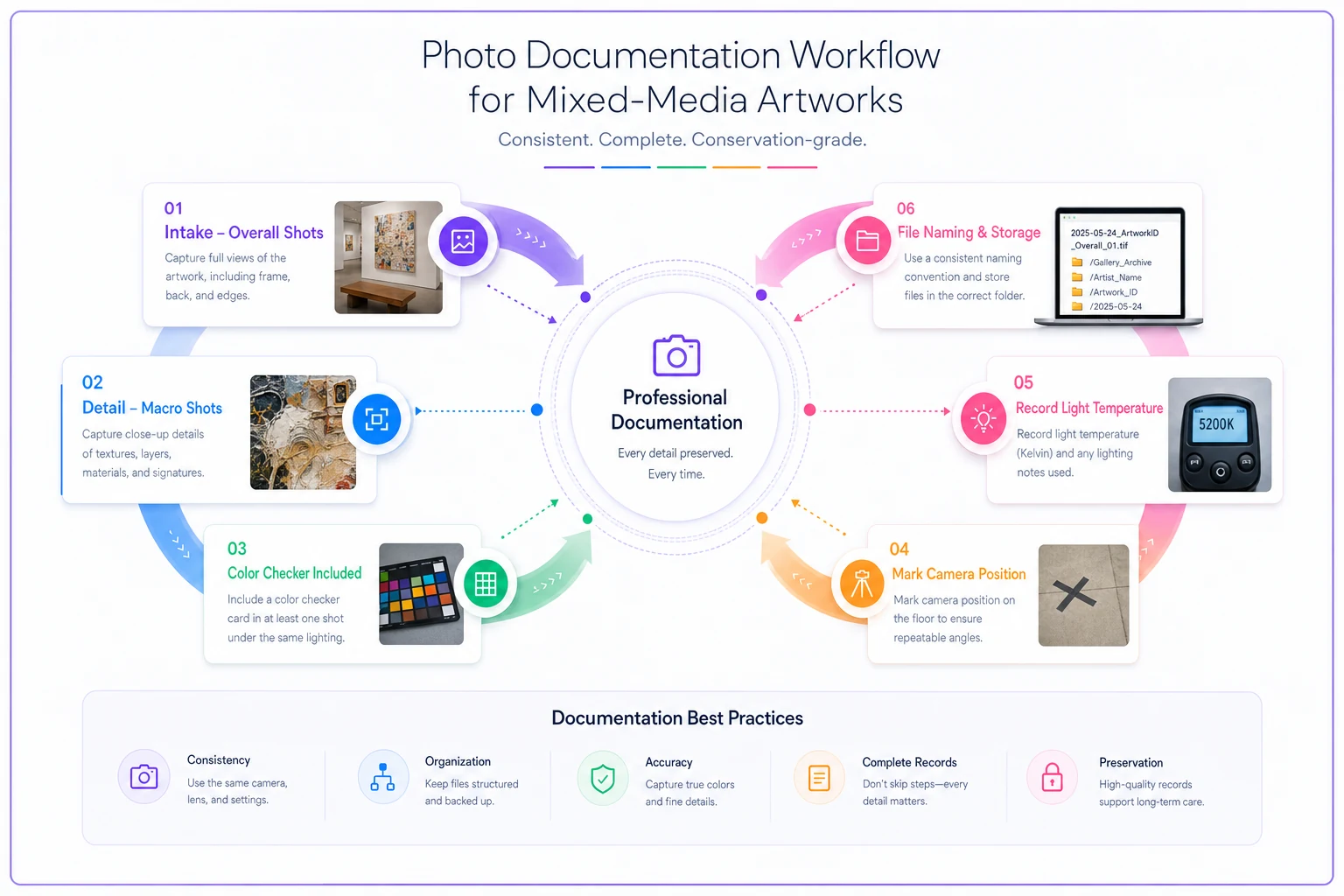
When disputes arise, comparison photos and consistent metadata are what let you respond quickly and confidently.
Language standardization: when "slight" means different things
Terminology inconsistency creates real problems. One registrar writes "minor abrasion," another writes "slight scratch," a third notes "surface disruption"—all describing the same condition. During disputes, opposing lawyers exploit these inconsistencies.
Standardized terminology glossary (abbreviated):
| Term | Definition | Measurement |
|---|---|---|
| Hairline crack | Crack visible at <12 inches, width <0.5mm | Measure length in cm |
| Network cracking | Multiple intersecting cracks in pattern | Note affected area % |
| Abrasion | Surface disruption without material loss | Describe area in cm² |
| Scratch | Linear surface disruption with material loss | Length x depth in mm |
| Accretion | Foreign material adhered to surface | Composition if known |
| Bloom | Hazy or cloudy surface alteration | Affected area % |
| Delamination | Layer separation in composite materials | Area and depth |
| Efflorescence | Crystalline deposits on surface | Pattern description |
Real example: a gallery described bronze patina changes as "some darkening" in the initial report and "significant discoloration" in the return report. Same condition, different words. The lender's insurance company used that inconsistency to claim new damage occurred, initiating a $45,000 claim.
Train every staff member on exact terminology. Print glossary cards. Post them at documentation stations. Eliminate interpretation.
Train every staff member on exact terminology.
Eliminate interpretation.
Sign-off gates and accountability chains
The most expensive disputes happen when no one clearly owns the condition report workflow. Reports get started but not finished. Photos get taken but not properly archived. Sign-offs happen verbally without any record of it.
Critical sign-off gates in the condition report workflow:
-
Gate 1
Intake documentation - Registrar completes initial report within 24 hours - Preparator reviews and adds handling notes - Both sign digitally with timestamps
-
Gate 2
Pre-installation check - Preparator examines after unpacking - Documents any transit-related changes - Gallery director approves for installation
-
Gate 3
Post-installation verification - Installer notes any mounting stress points - Photographer captures installation views - Registrar updates report with display conditions
-
Gate 4
De-installation inspection - Same preparator who installed conducts the check - Documents any exhibition-period changes - Creates comparison report against intake
-
Gate 5
Pre-return verification - Registrar generates final comparative report - Director reviews significant changes - Lender receives report 48 hours before shipping
Each gate requires actual signatures or digital sign-offs with timestamps. Verbal approvals don't exist in a proper workflow. When disputes arise, you need an evidence trail showing who approved what and when.
A gallery handling a Louise Bourgeois fabric sculpture skipped the pre-return verification gate to meet shipping deadlines. The lender claimed moth damage occurred during the loan. Without that final inspection report, the gallery couldn't prove the damage was pre-existing. Settlement: $120,000.
Sample workflow execution for a mixed-media loan
Walking through an actual loan shows how these elements connect.
Artwork: Mixed-media assemblage with rusted steel, preserved botanicals, and LED components Value: $67,000 Loan period: 3 months
Day 1 – Arrival:
-
Crate arrives at 2
15 PM. Registrar photographs crate condition, notes "corner compression on panel 3, no punctures." Unpacking begins at 3:00 PM with preparator present.
Day 1 – Initial documentation:
-
24 photos taken following protocol
-
Rust patterns documented at 5 points
-
Botanical elements show expected brittleness
-
LEDs tested
18 of 20 functional
-
Report notation
"Artist confirms 2 LEDs were non-functional at creation"
Day 2 – Lender review:
-
Report sent to lender via encrypted link. Lender responds with corrections
"Rust pattern at lower left quadrant was created in 2019, not damage." Report updated with artist's intent notes.
Week 2 – Installation:
-
Minor botanical fragment falls during mounting. Fragment preserved in archival envelope, location photographed, incident noted in report. Lender notified same day, approves proceeding.
Week 11 – De-installation:
-
Comparison photos show no change in rust patterns. One additional LED now non-functional. Gallery electrician tests and confirms loose connection, not component failure. Repair attempted per loan agreement, LED restored.
Week 12 – Return prep:
-
Final report shows
- Botanical fragment loss (approved by lender) - LED temporarily repaired (documentation included) - All other conditions match intake
Lender signs off on return condition. Artwork shipped. No disputes.
This level of documentation seems excessive until you face your first major claim. Then it becomes essential infrastructure.
The cascade effect of poor documentation
Weak condition reporting creates cascading problems beyond individual disputes. Insurance premiums increase after claims. Lenders become reluctant to loan works. Collectors question your professionalism. Staff morale drops when they're blamed for undocumented pre-existing conditions.
One gallery faced three condition disputes in eighteen months, all due to insufficient documentation rather than actual mishandling. Their fine arts insurance premium increased by around 40%. Major collectors stopped loaning works. They lost two key exhibitions when institutions questioned their handling capabilities.
The operational burden of disputes far exceeds prevention costs. A single claim typically involves:
-
20–30 hours of staff time gathering evidence
-
Legal consultation fees starting around $5,000
-
Potential settlement costs
-
Relationship damage with lenders
-
Reputation impacts that linger for years
Compare that to proper workflow implementation: roughly 8–10 hours setting up protocols, then 30–45 minutes per artwork for thorough documentation. The math isn't complicated.
Building resilience through systematic documentation
The galleries with the strongest condition report workflows treat documentation as protective infrastructure, not administrative burden. Every photo, every standardized term, every sign-off creates evidence that either prevents disputes or resolves them quickly.
Mixed-media and fragile works demand this kind of systematic approach. Their material complexity, natural deterioration patterns, and interpretive nature make casual documentation genuinely dangerous. When a collector claims their Sol LeWitt wall drawing instructions look different, or their Eva Hesse latex piece shows new degradation, your documentation is your only defense.
Galleries with structured condition reporting face fewer disputes, maintain better lender relationships, and secure insurance coverage at lower premiums. Those treating reports as afterthoughts face escalating claims and operational chaos that compounds over time.
The integration points matter too. Your condition report workflow should connect directly to your exhibition operations system, ensuring documentation happens at natural handoff points rather than as isolated tasks someone remembers to do at the last minute. When operational software tracks these workflows—automating reminders, maintaining photo archives with proper metadata, flagging missing sign-offs—the administrative burden drops significantly while protection increases.
Some galleries are now using AI-assisted platforms to standardize terminology, catch missing documentation before it becomes a problem, and generate comparative reports automatically. Over time, patterns emerge: which types of works generate the most disputes, which transport companies correlate with damage claims, which exhibition conditions affect certain materials. That's genuinely useful operational intelligence, not just a paper trail.
The galleries that build these systems before they need them are the ones that survive long-term. Document obsessively, standardize terminology, maintain the sign-off chain. The alternative—hoping nothing goes wrong—isn't a strategy any gallery can actually afford.
Ready to elevate your gallery operations?
Join 500+ galleries using Artioly to streamline operations, boost visitor engagement, and increase art sales.