

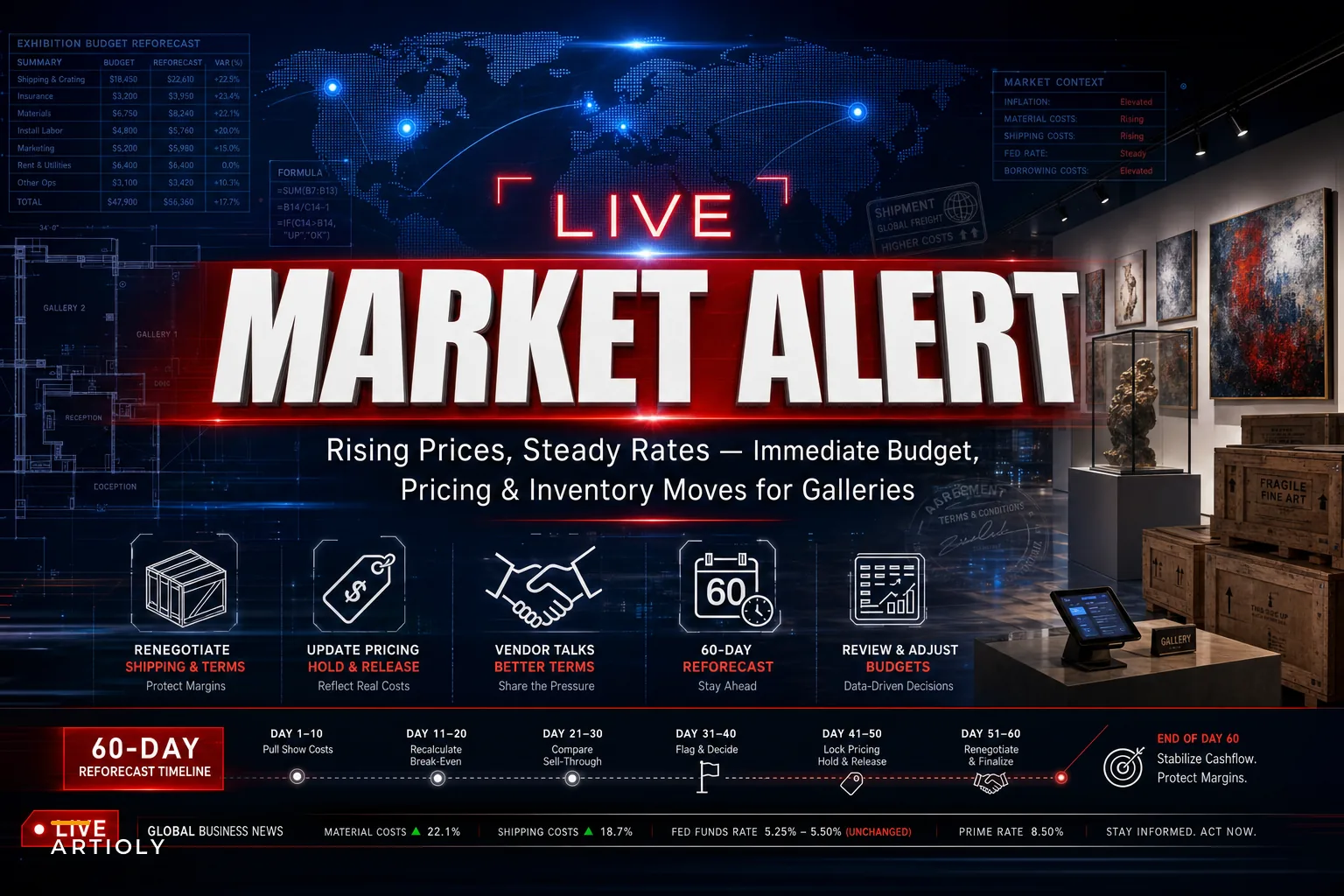

The September numbers landed in an awkward spot for anyone running a gallery. Inflation came in hotter than most forecasters expected, consumer spending held up anyway, and the Fed decided to sit still — holding the federal funds rate at 3.75–4.00% in its late-October statement. Reuters covered the inflation and spending uptick, and the Fed laid out its reasoning in the FOMC press release.
For a big retailer this is a line item on an earnings call. For a small commercial gallery, it's your crate quote going up, your art-handler charging more per hour, your insurance renewal creeping, and your collectors getting quietly more selective — all at the same time, with no cheaper financing coming to bail you out.
That combination is worth paying close attention to. Not the headline number. The shape of it. Costs are rising while the escape valve of cheap borrowing stays shut. So the margin you protect has to come from operations, not from a loan that papers over a weak show.
Here's what actually moves when the numbers look like this, and what a gallery should do in the next 60 days.
What "costs up, rates flat" actually does to your show budget
Most galleries budget an exhibition once, early, and then treat that number as fixed until the invoices arrive. When input prices were stable, that was fine. It isn't fine right now, because the gap between your budgeted cost and your real cost is widening mid-cycle.
The pressure shows up first in a pretty consistent order:
-
Shipping and crating. Freight and fine-art logistics respond quickly to fuel and labor pressure. A round-trip crate budget you set in the spring can be 8–15% light by fall.
-
Installation labor. Art handlers and preparators bill by the hour, and those rates follow general wage pressure.
-
Materials and framing. Plexi, lumber, hardware, archival supplies — these creep rather than spike, but they creep on every show.
-
Insurance. Renewal premiums lag the other costs but adjust upward once replacement values and claims data catch up.
None of these is dramatic alone. Together they quietly eat 10–20% of a thin exhibition margin before you've sold a single piece. And because the Fed pause keeps borrowing expensive, you can't just finance your way through a show that's underwater — the math on a line of credit at today's rates makes a weak exhibition worse, not survivable.
The underlying problem this exposes isn't "costs went up." It's that most small galleries don't have a living budget. They have a one-time estimate. When conditions move, nothing in the workflow forces a re-check.
The deeper issue: your break-even is probably stale
A show's break-even point isn't a fixed number — it drifts every time an input cost changes. If you set your break-even in April assuming $4,200 in logistics and the real figure comes in at $4,900, you're now selling to a target that no longer exists, and you won't notice until reconciliation.
Never miss a key exhibition detail again.
Artioly helps you organize, promote, and manage every exhibition effortlessly.
- Unified exhibition scheduling
- Artist and visitor notifications
- Inventory and sales tracking
No credit card required
What turns up across a lot of small galleries is that the break-even gets calculated once, lives in someone's head or a single spreadsheet tab, and never gets revisited between the planning meeting and the opening. That worked in a flat-cost environment. It quietly loses money in this one.
If you want the full method for building a break-even you can actually update, the exhibition financial model and break-even playbook covers the structure in detail. The short version for right now: your break-even is a variable, and you need to treat it like one for the next few shows.
A quick way to see the drift:
| Cost line | Spring estimate | Likely fall actual | Drift |
|---|---|---|---|
| Round-trip crating & freight | $4,200 | $4,750 | +13% |
| Install labor (3 handlers, 2 days) | $2,400 | $2,650 | +10% |
| Framing & materials | $1,800 | $1,950 | +8% |
| Insurance (show rider) | $900 | $1,000 | +11% |
| Total direct show cost | $9,300 | $10,350 | +11% |
An extra ~$1,050 on a single mid-size show doesn't sound catastrophic. But if your planned margin on that exhibition was $3,000, you just lost a third of it without changing anything about the art, the pricing, or the sales effort. That's the whole game right now.
A 60-day reforecast sequence
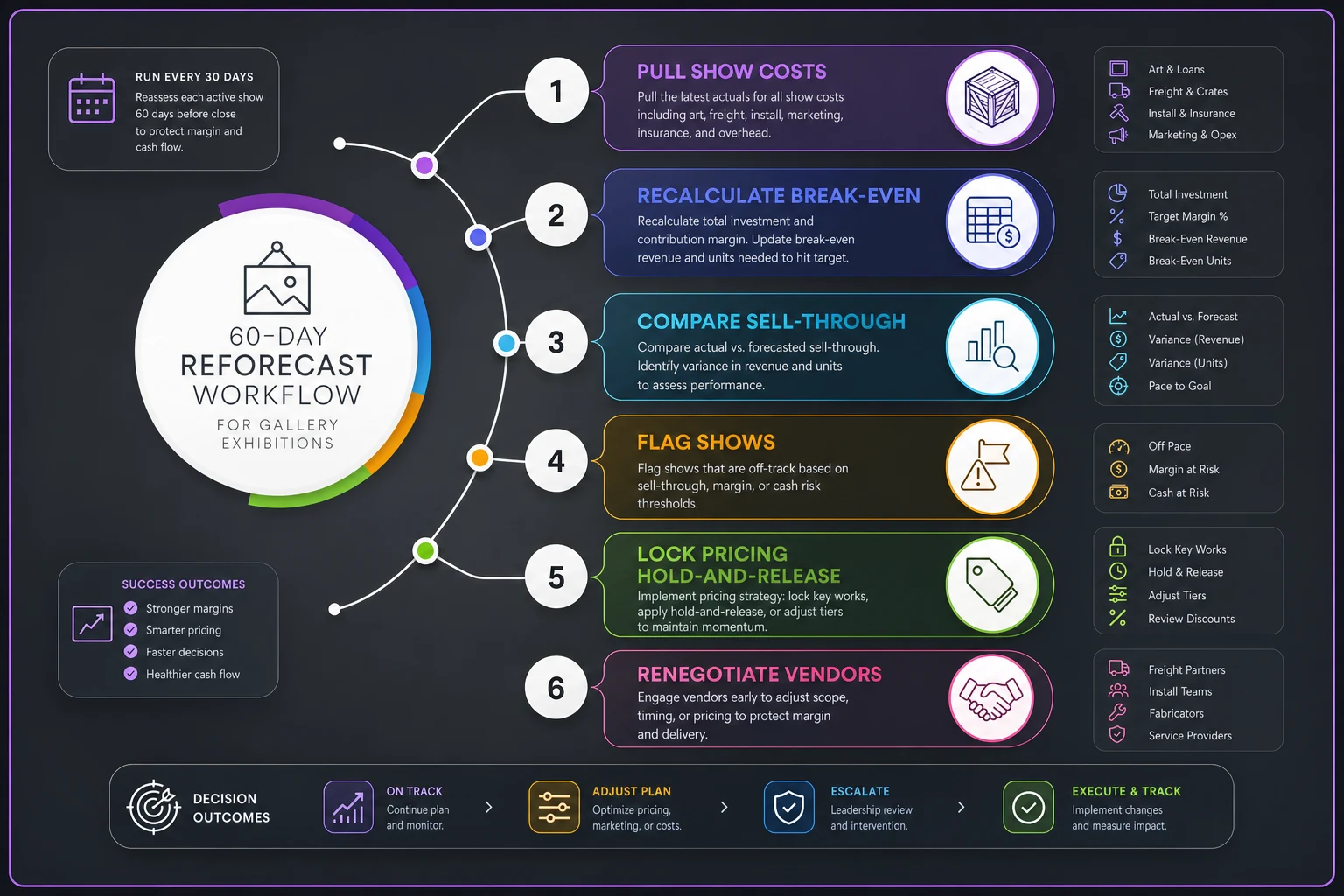
This is the part to actually do, not just read. Run it in order — each step feeds the next.
-
Pull your next three confirmed shows and re-cost every direct line. Get fresh quotes on crating and handling specifically. Don't trust spring numbers. This usually takes an afternoon and surfaces most of the drift immediately.
-
Recalculate break-even for each show using the new costs. You're looking for the number of sales — or the single hero-piece sale — that gets you to zero. Write it down per show.
-
Compare the new break-even to realistic sell-through. If a show now needs to sell four works to break even and you've historically sold two per show of that type, you have a problem to solve now, not in six weeks.
-
Flag shows where the gap is unrecoverable through sales alone. Those need a cost change, not a sales pep talk.
-
Lock a hold-and-release rule for pricing. Decide in advance how long a piece stays at list before any negotiation, and what your floor is. Don't improvise this at the opening when a collector is standing in front of you.
-
Renegotiate one vendor relationship. Usually shipping or framing. Volume commitments, off-peak scheduling, or bundling multiple shows into one freight run can claw back real money.
Here's a quick visual of the sequence.
The galleries that handle cost shocks well aren't the ones with the biggest cushion. They're the ones who notice the drift in week two instead of at year-end reconciliation.
Pricing moves that don't cheapen the program
There's a reflex, when margins tighten, to discount harder to move inventory. That's usually the wrong lever — especially when consumer spending is still holding. Buyers aren't absent, they're just more deliberate.
A few adjustments that protect margin without starting a race to the bottom:
-
Tighten your discount authority. Decide who can approve what. A loose "sure, we can do 10%" culture at the front of house leaks more margin than any freight increase.
-
Price the show, not just the pieces. Build the cost drift into your list prices for new work going forward rather than eating it on the back end. A modest, consistent list adjustment is invisible to collectors and recovers the margin cleanly.
-
Lead with your strongest works. When buyers are selective, a show carried by one or two hero pieces reaching break-even beats hoping for broad sell-through. Hang and promote accordingly.
-
Keep a documented floor per work. Not a public number — an internal line you won't cross. This stops the slow erosion that happens when every sale involves a slightly bigger concession than the last.
Confusing "the environment is tough" with "I need to discount" is a common mistake. Discipline reads as confidence. Panic discounting reads as a gallery that doesn't believe in its own program — and collectors notice.
Inventory and programming: shift the mix, not the quality
When logistics costs lead the increases, the smart operational response is to lean temporarily toward programming that's light on freight and heavy on what you already have on hand.
In practice:
-
Prioritizing local and regional artists for the next cycle, cutting round-trip international shipping entirely on a show or two.
-
Pulling forward works already in your inventory or on local consignment rather than booking new inbound loans.
-
Favoring formats that ship flat or small over large, crate-intensive installations for the near term.
-
Getting your online viewing room genuinely sale-ready so you can convert remote interest without the cost of physically moving everything.
This isn't a permanent shrinking of ambition. It's a season of choosing shows where the cost structure is on your side while input prices are elevated. You can absolutely return to the ambitious international loan once the crate quotes calm down.
When this makes sense — and when it doesn't
Leaning into low-capex local programming is the right call when your reforecast shows multiple near-term shows with unrecoverable break-even gaps, and when you have strong local or in-inventory work you can actually build around.
It's a bad idea if you have a signed, anchor international show that's central to your reputation or already pre-sold. Don't blow up a strategically important exhibition to save freight money — protect it by cutting cost elsewhere instead.
And it's genuinely the wrong move if your gallery's entire positioning depends on international programming and your collectors come specifically for that. In that case the answer is margin recovery through pricing and vendor terms, not changing what you show.
A realistic scenario
Consider a two-person contemporary gallery doing six to eight shows a year, running roughly $45k–$55k in annual exhibition direct costs. Going into fall they had three shows booked, all costed in the spring.
When they re-quoted, the pattern from the table above showed up almost exactly — around 11% average drift across the three shows, about $3,000 in unplanned cost spread across them. Their typical per-show margin was thin enough that this would have erased the profit on one of the three entirely.
What they did: re-costed all three, found the third show — an inbound loan-heavy group exhibition — was the worst offender, and swapped it for a show built from two local artists already in regular contact with the gallery. That one move cut their inbound freight for the quarter substantially. On the two remaining shows they nudged list prices on new work up a few percent and tightened discount approval to the owner only.
The outcome wasn't dramatic. They didn't triple sales. They held their margin roughly flat against a season that would otherwise have cost them a show's worth of profit — and they did it without discounting or cutting staff hours. That's what winning looks like in this environment: not growth, but margin that doesn't quietly leak away.
The habit worth keeping
The real lesson from a "costs up, rates flat" moment isn't about any single show. It's that a one-time budget is a liability whenever conditions move, and conditions are moving. The galleries that come through fine are the ones that build a quick re-costing step into their exhibition workflow permanently — a 30-minute re-quote and break-even check before every show gets final sign-off.
Block a recurring 30-minute slot on the calendar before each show for a quick re-quote and break-even check.
Do that, keep your pricing discipline, and stay flexible on which shows you commit to while input costs are elevated. The financing environment isn't going to rescue a weak exhibition right now, so the discipline has to live in your operations. That's not a bad place for it anyway — it was always the more reliable one.
Do that, keep your pricing discipline, and stay flexible on which shows you commit to while input costs are elevated. The financing environment isn't going to rescue a weak exhibition right now, so the discipline has to live in your operations. That's not a bad place for it anyway — it was always the more reliable one.
Ready to elevate your gallery operations?
Join 500+ galleries using Artioly to streamline operations, boost visitor engagement, and increase art sales.