


Most galleries treat walk-ins like museum visitors instead of potential buyers. The difference between a gallery generating $15k monthly versus $45k monthly often comes down to what happens in those first 90 seconds after someone walks through the door.
Gallery sales aren't like retail. A visitor might spend 20 minutes with a single piece, leave without saying much, then come back three weeks later ready to drop $8,000. Or they walk in during lunch, fall in love with something, and need to complete the purchase in under ten minutes. Your gallery sales conversion flow needs to handle both scenarios — plus everything in between.
The gap between galleries converting 2% of visitors versus 8–12% usually comes down to three things: how staff engage without being pushy, how pricing flows through the conversation, and how smoothly the gallery handles the messy reality of art transactions — holds, payment plans, shipping quotes, authentication documents.
Why galleries lose sales at the front desk
Walk into most small galleries on a Saturday afternoon. The person at the desk might be an intern, a part-time assistant, or the gallery director juggling three conversations at once. Someone asks about a price. The staff member checks a binder, logs into a system, or texts the director. By the time they have an answer, the visitor has mentally moved on.
This happens because most galleries assume serious buyers will always identify themselves. They won't. A collector with a $50k annual art budget might walk in wearing sneakers and barely make eye contact. Meanwhile, someone who talks at length about their collection might never buy anything.
-
Pricing scattered across spreadsheets, artist agreements, and someone's memory
-
No reliable way to capture visitor information without feeling intrusive
-
Payment processes that require multiple touchpoints and manual coordination
-
Hold policies that exist only in the director's head
When your gallery sales conversion flow depends on institutional knowledge rather than actual systems, every staff change becomes a revenue risk. Every busy Saturday becomes a stress test of whether the right information reaches the right person at the right moment.
The greeting framework that reads the room
The 15-second assessment Before approaching, staff observe. Is the visitor:
Never miss a key exhibition detail again.
Artioly helps you organize, promote, and manage every exhibition effortlessly.
- Unified exhibition scheduling
- Artist and visitor notifications
- Inventory and sales tracking
No credit card required
-
Moving quickly through the space (tourist mode)
-
Focused on specific pieces (potential interest)
-
Reading wall labels carefully (information gathering)
-
Taking a lot of photos (social media or a remote buyer)
Tier 1: Light touch (most visitors) "Feel free to explore. The current exhibition is [artist name]'s recent work. I'm around if you have questions."
Tier 2: Engaged interest (visitor spending 3+ minutes with specific works) "That piece has an interesting backstory — [one compelling detail]. Are you familiar with the artist?"
Tier 3: Buying signals (asking about specifics, returning to the same piece, bringing someone else over to look) "I can walk you through more on that piece — availability, pricing, all of it. Would that be useful?"
The framework adapts. Someone might jump from Tier 1 to Tier 3 in five minutes, or stay at Tier 1 for their whole visit. Both are fine. Staff aren't guessing — they're responding to what's actually in front of them.
Pricing transparency without killing the moment
What kills sales is making pricing feel like a negotiation before the buyer has fallen in love with the work. But opacity doesn't work either. People need to know if they're in the right ballpark before they let themselves get attached.
Graduated pricing disclosure handles this:
Phase 1: Range indication When someone shows interest but hasn't asked directly: "The works in this series run from about $3,000 to $12,000 depending on size and medium."
Phase 2: Specific pricing with context When asked directly: "This one is $7,500. That includes the frame and certificate of authenticity. We can also talk through installation if you're local."
Phase 3: Payment flexibility Before they can raise an objection: "We work with collectors at different stages. Payment plans are available, and we can hold pieces for up to 30 days with a deposit."
For this to work, every staff member needs instant access to current pricing for all displayed works, available payment options, hold policies and procedures, and any special considerations — artist pricing changes, upcoming shows, pieces already on reserve. That information can't live in one person's head or on one computer. It needs to be accessible from a phone, a tablet, wherever someone is standing when the question comes up.
Payment flows that don't break momentum
The moment someone decides to buy is fragile. Every friction point — every "let me check on that," every form, every system that takes a minute to load — risks breaking the decision.
Standard gallery transaction:
-
Buyer expresses interest
-
Gallery takes contact info
-
Invoice created (often later, sometimes much later)
-
Email sent with payment instructions
-
Payment processed by wire, check, or card
-
Confirmation sent
-
Pickup or delivery arrangements made separately
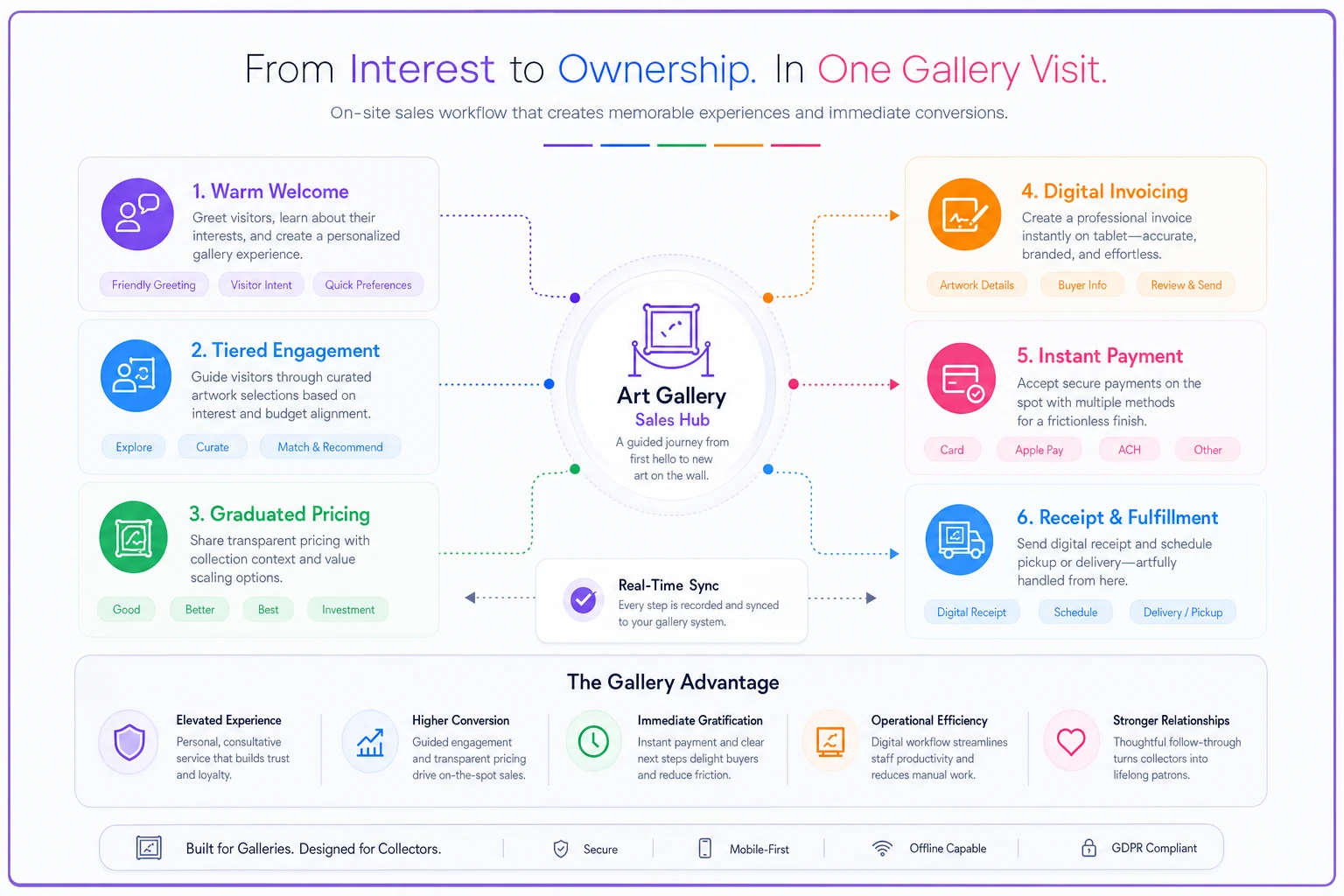
Optimized gallery sales conversion flow:
-
Buyer expresses interest
-
All options presented immediately via tablet or phone — pay in full now, put down a deposit, set up a payment plan
-
Digital invoice generated on the spot with full terms
-
Payment processed immediately
-
Digital receipt with clear next steps
-
Calendar booking for pickup or delivery offered before they leave
The difference: the optimized flow happens in one conversation, often under five minutes. The standard flow requires multiple touchpoints spread across days.
Here's a visual of the optimized flow.
One gallery in Seattle reorganized their payment process and saw transaction completion rates climb from around 60% to 85%. The main change was stopping the practice of sending invoices later and processing everything during the visit.
Hold policies and reservation handling
Holds are where galleries quietly bleed revenue. Someone puts a piece on hold, it gets marked as unavailable, and then nothing happens. The piece sits while other interested buyers get turned away.
The 72-hour soft hold
-
No deposit required
-
Piece marked as "on reserve," not unavailable
-
Automatic follow-up at 24, 48, and 72 hours
-
Other interested buyers can join a waitlist
-
Hold expires after 72 hours unless a deposit is received
The 30-day committed hold
-
Requires 25% deposit
-
Piece marked unavailable
-
Payment plan terms locked in
-
Automatic reminders for balance due
-
Clear terms for non-completion — deposit retained minus a handling fee
The collection hold
-
For buyers taking multiple pieces
-
Works held together until full payment
-
Special terms for established collectors
Every hold needs a start date, expected resolution date, verified contact info, a follow-up schedule, and documented next steps. Sticky notes and memory don't cut it. It needs systematic tracking — with reminders and escalation built in.
Buyer data that drives future sales
Every gallery says they have a collector database. Most actually have a messy spreadsheet with outdated emails and notes like "likes blue paintings."
Layer 1: Basic contact (every visitor who engages)
-
Name and email
-
How they heard about the gallery
-
General interest areas
-
Opted in for updates
Layer 2: Behavioral data (tracked automatically)
-
Which pieces they spent time with
-
Price ranges they asked about
-
Questions and objections they raised
Layer 3: Transaction data (for buyers)
-
Purchase history with amounts
-
Payment preferences
-
Shipping and delivery needs
-
Collection focus
Layer 4: Relationship data (built over time)
-
Other galleries they work with
-
Artists they collect
-
Upcoming needs — new home, office, a gift
-
Personal preferences around framing, hanging, lighting
The curation metrics approach discussed previously feeds directly into this. When you understand which exhibitions attract which collector segments, you can build more targeted conversion flows from the start.
Small team implementation
For galleries with 2–5 staff, a comprehensive gallery sales conversion flow can feel like too much. Start here:
Week 1–2: Information accessibility Get pricing, availability, and hold status into one shared place everyone can pull up from their phone. Google Sheets works at first, though you'll outgrow it.
Week 3–4: Greeting framework training Practice the three-tier model during slow periods. Role-play different visitor types. The goal isn't perfection — it's consistency.
Week 5–6: Payment streamlining Set up mobile card processing and digital invoicing. Build templates for common transactions. Remove every unnecessary step between "I want to buy this" and "transaction complete."
Start with one shared mobile document for pricing and holds to reduce mid-conversation check delays.
Small galleries often skip systemization because they think they need expensive gallery software. They don't. A gallery doing $30k monthly can run solid operations with basic digital tools as long as the workflows are actually designed.
Measuring what drives sales
Track these weekly:
| Metric | Healthy Range |
|---|---|
| Engagement rate (engagements ÷ visitors) | 20–30% |
| Inquiry conversion (inquiries ÷ engagements) | 40–50% |
| Hold conversion (sales ÷ holds) | 60–70% |
| Overall conversion (sales ÷ visitors) | 5–10% |
Ratios matter more than raw numbers. If your numbers are well below these ranges, the bottleneck is usually in one of three places: the greeting approach, pricing transparency, or transaction friction. Raw visitor counts tell you almost nothing on their own.
When AI automation amplifies conversion
The operational complexity of running a gallery — tracking holds, managing follow-ups, coordinating payment plans, maintaining buyer data — creates friction that quietly suppresses conversion rates. This is where AI-powered operational software earns its place.
Instead of staff manually tracking hold expirations, automated systems monitor timelines and trigger follow-ups. Rather than hunting through spreadsheets for pricing mid-conversation, the right information surfaces instantly. Payment plan calculations, shipping quotes, availability checks — these stop requiring a trip to the back office.
The point isn't replacing human interaction. Galleries are relationship businesses. The point is freeing staff from administrative tasks so they can focus on what actually requires a person: reading the room, sharing context about the work, building collector relationships over time.
A well-implemented operational platform with AI automation typically helps galleries reduce time-to-quote from hours to seconds, improve hold conversion through consistent follow-up, capture more meaningful buyer data without additional effort, and process transactions faster with fewer errors. Better data capture improves future targeting. Automated follow-ups prevent deals from dying in the gap between visits. The whole conversion flow becomes more self-reinforcing over time.
Building conversion momentum
Gallery sales aren't about aggressive selling. They're about removing friction from the natural process of falling in love with a piece of art and taking it home.
Every operational improvement — faster pricing access, smoother payment processing, consistent hold follow-up — removes a potential breaking point in the buyer journey. Galleries that systemize their front-of-house operations don't just increase sales. They create better experiences for both visitors and staff.
Start with the greeting framework. Get pricing flowing to the right people at the right moment. Streamline your payment process. Build from there. Galleries consistently converting 8–12% of visitors aren't doing anything magical — they've just removed the operational obstacles that stop interested visitors from becoming buyers.
The gallery that treats operational excellence as seriously as curatorial excellence is the one that holds up, regardless of market conditions or foot traffic. Your gallery sales conversion flow isn't just about processing transactions. It's about building the conditions where art and collectors actually connect.
Gallery sales aren't about aggressive selling. They're about removing friction from the natural process of falling in love with a piece of art and taking it home.
Every operational improvement — faster pricing access, smoother payment processing, consistent hold follow-up — removes a potential breaking point in the buyer journey. Galleries that systemize their front-of-house operations don't just increase sales. They create better experiences for both visitors and staff.
Start with the greeting framework. Get pricing flowing to the right people at the right moment. Streamline your payment process. Build from there. Galleries consistently converting 8–12% of visitors aren't doing anything magical — they've just removed the operational obstacles that stop interested visitors from becoming buyers.
The gallery that treats operational excellence as seriously as curatorial excellence is the one that holds up, regardless of market conditions or foot traffic. Your gallery sales conversion flow isn't just about processing transactions. It's about building the conditions where art and collectors actually connect.
Ready to elevate your gallery operations?
Join 500+ galleries using Artioly to streamline operations, boost visitor engagement, and increase art sales.