

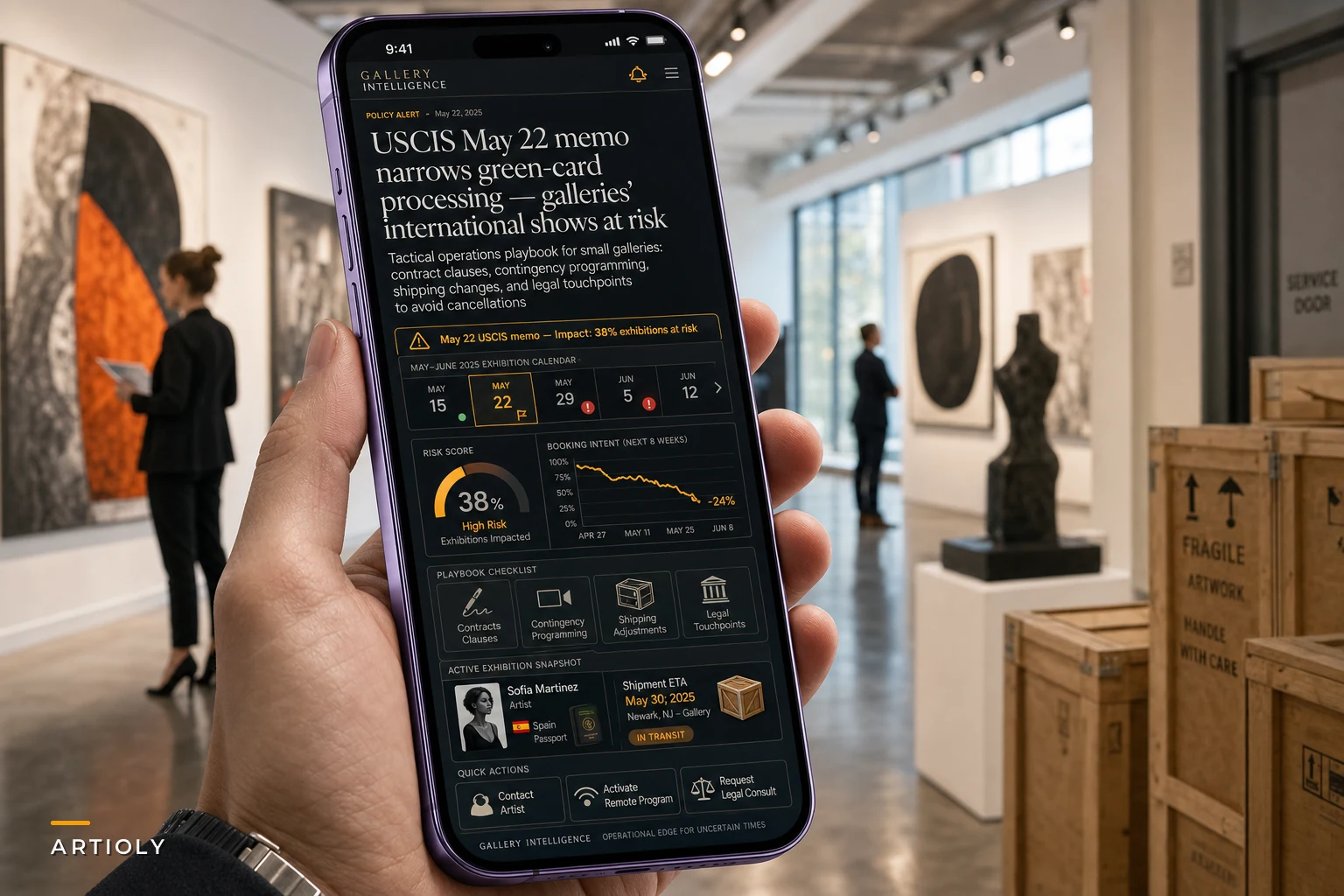
Last week, USCIS announced they'll restrict adjustment of status to only "extraordinary circumstances," forcing most green card applicants to leave the U.S. for consular processing. If you're running a gallery that brings international artists for exhibitions, residencies, or collaborations, your exhibition calendar just became completely unpredictable.
The problem goes way beyond visa delays. Artists currently in the U.S. on temporary visas — your O-1B holders, your J-1 exchange visitors — now face a much harder path to extend their stays or transition to permanent status. That sculptor from Seoul who's halfway through a six-month installation? That painter from Lagos whose solo show opens in September? They might need to leave the country mid-project.
What breaks when artists can't stay
A gallery director in Chelsea recently told me about their spring 2025 exhibition lineup. Three of their five featured artists are international, two on O-1B visas. Under the old system, those artists could potentially adjust status while continuing their work. Now each artist needs contingency plans that the gallery has to coordinate.
An artist on a temporary visa gets word their adjustment application will require consular processing abroad. They need to leave the U.S., potentially for months. Your gallery now manages:
-
Contract renegotiation for delayed deliverables
-
Insurance adjustments for works in progress
-
Storage costs for incomplete installations
-
Rescheduling of artist talks, workshops, and collector meetings
-
Communication with lenders who expected the artist present for installation
-
Backup programming to fill suddenly empty calendar slots
The real killer is timing uncertainty. Consular processing can take anywhere from three months to over a year, depending on the embassy and country. You can't hold a gallery schedule hostage to State Department processing times.
The hidden operational load most galleries miss
Beyond the obvious scheduling chaos, this USCIS shift creates documentation nightmares most galleries aren't equipped to handle. Every international artist collaboration now needs:
Enhanced contract architecture Standard gallery agreements assume artist availability. Now you need force majeure clauses specifically addressing visa delays, clear ownership terms for incomplete works, and milestone-based payment structures that account for potential artist absence.
Visitor program restructuring Those artist-led workshops and curator talks you use to drive foot traffic? Each one needs a Plan B facilitator. One gallery in Miami started requiring all international artists to pre-record workshop content and identify local artist proxies who can step in.
Shipping and customs contingencies When an artist can't be present for customs inspections or installation, someone needs power of attorney. Shipping insurance needs adjustment. Crating instructions become critical when the artist won't be there to supervise unpacking.
Building visa-resilient exhibition operations
The galleries that survive this shift are already adapting their workflows. What's actually working:
Phase-gated project planning
-
Remote feasible phase (3-4 months before opening) - Concept development - Digital mockups and planning - Remote studio visits via video - Catalog essay development
-
Critical presence phase (4-6 weeks) - Physical installation - Opening events - Collector meetings - Press interviews
-
Post-opening phase (ongoing) - Sales support (can be remote) - Conservation guidance - Deinstallation planning
This structure lets you compress the required U.S. presence into shorter, more predictable windows that align with visa limitations.
A visual workflow of the phase-gated planning process:
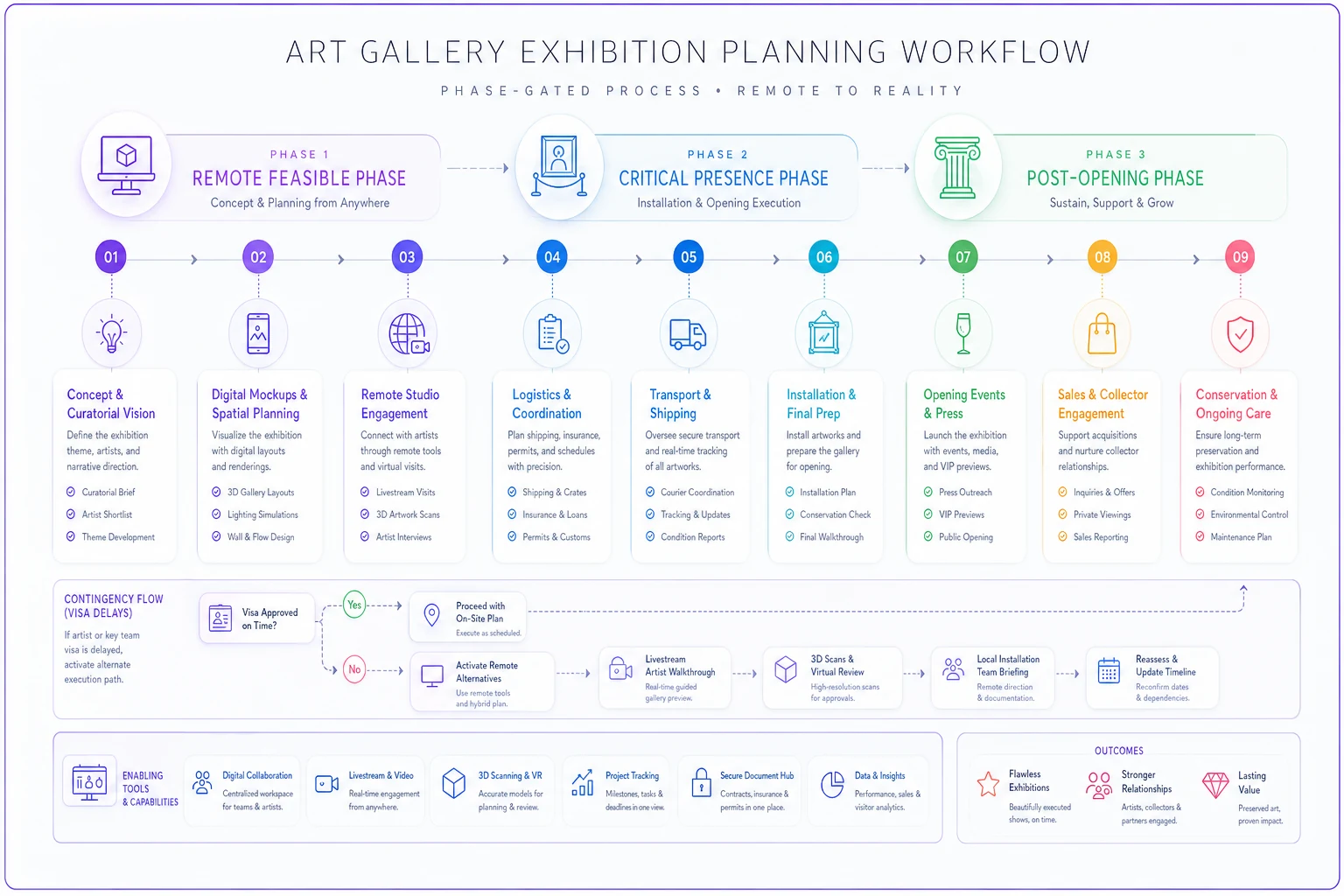
Use this as a planning reference when scheduling international artists.
Digital-first documentation workflows
-
3D gallery scans shared with artists for remote installation planning
-
Video walkthroughs replacing in-person site visits
-
Digital condition reporting with timestamped photo documentation
-
Remote installation supervision using livestream setups
The upfront technology investment (roughly $12k for scanning equipment and software) paid for itself when they successfully mounted an exhibition with the artist stuck in Berlin for three extra months.
The galleries that survive visa disruptions have what I call "continuation rights" built into their contracts. If an artist can't complete work due to visa issues, the gallery gains expanded rights to:
-
Complete installation using artist-provided instructions
-
Make curatorial decisions about work placement
-
Authorize conservation or modification
-
Represent the artist in sales discussions
Without these rights, a half-installed exhibition becomes a legal nightmare.
When to redesign your entire international program
Some galleries are better off fundamentally restructuring how they work with international artists. The decision usually comes down to three factors:
| Factor | Keep current model | Restructure operations |
|---|---|---|
| International artist percentage | Under 30% of exhibitions | Over 50% of exhibitions |
| Average project timeline | 6 months or less | 8+ months |
| Revenue per international show | Over $150k | Under $75k |
If you're in the restructure column, consider:
Shift to touring exhibitions Partner with international galleries to bring complete exhibitions rather than commissioning new work. The operational complexity moves to the partner institution.
Digital-first exhibitions Not just virtual galleries, but exhibitions where physical presence enhances but isn't essential to the work. One gallery now requires all international artists to create works that can be fabricated locally from detailed instructions.
Regional artist networks Instead of flying artists from their home countries, work with international artists already based in North America on more stable visa categories.
Most galleries don't realize how visa limbo creates daily operational friction until they're in the middle of it.
The coordination nightmare nobody talks about
What actually breaks galleries isn't the big visa denial — it's the slow coordination decay when artists are in visa limbo.
You're managing an exhibition opening in October. The featured artist, based in Istanbul, has been in the U.S. on an O-1B coordinating with your preparators. According to Forbes analysis, they now need to return to Turkey for adjustment of status processing.
The daily operational friction:
-
7-hour time zone differences for every decision
-
Preparators waiting for artist approval on hanging decisions
-
Marketing team unable to schedule artist interviews
-
Collectors expecting studio visits that can't happen
-
Educational programs losing their workshop leader
Each delay cascades. The preparators work overtime (increased labor costs). Marketing pivots to less compelling content (reduced attendance). Collectors get frustrated (damaged relationships).
This is where operational software becomes critical — not as a magic solution, but as infrastructure for managing complexity. When you're coordinating between artists in multiple countries, freight forwarders, insurance agents, and installation teams, centralized project management isn't optional anymore.
Protecting your gallery's exhibition pipeline
The galleries adapting fastest to these USCIS changes share three operational characteristics:
1. They document everything obsessively Every artist interaction, every installation decision, every shipping update gets logged in a central system. When visa issues force personnel changes, the institutional knowledge survives.
2. They build redundancy into creative decisions Major curatorial choices happen early when the artist is definitely available. Minor adjustments have pre-approved parameters that staff can execute without artist presence.
3. They treat visa status as an operational metric Just like you track sales pipeline or visitor numbers, successful galleries now track visa expiration dates, application statuses, and processing times as KPIs.
These galleries aren't just surviving the new reality — they're finding competitive advantages.
The uncomfortable reality about international exhibitions now
This USCIS policy shift isn't temporary turbulence — it's the new operating environment. Galleries that pretend otherwise will find themselves constantly in crisis mode.
The successful response isn't to stop working with international artists. It's to build operations that assume visa complications as the default, not the exception. This means:
-
Longer lead times (12-18 months instead of 6-8)
-
Higher operational budgets (legal fees, travel costs, contingency programming)
-
More complex contracts and documentation requirements
-
Investment in remote collaboration infrastructure
-
Detailed succession planning for every role an artist fills
For smaller galleries, this might mean fewer but deeper international collaborations. Instead of bringing five artists for short residencies, bring one for a properly supported extended project with full visa sponsorship and legal support.
The galleries that move fast have an advantage while competitors scramble.
Your next 90 days
Your immediate priorities:
Audit current commitments List every international artist with upcoming exhibitions or projects. Check their current visa status and expiration dates. Identify who needs adjustment of status in the next 12 months.
Revise your contracts Add visa contingency clauses to all new agreements. For existing contracts, negotiate addendums that address the changed circumstances.
Build your bench Identify local artists who can serve as backups or collaborators. Create relationships with immigration attorneys who understand artist visas. Develop partnerships with galleries in other countries for reciprocal support.
Document your workflows Map out every touchpoint where an artist's physical presence is currently required. For each one, develop a remote alternative or delegate protocol.
Communicate transparently Tell your international artists about these changes now. Provide resources and support. The galleries that help their artists navigate this maintain the strongest relationships.
The USCIS adjustment of status restrictions fundamentally change how galleries operate international programs. But galleries are adaptable. The ones that build robust operational systems — combining clear documentation, smart contracts, and strategic contingency planning — will continue bringing incredible international art to American audiences.
The operational burden is real. The costs are higher. The timelines are longer. But the galleries that figure this out won't just survive — they'll have a competitive advantage in accessing international talent while others retreat to safe, local-only programming.
The galleries thriving despite these changes aren't the ones with the biggest legal budgets or the most connections. They're the ones who rebuilt their operations to assume complications as standard, then built systems to handle them smoothly. That's not just good crisis management. It's how modern galleries need to operate.