



You know that sinking feeling when a collector walks away from a piece you priced at $12,000, then comes back two hours later to buy your $3,500 work instead? That gap between what you think something's worth and what the market will bear is where most galleries bleed money.
Galleries without a structured pricing framework leave somewhere between 15% and 40% on the table. Not because they're greedy or naive—because pricing art feels impossible when every piece is unique, every artist has different expectations, and every collector negotiates differently.
The real issue isn't confidence or market knowledge. It's that most galleries price reactively—adjusting numbers based on gut feel, recent sales, or whatever the artist suggests. That inconsistency is something experienced collectors pick up on immediately. When pricing feels arbitrary, negotiations get brutal, and you end up defending numbers you can't really explain.
Why traditional gallery pricing breaks down
Most galleries inherit their pricing approach from whoever trained them. Usually that means some combination of:
-
Artist sets a number, gallery adds commission
-
Look at similar works that sold recently
-
Start high for new artists, adjust based on sales
-
Different rules for different media
-
Panic adjustments when things don't move
This patchwork approach creates operational chaos. Your team can't explain pricing consistently. Artists get confused about why similar pieces have different prices. Collectors lose trust when they sense the numbers are made up on the spot.
The bigger problem happens at scale. When you're managing 20 artists with 300+ works in inventory, inconsistent pricing becomes a coordination nightmare. Staff spend hours in pricing meetings. Artists complain about favoritism. The whole system ends up depending on one or two people who "just know" what things should cost—which is a fragile way to run a business.
What works is a rule-based matrix that removes emotion from the equation. Not a rigid formula that ignores market reality, but a framework flexible enough to handle singles, editions, prints, and commissions while staying consistent enough that collectors can understand it.
Building your cost foundation layer
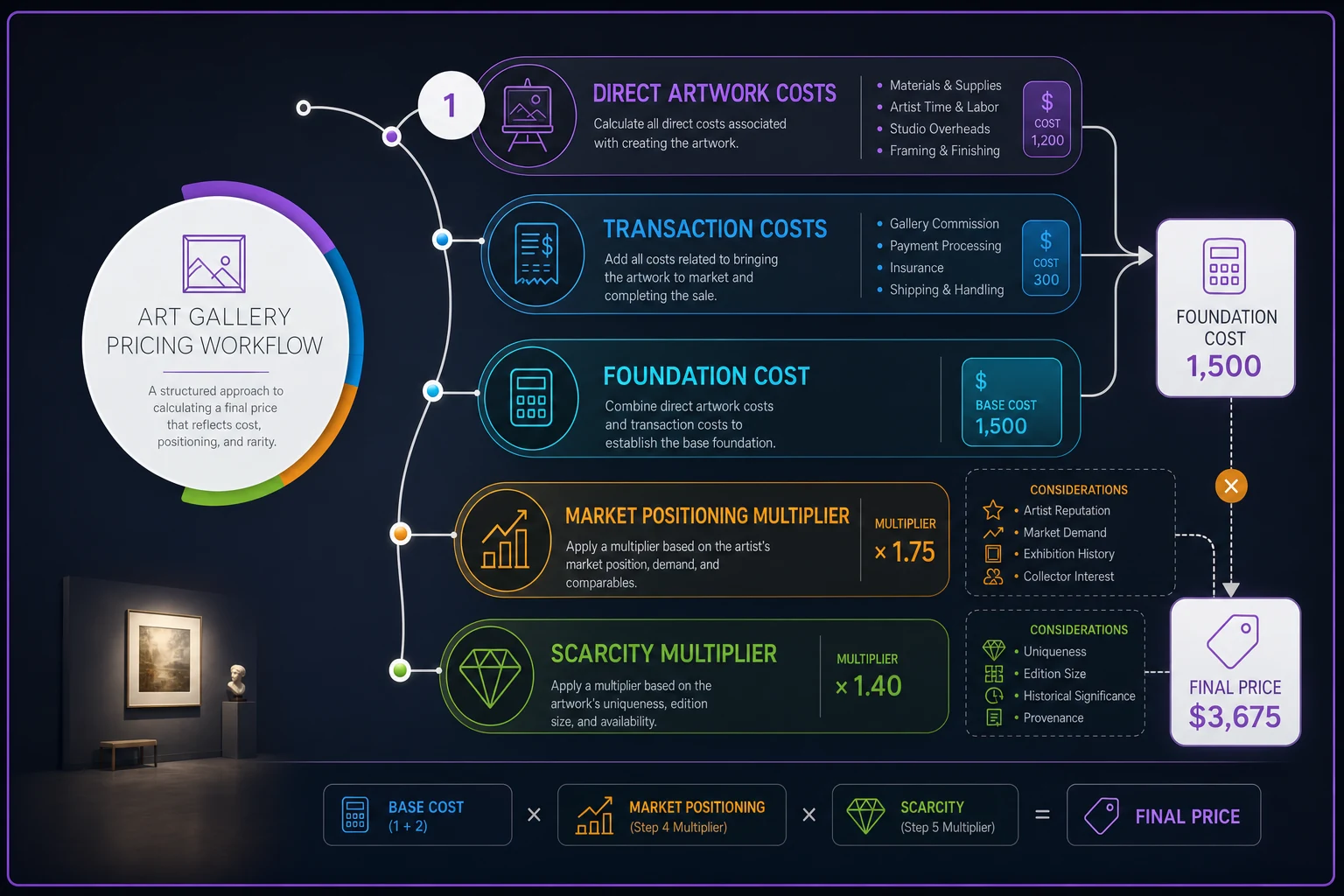
Before touching market factors or scarcity rules, you need a clear cost foundation. This isn't just materials and framing—it's the true operational cost of bringing work to market.
Start with direct artwork costs:
-
Materials (at actual purchase price, not list)
-
Framing and mounting
-
Photography and documentation
-
Storage allocation (monthly cost × expected hold time)
-
Insurance during inventory period
-
Shipping from artist studio
Then add transaction costs:
-
Payment processing (usually 2.9% + $0.30)
-
Packaging materials
-
Delivery or shipping to buyer
-
Installation support if offered
-
Any restoration or conservation needed
For a typical $8,000 painting, your real costs might look like:
| Item | Amount |
|---|---|
| Materials claimed by artist | $400 |
| Framing | $650 |
| Photography | $125 |
| Storage (6 months) | $90 |
| Insurance | $48 |
| Inbound shipping | $185 |
| Payment processing | $232 |
| Packaging | $45 |
| Local delivery | $125 |
Total foundation cost: $1,900
Track storage allocation per work monthly to avoid underestimating hold costs.
That's your absolute floor. Selling below this means you're paying to move inventory.
Here's a quick visual workflow of how to compile foundation costs into a pricing floor.
That's your absolute floor. Selling below this means you're paying to move inventory.
Market positioning rules that reflect reality
Cost foundation gives you a floor, but market position determines your ceiling. This is where most galleries get tangled up in subjective judgments.
A workable framework uses three market indicators:
Recent comparable sales (40% weight)
-
Look at actual transactions, not asking prices. Pull data from
-
Your own sales in the past 18 months
-
Regional auction results for similar works
-
Verified gallery sales when you can get them
-
Online marketplace transactions
Artist trajectory (35% weight)
-
Exhibition history (solo shows worth more than group)
-
Collection placements (museums > corporate > private)
-
Press coverage quality, not just quantity
-
Award recognition
-
Gallery representation history
Local market capacity (25% weight)
-
Average transaction value in your market
-
Collector density in your area
-
Competition from other galleries
-
Economic indicators specific to your region
For that $8,000 painting example:
-
Comparables suggest a $6,500–$9,500 range
-
Artist has strong regional presence, emerging nationally
-
Local market supports this price point
This gives you a market-justified range of $7,000–$9,000.
Scarcity multipliers for different work types
Scarcity rules operate differently across work types. Original single works follow different logic than editions or prints.
Original single works:
-
Base multiplier
1.0x
-
Artist produces fewer than 10 works annually
1.3x
-
Final work in a series
1.2x
-
Artist is deceased
1.5x–2.0x
-
Work has exhibition history
1.15x
-
Work has publication history
1.1x
Limited editions:
-
Base multiplier starts at 0.7x of original value
-
Edition of 3–5
0.7x
-
Edition of 6–10
0.5x
-
Edition of 11–25
0.35x
-
Edition of 26–50
0.25x
-
Edition over 50
0.15x
Then adjust for position in edition:
-
First 20% of edition
full multiplier
-
Middle 60%
0.9x
-
Final 20%
1.1x
-
Artist proofs
1.25x
Prints (non-unique):
-
Start at 0.1x of original work value
-
Signed and numbered
1.5x base
-
Estate stamped
1.2x base
-
Poster reproductions
0.5x base
-
Limited availability (under 100)
1.3x
-
Open edition
0.8x
Commissioned works:
-
Base at 1.2x of a similar non-commissioned work
-
Approval rounds required
add 10% per round
-
Specific size requirements
add 15%
-
Specific color or theme requirements
add 10%
-
Rushed timeline under 6 weeks
add 25%
-
Installation included
add actual cost + 20%
Commissioned works:
Worked examples across scenarios
Scenario 1: Emerging artist, original painting
Cost foundation:
-
Materials (artist)
$325
-
Framing
$475
-
Documentation
$125
-
Storage (est. 4 months)
$60
-
Insurance
$30
-
Shipping from studio
$85
-
Transaction costs (est.)
$145
Total base: $1,245
Market position:
-
Recent comparables
$3,500–$4,500
-
Artist showing upward trajectory
-
Local market strong for emerging work
Market range: $3,800–$4,200
Scarcity factors:
-
Artist produces roughly 15 works per year
1.0x
-
Part of new series (3 of 8)
1.0x
-
No special factors
Final price: $4,000
Scenario 2: Established artist, limited edition
Cost foundation per edition:
-
Casting and finishing
$3,200
-
Base and mounting
$450
-
Documentation
$200
-
Storage
$150
-
Insurance
$270
-
Shipping
$320
Total base: $4,590
Edition pricing:
-
Original value
$45,000
-
Edition of 8 multiplier
0.55x
-
Base edition price
$24,750
Position in edition:
-
This is #3 of 8 (early-middle)
1.0x
Final price: $24,750
Scenario 3: Commissioned portrait
Base pricing from similar non-commissioned works: $12,000
Commission adjustments:
-
Base commission multiplier
1.2x = $14,400
-
Two approval rounds
+10% = $1,440
-
Specific requirements
+10% = $1,440
-
Normal timeline
no adjustment
Subtotal: $17,280
Additional costs:
-
Travel for sittings
$650
-
Extra documentation
$200
Final commissioned price: $18,000 (rounded)
Negotiation scripts that protect your framework
Even with clear pricing rules, you need scripts for common negotiation scenarios. Turning openings into sales requires consistent messaging about value, and pricing conversations are where that consistency matters most.
Script 1: "Can you do better on price?"
"I understand price is always a consideration. This piece is priced based on [artist's] current market position and the specific qualities of this work—specifically [size, complexity, series position]. What I can offer is our payment plan option, which spreads this over 4 months with no interest. Would that help make it work?"
Script 2: "I saw similar work for less at [other gallery]"
"Pricing can definitely vary between galleries. Ours reflects not just the work itself but the full support system—conservation-quality framing, detailed documentation for your collection records, and our ongoing relationship with the artist for any future needs. That said, I'd want to make sure we're comparing similar pieces. Same size and medium? Same period in their career?"
Script 3: "Would the artist accept less?"
"Our pricing is set collaboratively with the artist based on their current market and career trajectory. Accepting less would actually hurt their market—and the value of any work you already own by them. What I can do is check whether they have any studies or works on paper in a more comfortable price range."
Script 4: "I'm buying multiple pieces"
"That's great. While individual piece pricing stays firm to protect market values, I can help with the logistics—consolidated shipping, staggered payment timing, or finding complementary pieces within your total budget. Which works are you considering?"
Resale guidance rules
When collectors come back to resell, your pricing framework needs clear rules that protect both gallery relationships and market values.
For works originally sold by your gallery:
Calculate resale price as:
-
Original sale price × time multiplier × condition factor
Time multipliers:
-
Less than 2 years
0.9x (discourages flipping)
-
2–5 years
1.0x–1.2x
-
5–10 years
1.2x–1.8x
-
Over 10 years
Requires new market analysis
Condition factors:
-
Excellent/as sold
1.0x
-
Minor issues (needs cleaning)
0.95x
-
Visible wear (needs restoration)
0.85x
-
Significant damage
Individual assessment
Your commission on resale:
-
Standard
40% (you're carrying inventory risk)
-
Consignment: 25–30%
-
Brokered (no inventory)
20%
For works bought elsewhere:
Start with a current market analysis, then apply:
-
Authentication verified
Proceed with pricing
-
Provenance complete
Full market value
-
Provenance gaps
Reduce 20–30%
-
Condition issues
Reduce accordingly
Never accept for resale:
-
Works with attribution questions
-
Pieces with unresolved ownership claims
-
Anything requiring expensive restoration
-
Works by artists you don't represent without their permission
Never accept for resale:
Technology integration for pricing consistency
Managing this framework across hundreds of works manually is where it starts to fall apart. The galleries that actually maintain pricing discipline are using operational software that embeds these rules directly into inventory management—so the calculations happen automatically and any staff member can explain the logic without digging through a spreadsheet.
These platforms store your base rules—cost calculations, market multipliers, scarcity factors—and apply them consistently across your catalog. When artists question relative pricing, you have documentation. When collectors negotiate, you have clear boundaries.
AI automation also helps with the part galleries rarely stay on top of: tracking market movements. Instead of guessing at changes during a quarterly review, the system monitors comparable sales, auction results, and relevant market data. You get flagged when a piece looks underpriced relative to recent sales, or when holding costs have crept past likely returns.
Commission pricing is another area where this pays off quickly. The platform calculates base prices from existing work, applies commission multipliers, tracks approval rounds, and accounts for special requirements. Artists get consistent quotes. Your team stops spending half an afternoon in pricing meetings every time a commission inquiry comes in.
The bigger benefit is just confidence. When every price has clear documentation behind it, negotiations shift from adversarial to educational. Your team sells with conviction because they actually understand the logic.
Making the framework sustainable
A pricing framework only works if you maintain it. That means regular reviews, clear documentation, and disciplined updates.
Set quarterly pricing reviews for active inventory. Look at:
-
Works priced over 9 months ago
-
Pieces with multiple inquiries but no sales
-
Artists with recent market changes
-
Your slowest-moving 20% of inventory
Update annually:
-
Storage cost calculations
-
Insurance rates
-
Market condition multipliers
-
Regional economic factors
Document everything:
-
Original pricing logic for each work
-
Any pricing adjustments and why
-
Negotiation outcomes and patterns
-
Resale performance vs. original sales
Train your team quarterly on:
-
Current framework rules
-
Negotiation scripts and boundaries
-
Market positioning updates
-
System documentation requirements
Galleries that hold their margins while building collector trust aren't doing it on intuition. They've encoded their market knowledge into repeatable rules, built those rules into their operations, and trained their team to use them consistently. Your pricing shouldn't be a mystery to your staff, your artists, or your collectors—and when it isn't, negotiations get easier and the numbers get better.
Galleries that hold their margins while building collector trust aren't doing it on intuition. They've encoded their market knowledge into repeatable rules, built those rules into their operations, and trained their team to use them consistently. Your pricing shouldn't be a mystery to your staff, your artists, or your collectors—and when it isn't, negotiations get easier and the numbers get better.