


Most galleries don't lose money at a fair because the art didn't sell. They lose it in the gaps — a crate that showed up damaged and nobody logged it, a sale closed on the booth iPad that never made it into the main ledger, a consignment work sold without the artist's split confirmed in writing, two staffers who both thought the other one was handling the comp tickets for a VIP collector.
The actual selling part is the fun part. Everything wrapped around it is where things fall apart. A fair compresses six weeks of normal gallery operations into four days in a strange city with half your usual staff and double the pressure. Without a written SOP, you're improvising — and improvisation at a fair is expensive.
This is the operational spine: a fair-specific SOP built for a team of two to five people, covering the pre-fair timeline, packing and staffing, on-site invoicing rules, a limited-staff coverage plan, insurer-ready condition protocols, and the reconciliation templates that tie everything back to your books when you get home.
Why fairs break small-gallery operations specifically
What makes fairs different from a normal show isn't scale — it's that your controls travel with you, and most of them don't survive the trip.
-
Dual systems. Sales happen on a tablet or paper at the booth, then get re-entered later into the gallery's real system. Anything entered twice eventually gets entered wrong or not at all.
-
Verbal commitments. "I'll take the small one, hold it for me" — no deposit, no written hold, and three other people asking about the same piece.
-
Condition blind spots. Works go out in good shape and come back with a ding, but there's no departure photo to prove when it happened, so the insurance claim stalls.
-
Split confusion. Consigned works sell, but the artist split, the fair commission, and shipping costs all get sorted "later" — and later turns into a spreadsheet argument.
None of these are sales problems. They're process problems that only show up because the environment stripped away your normal structure.
The pre-fair timeline: work backwards from load-in
The single most useful thing you can build is a countdown. Fairs have a hard, immovable date, which is exactly what makes a backwards-planned timeline work. Most small galleries start too late on logistics and too early on nothing, then scramble in the final week.
Never miss a key exhibition detail again.
Artioly helps you organize, promote, and manage every exhibition effortlessly.
- Unified exhibition scheduling
- Artist and visitor notifications
- Inventory and sales tracking
No credit card required
Here's a realistic six-week countdown for a small booth:
| Timeframe | Focus | Key actions |
|---|---|---|
| 6 weeks out | Selection & contracts | Lock the works list, confirm consignment terms and splits in writing, secure insurance rider covering transit + booth |
| 4 weeks out | Logistics | Book crating/shipping, confirm booth dimensions and electrical, order any wall/plinth materials, reserve accommodation |
| 3 weeks out | Collateral & pricing | Finalize price list (with reserve/net to artist calculated), print tear sheets, prep digital viewing room links, draft hold/deposit policy |
| 2 weeks out | Condition & packing | Full condition report + departure photos on every work, pack with labeled crate manifest, prep the booth kit |
| 1 week out | Staffing & comms | Confirm shift schedule, assign booth roles, brief on invoicing rules, confirm VIP/collector appointments |
| Load-in day | Install & verify | Unpack against manifest, re-check condition on arrival, photograph installed booth, test card reader + wifi |
The "confirm splits in writing" item at six weeks is the one people skip, and it causes the worst fallout. If a consigned piece sells at the fair and the artist's split, the fair's cut, and shipping recovery weren't agreed before departure, you're negotiating money after the sale — which is the worst possible time to do it.
For the mechanics of getting those splits documented and scheduled cleanly, the approach in our piece on artist payments and resale royalties carries directly into fair prep.
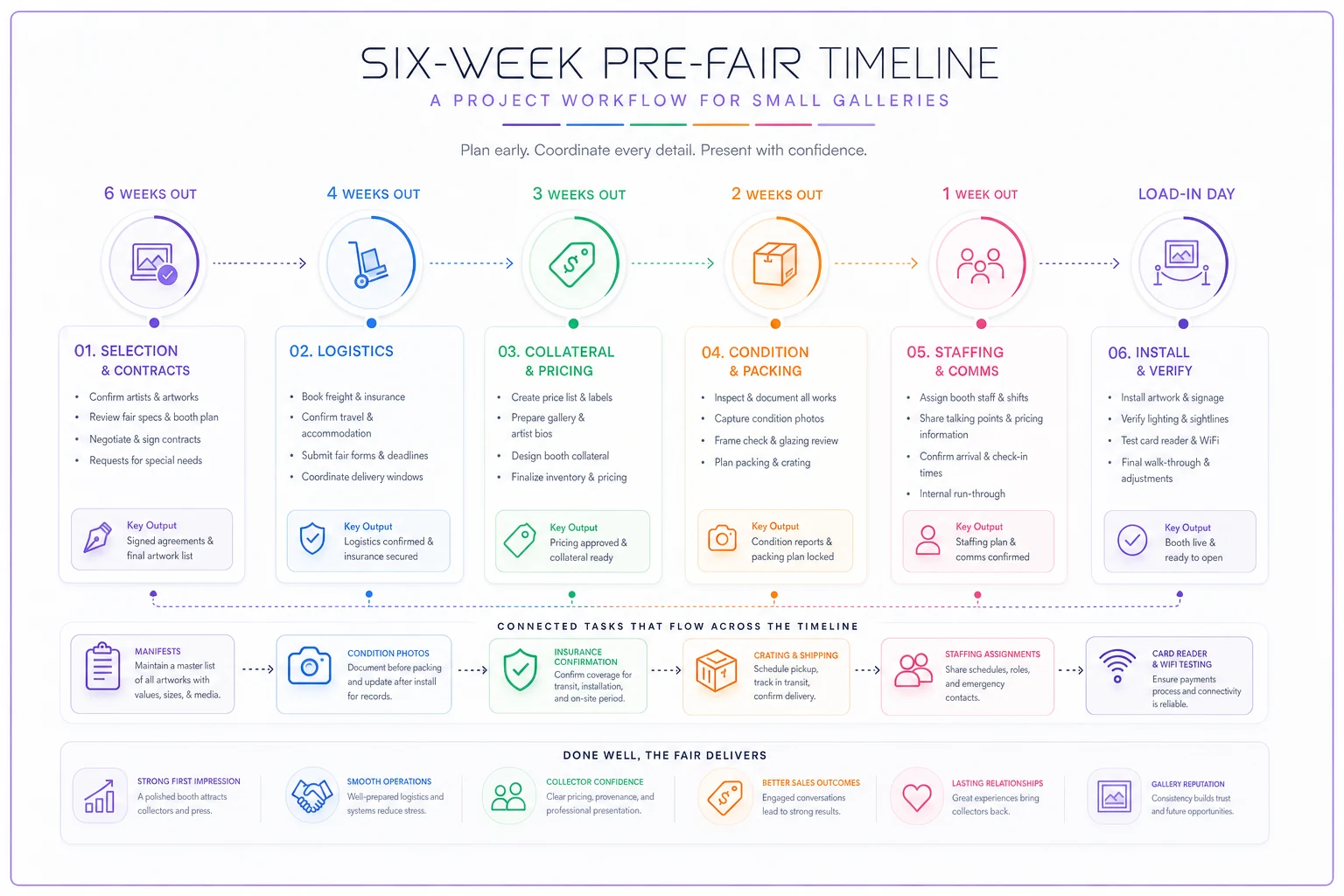
This visual maps the key milestones and handoffs from selection to load-in.
Packing and the condition protocol insurers actually accept
Condition reporting at a fair isn't the same as condition reporting for a loan. You're doing it faster, on more works, and the whole point is to create a clean record that protects you at three distinct moments: departure, arrival, and return.
The rule that saves the most money: every work gets photographed at departure, and those photos get timestamped and stored somewhere other than the installing person's phone. The number of claims that die because "we're pretty sure it left fine" is genuinely depressing. A dated departure photo turns a disputed claim into a paid one.
A workable per-work condition packet includes:
-
Front and back high-res photos, raking light on anything with surface texture
-
Close-ups of existing flaws (corners, frame edges, glazing) — document what's already there so it can't be blamed on transit later
-
A one-line condition note per work in plain language
-
Crate/box ID so you can tie the work to its container on the manifest
The packing checklist for a small booth:
-
[ ] Crate manifest
every work numbered, matched to a crate, matched to the price list
-
[ ] Condition packet complete and backed up before anything is sealed
-
[ ] Hardware kit
hanging hardware, level, drill, spare bulbs, labels, cleaning cloth
-
[ ] Booth kit
price lists (printed + digital), tear sheets, business cards, hold forms, deposit receipts
-
[ ] Payment kit
card reader (charged), backup reader, written card-decline procedure, bank deposit details
-
[ ] Wall labels printed and sorted in hang order
-
[ ] Insurance documents and emergency contacts in the booth folder
Store departure photos in a shared cloud folder with timestamps and a clear naming convention so anyone on the team can access them quickly.
Pack the condition packet before you seal anything. Teams routinely seal crates and then realize the only photos they have are from the gallery wall three weeks ago, which proves nothing about the state the work left in.
On-site invoicing and fulfillment rules
This is where discipline earns its keep. A fair booth is a high-pressure sales environment, and the instinct is to close fast and sort paperwork later. Later is where the leaks happen.
Set hard rules before load-in and brief everyone on them:
-
No work leaves without a completed invoice. Even if it's a trusted collector, even if they're "sending their art handler Thursday." The invoice gets made at the point of sale.
-
Every hold needs a deposit and an expiry. A verbal hold is not a hold. Written hold form, deposit taken (even a small one), and a stated expiry time — "held until 6pm today" — so you're not stuck when a second buyer appears.
-
One sales log, updated in real time. Not three people's memories. A single shared log every staffer updates the moment a sale, hold, or deposit happens.
-
Consignment sales get flagged at point of sale. The log notes it's consigned and which artist, so the split is unambiguous when you reconcile.
-
Shipping and collection method captured on the invoice. Who ships, who pays, when it releases. This is exactly where "I thought you handled it" disputes are born.
The fulfillment distinction worth making explicit: a sale is not the same as a release. A piece can be sold on Friday and still hang in the booth until the fair closes Sunday. Your log needs a status field — available / held / sold-stays / sold-released — so nobody accidentally lets a sold-but-staying work walk out early, or offers a held piece to someone else.
The same discipline that makes an opening convert applies here, just under more time pressure. If your front-of-house instincts need sharpening, the on-site conversion flow playbook covers the selling side that pairs with this operational layer.
The limited-staff coverage plan
Most small galleries staff a fair with two or three people. That's enough to sell and almost never enough to also handle every walk-up, VIP appointment, bathroom break, and coffee run without something dropping.
The fix isn't more people — it's defined roles and a shift rhythm that assumes someone will always be mid-conversation when the next thing happens.
A practical two-to-three person model:
-
Lead (relationship + close). Handles serious buyers, VIP appointments, and anything above a set price threshold. Doesn't get pulled into logistics.
-
Floor (coverage + qualifying). Greets, answers questions, qualifies interest, hands off hot leads to Lead, keeps the sales log updated.
-
Floater / relief (if you have a third). Covers breaks, runs shipping/office errands, handles overflow at peak hours.
With only two people, the Floater role collapses into a schedule: block known-quiet windows for breaks and errands, and agree that if both are tied up, the lower-priority conversation gets a graceful "let me grab your details and follow up in 20 minutes" rather than a dropped lead.
One underrated detail: write down who has the authority to discount and by how much. At a fair, a collector will push on price, and if your Floor person doesn't know the ceiling, they either freeze or give away margin they shouldn't. A one-line rule — "Floor can confirm list price only; anything else goes to Lead" — removes the hesitation entirely.
Reconciliation: tying the booth back to your books
The fair ends, everyone's exhausted, crates come home, and the reconciliation that should happen within 72 hours slides into "next week," then into whenever the accountant asks. This is the single biggest source of post-fair financial mess.
Reconciliation is just matching four things that got separated by the chaos of the fair:
-
Sales log (what you recorded selling)
-
Payment records (what actually hit the card reader / bank)
-
Works returned (what physically came back vs. what shipped to buyers)
-
Splits owed (artist shares, fair commission, shipping recovery)
A simple post-fair reconciliation template, one row per transaction:
| Field | Purpose |
|---|---|
| Work ID / title | Match to manifest and price list |
| Sale price | Gross |
| Payment received? | Confirmed against bank/reader — flag deposits vs. paid-in-full |
| Consigned? / Artist | Determines split |
| Artist split amount | Calculated, not estimated |
| Fair commission | If applicable |
| Shipping cost / recovered | Net impact |
| Net to gallery | What you actually keep |
| Status | Released / to-ship / held-rolled-over |
Run this within three days while memory is fresh and the booth folder is still intact. The works that didn't sell matter too — reconcile the physical return against the manifest so a work that stayed with a buyer on a verbal "I'll decide next week" doesn't quietly vanish from your inventory count.
Where small teams keep a lot of this scattered across a sales iPad, a notebook, and someone's email, a gallery management platform that holds the works list, condition records, and sale status in one place removes the double-entry step entirely — the booth log is the ledger, so there's nothing to re-key and nothing to lose in translation. That's less about software and more about not maintaining two versions of the truth that have to be manually married together afterward.
A real scenario: what the gap actually costs
A two-person gallery took eight works to a regional fair — a mix of gallery-owned and three consigned pieces. They sold five over the weekend, including two of the consigned works, for a gross in the low $40k range.
The problem showed up two weeks later. One consigned sale had been closed quickly on the last day with a handshake on "we'll sort the split." The artist assumed 60/40 in their favor based on a prior conversation; the gallery had a 50/50 standing agreement that was never put in writing for fair sales specifically. The difference was around $1,800 on that one piece — and the relationship took a hit that no amount of later apology fully fixed.
Separately, a departure photo was missing for a framed work that came back with a scuffed corner. Without the dated image, the insurer treated it as pre-existing, and the roughly $400 reframing cost came out of the gallery's pocket.
Neither loss was about selling ability. Both were documentation gaps that a six-week checklist and a written splits confirmation would have closed before the gallery ever left town. The next fair, they ran departure photos on everything and locked splits in writing at the selection stage. The scuffs and arguments didn't disappear entirely — but they stopped eating into the margin that made the trip worth taking.
When fairs make sense — and when the SOP says skip it
Not every fair is worth doing, and a good SOP includes the decision to not go.
A fair makes sense when the collector base attending matches your artists' work, the booth cost plus travel plus shipping sits comfortably below your realistic sales projection, and you have at least two people who can staff it without gutting your home gallery operations for the week.
A fair is a bad idea when you're saying yes to visibility alone with no price-list math behind it, when splits and consignment terms aren't locked, or when staffing the booth means your own space goes dark during a window that would normally sell. "We'll get exposure" is not a line item, and exposure doesn't pay the crating invoice.
Who should genuinely wait: galleries whose inventory records, condition reporting, and sales logging aren't yet reliable in their own space. A fair amplifies whatever system weaknesses you already have. If reconciliation is messy at home, it'll be a disaster on the road. Fix the home operation first, then travel.
The short version
A fair-specific SOP for a small gallery comes down to a few non-negotiables: plan backwards from load-in, confirm every split in writing before departure, photograph every work at departure, keep one real-time sales log, treat a sale and a release as different events, and reconcile within 72 hours against payments, returns, and splits.
The fair itself is unpredictable — the collector who appears out of nowhere, the piece that sells in the first hour, the crate held up in transit. You can't control any of that. What you can control is the structure around it, so that when the good chaos happens, nothing valuable slips through the cracks while you're busy selling.
The fair itself is unpredictable — the collector who appears out of nowhere, the piece that sells in the first hour, the crate held up in transit. You can't control any of that. What you can control is the structure around it, so that when the good chaos happens, nothing valuable slips through the cracks while you're busy selling.
Ready to elevate your gallery operations?
Join 500+ galleries using Artioly to streamline operations, boost visitor engagement, and increase art sales.