



Artist payment scheduling and royalty tracking create more gallery headaches than almost any other financial operation. You sell a piece, the artist gets paid weeks later. A collector resells that same work at auction, suddenly there's a resale royalty dispute. Three years pass, an audit surfaces missing documentation, and now you're digging through boxes of invoices trying to reconstruct payment histories.
The real nightmare starts when multiple triggers overlap. A work sells but doesn't physically leave for export until months later. Payment schedules get tangled between initial sale percentages, shipping reimbursements, and resale rights. Without proper ledger architecture, these overlapping obligations turn into expensive disputes that poison artist relationships.
The hidden complexity of trigger-based payments
Most galleries handle artist payments through basic spreadsheets or manual bookkeeping. This works fine until you hit the complexity wall — usually somewhere around 15–20 active artists with varying contract terms.
-
Initial deposit triggers 25% artist payment ($11,250)
-
Buyer pays balance 30 days later, triggering remaining 25% ($11,250)
-
Piece ships internationally, triggering export documentation fee reimbursement ($800)
-
Installation completion triggers final verification and any adjustments
-
Two years later, resale at auction triggers 5% royalty on a $72,000 sale ($3,600)
Each trigger point needs its own ledger entry, documentation trail, and verification method. Miss one and you're either overpaying, underpaying, or — worse — unable to prove what happened when disputes surface.
The burden compounds fast. A mid-size gallery with 40 active consignment agreements might process 300+ payment triggers monthly across primary sales, secondary market transactions, and various contractual obligations. Manual tracking becomes a liability, not just an inconvenience.
Building ledger architecture that survives audits
Dispute-proof artist payment tracking starts with proper ledger field structure. Most accounting software wasn't built for art market complexity, so you need custom fields that capture the full payment context.
Never miss a key exhibition detail again.
Artioly helps you organize, promote, and manage every exhibition effortlessly.
- Unified exhibition scheduling
- Artist and visitor notifications
- Inventory and sales tracking
No credit card required
Essential ledger fields for gallery payments
| Field Category | Required Data Points | Audit Purpose |
|---|---|---|
| Transaction Identity | Work ID, Artist ID, Sale ID, Contract Reference | Links payment to specific obligations |
| Trigger Documentation | Trigger type, trigger date, verification source, authorizing document | Proves payment timing was correct |
| Calculation Basis | Gross sale amount, applicable percentage, deductions, net payable | Shows mathematical accuracy |
| Payment Execution | Payment date, payment method, transaction ID, receipt confirmation | Confirms actual disbursement |
| Royalty Tracking | Original sale price, resale price, royalty percentage, calculation method | Handles secondary market obligations |
Beyond the core fields, you need metadata connecting payments to their operational context. When an artist questions a payment three years later, you should be able to pull up not just the amount, but the entire chain of events that triggered it.
Sample ledger entry structure
Here's what a properly documented payment entry looks like:
Entry ID: PAY-2024-0892 Date: March 15, 2024 Artist: Sarah Chen (ID: ART-0234) Work: "Fractured Light III" (INV-2023-0445)
Trigger Event:
-
Type
Primary sale completion
-
Sale ID
SALE-2024-0178
-
Trigger date
March 14, 2024
-
Verification
Signed delivery receipt #DR-4456
Payment Calculation:
-
Gross sale amount
$38,500
-
Commission rate
50%
-
Gallery portion
$19,250
-
Artist payment due
$19,250
-
Deductions
None
-
Net payable
$19,250
Payment Details:
-
Payment method
ACH transfer
-
Bank reference
ACH-789234
-
Processed date
March 15, 2024
-
Confirmation
Email receipt sent 3:45 PM
Supporting Documents:
-
Consignment agreement
DOC-2023-0234-CA
-
Sales invoice
INV-2024-0178
-
Delivery confirmation
DR-4456
-
Payment authorization
PA-2024-0892
This level of detail feels excessive right up until you're facing an audit or a dispute. Then it becomes your lifeline.
Royalty tracking across primary and secondary markets
Resale royalties add layers of complexity that break most gallery payment systems. The challenge isn't just tracking percentages — it's maintaining visibility into secondary market activity and proving calculation accuracy years after the initial sale.
Start with clear royalty field architecture:
Initial Sale Record:
-
Original sale price
-
Original sale date
-
Buyer information
-
Resale right percentage
-
Geographic restrictions
-
Time limitations
Resale Monitoring:
-
Auction house notifications
-
Private sale disclosures
-
Online platform alerts
-
Collector self-reporting
Royalty Calculation:
-
Resale price verification
-
Applicable percentage
-
Currency conversions
-
Deduction allowances
-
Payment timeline
The operational challenge is that resale information arrives through multiple channels with varying reliability. Auction houses might notify you directly. Collectors might ignore disclosure requirements entirely. Online platforms operate under different rules. A working royalty tracking system needs automated monitoring combined with manual verification checkpoints — set up Google Alerts for artist names, subscribe to auction house databases, and maintain relationships with key secondary market players. But also build contractual notification requirements into your original sales agreements, because passive monitoring only catches so much.
Automation checkpoints that prevent payment disasters
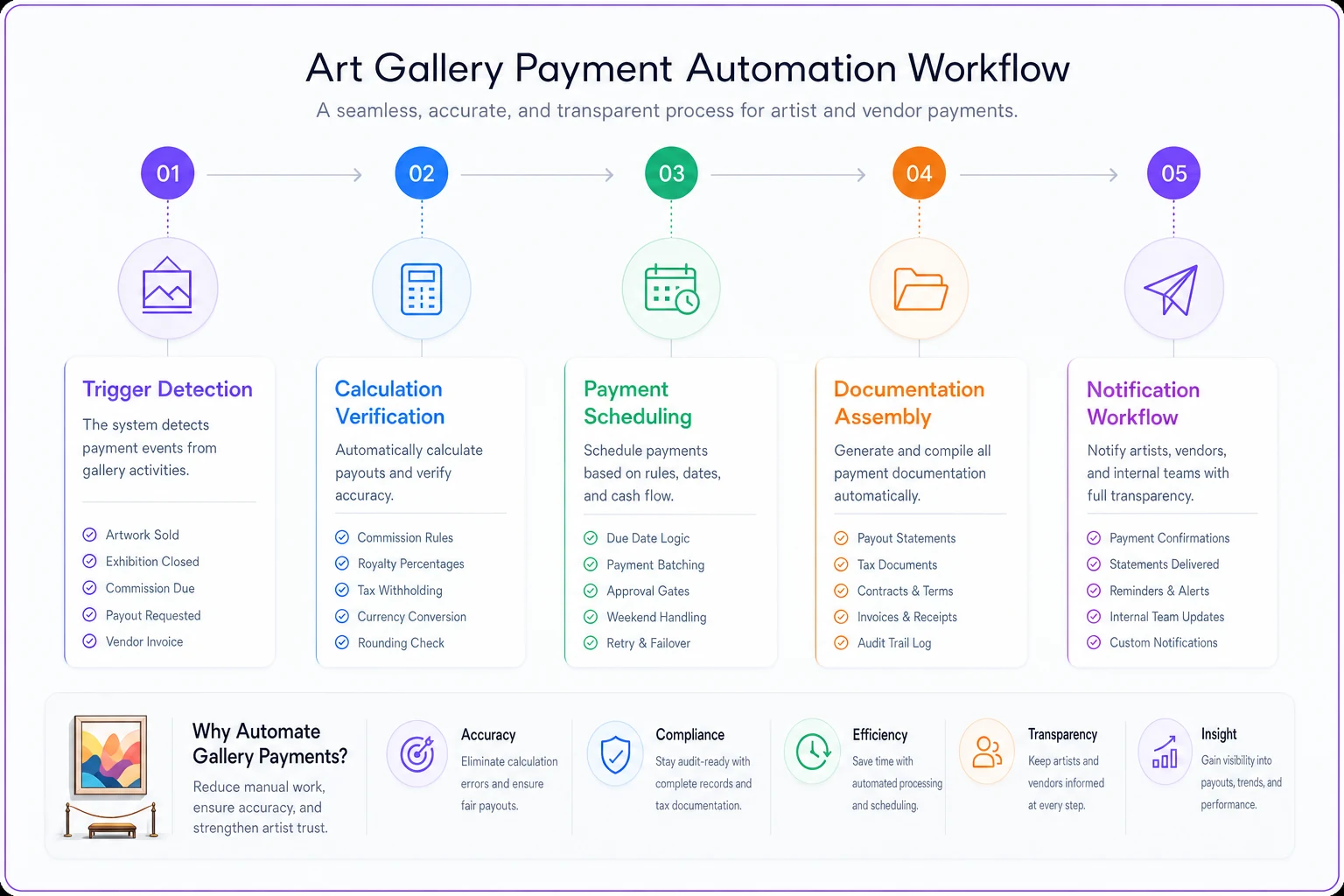
Manual payment processing invites errors that compound over time. Even careful galleries make mistakes when juggling dozens of payment triggers monthly. The solution isn't full automation — it's strategic automation at critical checkpoints.
Critical automation points
Trigger Detection:
-
Sales completion flags payment calculations
-
Shipping confirmations trigger export fees
-
Delivery receipts initiate final payments
-
Calendar dates prompt time-based obligations
Calculation Verification:
-
Pull contract percentages from source documents
-
Apply deduction rules consistently
-
Flag unusual amounts for review
-
Generate calculation documentation
Payment Scheduling:
-
Batch similar payments together
-
Align with cash flow cycles
-
Respect contractual timing requirements
-
Maintain buffer for verification
Documentation Assembly:
-
Relevant contracts
-
Sale documentation
-
Shipping records
-
Prior payment history
Notification Workflows:
-
Payment initiation notices
-
Calculation breakdowns
-
Expected timeline
-
Receipt confirmations
Here's a simple visualization of the automation checkpoints workflow.
These automations don't replace human judgment. They free up time for handling exceptions, managing relationships, and solving complex situations that require actual context.
When payment schedules actually break down
Even with solid systems in place, payment disputes still happen. Knowing the common failure points helps you either prevent them or resolve them faster.
Contract interpretation conflicts: Artists remember handshake modifications that were never documented. Verbal agreements about exhibition costs, framing responsibilities, or marketing investments create payment expectation mismatches. Document every deviation from standard terms, even informal ones.
Timing disagreements: "Net 30" means different things depending on who you ask. Does it start from sale date, invoice date, or payment receipt? When holidays intervene, who absorbs the delay? Clear trigger definitions prevent these arguments before they start.
Resale discovery gaps: Artists find out their work resold through Instagram or collector gossip, then wonder why they weren't paid royalties. Often the gallery never knew about the resale either. Building notification requirements into original sale agreements helps, but it's not foolproof.
Currency and conversion disputes: International sales create conversion timing questions. Which exchange rate applies — sale date, payment date, or transfer date? Small rate changes on large sales create thousand-dollar swings that someone has to absorb.
Expense allocation fights: Who pays for crating, insurance, photography, or restoration? These costs significantly impact net payments but often aren't clearly addressed in consignment agreements. Standard consignment workflows need explicit expense allocation terms.
Building an audit-ready payment system
When disputes escalate or routine audits arrive, your payment documentation becomes the whole ballgame. An audit-ready system isn't just about keeping records — it's about making information accessible and verifiable quickly.
Chronological accessibility: Can you pull all payments to a specific artist within a date range? Your filing system should allow retrieval by artist, date, or work without significant effort.
Cross-reference capability: Every payment should link to its source transaction, supporting contracts, and calculation basis. Auditors trace money flows, not just final amounts.
Calculation transparency: Show your math. Every payment should include not just the final number, but how you got there — contract references, percentages applied, deductions taken.
Verification trails: Payment authorizations, transfer confirmations, and receipt acknowledgments prove money actually moved. Bank statements alone aren't sufficient.
Exception documentation: When payments deviate from standard terms, document why. Late payments, partial payments, adjusted amounts — all of it needs explanation beyond just the numbers.
Use a consistent file-naming and indexing convention so you can pull an artist's payment chain quickly during audits.
A properly structured payment system saves somewhere around 20–30 hours during a typical audit. More importantly, it demonstrates professional operations, which tends to reduce scrutiny and prevent deeper investigations.
Payment templates that scale with your gallery
Small galleries often resist formal payment systems, thinking they're overkill. But building solid templates early prevents a painful migration later when you're managing 50+ artists and hundreds of annual transactions.
Starter payment template structure
Payment Authorization Form:
-
Artist name and ID
-
Work(s) included
-
Trigger event description
-
Calculation breakdown
-
Approval signatures
-
Processing date
Ledger Entry Template:
-
Unique payment ID
-
All required fields from earlier table
-
Link to source documents
-
Notes field for exceptions
Artist Statement Template:
-
Period covered
-
Sales summary
-
Payment calculations
-
Deductions itemized
-
Net payment amount
-
Next payment schedule
Royalty Tracking Sheet:
-
Original sale details
-
Monitoring status
-
Resale notifications
-
Calculation worksheet
-
Payment history
Consistency matters more than complexity here. A simple system used reliably beats a sophisticated system used sporadically.
As you grow, enhance templates with:
-
Multiple currency support
-
Tiered commission structures
-
Exhibition cost allocations
-
International tax withholding
-
Estate payment provisions
Start with foundations that can expand rather than ones that require complete rebuilds.
The technology layer that makes this manageable
Manual payment tracking works until roughly 20 active artists or 15 monthly transactions. Beyond that, the operational burden starts outpacing accuracy. This is where AI-powered operational software genuinely earns its keep — not as a replacement for judgment, but as the infrastructure that keeps routine work from becoming a full-time job.
Modern platforms designed for gallery operations handle trigger detection, calculation verification, and documentation assembly automatically. Instead of manually checking whether a sale completed or a shipment arrived, the system monitors those events and initiates the appropriate payment workflows.
The real value shows up in relationship preservation. When artists can access payment histories, upcoming schedules, and calculation details through a self-service portal, trust increases while your support burden drops. Disputes shift from "where's my money?" to "can you explain this specific calculation?" — a much healthier conversation to be having.
AI automation particularly helps with:
-
Monitoring secondary market activity for resale royalties
-
Detecting payment anomalies that need human review
-
Assembling supporting documentation ahead of audits
-
Generating payment communications that keep artists informed
-
Predicting cash flow impacts of scheduled payments
But technology isn't a complete solution. You still need solid contracts, clear policies, and human judgment for complex situations. The goal is freeing up attention for relationship building while automation handles the repetitive execution.
Moving from reactive to proactive payment operations
Galleries that avoid payment disputes don't just have better systems — they've shifted how they operate. Instead of responding to artist inquiries, they communicate payment schedules preemptively. Rather than scrambling during audits, they maintain audit-ready records continuously.
That shift requires operational discipline but pays off through:
-
Stronger artist relationships built on transparency
-
Less time spent on payment disputes and back-and-forth clarifications
-
Faster audit completions with fewer findings
-
Better cash flow management through predictable payment schedules
-
Protection against legal challenges through proper documentation
More than anything, proactive payment operations free gallery leadership to focus on what actually matters — developing artists, building collector relationships, and doing the cultural work. When payment operations run smoothly in the background, everything else gets easier.
The galleries that are thriving right now have figured out that operational excellence isn't separate from artistic mission — it's what enables it. Professional payment operations might seem mundane compared to curating a groundbreaking show, but they're what keep doors open and artists trusting you with their life's work.
Start with one improved process, one better template, one automated checkpoint. Build payment operations that protect both your gallery and your artists. Because payment disputes don't just cost money — they cost relationships that took years to build and can fall apart fast.
Ready to elevate your gallery operations?
Join 500+ galleries using Artioly to streamline operations, boost visitor engagement, and increase art sales.