


Most galleries treat image licensing as a favor. A magazine emails asking for a high-res file from your last show, someone forwards it to you, you attach the JPEG, done. No fee, no license terms, no record. Six months later that same image is running in a paid ad campaign for a furniture brand and nobody — not you, not the artist — sees a cent.
This is one of the quietest revenue leaks in a small gallery. Not because licensing is complicated, but because there's no system deciding what gets sent, at what price, under what terms, and who signs off. This guide is a working SOP for exactly that: the fee heuristics, the clauses that separate commercial from editorial use, sample invoice language you can copy, and an approval workflow that keeps you from emailing a $4,000 usage right out the door for free.
The core mistake: treating every image request as identical
The pattern behind almost every licensing loss is that galleries respond to requests reactively — one email at a time, no framework for sorting them. A request from a university press for a scholarly catalog and a request from a hotel chain for lobby prints get the same reply: "Sure, here's the file."
Those two requests are worth wildly different amounts. One is editorial, low-fee or even free-with-credit. The other is commercial, and depending on print run and territory it can be worth thousands. When you handle both the same way, you either overcharge the professor and lose goodwill, or undercharge the hotel and lose money. Usually it's the second one.
The fix isn't a lawyer on retainer. It's a decision structure that lets whoever opens the inbox route the request correctly before anyone attaches a file.
First, separate the two worlds: editorial vs commercial
Everything in licensing flows from this distinction. Get it wrong and every downstream decision — fee, clause, credit line — goes wrong too.
Never miss a key exhibition detail again.
Artioly helps you organize, promote, and manage every exhibition effortlessly.
- Unified exhibition scheduling
- Artist and visitor notifications
- Inventory and sales tracking
No credit card required
Editorial use means the image illustrates, informs, or comments. Magazine articles, academic books, museum wall texts, non-promotional press coverage, exhibition reviews. The image is about something, not selling something.
Commercial use means the image helps sell a product, service, or brand. Advertising, packaging, product design, merchandise, corporate décor, hotel prints — anything where the image adds commercial value to a third party's business.
The tricky middle: a "brand editorial" piece in a fashion magazine that's really a paid placement, or a nonprofit annual report used in a fundraising campaign. When in doubt, ask what the image is doing. If it's helping someone make money or attract customers, treat it as commercial.
Here's a working reference table you can adapt:
| Factor | Editorial | Commercial |
|---|---|---|
| Purpose | Inform, illustrate, review | Promote, sell, brand |
| Typical fee range | $0–$400 (often credit-only) | $500–$5,000+ |
| Territory | Usually limited or single-market | Often broad / worldwide |
| Duration | Tied to publication run | Fixed term, renewable |
| Credit line | Required | Required, but fee comes first |
| Approval needed | Gallery manager | Gallery director + artist |
| Exclusivity | Never | Sometimes (priced higher) |
The point isn't the exact numbers — those depend on the artist's stature and your market. The point is that the two columns should never be handled by the same reflexive "here's the file" reply.
Fee heuristics that hold up in the real world
Galleries freeze on pricing because they think every license needs a custom valuation. In practice, you can price 90% of requests with four inputs:
-
Use type — editorial or commercial (from above).
-
Reproduction size and prominence — a quarter-page interior shot is not a full-page cover, and a cover is not a billboard.
-
Print run / audience reach — 2,000 copies of a regional journal versus a national ad buy.
-
Territory and duration — one country for one year versus worldwide in perpetuity.
A practical approach that works for small and mid-size galleries: set a base editorial fee (say $150–$250 for a standard interior magazine reproduction), then apply multipliers for commercial use, size, reach, and territory rather than pricing from scratch each time.
Set a simple base editorial fee and keep a short multiplier table for quick quoting.
A typical example: a design magazine wants a full-page reproduction of a painting, editorial, print run around 30,000, single country, one issue. Base editorial fee, bump for full-page prominence, small bump for reach — you land somewhere around $350–$500. Clean, defensible, quick to quote.
Same painting, requested by a boutique hotel group for roughly 40 framed prints across their properties, displayed indefinitely. That's commercial, multi-location, effectively perpetual. You're no longer at $500 — you're negotiating a licensing fee in the low thousands plus a per-unit or per-property consideration, and you're looping in the artist before you quote anything.
The heuristic keeps your team fast on easy requests and forces a pause on expensive ones. That pause is where the money is.
When to charge nothing (on purpose)
Free licensing is a legitimate strategic choice — but it should be a decision, not a default. Waiving a fee makes sense for:
-
Major museum publications that genuinely elevate the artist's profile
-
Serious scholarly monographs with limited budgets
-
Press coverage driving real visibility to a current show
Even then, "free" doesn't mean "free for anything." A waived fee still gets a written license, a defined use, and a mandatory credit line. You're giving away the fee, not the control.
The clauses that actually protect you
You don't need a 12-page contract for a magazine reproduction. You need a handful of clauses that appear in every license, scaled to the request. These are the ones that matter most in day-to-day gallery licensing.
Scope of use. State exactly what's permitted: medium, size, placement, number of uses. "One (1) full-page reproduction in the print edition of [Publication], Issue [X]." Anything not written is not granted.
Territory and term. Where and for how long. "United States and Canada, print and digital editions, for the natural life of the issue" reads very differently from "Worldwide, all media, in perpetuity" — and should be priced accordingly.
Exclusivity. Almost always non-exclusive. If a commercial client wants exclusivity, that's a separate, much higher fee, and the artist must approve it because it locks the image out of other deals.
Credit and copyright. Mandatory attribution: artist name, title, year, medium, and "© [Artist], courtesy [Gallery]." Non-negotiable across both editorial and commercial.
No modification. Cropping, color alteration, overlaying text, or compositing usually requires written consent. Artists care deeply about this, and disputes here get ugly fast.
Warranty and indemnity. You warrant you have the right to license the image; the licensee indemnifies you for how they use it beyond the granted scope. This is your firewall if a client misuses the file.
Payment before delivery. For commercial licenses especially, the high-res file releases after payment or signed agreement — not before. This one clause prevents most non-payment problems.
The mistake that comes up repeatedly: galleries send the file first and treat the paperwork as follow-up. Once the JPEG is out, your leverage is gone. Reverse the order.
Sample invoice language you can actually use
Your invoice does double duty — it bills the client and documents the license terms. Vague invoices ("Image licensing fee — $500") create disputes because they don't define what was actually bought. Here's copy you can adapt:
> Image Licensing Fee > License granted to [Client/Publication] for the reproduction of the following work: > [Title], [Artist], [Year], [Medium]. > > Permitted use: One (1) [full-page/quarter-page] reproduction, [editorial/commercial], in [named publication/campaign]. > Territory: [e.g., United States, print and digital]. > Term: [e.g., life of the issue / 12 months from publication]. > Exclusivity: Non-exclusive. > Required credit: "[Title], [Artist], [Year]. © [Artist], courtesy [Gallery]." > > This license is granted upon receipt of full payment. Use beyond the permitted scope requires a separate written agreement. No modification of the image is permitted without prior written consent. > > License fee: $[amount] — Net 15.
That block turns your invoice into a mini-contract. If a client later runs the image somewhere it wasn't licensed, the invoice itself is your evidence of the agreed scope.
The approval workflow: who signs off, and when
Most licensing revenue leaks aren't pricing failures — they're workflow failures. Someone junior answers the inbox, wants to be helpful, and sends the file before anyone with authority sees the request. A clear approval path fixes this without slowing you down.
-
Intake. Every image request lands in one place — a shared inbox or a form, never someone's personal email. Whoever receives it logs it: requester, work requested, stated use, publication/campaign, reach, deadline.
-
Route by use type. Editorial requests under your base-fee threshold can be approved by the gallery manager. Anything commercial, exclusive, worldwide, or high-value routes to the director and triggers artist consultation.
-
Artist consultation (commercial only). For commercial licenses, the artist gets a say — and often a share. Many artist agreements already require this, and it ties directly into how you track what's owed. If you've built a proper ledger for artist earnings, licensing income should flow through the same system you use for artist payments and resale royalties so nothing gets missed at reconciliation.
-
Quote and agreement. Send the fee, the scope, and the terms together. For commercial deals, get a signature or written acceptance before proceeding.
-
Payment gate. Commercial
payment or signed agreement clears before the file goes out. Editorial: file releases on written acceptance of terms and credit line.
-
Delivery and logging. Send the correctly sized file (never the full archival master unless licensed for print production), then log the completed license: fee, terms, expiry, credit confirmed.
-
Follow-up. Note the term expiry. When it lapses, the license ends — renewals are new agreements, not automatic.
A quick visual helps: map intake → route → artist consult → payment gate → delivery and logging.
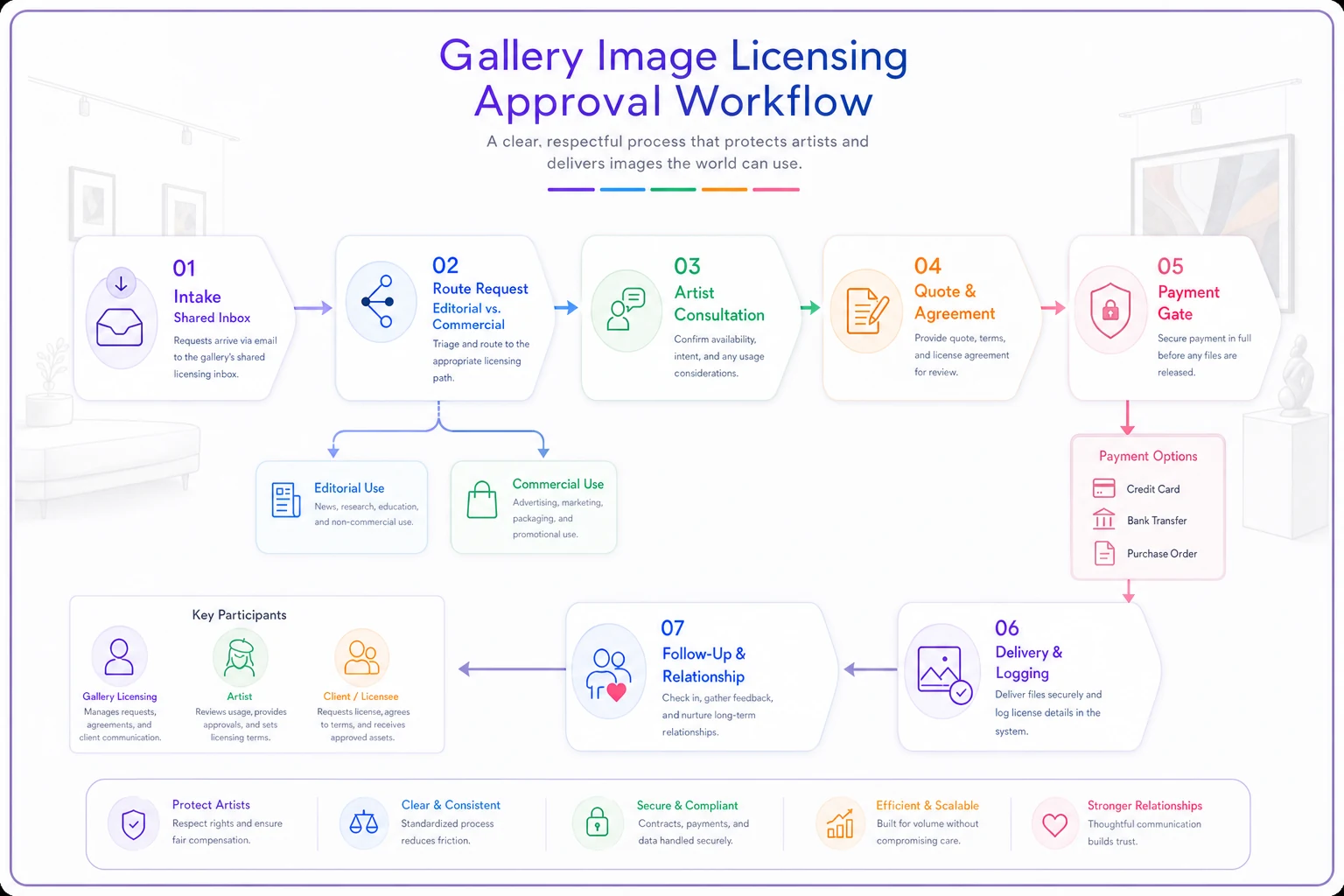
The discipline that matters most is step 5. The file never leaves before the gate clears. Galleries that actually enforce this convert far more requests into paid licenses.
A quick checklist before any file leaves the building
-
[ ] Use type identified
editorial or commercial?
-
[ ] Fee set using the heuristic (size, reach, territory, term)?
-
[ ] Correct approver signed off (manager vs director + artist)?
-
[ ] Artist consulted and share recorded (commercial)?
-
[ ] Written terms sent and accepted?
-
[ ] Payment cleared or agreement signed (commercial)?
-
[ ] Credit line specified and confirmed?
-
[ ] Correct file size prepared (not the full master)?
-
[ ] License logged with fee, scope, and expiry?
The discipline that matters most is step 5. The file never leaves before the gate clears. Galleries that actually enforce this convert far more requests into paid licenses.
A real scenario
A single-location contemporary gallery, two full-time staff, fielding maybe 15–20 image requests a year and treating almost all of them as free favors. Their whole process was the director forwarding files from her personal email whenever she got around to it.
Two things were going wrong. Commercial requests — a couple of hotel and interior-design projects per year — were being answered like editorial ones, meaning several thousand dollars in usage fees walked out the door for free. And nobody was logging anything, so when one artist asked whether their work had been licensed anywhere, the gallery genuinely couldn't answer.
They put in a plain version of the SOP above: shared intake, the editorial/commercial split, base fee plus multipliers, payment-before-delivery for commercial work. Nothing fancy. Within the first year they turned two of those commercial requests into paid licenses — roughly $1,800 and $2,600 — kept editorial goodwill intact by staying generous on genuine press and scholarly requests, and could finally tell each artist exactly where their images had gone. Somewhere north of $4k in newly captured revenue on requests they'd been giving away, plus a lot fewer awkward conversations with artists.
The revenue was always there. The system just wasn't catching it.
When a formal licensing SOP is worth it — and when it isn't
When it makes sense: you get more than a handful of requests a year, you represent artists whose work has commercial appeal (design-friendly imagery, recognizable names, photography, prints), or you've already had a "wait, that was our image in an ad?" moment. Any of those and the SOP pays for itself the first time you correctly price a commercial deal.
When it's overkill: a very quiet program with two or three editorial requests a year and no commercial interest. Even then, keep the one clause that matters — written scope plus mandatory credit — because it costs nothing and protects the artist.
Who should not skip the artist step: anyone licensing commercially. Waiving fees or granting broad commercial rights without artist sign-off is how you lose trust and, in some jurisdictions, breach your own consignment or representation agreement. Keep it in writing.
Where this connects to the rest of your operations
Licensing doesn't live in a vacuum. The same file-management discipline that makes licensing clean is the discipline that keeps your whole image library sale-ready, and the same approval-gate thinking applies anywhere money and artist rights intersect — including commissioned work, where scope creep and unpaid rights are a constant risk. If you've already tightened up your gallery-side briefs and milestone approval gates for commissioned work, you'll recognize the pattern: define scope, gate the deliverable behind payment, and log everything.
A shared intake, a simple ledger, and a single source of truth for who-owns-what matter because licensing revenue is small and frequent. It's exactly the kind of income that slips through when it lives in one person's inbox and memory. A lightweight operational system — even a well-structured spreadsheet paired with a shared inbox, or a proper gallery management platform if you're past that stage — turns scattered favors into tracked, priced, credited, paid licenses.
The bottom line
Image licensing isn't hard. It's just easy to give away by accident. The two things that fix almost all of it: sort every request into editorial or commercial before you touch the file, and never let a file leave until the terms are agreed and — for commercial — the money is in.
Everything else in this guide — the fee heuristic, the clause list, the invoice language, the approval steps — exists to enforce those two habits. None of it requires a legal team or expensive software. Most of it can run off a shared inbox, a simple log, and the willingness to say "payment first, file after."
Start with the intake inbox and the payment gate. Those two alone will capture more licensing revenue than any amount of custom contract drafting, and they'll take you an afternoon to set up.
Start with the intake inbox and the payment gate. Those two alone will capture more licensing revenue than any amount of custom contract drafting, and they'll take you an afternoon to set up.
Ready to elevate your gallery operations?
Join 500+ galleries using Artioly to streamline operations, boost visitor engagement, and increase art sales.