



Managing commissioned artwork starts simple enough on paper. A collector wants something specific, the artist agrees to make it, the gallery facilitates, money changes hands. Everyone's happy.
Except that's rarely how it actually plays out.
Why galleries struggle with commission management
Commissions sit in this weird operational space between traditional sales and project management. They're not inventory you can point to and price. They're not exhibitions with established workflows. They're custom projects with multiple stakeholders, evolving requirements, and timeline dependencies that most galleries aren't structured to handle.
The gaps show up fast. Without a proper brief, the artist and collector start with different visions. Without milestone payments tied to approval gates, the gallery floats costs for months. Without quality acceptance criteria, subjective disagreements turn into refund demands. Without installation checklists, the final handoff becomes a scramble.
Most galleries try to manage commissions through email chains and verbal agreements. That works until it doesn't. One disputed interpretation, one delayed payment, one damaged piece during transport—and suddenly the gallery's reputation and cash flow take the hit.
The commission brief that prevents interpretation disputes
A solid commission brief does more than describe what the collector wants. It creates boundaries, sets expectations, and gives everyone a reference point when things get murky.
Never miss a key exhibition detail again.
Artioly helps you organize, promote, and manage every exhibition effortlessly.
- Unified exhibition scheduling
- Artist and visitor notifications
- Inventory and sales tracking
No credit card required
Start with the conceptual parameters. Not just "a landscape painting" but specifics around mood, color palette, compositional elements, and reference materials. Include what the collector explicitly doesn't want. Sometimes knowing they hate orange or won't display anything with visible text matters more than knowing they prefer blue.
Document the physical specifications precisely. Dimensions with acceptable variance ranges. Weight limitations if it's going on a specific wall. Material requirements or restrictions. Framing expectations. These details feel excessive until the artist delivers a 200-pound steel sculpture for a collector expecting a canvas painting.
Add context about the final environment. Where will the piece live? What's the lighting situation? What else is in the room? An artist creating for a minimalist beach house produces very different work than for a maximalist city loft, even with an identical conceptual brief.
Include process expectations. Will the collector see sketches? Do they want progress updates? Are studio visits expected? Some collectors want deep involvement; others want to be surprised. Document it either way.
Ask collectors to explicitly list what they don't want early in the brief to avoid wasted iterations.
Set revision parameters upfront. How many rounds of changes are included? What counts as a minor adjustment versus a major rework? At what point does the commission reset entirely? These boundaries prevent endless revision cycles that quietly destroy margins.
The brief becomes your operational anchor. When the collector says "this isn't what I imagined," you return to the documented vision. When the artist wants to pivot dramatically, you check against agreed parameters. When scope creep starts, you reference what was actually commissioned.
Milestone payments that protect cash flow and create commitment
The traditional gallery payment structure—50% deposit, 50% on delivery—doesn't hold up well for complex commissions. Too much risk sits with the gallery between those two points. Too little incentive for collectors to stay engaged. Too few checkpoints to catch problems before they become expensive.
Think about a $40,000 commission for a large mixed-media piece. With the traditional structure, the gallery collects $20,000 upfront, pays the artist their advance, then waits six months hoping everything goes smoothly. If the collector rejects the final piece, the gallery's stuck mediating between an unpaid artist and an unhappy collector.
Better milestone structures tie payments to specific approval gates.
-
After brief approval
25%.
-
After initial sketches or maquettes
25%.
-
After mid-point review
25%.
-
Upon final acceptance
25%.
Each payment confirms the collector's commitment to continue. Each gate provides a natural exit point if something isn't working.
These gates serve operational purposes beyond payment. They force communication at critical moments. They document approval of decisions that can't be undone. They create natural points to address concerns before they become crises.
The mid-point review catches most problems. The collector sees the piece taking shape, not just conceptual drawings. Color relationships become real. Scale feels tangible. If something's off, there's still time to adjust without starting over entirely.
Map payment milestones to the artist's payment schedule, but don't mirror them exactly. If you're paying the artist in thirds, collect from the collector in quarters. That buffer protects gallery cash flow when collectors pay late or projects extend.
Build penalties and remedies into the payment structure. Late payments pause work. Missed gates trigger automatic extensions. Cancellations forfeit completed milestone payments. These aren't punitive—they're operational necessities that keep projects moving.
Quality acceptance criteria that eliminate subjective disputes
"I don't like it" becomes an expensive problem without clear acceptance criteria. Subjective disappointment differs from objective non-compliance, but without documented standards, everything becomes negotiable.
Quality criteria start with technical standards. For paintings: no visible repairs, consistent paint application, proper varnishing, secure stretching. For sculpture: structural integrity, finish consistency, stable mounting points. For photography: print quality, color accuracy, edition documentation. These baseline requirements protect against technical defects regardless of personal taste.
Then layer in commission-specific criteria tied to the brief. If the commission specified "vibrant jewel tones," document what that means using color references. If it required incorporating family heirloom textiles, specify how they should be integrated. These criteria bridge subjective preferences and objective delivery.
Include negative space in your criteria—what the piece shouldn't have. No political imagery. No nudity. No text. No representational elements. Whatever limits the collector established, document them as acceptance criteria.
Create a formal acceptance process. The collector reviews the work against documented criteria. They either accept, reject with specific criterion violations cited, or request minor adjustments within scope. General "it doesn't feel right" rejections without tied criterion failures shouldn't hold up payment.
This structure protects everyone. Artists know exactly what constitutes acceptable delivery. Collectors can't reject work that meets agreed standards. Galleries avoid mediating purely subjective disputes.
The handoff checklist that prevents installation disasters
The commission doesn't end when the artist finishes the piece. Installation and delivery can unravel months of careful management in a single afternoon.
Start with physical logistics. How does this piece move from studio to site? Standard art handlers might not work for unconventional materials or oversized works. That kinetic sculpture needs specialized rigging. That site-specific installation requires the artist present. Document requirements while the artist is still in the production phase, not after they've moved on to their next project.
Create installation specifications during the commission process, not at delivery. Mounting requirements, wall reinforcement needs, electrical considerations for lit pieces, environmental controls for sensitive materials. The collector who commissioned a 500-pound marble sculpture needs to know their floor can support it before it arrives at the door.
Build a pre-delivery checklist. Photograph the work from every angle at the studio. Document any intentional irregularities that might look like damage later. Test all mechanical or electrical components. Create condition reports that follow the detailed workflows we've covered for fragile works. These records become essential if damage occurs during transport.
Map the handoff sequence. Who inspects the piece on delivery? Who confirms installation completion? Who signs off on final acceptance? When does the final payment trigger? When does ownership officially transfer? This sequence prevents the all-too-common scenario where the piece is installed, the collector's happy, and nobody remembered to collect the final payment.
Include post-installation documentation. Maintenance instructions for complex materials. Artist's notes about intent and care. Warranty terms if applicable. Contact information for future conservation needs. This package adds real value while preventing future "the gallery never told us" claims.
When commission scope creep destroys profitability
A collector starts with a simple portrait commission. Then they want the background changed to include their country house. Then they want their dog added. Then they decide it should be larger. Then they want a companion piece. Each change seems small. Collectively, they've doubled the scope.
Without change order protocols, galleries eat these costs. The artist needs more money for the expanded work. The timeline extends. The gallery's commission percentage stays fixed while managing twice the complexity. That profitable $30,000 commission becomes a break-even $60,000 headache.
Document every scope change immediately. New size? Written amendment with pricing adjustment. Additional elements? Documented with timeline impact. Changed materials? Confirmed with budget implications. These amendments don't need to be formal contracts, but they must be written and acknowledged by all parties.
Price changes progressively. The first minor adjustment might be absorbed. The second costs 10% of the change value. The third costs 25%. This structure accommodates reasonable refinements while discouraging endless tinkering. Collectors learn to batch their changes rather than dribbling them out one at a time.
Reserve the right to reset the commission entirely for major pivots. When a collector decides halfway through that they want sculpture instead of painting, that's a new commission, not a revision. Deposits already paid might transfer, but the timeline, pricing, and approval gates start fresh.
Managing artist capacity and collector expectations
Galleries often forget they're managing two relationships in every commission: collector to gallery and gallery to artist. When those relationships aren't aligned, the gallery absorbs the tension.
Track artist capacity realistically. A painter who produces two major works annually can't suddenly deliver five commissions. A sculptor whose process requires specific seasonal conditions can't work year-round. Build these constraints into commission timelines from the start, not after you've already promised a delivery date.
Create commission queues when demand exceeds capacity. Better to tell a collector they're third in line for their preferred artist than to pressure that artist into an impossible timeline. Transparent queues also create urgency—collectors tend to commit faster when they see others waiting.
Standardize artist commission agreements separately from collector contracts. The artist needs to know their payment schedule, material budgets, revision limits, and delivery requirements independent of what you've promised the collector. This separation lets you buffer operational complexity rather than passing it straight through.
Build some redundancy into your network for common commission types. Multiple artists who excel at contemporary portraiture. More than one fabricator for large-scale installations. Several photographers comfortable with architectural commissions. When your primary artist gets overwhelmed or falls through, you have alternatives without starting from scratch.
The financial reality of commission management
Commissions look incredibly profitable on paper. The gallery takes 40–50% for facilitating, without holding inventory or fronting material costs. A $50,000 commission nets $20,000–$25,000 in gallery commission. Straightforward.
Except operational complexity eats those margins fast. Eight rounds of collector meetings. Fifteen artist check-ins. Three rounds of contract revisions. Studio visits. Progress documentation. Installation coordination. Suddenly you've invested close to a hundred hours of staff time into a single commission. At loaded labor costs, that $20,000 commission might net $5,000.
| Example | Value |
|---|---|
| Gallery commission percentage | 40–50% |
| $50,000 commission nets | $20,000–$25,000 |
Price commissions based on true operational cost, not standard commission percentages. Complex commissions might need 60% gallery commission to actually be profitable. Simple ones might work at 35%. Build pricing models that account for meetings, revisions, project management time, and installation complexity.
Consider flat project management fees on top of commission percentages for complex projects. A $5,000 management fee for coordinating a major installation changes the economics considerably. Collectors understand project management costs from other industries—they just need the structure explained clearly.
Track commission profitability consistently. Which artists require more management? Which collectors demand excessive revisions? Which commission types consume disproportionate resources? This data helps you price future commissions appropriately and recognize which structures aren't worth accepting.
Building repeatable commissioned artwork workflow
Galleries that excel at commissions treat them as repeatable operations, not one-off projects. They have templates, checklists, and workflows that remove operational friction while maintaining creative flexibility.
Start with commission intake workflows. Standardized brief templates that collectors complete before anything else happens. Initial feasibility assessments before accepting projects. Artist availability checks before promising timelines. Budget range confirmations before detailed discussions. These front-end steps prevent a lot of downstream problems.
-
briefing
-
concept development
-
approval
-
production
-
finishing
-
delivery
-
installation
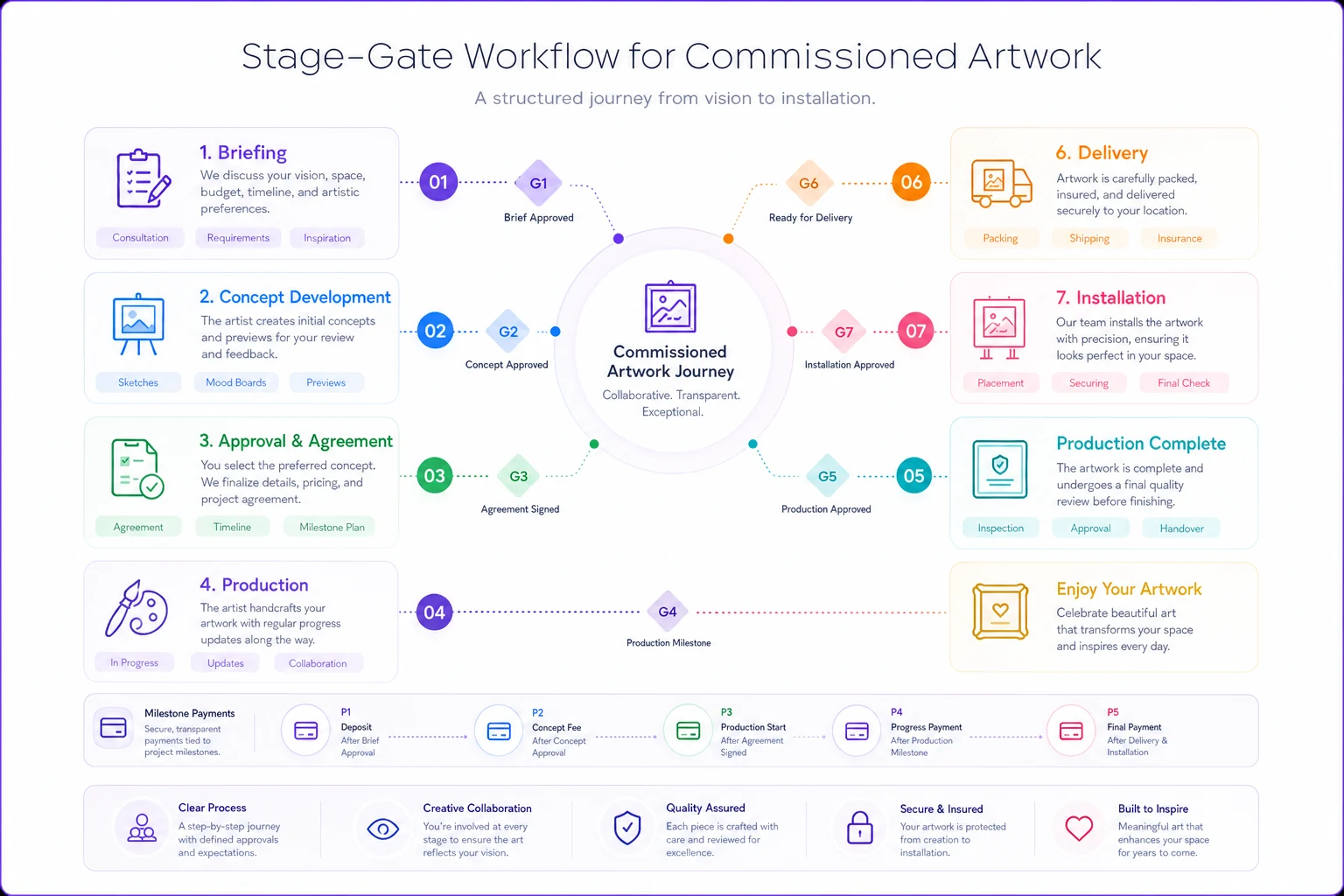
Create stage-gate project structures. Each commission moves through defined phases: briefing, concept development, approval, production, finishing, delivery, installation. Each phase has specific deliverables, approval requirements, and payment triggers. This structure works whether the commission takes three months or eighteen.
This visual shows the stage-gate workflow in practice.
Build your document library iteratively. Start with basic templates. Add clauses as situations come up. That dispute over weather delays? Add force majeure language. That confusion over color matching? Add Pantone reference requirements. Your templates become more comprehensive through actual experience, not by trying to anticipate every scenario upfront.
Centralize commission information somewhere accessible. Email chains don't work for six-month projects with multiple stakeholders. Whether it's project management software, shared folders, or dedicated commission tracking tools, centralized information prevents the "nobody told me" problems that derail projects at the worst possible moments.
The most successful commission programs feel effortless to collectors while being highly structured operationally. The collector experiences smooth progress and clear communication. Behind the scenes, workflows and checkpoints catch problems before they escalate.
Modern tools for commission operations
Manual commission tracking starts breaking down around five simultaneous projects. Spreadsheets can't handle the communication complexity. Email chains become unsearchable. Document versions multiply. The operational overhead consumes whatever profit margin was there.
This is where AI-powered operational software changes commission economics—not by replacing gallery expertise, but by increasing human capacity to handle more commissions profitably. Automated payment reminders tied to milestone completions. Templated but personalized collector updates generated from project status. Document assembly that pulls from clause libraries based on commission parameters.
The better platforms centralize commission workflows without forcing rigid structures. They track milestones and payments while allowing for the creative flexibility commissions actually require. They maintain communication history across all stakeholders and generate reports that show true commission profitability, not just top-line revenue.
Where AI automation genuinely helps is with the repetitive communication that quietly consumes commission management time. Status updates, payment reminders, scheduling confirmations, document requests—these necessary but time-consuming tasks can be systematized while still maintaining a personal touch through intelligent customization.
Final thoughts on commission excellence
Profitable commission management isn't about accepting every request or maximizing commission percentages. It's about building operational infrastructure that makes complex projects manageable and repeatable.
Galleries doing well with commissions have learned to treat them as a distinct business line with specific workflows. They've developed comprehensive agreements similar to consignment structures but adapted for custom work. They've built approval gates and quality criteria that prevent subjective disputes. They've created payment structures that protect cash flow while maintaining collector commitment.
More than anything, they've recognized that commission success depends on operational excellence, not just artistic quality. The best artist relationships and collector connections mean nothing if the underlying workflows can't support complex, multi-month projects at a sustainable margin.
Start with one component. Better commission briefs. Milestone payment structures. Formal acceptance criteria. Build that one piece, test it on your next commission, and refine based on what actually happens. Over time, these components combine into a commissioned artwork workflow that turns complex custom projects into profitable, repeatable operations.
Galleries that master commission operations don't just facilitate individual projects—they build sustainable revenue streams that deepen artist relationships and collector loyalty while protecting their margins. In an industry where differentiation matters more every year, that's a real competitive advantage.
Ready to elevate your gallery operations?
Join 500+ galleries using Artioly to streamline operations, boost visitor engagement, and increase art sales.