

Most galleries treat press like a favor they're begging for. Someone on the team — usually the person already handling installs, sales, and the front desk — sends a rushed press release the week before an opening, forwards it to a list they haven't touched since the last show, and then wonders why nobody from the local paper showed up.
The problem isn't that press is hard. It's that most galleries run outreach as a panic activity instead of a repeatable operation. Because it's unstructured, it eats staff hours nobody can spare, produces coverage that doesn't move attendance, and leaves zero data behind for the next show.
This is about fixing that specific failure: turning ad-hoc press begging into a lean, measurable system where every hour of outreach connects to a number you actually care about — bodies through the door and named leads in your CRM.
Why press outreach quietly becomes your most expensive unmeasured activity
The pattern that shows up over and over in small galleries: outreach lives entirely in one person's inbox and head. There's no shared media list, no record of who was contacted last time, no notes on which journalist actually opened the email or replied. So every show, the team rebuilds the effort from scratch.
A rough audit of where the time goes on a typical opening looks like this:
-
Writing and rewriting the press release
3–5 hours
-
Hunting down journalist emails again because last cycle's list vanished
2–4 hours
-
Individually copy-pasting and personalizing emails
3–6 hours
-
Chasing follow-ups (usually forgotten or done inconsistently)
1–3 hours
That's easily a full workday, sometimes two, spread across the busiest week before an opening. And the return is almost never tracked. When someone asks "did the press coverage bring anyone in?" the honest answer is a shrug.
The deeper issue: press gets judged on whether coverage appeared, not whether it did anything. A write-up in a regional arts blog feels like a win. But if that blog's readers never converted into RSVPs or CRM contacts, you paid for a trophy, not a result.
Reframe the goal before touching a media list
Coverage is a means, not the outcome. The outcomes that matter for a small gallery are narrow:
-
More qualified people at the opening — not just warm bodies, but people who might actually collect or return.
-
Named contacts entering your CRM so the relationship outlives the show.
Once you accept that, press outreach stops being a communications task and becomes a top-of-funnel acquisition channel — the same way paid ads or email would be. And you'd never run a paid channel without knowing cost-per-result. Press deserves the same discipline.
This ties directly into work you may already be doing downstream. If your visitor engagement funnel is set up to convert attendees into buyers, then press outreach is simply the very first stage feeding it. And your on-site conversion flow at the opening is what catches the people press brought in. Press that doesn't connect to those two systems is just noise.
The media list: build it once, maintain it forever
The single biggest time sink is rebuilding contacts every cycle. The fix is a living media list that gets updated after every show instead of recreated before every show.
A usable media-list template needs these columns, nothing fancier:
| Field | Why it matters |
|---|---|
| Name & outlet | Obvious, but split first/last for personalization |
| Beat / focus | So you don't pitch a photography critic your ceramics show |
| Email & handle | Direct email beats general tips@ almost always |
| Tier | A (must-have), B (nice-to-have), C (mass/listings) |
| Last contacted | Prevents over-pitching and awkward cold re-approaches |
| Last response | "Replied," "opened," "ghosted," "declined" |
| Relationship notes | "Prefers 3-week lead time," "covered our 2023 group show" |
| Next action | The follow-up you owe them |
The tier system is what makes this efficient. Your A-list — maybe 8 to 15 real contacts who genuinely cover work like yours — gets personal, individually written pitches. Your C-list gets a clean listings submission and nothing more. Most galleries waste their best writing energy blasting everyone equally, which means the A-list contacts who could actually deliver get the same generic email as a community calendar bot.
Maintenance rule: the day after an opening, spend 20 minutes updating the "last response" and "notes" columns while it's fresh. That one habit is the difference between a list that compounds in value and a list you throw away.
Update 'last response' and 'notes' the day after an opening while it's fresh.
The list itself isn't complicated to build. What kills it is neglect between shows.
The story-angle matrix: stop sending "we have a new show"
The reason most gallery pitches get ignored is that "we're opening an exhibition" is not a story. It's an announcement. Journalists get dozens of announcements a week.
What works is matching a specific angle to a specific contact's beat. Build a small matrix before each show — five or six angles, mapped to who cares about each:
| Angle | Hook | Best-fit contact |
|---|---|---|
| The artist's personal narrative | Career shift, first solo show, returning to the city | Human-interest / feature writers |
| Local/civic relevance | Work responds to a neighborhood, event, or issue | City desk, local culture editors |
| Trend or medium | Part of a broader movement (new material, technique) | Arts critics, trade press |
| Timeliness / news peg | Ties to an anniversary, season, current conversation | News-adjacent, listings with editorial |
| Access / exclusive | Studio visit, early preview, interview slot | Anyone A-tier — exclusivity is leverage |
| Visual-first | Striking, photogenic install | Photo-led outlets, social-first publications |
The mistake is picking one angle and mailing it to everyone. The whole point of the matrix is that the same show becomes five different pitches, each written for the person receiving it. A feature writer wants the artist's story; a listings editor wants dates, price, and a good image. Send the wrong one and you're filtered out in two seconds.
It sounds like more work. In practice, once you've mapped the angles, the actual writing goes faster because you know exactly what each recipient needs to hear.
Embargo and timing: the playbook nobody follows and everybody should
Timing failures kill more coverage than bad writing does. Two patterns cause most of the damage: pitching too late, and pitching everyone at once with no structure.
A workable timeline for a standard opening:
-
6–8 weeks out Confirm your A-list. Offer exclusives or early previews to your top one or two contacts. Print and feature writers need long lead times — a monthly magazine may already be closed for the month by the time you think you're "early."
-
4 weeks out Send personalized A-list pitches. This is where your story-angle matrix does the work. Offer interviews, studio access, high-res images.
-
2–3 weeks out Send B-list pitches. Follow up once with any A-list contact who opened but didn't reply.
-
10–14 days out Submit to C-list listings and community calendars. These have short lead times and don't need finesse.
-
3–5 days out Final reminder to confirmed-interested contacts. Confirm attendance for the opening, hold press images ready.
-
Day of / after Send a post-opening note with install photos to anyone who couldn't attend — many outlets run coverage after a show opens.
On embargoes: only use one when you're genuinely offering something exclusive and time-sensitive, like breaking news of a major acquisition or a notable artist's first showing in the region. For a routine opening, an embargo just annoys people. Save it for when exclusivity actually has value — and when you do use one, state the embargo date in one clear sentence at the top. Don't bury it.
Outreach cadences and the scripts that actually get replies
Cadence matters more than volume. The galleries that get coverage aren't sending more emails — they're following up consistently and stopping at the right point.
A realistic cadence for an A-list contact:
-
Touch 1 Personalized pitch (angle-matched).
-
Touch 2 (5–7 days later, only if no reply) Short, genuinely useful follow-up — new image, confirmed interview slot, a fresh detail. Never "just checking in."
-
Touch 3 (after opening, if still no reply) Install photos + "here's what it looked like." Then stop.
Three touches. Past that, you're a nuisance and you're burning the relationship you spent a year building.
Script — A-list personalized pitch
> Subject: [Artist name]'s first [city] solo show — early look? > > Hi [First name], > > I know you've written about [specific thing they covered], so I thought this might be up your alley. We're opening [Artist]'s first solo show in [city] on [date] — the work deals with [one-sentence angle matched to their beat]. > > Happy to set up a studio visit or an interview before the opening, and I can send high-res images whenever useful. Would an early look interest you? > > [Name, gallery, phone]
Script — follow-up (touch 2)
> Subject: Re: [Artist name] — quick addition > > Hi [First name], quick follow-up — [Artist] just [finished the final pieces / confirmed availability for an interview / here's a new image]. Still glad to arrange access before the [date] opening if it's a fit. No worries if not.
Short. Specific. A reason to reply that isn't guilt.
Lead capture: the part galleries almost always skip
Getting press is half the job. Turning the resulting foot traffic into CRM records is the half that actually pays. If someone reads a write-up, comes to the opening, admires a piece, and leaves without you capturing anything — the press worked and you still got nothing lasting.
A lean lead-capture setup for a small team:
-
RSVP form with a UTM or unique source tag per press channel, so you can later see which outlet's link drove sign-ups.
-
Sign-in at the door — even a tablet or a clean paper sheet — with name, email, and an optional "how did you hear about us?" field.
-
A single follow-up field so front-of-house can flag anyone who showed real interest in a specific work.
-
Same-week CRM entry tagged by show and source, so the contact is searchable next cycle.
The "how did you hear about us?" field is the quiet MVP here. It's the only cheap way to connect a specific piece of coverage to a specific human who walked in. Over two or three shows, that field tells you which outlets are worth your best pitches and which are just decoration.
The "how did you hear about us?" field is the quiet MVP here. It's the only cheap way to connect a specific piece of coverage to a specific human who walked in. Over two or three shows, that field tells you which outlets are worth your best pitches and which are just decoration.
KPI mapping: how to know if any of this worked
You don't need a dashboard. You need four numbers per show, tracked in the same spreadsheet as your media list:
| Metric | What it tells you |
|---|---|
| Pieces of coverage secured (by tier) | Raw output — least important |
| RSVPs / attendees attributed to press | Did coverage move bodies? |
| New CRM contacts captured at opening | Did those bodies become relationships? |
| Contacts that later booked a viewing or bought | Did press touch actual revenue? |
The trap is stopping at the first row. Coverage count feels good and means almost nothing. The row that matters is the last one — press-sourced contacts that eventually convert. Even if that number is small at first, it reframes press from "PR expense" to "acquisition channel with a measurable cost per lead."
Once you're tracking source tags, keeping that data consistent across shows gets tedious fast. This is where a simple CRM or workflow tool earns its place — not for anything clever, just for logging where each contact came from and reminding whoever's on outreach which follow-up is due. The value isn't automation for its own sake; it's that nobody has to remember the cadence, and the source data doesn't get lost between shows.
Here's the workflow at a glance.
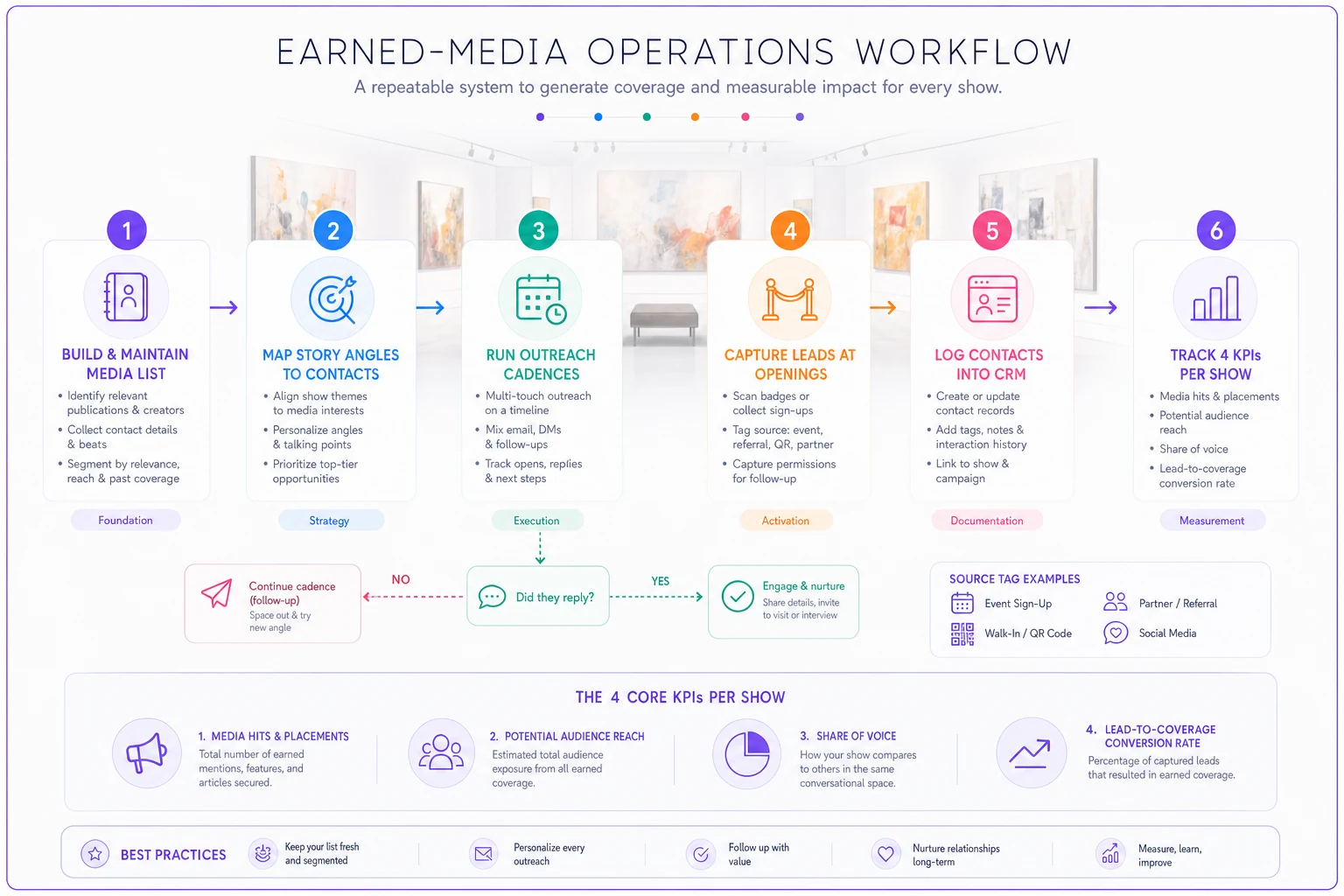
The value isn't automation for its own sake; it's that nobody has to remember the cadence, and the source data doesn't get lost between shows.
When this full system makes sense — and when it doesn't
When it's worth building: You're running three or more openings a year, you have at least one person who can own the media list, and you're already trying to grow your collector base beyond walk-ins. The system compounds — by your third show, the list and notes make outreach dramatically faster.
When it's overkill: You do one small show a year, or you're a project space where press genuinely doesn't affect who shows up. In that case, a single clean listings submission and a good email to five real contacts is enough. Don't build a matrix for one email.
Who should not do this: Galleries with no plan for what happens after someone walks in. If your front-of-house and follow-up are broken, better press just means more people slipping through the cracks. Fix the conversion side first, then turn the press faucet on.
A realistic before-and-after
A two-person contemporary gallery running four shows a year had press handled entirely by the co-owner, squeezed into opening week. Coverage was inconsistent — a couple of listings, occasionally a blog post, no idea whether any of it mattered. Outreach ate roughly a day and a half per show and left nothing behind.
They made three changes: built a tiered media list of about 40 contacts, wrote angle-matched pitches for the top 12, and added a "how did you hear about us?" field at the door.
Over the next two shows, the picture shifted. Outreach time dropped to around half a day per show because the list and scripts were reusable. Attributed press RSVPs went from "no idea" to somewhere in the range of 15–25 per opening. A handful of those press-sourced contacts booked private viewings afterward, with one leading to a mid-four-figure sale. Not a flood. But now it was a channel they could see, repeat, and improve — which is more than most galleries have.
The real shift
The change here isn't about writing better press releases. It's about treating earned media as an operation with inputs, cadences, and outcomes you can actually read — instead of a frantic favor you beg for the week before every opening.
Build the list once. Match the angle to the person. Follow up three times and stop. Capture every name that walks in, tagged by where it came from. Do that across a few shows and press stops being the thing that drains your team's time and starts being the thing that quietly fills your CRM.
Build the list once. Match the angle to the person. Follow up three times and stop. Capture every name that walks in, tagged by where it came from. Do that across a few shows and press stops being the thing that drains your team's time and starts being the thing that quietly fills your CRM.