


Running a gallery means watching hundreds of people walk through your doors each month. Maybe 60% browse quietly, 30% engage with staff, 10% leave contact information, and 2-3% actually buy something. Those percentages represent a broken funnel leaking revenue at every stage.
Most galleries treat visitor flow like weather—something that just happens to them. They count heads at openings, collect some emails, celebrate when someone buys. But there's no systematic approach to moving people from awareness through to becoming repeat collectors. No staff scripts. No data capture beyond a guest book. No follow-up sequences tied to actual buying behavior.
The galleries that consistently hit revenue targets run a completely different operation. They've built a visitor engagement funnel—a repeatable system that captures data at multiple touchpoints, guides staff interactions, measures conversion at each stage, and ties everything back to monthly revenue goals.
The revenue math that changes everything
A typical small gallery might see 400 visitors monthly during regular hours, plus another 200 at openings or events. Converting at 2%, that's 12 sales. Average transaction around $3,500 means $42,000 monthly revenue from walk-ins and events.
Here's what happens when you run an actual engagement funnel:
-
Awareness
600 total monthly exposures
-
Visit
400 actually enter (67% conversion)
-
Engagement
140 have meaningful interaction (35% of visitors)
-
Data capture
56 provide contact info (40% of engaged)
-
First purchase
14 buy within 90 days (25% of captured)
-
Retention
7 make second purchase within year (50% retention)
Those aren't dramatic improvements—just a couple percent better at each stage. But that extra engagement means 14 sales instead of 12, plus the compounding effect of retention. Annual revenue difference? Around $84,000.
The real point is that galleries already have these visitors. They're just not systematically working the funnel.
Why galleries fail at the awareness stage (before anyone walks in)
Awareness isn't marketing—it's operational readiness for when marketing works. Most galleries think awareness means Instagram posts and email blasts. But operationally, awareness means having systems ready to handle different visitor types when they show interest.
A gallery in Denver learned this the hard way. They spent $4,000 on a social media campaign that drove 300 new visitors in one month. Great traffic. Zero operational preparation. No special signage for first-timers. No modified floor plan to handle crowds. No data capture beyond the usual guest book. Staff had no approach for engaging newcomers versus regulars.
Result? They captured contact info from 8 people. Normal months they got 12 from organic traffic.
The awareness stage needs:
-
Entry protocols for different visitor types
-
Physical space configured for flow
-
Data capture mechanisms at multiple points
-
Staff scripts for initial engagement
-
Systems to track source (walk-in, referral, event, digital)
The awareness stage needs to be operational, not just promotional. Without that, marketing spends fail to convert into long-term value.
The visit stage: first 30 seconds determine everything
What typically happens: someone walks in. If staff is free, they might say hello. If busy, the visitor wanders alone. No systematic approach to those critical first moments.
Compare that to galleries running proper funnels. They operate on a 30-second rule. Every visitor gets acknowledged within 30 seconds, even if staff is occupied. Could be a nod, a "I'll be right with you," or a full greeting. But contact happens.
The script matters less than consistency. One gallery uses:
-
First 10 seconds
Visual acknowledgment
-
Next 20 seconds
Verbal greeting if possible
-
By 30 seconds
Some form of engagement
They track this religiously. Days when the 30-second rule breaks down, conversion drops by half.
Physical layout matters too. Galleries with engagement funnels arrange their space deliberately:
-
Power wall visible from entrance
-
Clear sight lines to desk and staff area
-
Seating areas that encourage lingering
-
Natural flow that passes high-margin pieces
Layout and staffing together determine whether that 30-second moment becomes an opportunity or a missed sale.
Engagement: where scripts meet spontaneity
This is where most galleries completely wing it. Staff might be knowledgeable about art but have no consistent approach to visitor engagement. Every interaction becomes a roll of the dice.
Galleries with working funnels give staff actual frameworks. Not robotic scripts—conversation structures:
Opening engagement framework:
-
Acknowledge and assess (touring, browsing, looking for something specific?)
-
Offer value (story about current exhibition, artist background, upcoming event)
-
Create connection point (what brought you in today?)
-
Soft data capture (can I add you to our preview list?)
One gallery tested this against their previous no-system approach. Structured engagement increased email capture by around 40% and average time in gallery from 8 minutes to 14 minutes.
The nuance is that different visitor types need different approaches:
First-time visitors: Focus on orientation and comfort
Return browsers: Reference previous visits, update on new work
Event attendees: Emphasize exclusive access, preview opportunities
Serious inquirers: Shift to consultative selling, pricing discussions
Tailoring the framework to visitor type keeps interactions natural while ensuring consistency.
Data capture: beyond the guest book
Walk into most small galleries and you'll find a guest book. Maybe 20% of visitors sign it. Of those, half use illegible handwriting or fake emails. It's theater, not data capture.
Effective galleries create multiple capture points:
Physical touchpoints:
-
QR codes next to specific pieces (learn more about this artist)
-
iPad stations for exhibition info (email required)
-
Event RSVPs that require full contact info
-
Catalog requests with shipping address
-
Prize drawings at openings (business cards in bowl)
Conversation touchpoints:
-
"I can send you the artist's full portfolio"
-
"We're having a collector preview next month"
-
"The piece you're interested in—I can hold it for 24 hours"
-
"Our newsletter features one artist deep-dive monthly"
Each touchpoint needs a reason for the visitor to share information. Generic "join our mailing list" requests get ignored. Specific value propositions work.
One gallery tracks capture rate by method:
-
Guest book
8%
-
Event RSVP
45%
-
Artwork inquiry
72%
-
Preview list signup
34%
-
Contest entry
61%
Offer a specific deliverable (image set, portfolio PDF, or preview invite) when asking for contact info—generic requests perform poorly.
Clean, multiple capture methods turn theater into usable data.
Conversion: the 7-touch reality
First-time visitors rarely buy on first visit. The conversion process typically requires somewhere between 7 and 12 touchpoints over 60 to 90 days. Most galleries have no systematic follow-up process at all.
A working conversion sequence might look like:
-
Day 1 Visit occurs, data captured
-
Day 2 Thank you email with one specific piece they viewed
-
Day 7 Artist spotlight email featuring work they engaged with
-
Day 14 Invitation to upcoming event
-
Day 21 New acquisition announcement in their interest area
-
Day 30 Personalized curator recommendations
-
Day 45 Preview opportunity for next exhibition
-
Day 60 Special collector pricing on specific piece
-
Day 75 Phone call from gallery director
-
Day 90 Final follow-up with featured collection
This isn't random emailing. Each touch should reference their specific interests, viewing history, and engagement level.
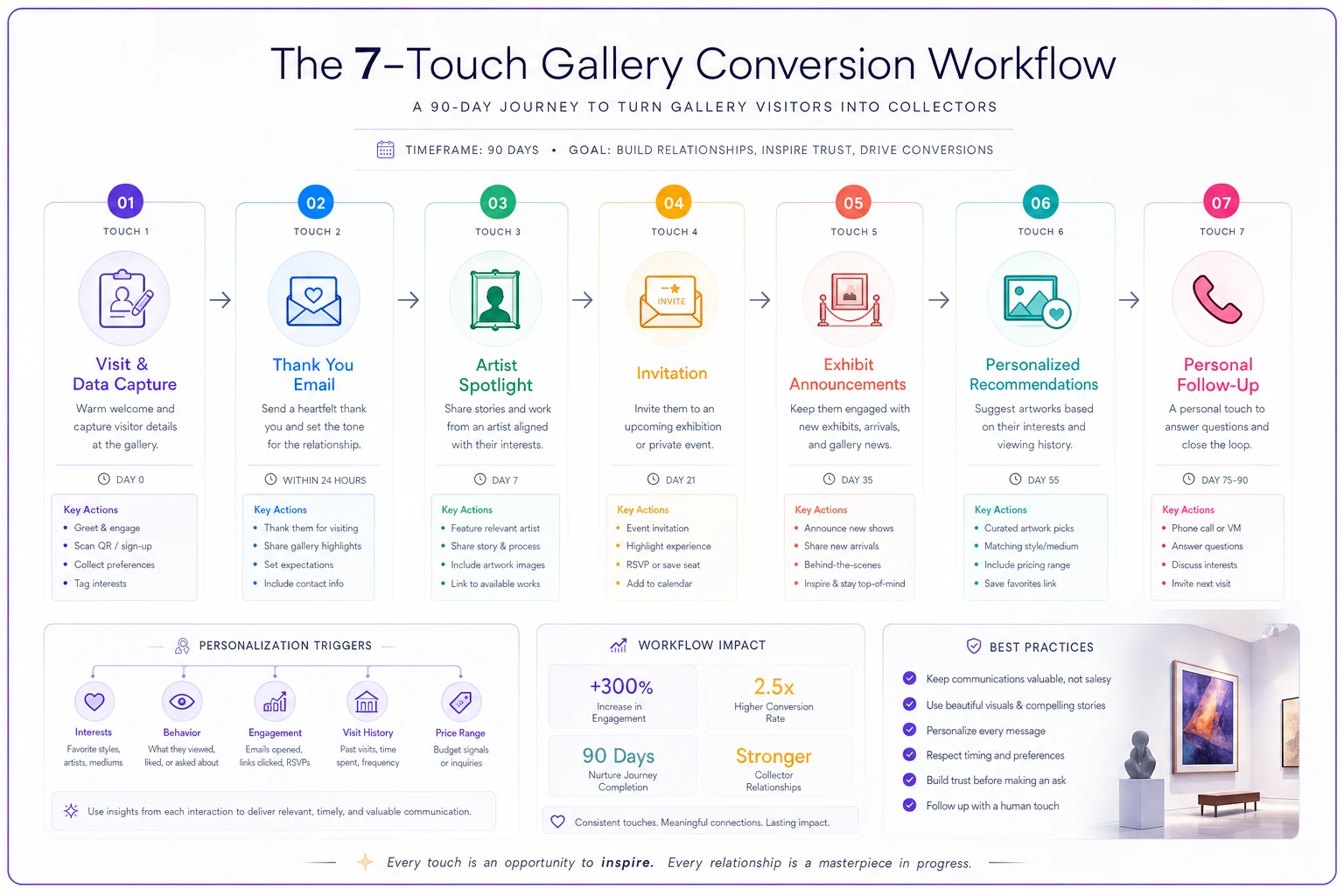
The graphic above maps the sequence and timing so teams can operationalize follow-ups without guesswork.
Consistency across these touchpoints is what turns initial interest into a sale.
Retention: where real gallery revenue lives
New collector acquisition costs galleries somewhere in the range of $200-$400 per buyer when you factor in events, marketing, and staff time. Keeping an existing collector active? Maybe $40-$60 annually.
Yet most galleries treat all buyers the same. No differentiation between first-time purchasers and collectors who've bought multiple pieces. No systematic approach to encouraging repeat purchases.
Retention requires segmentation:
First-time buyers:
-
Immediate post-purchase thank you
-
Artist meet-and-greet invitation
-
Complementary piece suggestions within 30 days
-
Framing and installation support
-
6-month check-in call
Repeat collectors (2-4 purchases):
-
Preview access to new acquisitions
-
Studio visit opportunities
-
Payment plan options
-
Commission possibilities
-
Annual collection review
Major collectors (5+ purchases or $25k+ annual):
-
Direct curator relationship
-
First refusal on major pieces
-
Private exhibition tours
-
Art fair VIP access
-
Estate planning consultation
Segmented retention programs increase lifetime value and reduce acquisition pressure.
The KPI scorecard that actually drives revenue
Most galleries track vanity metrics—Instagram followers, email open rates, total visitors. Those don't directly tie to revenue. A proper funnel scorecard tracks metrics that actually matter:
| Funnel Stage | Key Metric | Target | Current | Gap | Revenue Impact |
|---|---|---|---|---|---|
| Awareness | Monthly unique visitors | 400 | 320 | -80 | -$8,400 |
| Visit | Greeting within 30 sec | 95% | 71% | -24% | -$5,200 |
| Engagement | Meaningful interaction rate | 35% | 22% | -13% | -$6,800 |
| Capture | Contact info collection | 40% | 18% | -22% | -$4,200 |
| Conversion | 90-day purchase rate | 25% | 14% | -11% | -$9,100 |
| Retention | Annual repeat rate | 50% | 31% | -19% | -$12,600 |
Total revenue gap: $46,300 monthly / $555,600 annually
That scorecard becomes the operational focus. Not general improvement—specific gaps to close.
Front-of-house scripts that actually work
Generic scripts fail because they sound robotic. No scripts means inconsistent visitor experience. The solution is framework scripts—structures that staff can personalize.
Initial greeting framework:
"Welcome! First time visiting us?" [If yes]: "Perfect timing—we just opened [current exhibition]. Can I give you a quick orientation?" [If no]: "Welcome back! Have you seen our new [specific change since last visit]?"
Engagement deepening:
"What brought you in today?" [Browsing]: "Any particular style or artist you're drawn to?" [Specific interest]: "You have great taste—let me show you something similar." [Event-driven]: "Since you're here for [event], you might appreciate [related pieces]."
Data capture transition:
"I'd love to send you more information about [specific piece/artist they engaged with]. What's the best email for you?"
Objection handling:
[Price]: "We offer payment plans starting at $200 monthly. Would that be helpful?" [Thinking about it]: "No pressure at all. I can hold this for 48 hours while you consider." [Spouse approval]: "Why don't I send you both some images and details to review together?"
Framework scripts like these keep the tone human while providing predictable outcomes for staff.
The technology layer (where automation helps)
Running this funnel manually requires real discipline. One busy Saturday and the whole system breaks down. That's where operational software keeps everything consistent.
A properly configured system handles:
-
Visitor check-in via iPad (not paper book)
-
Automatic engagement timers for staff
-
Follow-up sequences triggered by visit type
-
Conversion tracking across all touchpoints
-
Revenue attribution by funnel stage
-
Staff performance against scripts
One gallery implemented funnel automation and saw immediate improvements—not because the software was magic, but because it enforced consistency. Staff couldn't skip the greeting protocol. Follow-ups happened automatically. Data got captured cleanly.
The automation also revealed problems hiding in manual processes. They discovered their weekend staff never captured emails because they were too busy. Their follow-up emails went out randomly, sometimes weeks late. Their "VIP collector" list included people who hadn't purchased in three years.
Real gallery, real numbers
A contemporary gallery in Austin ran without a funnel system for four years. Monthly revenue averaged $31,000, heavily dependent on quarterly openings. The owner knew most collectors personally but had no systematic approach to developing new ones.
They implemented the full funnel approach:
-
Awareness
Added QR codes, Instagram check-in incentive, referral program
-
Visit
30-second rule, reorganized layout for better flow
-
Engagement
Staff training on framework scripts, visitor type identification
-
Capture
Multiple touchpoint strategy, value-driven offers
-
Conversion
90-day automated sequence with personalization
-
Retention
Collector segmentation, targeted retention programs
Month 1: Chaos. Staff resisted scripts. Systems felt forced.
Month 2: Rhythm developing. 30-second rule becoming habit.
Month 3: Email list grew by 140 contacts. No sales increase yet.
Month 4: First conversion from automated sequence. $4,200 sale.
Month 5: Three purchases from nurtured leads. Total $11,000.
Month 6: Monthly revenue hit $43,000. Best non-opening month ever.
By month 12, average monthly revenue was $47,000. The funnel hadn't created new visitors—it just stopped losing the ones they already had.
When this system doesn't work
This approach isn't for every gallery. If you're running a pure passion project, showing only emerging artists, operating by appointment only—this level of systematization might actually kill what makes you special.
It also requires staff buy-in. If your team sees structure as corporate nonsense, if they resist any form of measurement, if they genuinely believe art should sell itself, you'll face constant friction.
Some galleries thrive on exclusivity and scarcity. Making everyone feel welcome, capturing all data, following up systematically—it can dilute the brand. A gallery in Miami tried this approach and actually saw revenue drop. Their collectors valued the difficulty of access.
Building your revenue-first plan
Start with your revenue goal and work backward. If you need $50,000 monthly, and average transaction is $4,000, you need 13 sales. At 25% conversion from captured leads, you need 52 quality leads. At 40% capture from engaged visitors, you need 130 engaged visitors. At 35% engagement rate, you need around 370 visitors.
Now you have concrete targets for each funnel stage.
Next, audit where you actually stand:
-
How many visitors do you actually get?
-
What percentage currently engage?
-
How many provide contact info?
-
What's your real conversion rate?
-
How many buyers purchase again?
The gaps between current state and required state become your operational priorities.
Then build incrementally:
-
Start with the 30-second rule (costs nothing, immediate impact)
-
Add one new data capture method (QR codes are easy)
-
Create a basic follow-up sequence (even three emails is better than none)
-
Develop framework scripts (test with willing staff first)
-
Implement a measurement system (manual tracking if needed)
Incremental changes compound over time; pick a small, measurable change and iterate.
The compound effect of systematic improvement
A visitor engagement funnel isn't about turning your gallery into a sales machine. It's about respecting the fact that most visitors need time and multiple touchpoints before they're ready to buy. It's about giving your staff tools to succeed consistently. It's about measuring what actually matters and improving from there.
The galleries succeeding today aren't necessarily showing better art. They're not always in better locations or targeting wealthier collectors. They've simply built operational systems that consistently convert interest into revenue.
Every visitor represents potential revenue. Not immediate, not guaranteed—but potential. The funnel approach increases the percentage of that potential you actually capture. Small improvements at each stage compound into meaningful revenue growth over time.
The art world likes to pretend that commerce and culture don't mix, that systematic approaches somehow diminish the gallery experience. But watching galleries close because they can't make rent—that's what really diminishes the culture. A revenue-first visitor funnel keeps galleries open, artists paid, and art accessible.
Your visitors are already coming. Your art is already compelling. The funnel just makes sure you're not losing them to operational inconsistency. In a business where margins are thin and every relationship matters, that consistency is often the difference between galleries that survive and those that thrive.
The art world likes to pretend that commerce and culture don't mix, that systematic approaches somehow diminish the gallery experience. But watching galleries close because they can't make rent—that's what really diminishes the culture. A revenue-first visitor funnel keeps galleries open, artists paid, and art accessible.
Your visitors are already coming. Your art is already compelling. The funnel just makes sure you're not losing them to operational inconsistency. In a business where margins are thin and every relationship matters, that consistency is often the difference between galleries that survive and those that thrive.