


Most galleries treat fundraising and reserves as two separate conversations. Development chases donors and events. Finance worries about cash on hand. The board sits somewhere in the middle, approving budgets without a clear line connecting "money raised" to "programs that work." That gap is where a lot of small and mid-sized galleries quietly lose ground year after year.
The galleries that handle this well think differently. They treat donor economics, reserve policy, and program KPIs as one connected system. A donor isn't just a check — they're a funding stream attached to a specific program with a specific cost and a measurable outcome. Reserves aren't a number someone picked because it felt safe — they're sized against real volatility in that program's funding. And the board ask isn't a vague "we need more money" — it's a request tied to what the money will actually produce.
This piece walks through how that system fits together: donor-tier economics, stewardship cadence mapped to program performance, reserve math that holds up under scrutiny, and the thresholds boards should use to decide between spending and preserving. If you want the broader governance context, the earlier piece on governance traps, boards, reserves and a 3–5 year fiscal roadmap is worth reading alongside this one — this article goes deeper into the donor-and-program math specifically.
The core problem: fundraising disconnected from what it funds
A pattern that shows up constantly: a gallery runs an education program, a residency, and its exhibition calendar. Donations come in from a mix of patrons, a few foundations, membership, and a gala. When someone asks "which program does this money support?" the honest answer is usually "all of it, kind of." Funds get pooled, spent against whatever is urgent, and nobody can say whether the education program is actually carrying its weight or quietly draining the general fund.
This matters because unrestricted pooling hides failure. A program that costs $40k a year and produces almost nothing measurable looks identical, on the books, to one that costs the same and brings in new collectors, press, and repeat donors. The money came from the same place and went into the same bucket.
When donor dollars aren't connected to program outcomes, three things tend to break down over time:
-
Donors get stewarded generically, so your biggest supporters get the same thank-you cadence as a $50 member
-
Reserves get sized by gut feeling instead of by the actual volatility of your funding streams
-
The board approves spending without any framework for when to spend versus when to preserve
The fix isn't a bigger development team. It's a tighter map between who gives, what their money funds, and whether that program is hitting its numbers.
Donor-tier economics: what each tier actually costs and returns
Start by being honest about the economics of each donor tier. Not just how much they give — what it costs you to acquire and keep them, and what they realistically return over a few years. A lot of galleries over-invest in low-tier donors with high-touch stewardship and under-invest in the mid-tier patrons who quietly deliver the best net return.
Never miss a key exhibition detail again.
Artioly helps you organize, promote, and manage every exhibition effortlessly.
- Unified exhibition scheduling
- Artist and visitor notifications
- Inventory and sales tracking
No credit card required
A typical donor-economics breakdown looks something like this:
| Donor tier | Typical annual gift | Acquisition cost | Annual stewardship cost | Retention rate | 3-yr net value (est.) |
|---|---|---|---|---|---|
| Members / entry | $75–$250 | Low ($20–$40) | Low (automated) | 55–65% | $300–$600 |
| Mid patrons | $1k–$5k | Moderate | Moderate (events + personal notes) | 70–80% | $4k–$12k |
| Major donors | $10k–$50k | High (relationship-driven) | High (curator time, visits, dinners) | 80–90% | $45k–$120k |
| Institutional / foundation | $25k–$150k | Very high (grant writing) | High (reporting burden) | Varies by cycle | Lumpy, cyclical |
The numbers will differ for every gallery, but the shape usually holds.
The mid-tier is where most galleries leave money on the table. These patrons are past the "testing you out" phase but haven't been cultivated toward major giving. They retain well, cost less than major donors to maintain, and a reliable chunk of them will move up if someone actually pays attention to them. In practice, the mid-tier gets neglected precisely because they don't demand attention — not big enough to flag, not small enough to automate fully.
Foundation money is lumpy and comes with a reporting tax. A $100k grant that requires 40 hours of reporting, restricted spending, and a hard deadline is not the same as $100k in flexible patron gifts. Price that reporting burden in when you compare streams, because it shows up as staff time you can't spend elsewhere.
Acquisition cost at the top is mostly staff hours, which is the one resource small galleries chronically under-count. When your curator spends two afternoons a month on a single major donor relationship, that's real cost — it just doesn't show up on an invoice.
Mapping stewardship cadence to program KPIs
This is the part most galleries skip entirely. Stewardship cadence — how often and how deeply you engage a donor — should be driven partly by the performance of the program their money supports. Not just by gift size.
If a donor funds your education program and that program is hitting its KPIs — attendance up, school partnerships renewed, new families converting to membership — you have a story to tell them. That's the moment for a visit, a report, a renewal ask. If the program is underperforming, the cadence shouldn't be silence; it should be a different kind of conversation about what's changing. Either way, program performance should be driving the content and timing of stewardship, not just a generic quarterly newsletter.
What this looks like in practice:
-
Tie each major donor to a program with 3–4 tracked KPIs. Education donor → attendance, partner renewals, membership conversions, cost-per-participant. Exhibition donor → attendance, press reach, acquisitions influenced, new collector intros.
-
Set stewardship touchpoints to coincide with KPI reporting moments. When a program hits a milestone, that's a trigger for outreach — not an arbitrary calendar date.
-
Match depth of touch to tier and to program outcome. A major donor whose program is thriving gets a curator-led walkthrough. A mid-patron whose program is steady gets a short personal note with the actual numbers.
The deeper mechanics of segmentation and touchpoint timing across the full relationship are covered in the piece on collector lifecycle governance and stewardship cadence. The difference here is that this version explicitly ties cadence to program KPIs, not just the donor's own giving history.
One common mistake: galleries report to donors only when they want more money. If the only time a major donor hears a detailed program update is three weeks before the renewal ask, they notice. Stewardship that actually builds lifetime value reports on outcomes whether or not an ask is attached.
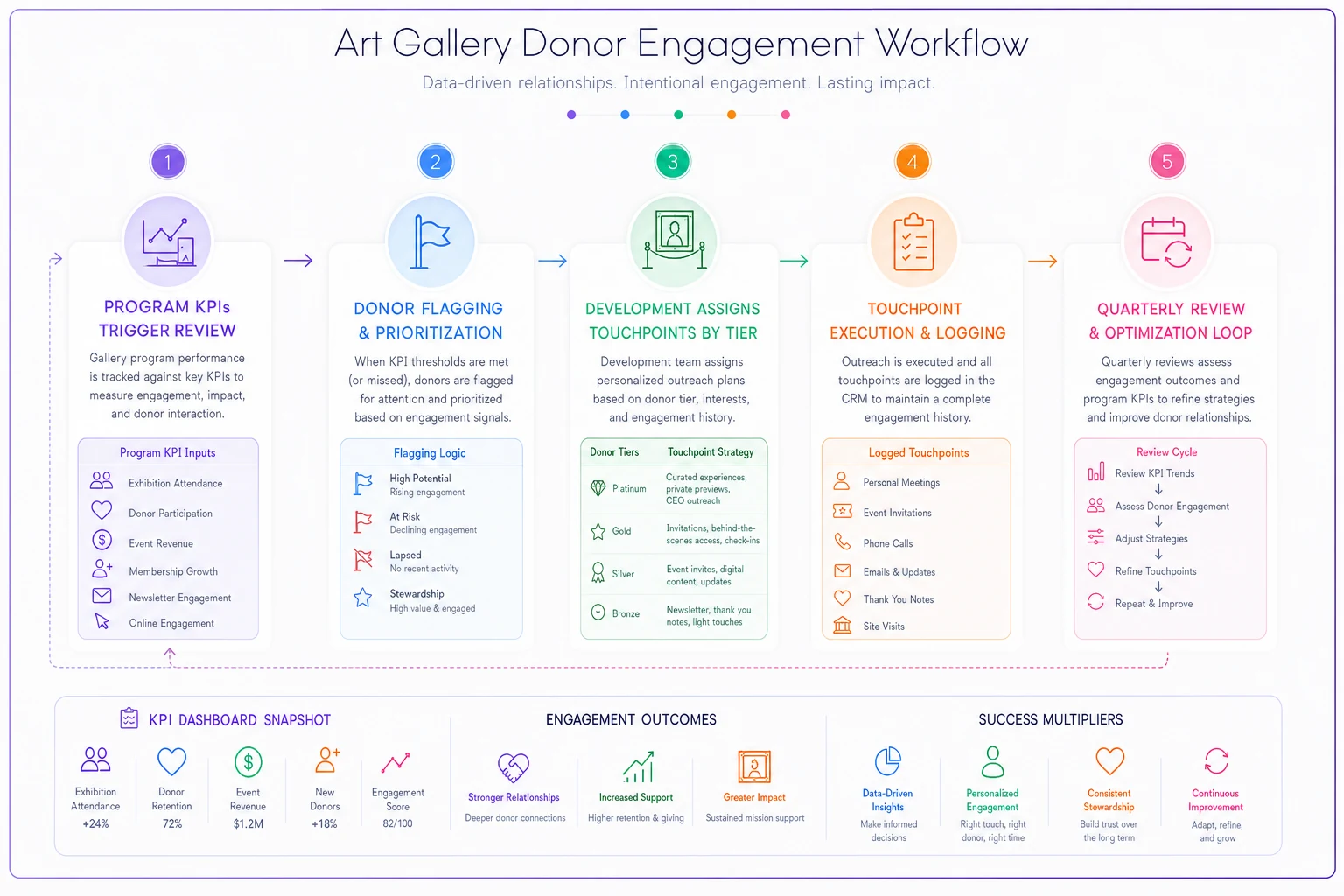
A simple stewardship workflow
-
Program logs its KPIs monthly — attendance, conversions, partnerships, spend against budget.
-
When a KPI crosses a milestone, good or bad, it flags the donors attached to that program.
-
Development reviews flagged donors weekly and assigns the right touchpoint by tier.
-
The touchpoint happens, gets logged, and the donor's record updates.
-
Quarterly, you review which stewardship actions correlated with renewals and upgrades.
Writing it as a loop matters because it keeps running without someone remembering to start it. Most stewardship breakdowns happen because the trigger is "when we get around to it" instead of "when the program data says so."
A shared system where program KPIs and donor records live in the same place — rather than program data in one spreadsheet and donor notes in someone's inbox — is what makes this cadence actually hold as you grow. AI-powered operational platforms can automate the flagging and touchpoint assignments in this loop, which removes a lot of the manual coordination that causes delays. The loop only works reliably if something is watching the data and surfacing the right names at the right time, and that's genuinely hard to do manually once you're tracking more than a handful of programs simultaneously.
Include staff time on donor-facing activities when you model acquisition and stewardship costs so their real cost shows up in decision-making.
Here's a simple visual of that loop.
The loop only works reliably if something is watching the data and surfacing the right names at the right time, and that's genuinely hard to do manually once you're tracking more than a handful of programs simultaneously.
Reserve-sizing math that holds up to board scrutiny
"How much should we hold in reserve?" gets answered with round numbers far too often — three months of operating expenses, or some figure a board member half-remembers from another organization. That's a starting point, not an answer.
Reserves should be sized against the volatility of your funding, not just the size of your budget. A gallery with steady membership and recurring patron gifts needs a smaller reserve than one leaning on a single annual gala and two foundation grants that could vanish in a bad cycle.
A workable approach:
-
Reliable recurring memberships, multi-year committed gifts, earned income like venue hire
-
Semi-reliable annual patron gifts with strong retention history
-
Volatile single events, one-time major gifts, grants on uncertain renewal
Step two — calculate your volatile exposure. Add up what percentage of your annual revenue comes from volatile sources. If roughly 35–45% of your income is volatile, your reserve needs to cover a realistic shortfall in that segment — not your entire budget, but the piece most likely to swing.
Step three — size the reserve to cover a plausible bad year in the volatile segment plus a fixed-cost buffer. A simple version:
> Target reserve = (volatile revenue × expected worst-case drop %) + (fixed monthly costs × months to recover)
A gallery with about $500k in annual revenue, where roughly $180k is volatile, might model a worst-case 40% drop in that segment — around $72k — plus four months of fixed costs to cover the gap while they recover. If fixed costs run about $22k a month, that's another $88k. Target reserve lands somewhere around $150k–$160k. That's a number you can defend to a board because every piece of it maps to a real risk.
Compare that to "three months of operating expenses," which for the same gallery might suggest $125k with no connection to where the actual danger is. The volatility-based number is both more defensible and more honestly tied to the gallery's real funding mix.
This also connects directly to revenue diversification — the more you shift income toward reliable streams, the smaller your required reserve gets. The earlier piece on lowering exhibition risk with predictable income and a revenue diversification portfolio covers the income side of that equation; reserve-sizing is the defensive mirror of it.
Board-level spend vs. preservation thresholds
Once you have a sized reserve, the board needs clear rules for when to spend from it and when to protect it. Without thresholds, every reserve conversation becomes a fresh argument, usually driven by whoever is most anxious or most optimistic in the room that evening.
| Reserve level (vs. target) | Status | Board posture |
|---|---|---|
| Above 100% of target | Green | Can fund approved strategic bets from surplus above target |
| 70–100% of target | Yellow | Preserve; spend only on committed obligations |
| Below 70% of target | Red | Active rebuild plan required; no discretionary spend |
The value here is that the board decides the rules when things are calm, then follows them when things aren't. A board that agrees in a quiet quarter that dropping below 70% triggers a rebuild plan will behave far more rationally in a crisis than one improvising under pressure.
A pattern worth watching: boards are often more willing to spend reserves on visible, exciting things — a flagship show, a new hire — than on the boring infrastructure that actually stabilizes the organization. The threshold framework helps because it forces the question "where are we relative to target?" before "is this project exciting enough to approve?" That sequence matters more than most boards realize.
A board ask template tied to measurable outcomes
The ask itself should read like an investment case, not a plea. The structure that works:
-
The program and its current KPIs. What it does, what it's producing now, with actual numbers.
-
The specific ask and what it funds. Not "support our operations" — "fund the education coordinator role for 18 months."
-
The measurable outcome you're committing to. "Grow school partnerships from 6 to 10 and lift membership conversions from the program by roughly 15%."
-
The reporting cadence. When and how you'll show progress against those targets.
-
The downside and the reserve implication. What happens if it underperforms, and how that affects reserves.
A filled-in version might read: "The education program currently reaches about 1,200 students across 6 school partnerships, converting roughly 8% of participating families into members. We're asking the board to approve $55k to fund a dedicated coordinator for 18 months. Target: 10 partnerships and a conversion lift to around 12–15%, reported quarterly against baseline. If conversion stalls below 10% after two quarters, we pause and reassess rather than extend."
That ask is approvable because the board knows exactly what they're buying, what success looks like, and what the exit is if it doesn't work.
When this level of rigor makes sense — and when it doesn't
Not every gallery needs all of this at once. The system earns its keep at a certain level of complexity; below that, it's more overhead than it's worth.
When it makes sense: You're running multiple programs, pulling from several funding streams, and have a board that approves budgets. Once you're past roughly $300k–$400k in annual revenue with a mix of restricted and unrestricted money, the connected system stops being optional. The complexity will cost you if you don't manage it.
When it's overkill: A very small gallery with one main revenue line and no formal board doesn't need volatility-weighted reserve math and tiered donor economics modeling. You'd spend more time building the system than it returns. A simpler cash buffer and a basic donor list will serve you until the complexity actually shows up.
Who should NOT start here: If your program KPIs aren't being tracked at all yet, don't begin with donor economics. The whole system depends on reliable program data. Get your programs reporting a handful of consistent KPIs first — attendance, conversions, cost — then layer donor and reserve logic on top. Building the fundraising map on top of program data you don't trust just produces confident-looking garbage.
A real scenario
A mid-sized nonprofit gallery, roughly $480k in annual revenue, three programs, nine-person board. Going in, everything was pooled. Reserves sat around $90k — a number chosen because it felt roughly like "a couple of months." Two foundation grants and the annual gala made up close to 40% of income, but nobody had flagged that as concentrated risk.
They did three things over about a year. First, they mapped each major donor and grant to a specific program with 3–4 KPIs each. Second, they re-sized the reserve against volatile exposure, which pushed the target up to around $150k and surfaced how exposed they actually were to a single bad gala year. Third, they rebuilt board asks around measurable outcomes and set spend-versus-preserve thresholds.
The wins weren't dramatic overnight. Within the year, mid-tier retention improved noticeably once stewardship started referencing actual program results instead of generic updates. The board stopped having circular reserve arguments because the thresholds did the arguing for them. And when one foundation grant came in late the following cycle, the reserve framework meant it was a managed inconvenience rather than a panic. The gallery didn't raise dramatically more money — it just stopped flying blind about which money was doing what.
Pulling it together
The thread running through all of this is connection. Donor tiers connect to programs. Programs connect to KPIs. KPIs drive stewardship cadence. Funding volatility sizes the reserve. The reserve level sets the board's spend-versus-preserve posture. And every board ask ties back to a measurable program outcome.
The galleries that struggle aren't usually bad at raising money or bad at running programs. They're just running the two as separate systems that never talk to each other — so the reserve is a guess, the stewardship is generic, and the board is approving budgets on faith. Closing that gap doesn't require more donors or a bigger team. It requires treating your fundraising reserve strategy as one map where every dollar has a program, every program has a number, and every number has someone watching it.
Ready to elevate your gallery operations?
Join 500+ galleries using Artioly to streamline operations, boost visitor engagement, and increase art sales.