


Most small galleries don't fail because of a single bad show or a difficult season. They fail because the machinery that's supposed to catch problems early never got properly wired together. The board meets quarterly and rubber-stamps whatever the director brings. Reserves exist as a number in a bank account nobody's assigned a purpose to. Programming decisions get made eighteen months out with no formal link to what the finances can actually absorb.
Each of those pieces can work fine in isolation. It's the gaps between them where galleries lose money, burn through cash cushions, and end up making panicked programming cuts that damage artist relationships they spent years building.
This is really a piece about governance financial strategy for small galleries as a connected system — how board charters, reserve policies, delegated approvals and scenario planning either lock together into something that protects you, or drift apart into a collection of documents nobody follows.
The core problem: your governance and your money live in separate worlds
Walk into most small nonprofit or hybrid commercial galleries and you'll find two parallel universes.
In one universe, there's governance: a board, some bylaws, maybe a committee structure copied from a template a lawyer sent over years ago. This world speaks in motions, minutes, and fiduciary duty.
In the other universe, there's the actual money: exhibition budgets, consignment payouts, a reserve account, membership income, the occasional grant. This world speaks in cash flow and "can we afford the shipping on that loan show."
These two worlds almost never share a vocabulary. The board approves a "strategic direction" without specifying what reserve level that direction actually requires. The director builds a programming calendar without a formal gate that says this show only proceeds if the reserve is above X. So when a lean quarter hits, there's no rule to fall back on — just a stressed director making judgment calls and a board that finds out after the fact.
The failure isn't usually a lack of documents. It's that the documents don't reference each other. The board charter doesn't mention the reserve policy. The reserve policy doesn't connect to programming decisions. Nobody has drawn the line from "we want to do three ambitious shows next year" back to "here's the financial condition that has to be true for that to happen."
Why this happens almost everywhere
Small galleries are usually founder-run or director-run, and governance gets built reactively. You form a board because a grant application required one. You set a reserve target because a consultant said "three months of operating expenses" once. You create an approval process because a purchase went sideways and everyone agreed there should be one.
Never miss a key exhibition detail again.
Artioly helps you organize, promote, and manage every exhibition effortlessly.
- Unified exhibition scheduling
- Artist and visitor notifications
- Inventory and sales tracking
No credit card required
Each piece is a patch for a past problem. None of them were designed to work together.
There's also a cultural dynamic. Boards at small galleries are often stacked with collectors, art lovers, and well-connected supporters — not people who naturally think in financial control systems. The board's instinct is to support programming, not interrogate whether the reserve can survive it. The director, meanwhile, doesn't want to be the person killing exciting exhibitions. Everyone is optimizing for the mission, and nobody is officially defending the balance sheet.
The result is a governance structure that's supportive but not protective. It cheers the shows on. It doesn't catch the slow bleed.
What actually breaks as you grow
At a very small scale — one space, a handful of shows a year, a director who knows every number personally — you can survive on informal governance. The director carries the whole model in their head. They know when the reserve is getting thin because they check the account.
That stops working faster than most people expect. Here's the progression:
Stage one — single decision-maker. Everything runs through one person. Governance is basically "ask the director." Works fine because the scope is small enough for one brain to hold.
Stage two — added complexity, same governance. Now there's a membership program, a venue-rental line, maybe a small endowment or restricted grant money. The director is still making every call, but the moving parts have outgrown any single mental model. Restricted funds get accidentally treated as spendable. A rental deposit gets counted as available cash when it's really an obligation.
Stage three — coordination breakdown. Multiple staff, multiple revenue lines, a board that's grown but still meets quarterly. Decisions are being made by different people who don't share the same picture of financial health. Someone commits to a shipping cost, someone else books an artist, and nobody's tracking the cumulative drawdown against the reserve until it's already happened.
What breaks at scale isn't ambition. It's the absence of shared decision gates. When several people can independently spend money against the same reserve without a rule tying spending to reserve condition, you get uncoordinated drawdowns that only become visible after the damage is done.
The four pieces that need to connect
A real governance financial strategy for small galleries isn't four separate documents. It's four documents that quote each other.
| Component | What it usually does alone | What it should do when connected |
|---|---|---|
| Board charter | Defines roles, meeting cadence, fiduciary duty | Assigns specific financial oversight duties — who reviews reserve levels, who approves spending above thresholds |
| Reserve policy | States a target ("3 months of expenses") | Defines tiers of reserve health and what programming is permitted at each tier |
| Delegated approvals | Vague sign-off authority | Dollar thresholds tied to reserve condition — approval limits tighten as reserves fall |
| Scenario plan | Optional wishful budget | 3–5 year roadmap where each programming choice is tagged to the reserve rule that governs it |
The value isn't in any single row. It's that the reserve policy references the approval thresholds, the approval thresholds reference reserve tiers, and the scenario plan references all of it. Change one, and you can see what else has to move.
Reserve tiers: the piece most galleries skip
A flat reserve target — "keep three months on hand" — is nearly useless as a decision tool. It tells you whether you're above or below a line. It doesn't tell you what to do about programming.
Reserve tiers fix that. Instead of one threshold, you set bands, and each band changes what the gallery is permitted to commit to.
-
Green tier (above roughly 4 months of operating expenses) Full programming latitude. Ambitious shows, loan exhibitions with real shipping costs, speculative acquisitions — all permitted through normal approval.
-
Yellow tier (roughly 2–4 months) Programming continues, but any new commitment above a set threshold — say $5k — requires board finance committee sign-off, not just director approval. No new speculative acquisitions.
-
Red tier (below roughly 2 months) Freeze on discretionary spending. Only contractually committed shows proceed. Any new spend requires full board approval. The roadmap shifts toward revenue-stabilizing activity.
Tie a simple, visible dashboard widget to your reserve tiers so everyone sees the current band.
The point of tiers is that they pre-decide the hard calls. When you're in the middle of a cash squeeze, that's the worst time to debate whether to cut a show. If the rule was written when everyone was calm, you just follow it. Nobody has to be the villain — the policy is.
This is also where reserve policy stops being an abstract number and becomes a live control on programming. And programming is where the money actually goes, which is why break-even discipline on individual shows matters just as much as the reserve rule sitting above it. If you haven't built solid unit economics for each exhibition, the reserve tiers are guarding a leaky boat — the exhibition financial model and break-even approach is worth working through so both systems reinforce each other.
Delegated approvals that flex with reserve health
Most gallery approval structures are static. The director approves up to some amount, the board approves above it, and those limits never change regardless of how the finances look.
That's backwards. Approval thresholds should tighten as reserves fall. In a green tier, a $10k director ceiling makes sense — you want speed and you can absorb a mistake. In a red tier, that same $10k ceiling is dangerous.
-
Set base thresholds for green tier. Director approves up to a comfortable operating amount; anything larger goes to the finance committee.
-
Define tightening at yellow. Cut the director's discretionary ceiling — often by half — and route more decisions to committee review.
-
Define a hard stop at red. No non-contractual spending without full board approval. Even routine discretionary purchases get scrutinized.
-
Write the trigger explicitly. The policy should specify which tier applies based on the last month-end reserve figure, so there's no argument about when the rules change.
-
Assign the monitoring duty. Someone — usually the treasurer or finance committee chair — is formally responsible for declaring the current tier at each board meeting.
That last step is the one people forget. A tiered system with nobody assigned to call the tier is just a nice diagram.
The 3–5 year roadmap: where programming meets financial reality
The scenario plan is what ties everything into the future. Not a fantasy budget — a roadmap where each planned exhibition, acquisition, or new revenue initiative is tagged with the reserve condition it depends on.
The exercise is straightforward but rarely done. You lay out programming ambitions across three to five years, and next to each one you write:
-
Estimated net cost or contribution
-
Which reserve tier must be in place for it to proceed
-
What revenue assumptions it's leaning on
-
What the fallback is if those assumptions miss
Suddenly the roadmap isn't a wish list. It's a decision tree. That ambitious international loan show in year two isn't just "planned" — it's "planned, conditional on being in green tier by Q1 of year two, with these membership and rental income assumptions underneath it."
This is also where revenue diversification stops being a buzzword and becomes structural. A roadmap that leans entirely on unpredictable show-by-show sales will keep you bouncing between reserve tiers. Building steadier income underneath the programming — memberships, rentals, licensing — smooths the whole thing out, which is the logic behind a gallery revenue diversification portfolio. Predictable income is what keeps you in the green tier long enough to actually execute the ambitious programming you want.
A worked example
Consider a mid-small gallery — hybrid nonprofit, one main space, annual operating budget somewhere around $340k. Reserve sits at roughly $70k, which is a little over two months of expenses. Technically yellow-tier, borderline red.
Before they built a connected governance system, their board approved a three-show year that included one loan-heavy exhibition with shipping and insurance running close to $18k net. It was approved because it was exciting and because nobody had a rule saying "not at this reserve level." Halfway through the year, a soft sales season pushed reserves under $50k, and they ended up cancelling a later show at the last minute — burning an artist relationship and eating a deposit.
After restructuring, the same loan show would have been flagged automatically: it required green tier (~$115k+ reserve) to proceed, and they were nowhere near it. The roadmap would have slotted it into year two instead, contingent on a membership push and two rental bookings landing first. The exciting show didn't die — it moved to a point where the finances could carry it.
The change wasn't more money. It was a rule that connected the programming decision to the reserve condition before the commitment was made.
When this level of structure actually makes sense
Not every gallery needs the full apparatus. A single-person operation doing four modest shows a year with no restricted funds and a board that's basically a legal formality can run on a spreadsheet and good instincts. Building elaborate tiered approvals there is over-engineering.
This system starts earning its keep when:
-
You have more than one person who can commit money
-
You're managing restricted or grant funds that can't be casually spent
-
You've got multiple revenue lines (memberships, rentals, licensing) that complicate the cash picture
-
Your board has moved past "friends who show up" into actual oversight
-
You're planning programming more than a year out with real cost commitments
If two or more of those are true, informal governance is already costing you — you just haven't traced a specific loss back to it yet.
When it's a bad idea — and who should not do this
There's a failure mode on the other side too: galleries that build so much governance machinery that decisions grind to a halt. If every $500 framing job needs committee review, you've traded one problem for a worse one. Over-governance kills the responsiveness that makes small galleries good.
Don't impose heavy tiered approvals if:
-
You're a true solo operation and the "board" is a formality
-
Your team is small, high-trust, and speed matters more than control
-
You don't yet have enough financial complexity for tiers to mean anything
The goal is proportional governance — enough structure to catch the drawdowns that kill you, not so much that you can't move.
Wiring it together operationally
The hard part isn't writing these policies. It's keeping them live — making sure the current reserve tier is actually known, that approval limits reflect it, and that the roadmap gets revisited when reality diverges from the plan.
Here's a simple visual to imagine the workflow that keeps reserve figures, approval thresholds, and roadmap items linked in one place.
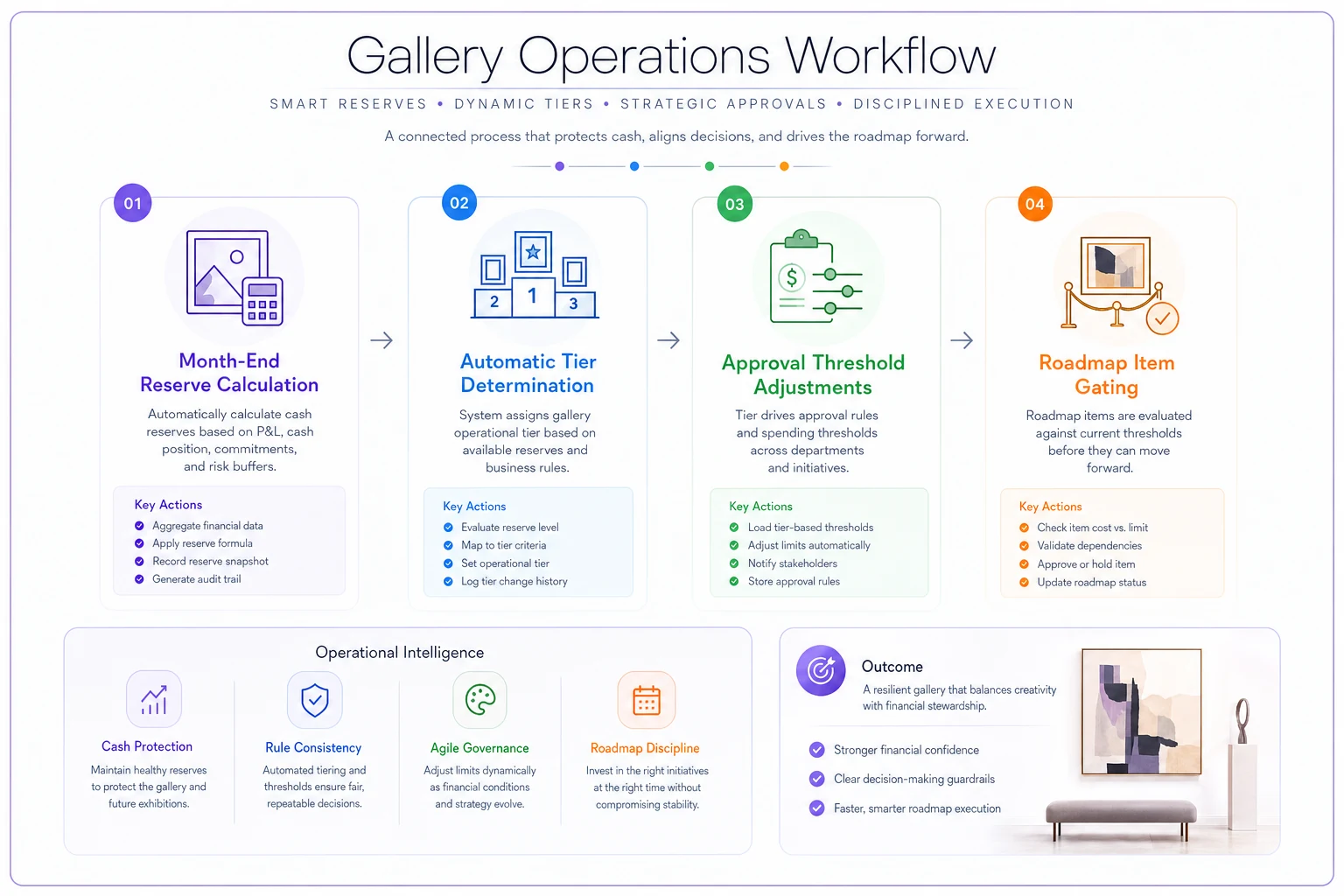
In practice this falls apart because the information lives in scattered places. The reserve figure is in the accounting software. The approval thresholds are in a board document nobody opens between meetings. The roadmap is in a spreadsheet the director updated once. There's no single view that says "here's our current tier, here's what that means for approvals right now, here's which roadmap items are unlocked."
Centralizing operational and financial data into one connected system addresses this directly — not as software for its own sake, but because governance rules only work when the numbers driving them are visible. When reserve levels, approval limits, and programming commitments sit in one place, the tier declaration stops being a manual scramble before each board meeting. Operational platforms built for gallery management can tie month-end reserve figures directly to approval rules and the roadmap, so the moment you slip from green to yellow, the tightened thresholds actually take effect instead of sitting forgotten in a policy PDF.
The technology matters far less than the discipline behind it. What you're really building is consistency — making sure the rule everyone agreed to when things were calm still applies when things get stressful and tempting to ignore.
The relationship dimension people underestimate
One more connection that gets missed: governance and reserve discipline directly protect your artist relationships. The most damaging thing a gallery can do is over-commit, then yank a show or delay a payout because the money wasn't there. That's how trust dies.
A tiered reserve system, followed honestly, means you commit to programming you can actually deliver. You don't promise a show you might cancel. You don't schedule payments you can't cover. The financial governance and the relationship governance are the same discipline viewed from two angles — which is exactly why linking contracts to lifecycle touchpoints and dispute prevention belongs in the same conversation as reserve tiers. A missed payout isn't just a cash problem; it's a relationship you may never fully repair.
Where to start
If your governance and finances currently live in separate worlds, don't try to build the whole system at once. Start by writing down the reserve tiers and what each one permits — that single document forces the hardest conversations and gives you an immediate decision tool. From there, connect the approval thresholds to the tiers. Then, once those two are working, layer the 3–5 year roadmap on top and tag each ambition to the reserve condition it needs.
The galleries that survive lean years aren't the ones with the biggest reserves. They're the ones whose governance actually reacts to the reserve before a bad quarter turns into a crisis. Build the connections between your board, your money, and your programming now — while things are calm — because the whole point is that the rules are already in place when calm is exactly what you don't have.
The galleries that survive lean years aren't the ones with the biggest reserves. They're the ones whose governance actually reacts to the reserve before a bad quarter turns into a crisis. Build the connections between your board, your money, and your programming now — while things are calm — because the whole point is that the rules are already in place when calm is exactly what you don't have.
Ready to elevate your gallery operations?
Join 500+ galleries using Artioly to streamline operations, boost visitor engagement, and increase art sales.