

Most galleries treat community work like a side quest. You do an education morning because a school emailed. You partner with a local nonprofit because someone on the board knows someone. You host a fundraiser because you need the cash. None of it connects, and six months later you can't actually tell whether any of it moved attendance, donations, or your standing in the neighborhood.
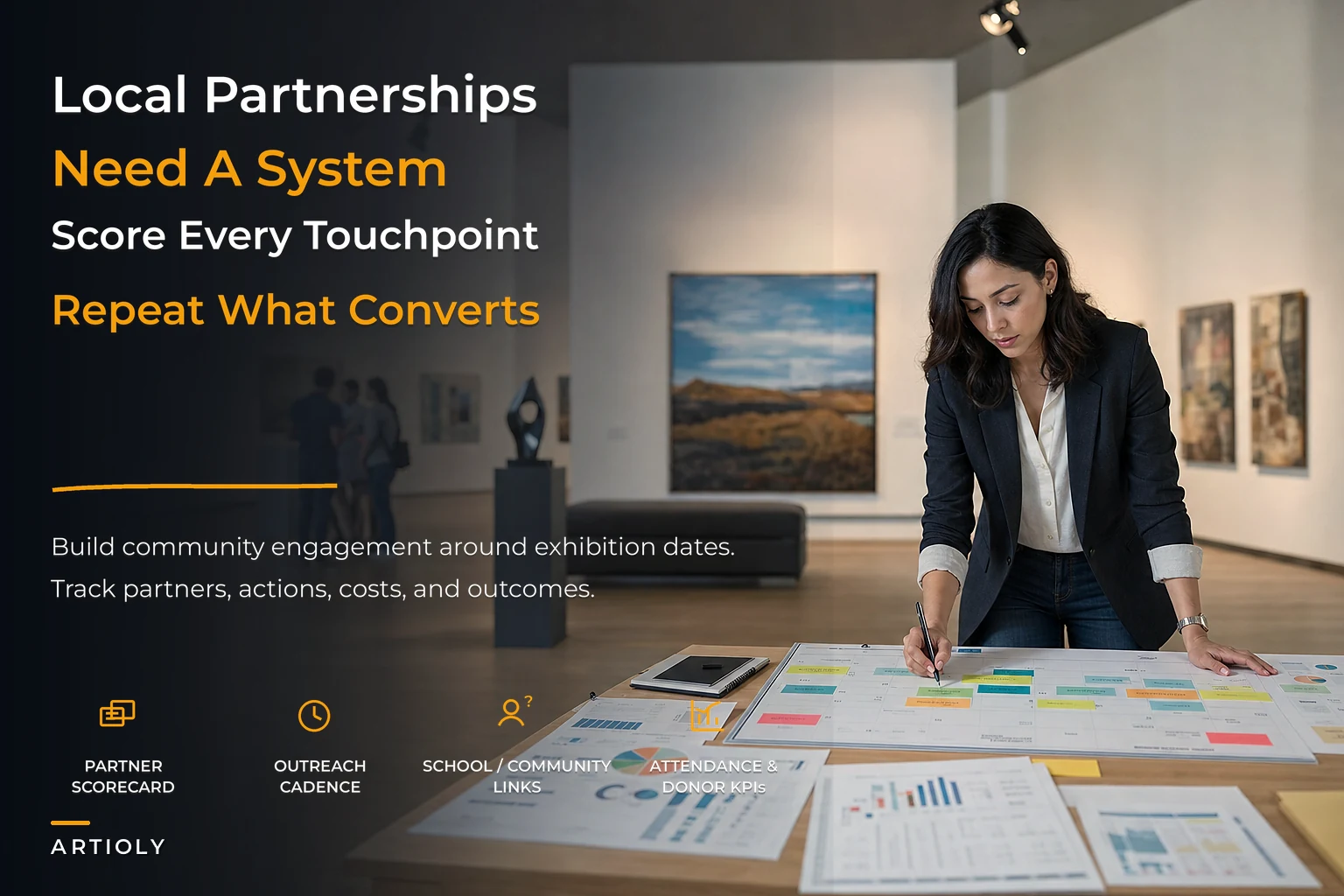
That disconnect is the real problem. A gallery community development strategy isn't about doing more events — it's about turning scattered goodwill into a system that produces predictable outcomes: warmer local relationships, steadier foot traffic, a donor base that renews, and education programming that doesn't quietly eat your calendar. The galleries that get this right stop thinking about "outreach" as a task and start treating partnerships as an ecosystem you actively manage — scored, mapped, and tied to the same operational rhythm as your exhibition calendar.
Why community efforts fall apart across most galleries
The failure pattern is almost always the same, and it isn't about caring too little. It's about the absence of any connective tissue.
A partnership starts with one enthusiastic person — usually a curator or the founder. They build a relationship with a school art teacher or a community center coordinator. Things go well for a year. Then that person gets busy, or leaves, and the whole relationship evaporates because it lived in one inbox and one memory. There's no record of what was promised, what worked, or who to call.
Then there's the scoring problem, or rather the total lack of it. Galleries say yes to almost every partner who asks, and no to almost every partner they'd have to chase. That's backwards. The school that emails you is often the one with the least capacity to actually deliver students on a Tuesday morning. The most valuable partners — the ones with reliable audiences, engaged donors, or genuine community reach — usually need to be pursued, not received.
And nothing is tied to numbers. Community work gets a pass on measurement that no other part of the gallery would tolerate. Nobody would run an exhibition without a break-even figure, but they'll run a year of education programming without ever asking how many of those visitors came back, gave money, or told a friend.
When those three gaps stack up — no memory, no scoring, no metrics — you get a gallery that's "active in the community" and has almost nothing to show for it.
Scoring partners like you'd score anything else that matters
Before you plan a single event, you need a way to rank potential and existing partners. Not everyone deserves the same energy, and pretending they do is how small teams end up spread across fifteen shallow relationships instead of five deep ones.
Never miss a key exhibition detail again.
Artioly helps you organize, promote, and manage every exhibition effortlessly.
- Unified exhibition scheduling
- Artist and visitor notifications
- Inventory and sales tracking
No credit card required
A partner scorecard doesn't need to be complicated. What tends to work is a simple weighted rating across a handful of dimensions that actually predict whether a partnership produces results.
| Scoring dimension | What you're measuring | Weight |
|---|---|---|
| Audience reach | Size and relevance of the people they can bring | High |
| Reliability | Do they actually show up and deliver what they promise? | High |
| Donor/funding proximity | Connection to money — grants, patrons, sponsors | Medium |
| Mission alignment | Does the work genuinely fit your program? | Medium |
| Effort cost | Staff hours required to keep it running | High (inverse) |
Score each partner 1–5 on the positive dimensions, subtract for effort cost, and you get a rough ranking. A local high school with a committed teacher, 30 reliable students per visit, and low coordination overhead might outscore a flashy regional nonprofit that needs six meetings to produce a single foggy commitment.
Rescore partners at predictable intervals — twice a year or after any staffing change — so your rankings reflect current reality.
The insight most galleries miss: effort cost is the dimension that quietly kills you. A partner can look great on reach and alignment, but if every event requires three weeks of back-and-forth and constant hand-holding, they're a net loss for a team of four. Score honestly, and you'll find some of your most "prestigious" relationships are the ones bleeding you dry.
Rescore twice a year. Partners drift. The teacher who was your champion transfers schools. The community group gets new leadership and loses interest. A scorecard you never revisit is just a snapshot of who mattered eighteen months ago.
Mapping touchpoints: schools and community, done deliberately
Once you know who's worth your time, the next question is how you touch them — and how often. Schools and community groups need slightly different playbooks, because they run on different clocks.
Schools operate on an academic calendar with hard windows. September is chaos, October through November is your sweet spot, December is dead, and spring gets eaten by testing. If your education offer doesn't line up with when teachers can actually book a trip, you'll get polite interest and zero bookings. The galleries that consistently fill their education mornings send offers in late August, before teachers have finalized their term plans — not in October when every slot is already spoken for.
Community groups — libraries, senior centers, cultural associations, neighborhood councils — run on their own event cadence and are far more relationship-driven. They'll partner with you if you show up first, consistently, without immediately asking for something. A curator who attends two of their events before ever pitching one of yours builds more goodwill than any polished proposal.
The touchpoint map is just a plan for who hears from you, when, and about what. For a high-priority school partner, that might look like:
-
Late August term offer email with 3 pre-set date options
-
Confirmation short MOU and a single-page prep sheet for the teacher
-
One week before logistics reminder plus a "what students will see" note
-
After the visit thank-you, a simple feedback ask, and a soft invite to a family open day
-
Next term repeat, referencing the last successful visit
That last point matters more than it looks. Referencing the previous good experience is what turns a one-off into a standing relationship. Most galleries drop the thread after the thank-you email and start from cold every single time.
Linking engagement to your calendar so it actually happens
Anything that isn't tied to your existing calendar won't get done. Community work loses every scheduling fight against install deadlines, openings, and sales follow-ups, because those have hard dates and community work usually doesn't.
The fix is to build "engagement plays" that attach to fixed points in your exhibition cycle. Every show already has an opening, a run, and a close. Bolt your community activity onto those anchors so it inherits their urgency.
-
Two weeks before opening invite your top-scored community partners to a quiet preview slot — before the public opening crowd.
-
Opening week run one scheduled education morning tied to the new show's theme.
-
Mid-run host a community-focused event (a talk, a workshop, a partner co-hosted evening) during the slow midpoint when foot traffic dips.
-
Closing period a donor-facing moment — a thank-you gathering that connects the community work back to the people who fund it.
This converts vague intentions into calendar entries with owners. The mid-run community event isn't a nice idea floating in someone's head; it's a fixed play that happens every exhibition, staffed and scheduled. Your on-site conversion flow at openings already gives you a front-of-house rhythm for busy nights — the community plays just extend that same discipline to the quieter parts of the run that usually get ignored.
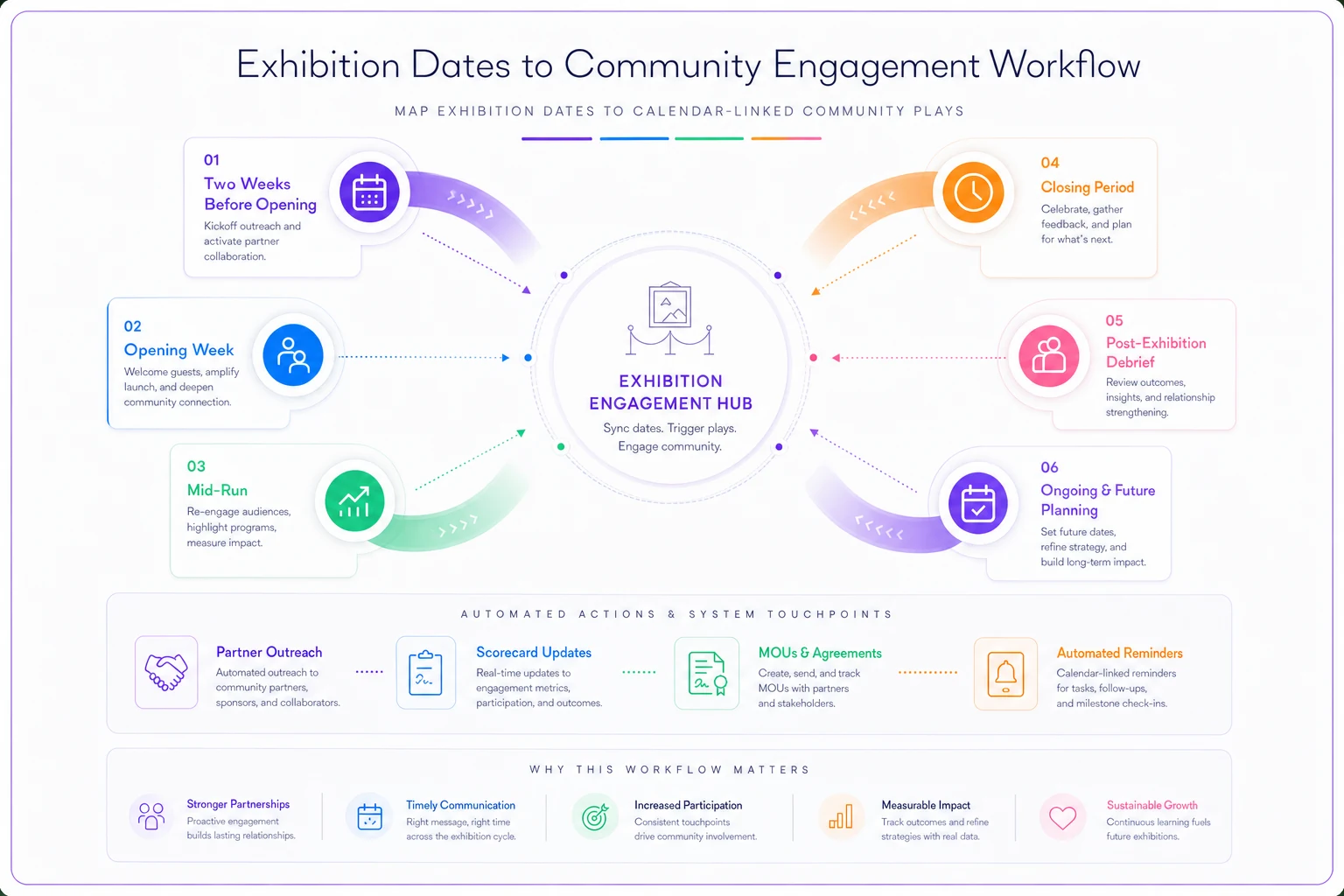
Keeping all of this straight across a year of shows is where most small teams drown. This is the point where lightweight operational software earns its place — not as some grand transformation, but as the shared calendar and partner record that stops relationships from living in one person's head. When your partner scorecards, MOU status, and touchpoint schedule sit in one system tied to your exhibition dates, the automation is boring and useful: reminders fire before term-offer deadlines, follow-ups get flagged after each visit, and nobody has to remember which teacher you promised what. The value isn't the tech — it's that the pipeline keeps running even when your calendar gets brutal.
The paperwork that keeps partnerships from going sideways
Two documents do almost all the heavy lifting here, and both should be short enough that nobody dreads them.
The short MOU (memorandum of understanding). This is not a contract for lawyers. It's a one-page mutual agreement that prevents the awkward "wait, I thought you were bringing the tables" conversations. A workable short MOU covers:
-
What each side will provide (space, staff, students, promotion, materials)
-
Dates and times, with clear responsibility for each
-
Who covers any costs
-
Cancellation terms and a rescheduling default
-
A single named contact on each side
That's it. If it runs past one page, you're overcomplicating a school visit.
The partner scorecard, which we covered above, doubles as your internal memory. Filled out after each engagement, it captures what actually happened versus what was promised — and that is the record that survives staff turnover.
The mistake galleries make is skipping the MOU with "friendly" partners because it feels cold. It's the friendly partnerships that produce the worst misunderstandings, precisely because everyone assumed everyone else understood. A one-page MOU with your nicest partner isn't distrust — it's respect for both teams' time.
Outreach scripts that don't sound like a form letter
Cold outreach fails when it's all about you. The gallery emails a school leading with "We're excited to offer educational tours of our new exhibition," and the teacher — drowning in emails — deletes it, because it's asking them to do work for the gallery's benefit.
Flip the framing. Lead with what the partner gets, keep it short, and make the next step tiny.
School outreach (initial): > Hi [Name] — I run education programming at [Gallery]. We've got a new show opening in October that ties directly into [curriculum area], and I'd love to host your class for a free morning visit built around it. We handle everything on our end — you just bring the students. Would any of these three dates work? [dates]
Community group outreach (relationship-building): > Hi [Name] — I came across [their recent event] and really admired what you're doing with [specific detail]. We run a small gallery a few blocks away and would love to find a way to work together on something for your members. No pitch — could we grab 20 minutes to trade ideas?
Donor/patron re-engagement (tied to a community moment): > Hi [Name] — wanted to share something you helped make possible: this term we hosted [X students / X community members] through our education program. We're marking the close of the current show with a small gathering on [date] and would love for you to see the impact firsthand.
The pattern across all three: specific, short, and the ask is a single easy yes. The donor script especially matters — it connects the money to the mission in concrete terms, which is what turns one-time givers into renewing ones. That thread naturally feeds into your broader collector and donor lifecycle stewardship cadence, where community impact becomes one of the strongest reasons a supporter sticks around year after year.
KPIs that tie community work to attendance and money
If you can't measure it, it'll be the first thing cut in a bad quarter. Community programming needs metrics that connect to outcomes the gallery already cares about — not vanity counts of how many events you ran.
-
Attendance conversion what share of community/education visitors return within 6 months as general visitors, members, or event attendees?
-
Donor pipeline movement how many donors were touched through community moments, and how many renewed or increased giving?
-
Partner retention what percentage of scored partners are still active year over year?
-
Cost per engaged visitor total resource cost of a play divided by people meaningfully reached.
-
Referral generation new partners or attendees who came through an existing partner.
That "cost per engaged visitor" number is the one that changes behavior. It forces the resource-cost mapping most galleries avoid: staff hours, materials, space downtime, refreshments — all of it. Once you can see that one education morning costs roughly $180–$250 in real resources while reaching 30 students, you can compare plays honestly and stop pouring effort into the ones that look good but cost a fortune per person reached.
Community work should feed the same funnel as everything else. A school family who comes back for a paid family day, then joins as a member, is your community strategy working. If you're not tracking that path, you'll never know which partnerships actually build the gallery versus which just keep you busy. And if membership is part of your model, this is exactly where community pipelines and your paid membership program start reinforcing each other.
A real scenario: turning scattered goodwill into a pipeline
A small commercial gallery — three full-time staff, a mix of sales and a modest education mission — had been running community events reactively for years. Roughly eight to ten events annually, no scoring, no records, driven almost entirely by the founder saying yes to whoever asked.
The problems were classic. Nobody could say whether any of it helped. Two strong school relationships had quietly died when a staff member left. And the founder was spending what felt like a full week per quarter just coordinating logistics over email.
They rebuilt it as a system. First, they scored every existing and potential partner, which immediately revealed that three of their ten relationships were producing almost all the value and four were pure effort drain. They cut the drains, kept the winners, and used the freed-up time to pursue two high-scoring partners they'd been ignoring.
Then they mapped four calendar-linked plays per exhibition and locked them to show dates. Short MOUs replaced the endless email confirmations. Everything — scorecards, MOU status, touchpoint reminders — moved into a single shared operational record instead of the founder's inbox.
Over the following year the results were uneven but real. Education mornings went from unpredictable to consistently filled, because offers went out on the academic calendar instead of whenever someone remembered. Partner retention improved noticeably — the relationships stopped dying with staff changes. A handful of education-family visitors converted into paying members and event-goers, something they'd never once tracked before. The coordination time the founder had been losing dropped to something manageable, maybe a day per quarter instead of a week.
The revenue impact wasn't dramatic, and it shouldn't be oversold — community development is a slow compounding play, not a quick sales bump. But the gallery finally knew what its community work was doing, and could defend the budget for it with actual numbers.
When this makes sense — and when it doesn't
This makes sense when you already have some community relationships and they feel chaotic, when staff turnover keeps killing partnerships, or when you're being asked to justify education and community spending you can't currently measure. It also makes sense if your local reputation genuinely feeds your business — foot traffic, donors, local collectors.
This is a bad idea when you're in survival mode financially. Community development is a compounding investment; if you need cash this month, this is not your lever. Fix the sales and cost problems first, then build the pipeline once you can afford to play a longer game.
Who should probably not do the full version: a solo-operator gallery with no education mission and a purely transactional collector base. For you, a stripped-down version — maybe two strong partners scored and maintained — is plenty. Don't build a machine you can't staff.
Pulling it together
The gap between galleries that are "involved in the community" and galleries that get real return from it comes down to whether they run it as a system or as a series of favors. Scoring tells you where to spend energy. Calendar-linked plays make sure the work actually happens. Short MOUs and scorecards keep it from dying with staff changes. And KPIs tied to attendance and donors keep the whole thing honest.
None of this requires a bigger team or a bigger budget. It requires treating your local relationships with the same operational seriousness you already bring to exhibitions and inventory.
Do that, and community development stops being the thing that gets cut first — and starts being one of the quieter, more durable reasons your gallery stays part of the neighborhood for the long run.
Ready to elevate your gallery operations?
Join 500+ galleries using Artioly to streamline operations, boost visitor engagement, and increase art sales.