

Most galleries don't think of themselves as data operations. They think of themselves as galleries — walls, works, openings, collectors. But if you actually map what flows through your systems over a year, you'll find a surprisingly large and messy pile of personal information: donor histories, collector purchase records, email subscribers, RSVP lists, loan contacts, consignment paperwork with artist bank details, and a CRM full of notes nobody has looked at since 2021.
That pile is a liability waiting to surface. And the gallery world has a particular weakness here: data gets collected informally, stored in too many places, and almost never reviewed or deleted. A collector's phone number ends up in a gallerist's personal phone, a spreadsheet, the CRM, a shared email inbox, and a WhatsApp thread. When something goes wrong — a breach, a data-access request, a collector who demands to be forgotten — nobody knows where all the copies live.
This is a governance problem, not a tooling problem. You can buy the fanciest archive system on the market and still leak a VIP collector's purchase history because someone CC'd the wrong person. So this piece is about building actual gallery data privacy governance: the policies, the retention logic, the consent templates, and the vendor tests that keep a small team out of trouble without needing a compliance department you can't afford.
Why gallery data sprawls faster than anyone expects
The core issue is that galleries collect data in moments of enthusiasm, not in moments of process. Someone buys a work at an opening — you grab their details on a sticky note and transfer them later. A donor pledges support — their giving history gets logged in a fundraising spreadsheet separate from the CRM. A collector asks to be notified about a specific artist — that preference lives in one staffer's memory.
Across a lot of small cultural organizations, the data problem is really a fragmentation problem. No single person can answer the question "where does this collector's information live?" because the honest answer is "about six places, and two of them are personal devices."
-
Dual-purpose records. The same spreadsheet holds donor giving and collector sales and email marketing consent, so you can't apply different rules to different data types.
-
Zombie contacts. People who unsubscribed years ago, or who were one-time art-fair leads, still sit in the active list because nobody deletes anything.
-
Invisible copies. Exported lists for an email blast, a printed guest list from an opening, a shared drive folder titled "VIP contacts FINAL v3."
-
Consent you can't prove. You think everyone on your newsletter opted in, but you have no record of when or how.
The reason this matters: privacy regulations — whether GDPR for your European collectors, various US state laws, or Canada's PIPEDA — generally assume you can account for the data you hold, justify why you hold it, and delete it on request. Fragmentation makes all three impossible.
What breaks as you grow
When you're a two-person gallery with 400 contacts, informal data handling feels harmless. The breakage starts when you grow — more shows, more fairs, more email volume, more staff, more vendors plugged into your CRM.
The progression tends to look like this:
Stage one — the small gallery. Everything's in a couple of spreadsheets and one gallerist's head. Risk is low mostly because the surface area is small, but there's zero documentation. One departing staffer can walk off with the entire collector list.
Stage two — the growing gallery. You adopt a CRM, maybe an email platform, maybe a POS. Now data is syncing between tools, and each integration becomes a place where data can leak or be over-shared. This is where fixing a noisy CRM with proper segmentation stops being a marketing nicety and becomes a privacy requirement — because segmentation is how you apply different consent and retention rules to different groups.
Stage three — the multi-channel operation. Art fairs generating lead lists, a membership program, loan partners, press contacts, external fundraising consultants with CRM access. Now you have vendors touching personal data, and you're legally responsible for how they handle it. A breach at your email provider is, in regulatory terms, partly your problem.
What breaks isn't any single tool. It's the absence of a map. Without a documented record of what you collect, why, where it lives, and how long you keep it, every new tool and every new hire increases risk faster than it increases capability.
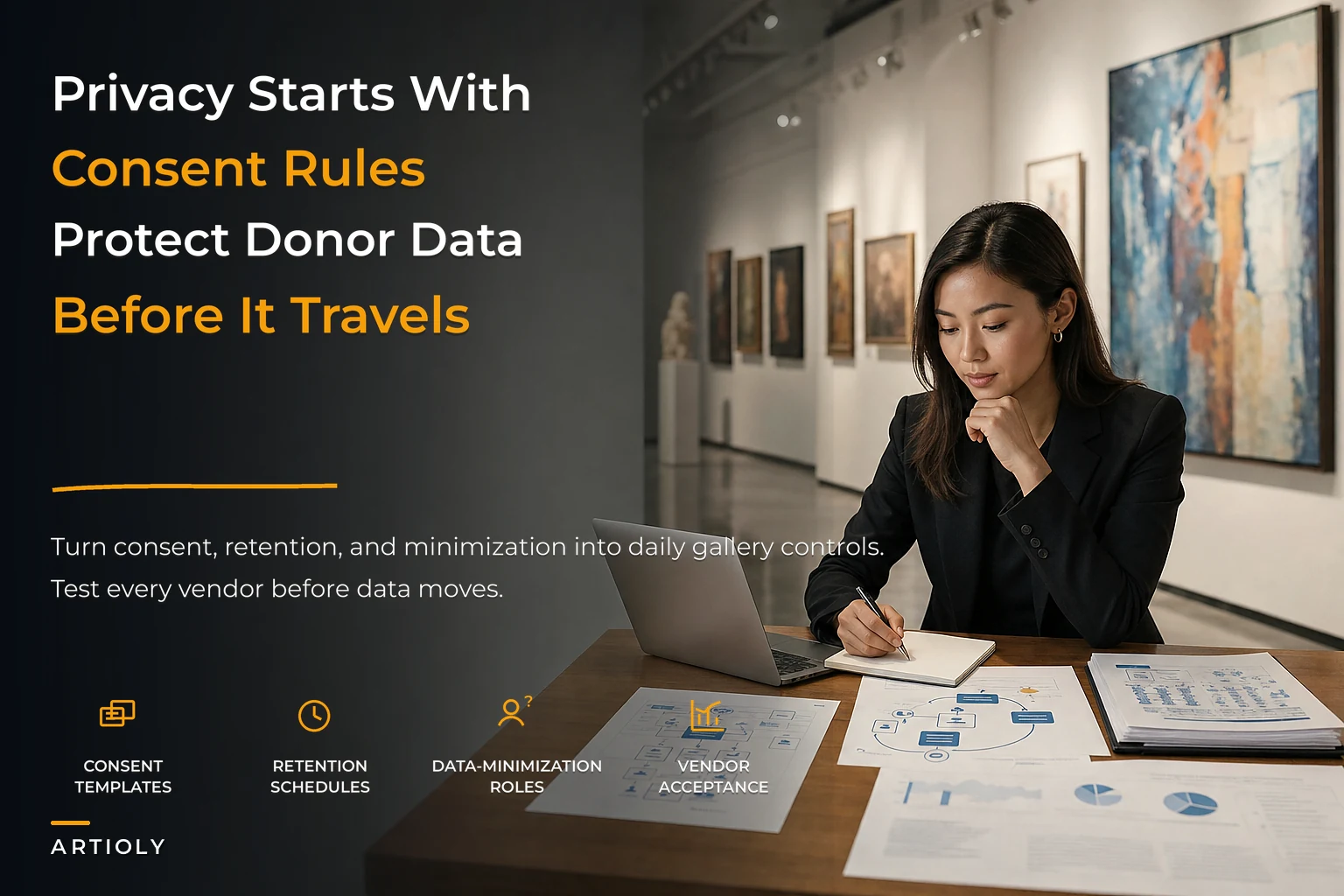
The five pillars of a workable governance pack
You don't need a 60-page policy binder. For a small gallery, governance comes down to five practical artifacts that work together. Think of them as a connected system — each one feeds the next.
| Pillar | What it does | What breaks without it |
|---|---|---|
| Consent templates | Record how and when someone agreed to each use of their data | You can't prove opt-in; marketing becomes legally shaky |
| Retention schedules | Define how long each data type is kept before deletion | Zombie data piles up; breach exposure grows |
| Data-minimization rules | Limit what you collect in the first place | You hoard sensitive info you never needed |
| CRM segmentation privacy rules | Apply different handling to different groups | Donors, collectors and leads get treated identically |
| Vendor integration acceptance tests | Vet tools before they touch personal data | A weak vendor becomes your breach |
The rest of this piece walks through each, with templates and tests you can actually use.
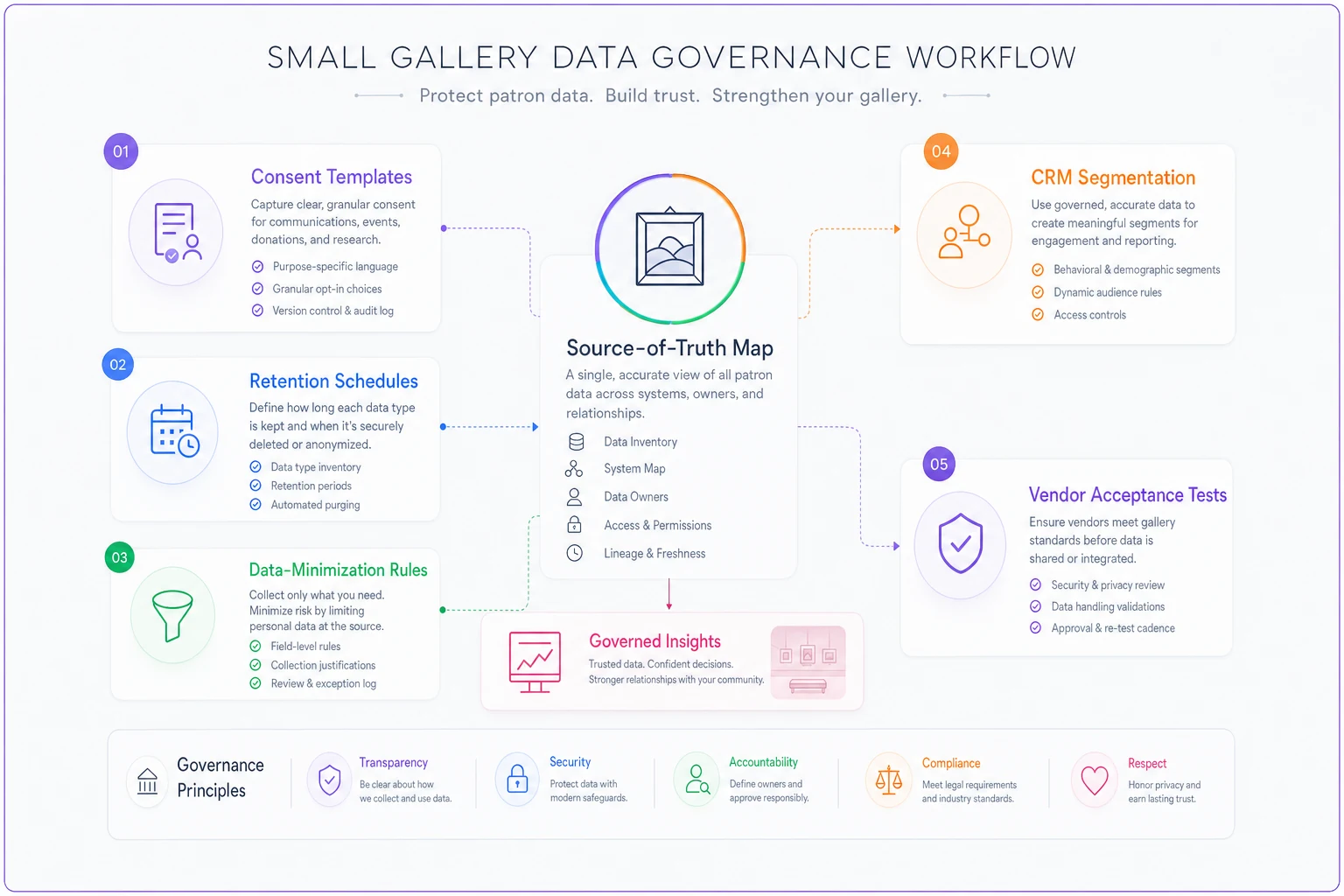
A simple visual of the workflow makes it easier to map where each pillar touches your CRM and vendors.
1. Consent templates that hold up
The mistake most galleries make is treating consent as a one-time checkbox. In practice, consent is purpose-specific. Someone agreeing to receive exhibition announcements has not agreed to have their purchase history shared with a partner fair, or to be profiled for a wealth-screening service.
-
Who — the person
-
What — the specific purpose (newsletter, sales follow-up, donor stewardship, event photos)
-
When — timestamp of consent
-
How — the mechanism (web form, signed sheet, verbal at desk — and yes, verbal needs a logged note)
-
Withdrawal path — how they can opt out, recorded when they do
A sample newsletter consent line that works: "I'd like to receive exhibition news and opening invitations from [Gallery]. I understand I can unsubscribe anytime, and my details won't be shared with third parties without separate consent." Short, specific, and it names the limits.
For donors, add a separate purpose. Donor data often carries an expectation of discretion that collectors' data doesn't, and donors frequently don't want to be marketed to the way buyers do. One consent does not cover both.
The pattern to avoid: bundling consents. "By submitting this form you agree to receive marketing, be added to our donor list, and have your photo used in promotional material" is exactly the kind of bundled consent regulators dislike, and it falls apart the moment someone objects to one part.
2. Retention schedules: the discipline galleries skip
Nobody deletes gallery data. That's the honest baseline. And it's a real problem, because data you don't need is pure liability — it can be breached, requested, or mishandled, and it protects you from nothing.
A retention schedule simply assigns a lifespan to each data type. Here's a realistic starting framework a small gallery can adapt:
-
Active collector sales records — retain for the legally required financial period (often 6–7 years for tax/accounting), then review for archival vs deletion.
-
Marketing/newsletter contacts — review every 18–24 months; remove contacts with no engagement over that window after a re-consent attempt.
-
Art-fair and event leads — short lifespan. If a lead hasn't converted or engaged within roughly 12 months, it goes.
-
Donor records — retain per fundraising and tax obligations, but segment and lock down access tightly.
-
Job applicant data — delete within a defined window after a hiring round closes unless you have consent to keep it on file.
-
Event photos with identifiable faces — retain only with consent; set a review date.
The operational trick is to attach a review date field to records rather than trying to auto-delete everything. Small galleries rarely trust full automation here, and that's fine — a quarterly "retention review" where someone works through flagged records is enough. The point is that deletion becomes a scheduled process instead of something that never happens.
3. Data-minimization rules
The cheapest data to protect is data you never collected. Every field on your intake form is a future liability, so the question for each one is: do we actually use this, and could we operate without it?
A gallery realistically needs a collector's name, contact method, and purchase history. It probably does not need their date of birth, home address (unless shipping), employer, or notes speculating about their net worth — yet these creep into CRM free-text fields constantly.
Free-text notes are the sneakiest minimization failure. A gallerist jots "husband going through messy divorce, soft on budget right now" into a contact record, and that subjective, sensitive note is now personal data you're legally responsible for — and that the collector could theoretically request to see. Set a rule: notes record gallery-relevant facts and preferences, not gossip or speculation.
-
Every intake field must map to a documented use. No use, no field.
-
Sensitive categories (health, financial status, family details) are off-limits unless operationally essential and consented.
-
Notes are factual and professional — written as if the collector might read them.
-
New fields require a quick sign-off, not just a staffer adding a column.
4. CRM segmentation as a privacy control
Segmentation usually gets framed as a marketing tool — and it is — but it's also the mechanism that lets you apply different privacy rules to different people. You can't honor "donors don't get sales marketing" or "fair leads get deleted after a year" if everyone sits in one undifferentiated list.
-
Buyers/collectors (consented to sales follow-up)
-
Donors (stewardship, not marketing, usually with tighter access)
-
Newsletter-only subscribers (marketing consent, nothing more)
-
Leads/prospects (short retention, limited use)
-
Press & professional contacts (business relationship, not marketing)
Once these segments exist, your retention and consent rules become enforceable per-segment instead of theoretical. This is also where good data architecture pays off — if you've built a canonical data model with clear KPI and data hierarchies, segmentation privacy rules bolt on cleanly because each record already has a defined type and purpose.
When tags overlap, default to the most restrictive consent to avoid accidental marketing.
The common failure: tagging that drifts. People get added to multiple segments, or a collector who's also a donor ends up receiving the wrong communications. Build a rule for overlap cases — usually the most restrictive consent wins.
5. Vendor integration acceptance tests
This is the pillar galleries neglect most, and increasingly the one that bites. Every tool you connect to your CRM — email platform, POS, fundraising app, analytics, an archive system — becomes a party that touches personal data. Under most privacy regimes, you remain responsible even when the vendor is at fault.
-
[ ] Data processing agreement — does the vendor offer one, and does it name you as controller?
-
[ ] Data location — where are servers hosted? Does that create cross-border transfer issues for your EU contacts?
-
[ ] Access controls — can you set role-based permissions, or does everyone see everything?
-
[ ] Deletion support — can the vendor actually delete a person's data on request, and confirm it?
-
[ ] Export portability — can you get your data out if you leave? (Lock-in is a privacy risk too.)
-
[ ] Breach notification — will they tell you promptly if they're breached?
-
[ ] Sub-processors — who else do they share data with downstream?
-
[ ] Audit trail — does the system log who accessed or changed records?
This same diligence applies when you're choosing and implementing archive software — privacy capability should sit alongside features and price in your selection matrix, not get discovered after migration.
One test that's saved galleries real pain: ask the vendor to walk you through deleting a single contact completely, across backups. If they can't demonstrate it, you can't honor deletion requests, which means you can't comply.
A short real scenario
A mid-sized commercial gallery running two spaces, a membership program, and a couple of fairs a year had data living in a CRM, two email tools, a POS, three staffers' phones, and an assortment of spreadsheets. Around 6,000 contacts total, nobody sure how many were duplicates.
The trigger was a European collector exercising a data-access request — asking exactly what the gallery held on them. It took the team the better part of three days to assemble an answer, and they still weren't confident they'd found every copy. That scare prompted a cleanup.
Over about two months they consolidated to a single source-of-truth CRM, segmented contacts into five groups, wrote consent records for marketing contacts — and re-consented the ones they couldn't document, losing roughly 15–20% of the list in the process. People who were never really engaged anyway. They set retention review dates and ran their vendors through an acceptance checklist. One email tool failed the deletion test and got replaced.
The outcome wasn't dramatic revenue growth. It was risk removed and time saved. The next data request took under an hour to answer. The marketing list got smaller but engagement rates went up, because the dead weight was gone. And the team finally knew where everything lived.
When this level of governance makes sense — and when it's overkill
When it's worth the effort: you have EU or UK collectors, you run a donor or fundraising program, you handle meaningful sales volume, you've grown past two or three staff, or you're connecting multiple vendors to your CRM. Any of these raises your exposure enough to justify the whole pack.
When a lighter touch is fine: a brand-new single-room gallery with a few hundred local contacts and one email tool doesn't need retention automation and vendor acceptance tests on day one. But even here, a one-page consent record and a basic retention rule cost nothing and prevent bad habits from calcifying.
Who should not over-engineer this: founder-run galleries with no technical help shouldn't buy a compliance platform and try to automate everything. Full automation you don't understand is worse than a simple quarterly manual review you actually do. Start with documentation and segmentation; add tooling only when volume forces it.
Pulling it together
The galleries that handle data well aren't the ones with the biggest software budgets. They're the ones who decided, once, to stop treating personal information as an afterthought — to write down what they collect, why, where it lives, and when it leaves.
Everything in this pack connects. Consent templates feed segmentation. Segmentation makes retention schedules enforceable. Minimization keeps the whole thing small enough to manage. Vendor tests stop you from undoing all that work by plugging in a leaky tool. Miss one pillar and the others weaken.
Start with the map. Spend an afternoon writing down every place personal data currently lives in your gallery — tools, spreadsheets, phones, inboxes. Most owners are genuinely surprised by what they find. That surprise is the whole reason gallery data privacy governance matters: you can't protect, delete, or account for data you didn't know you had. Once the map exists, the policies almost write themselves — and your gallery becomes a far harder target for the kind of quiet, avoidable mistakes that turn into real problems.