

Most galleries that run their first hybrid show — physical opening plus online viewing room, maybe a livestream walkthrough, maybe a members-only preview window — treat it as a special event. Everyone pulls extra hours, the intern manually copies price lists into three systems, and by the time the show closes nobody can actually say whether the online audience bought anything or just clogged the inbox with questions.
Then the next show comes and you do it all again from scratch.
The problem isn't that hybrid programming is hard. It's that most small galleries never build the governance layer underneath it — the rules that decide who sees what, at what price, on which channel, and what happens when two collectors want the same piece from two different places at the same time. Without that layer, every hybrid show is a custom project. With it, hybrid shows become a repeatable product line.
This is what a real gallery omnichannel programming strategy looks like when you stop treating each channel as a separate silo and start treating the whole thing as one program with shared rules.
Why hybrid shows quietly break at scale
A single hybrid show run once a year is manageable through sheer effort. The trouble starts when you run four to six a year, or when you layer memberships, fairs, and consignment inventory on top.
There's a pattern that comes up constantly. The physical channel and the digital channel end up with different sources of truth. The wall labels say one price. The viewing room says another because someone updated it after a studio visit and forgot to sync. A collector who joined your paid membership expected 48 hours of early access, but a walk-in bought the piece off the wall on opening night because front-of-house had no idea a hold existed.
None of these are dramatic failures. They're small, and that's exactly why they compound. Each one erodes trust with a collector or an artist, and each one costs staff time to untangle. Multiply that across a year of shows and you've got a program that feels chaotic even though every individual show "went fine."
What breaks at scale is coordination, not creativity. The curation is usually solid. The pricing logic falls apart because nobody wrote down the rules, and fulfillment falls apart because nobody decided in advance who wins a conflict.
If your viewing room and physical show aren't already connected through a shared fulfillment path, that's the first crack — and it's worth reading how a gallery viewing-room system links discovery to fulfillment before you scale hybrid programming on top of a broken handoff.
The four layers of a repeatable hybrid program
A hybrid show becomes a product when four things are defined before the show opens, not decided on the fly during it:
Never miss a key exhibition detail again.
Artioly helps you organize, promote, and manage every exhibition effortlessly.
- Unified exhibition scheduling
- Artist and visitor notifications
- Inventory and sales tracking
No credit card required
-
Audience segments — who gets access, and in what order
-
Unified pricing and availability rules — one source of truth across all channels
-
Fulfillment guardrails — what staff can and can't do without escalating
-
Attribution and a runbook — how you know what worked, and how you repeat it
Get these four right once, and the next show is a configuration change, not a rebuild.
Layer 1: Audience segments (access order is the whole game)
The single biggest lever in hybrid programming is sequencing — deciding who sees the work first. Most galleries don't design this deliberately. They blast everything to everyone at the opening and hope the right collectors bite.
A more intentional approach tiers your audience and staggers access windows. A typical structure looks like this:
| Segment | Access window | What they can do | Why they're first |
|---|---|---|---|
| Priority collectors / patrons | 72 hrs before opening | Reserve, buy, request condition report | Highest lifetime value; reward loyalty |
| Paid members | 48 hrs before opening | Buy, join waitlist | Membership promise; retention driver |
| Waitlist / newsletter | Opening morning | Buy remaining works | Warm audience, lower priority |
| General public / walk-in | Opening night onward | Buy remaining works | Broadest reach, discovery channel |
The insight most people miss: the value of a priority window isn't just the early sale. It's that you learn demand before the general public sees the show. If three priority collectors all reserve from the same series in the first 24 hours, you now know that series is hot — you can adjust how you present the rest, or hold a piece back for a studio visit rather than dumping it online.
The common mistake is giving everyone "early access" so it means nothing. If your entire mailing list gets the same 48-hour preview, you don't have a priority tier — you have a slightly earlier public launch. Segments only work when the gaps between them are real and enforced.
Layer 2: Unified pricing and availability rules
This is where most hybrid programs leak money and credibility. The core principle is boring but non-negotiable: one source of truth for price and status, everywhere.
That means the wall, the viewing room, the PDF price list you email, and the WhatsApp message your director sends to a top collector all pull from the same record. If a price changes, it changes in one place and propagates. If a piece goes on hold, it shows as held on every channel within minutes, not at end of day.
Availability status needs to be more granular than "available / sold." In practice you need at least:
-
Available — buyable on any channel the segment allows
-
On hold — reserved for a named collector with an expiry time
-
Reserved (soft) — verbal interest, not yet a firm hold, doesn't block others
-
Sold — pending payment — committed but not yet cleared
-
Sold — cleared
The distinction between a soft reserve and a firm hold is where fights happen. A collector says "I'm very interested" on a call. Is that a hold? For how long? Can front-of-house sell it to a walk-in that night? If you haven't defined it, two staff members will answer differently, and one of your collectors will feel betrayed.
Make a firm hold a timestamped action in your records so expiry and ownership are unambiguous.
A workable rule: soft interest never blocks a sale; only a firm hold with a timestamp and an expiry does. Firm holds default to 24–48 hours and auto-release when they expire. Nobody has to remember to chase it.
Pricing rules should also cover the messy stuff hybrid shows expose:
-
Edition pricing that steps up as the edition sells through
-
Member discounts (and whether they apply to reserved works)
-
Shipping and framing costs quoted consistently online and in person
-
Currency and tax handling when the online audience is international
If you already run a rule-based pricing matrix internally, hybrid programming doesn't need new pricing logic — it needs that logic enforced across channels instead of living in one person's head.
Layer 3: Fulfillment guardrails
Guardrails are the rules that tell staff what they're allowed to do on their own and what has to be escalated. Without them, a well-meaning gallery assistant discounts a piece to close a Friday-night sale, and you find out Monday that they undercut a member price and annoyed the artist.
A guardrail table makes the boundaries explicit:
| Action | Front-of-house can do | Requires director sign-off |
|---|---|---|
| Confirm a sale at list price | ✅ | — |
| Place a 24-hr firm hold | ✅ | — |
| Extend a hold past 48 hrs | — | ✅ |
| Apply member discount | ✅ (verify membership) | — |
| Apply any other discount | — | ✅ |
| Sell a work with an active hold | — | ✅ (must contact holder first) |
| Ship internationally | — | ✅ |
| Split-buy / payment plan | — | ✅ |
The point of guardrails isn't control for its own sake — it's speed. When staff know exactly what they can approve, they stop freezing up and messaging the director for permission on every routine question. The escalation list stays short, so the things that do get escalated actually get attention.
Galleries that skip guardrails usually over-correct by funneling every decision to the owner. That turns the owner into a bottleneck who has to be reachable during every opening, which doesn't scale past a couple of shows a year. Guardrails push routine decisions down and lift only the genuine conflicts up.
The conflict-resolution workflow
The nastiest hybrid conflict is the double-claim: two buyers, two channels, one artwork. Here's a workflow that resolves it cleanly and consistently:
-
Check the record's status and timestamp. Whoever placed a firm hold first wins — the timestamp is the tiebreaker, not who's louder or richer.
-
If no firm hold exists, the first confirmed sale (payment initiated or firm verbal commitment logged) wins. Soft interest does not count.
-
If both are genuinely simultaneous (rare, but it happens on opening night), priority segment wins — a priority collector or member outranks a walk-in.
-
Notify the losing party within the hour with a personal message, and offer a concrete next step: a similar available work, a waitlist spot for the artist's next release, or first look at the next show.
-
Log the resolution so the pattern is visible. If double-claims keep happening on the same artists, your access windows are too tight or your sync is too slow.
Writing this down matters because conflicts are emotional in the moment. A pre-agreed rule takes the emotion out — staff aren't negotiating, they're applying a policy, which protects them and protects the gallery's collector relationships.
This visual shows the decision flow for resolving double-claim conflicts.
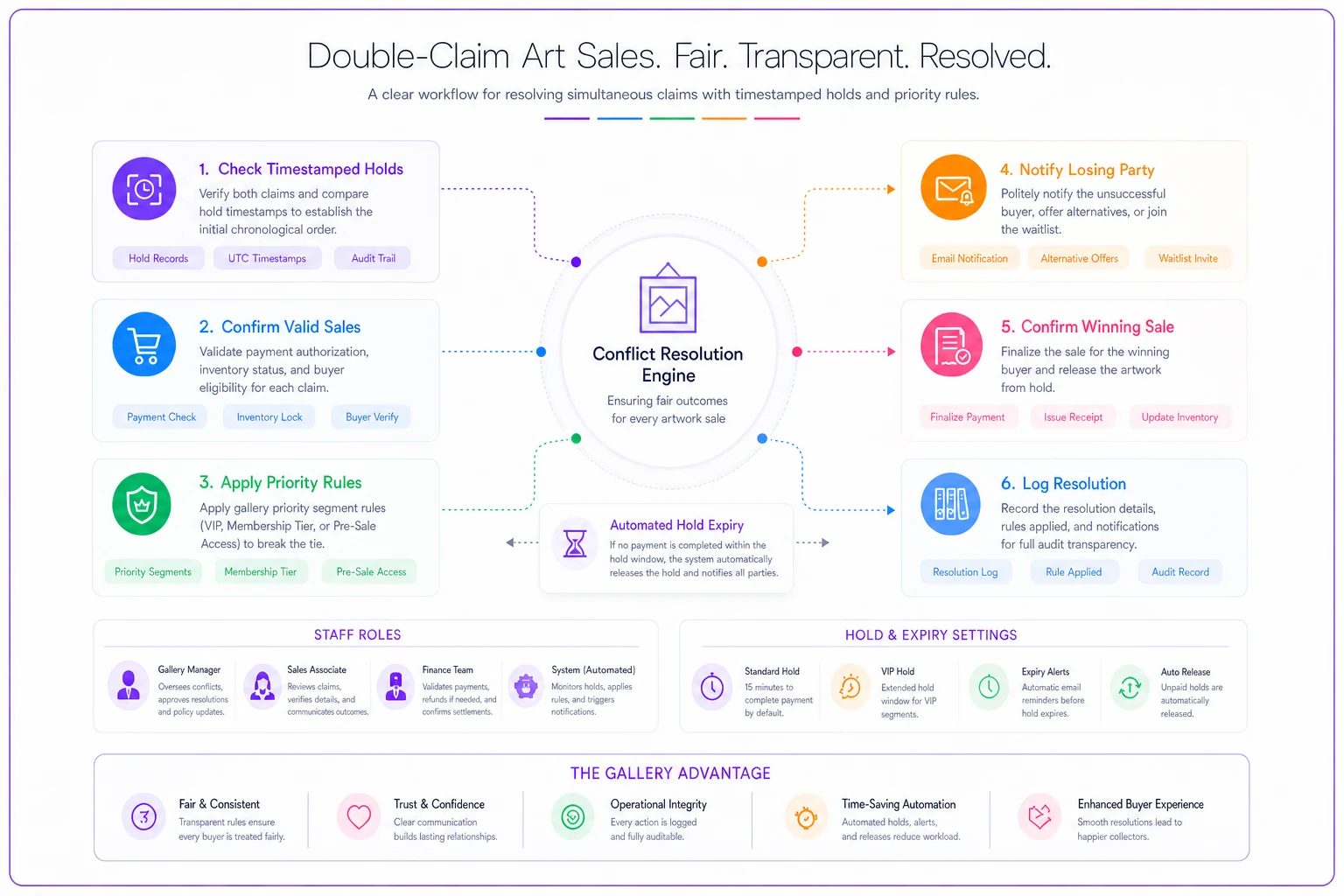
A pre-agreed policy combined with these guardrails keeps the owner out of routine decisions and ensures consistent treatment of collectors.
Layer 4: Attribution dashboard and the runbook
You can't call a hybrid show a repeatable product if you can't say what worked. Most galleries genuinely can't — they know total sales, but not whether the online preview drove them or whether the piece would've sold off the wall anyway.
Attribution doesn't need to be sophisticated. It needs to be consistent. Tag every sale with:
-
Origin channel (viewing room, opening night, follow-up email, private message)
-
Segment (priority, member, waitlist, public)
-
First-touch vs. closing-touch — where the collector first saw it vs. where they bought
That last one matters more than people expect. A collector often discovers a work in the online viewing room, then buys it in person at the opening. If you only credit the closing touch, you'll conclude the viewing room "doesn't sell" and cut it — when it's actually your top discovery engine.
A simple dashboard tracks a handful of numbers per show:
-
Sales by channel and by segment
-
Conversion rate of each access window (how many priority collectors who viewed actually bought)
-
Hold-to-sale ratio (how many holds converted vs. expired)
-
Number of conflicts and how they resolved
-
Online reach vs. online-attributed revenue
For galleries building this into a broader measurement habit, hybrid attribution fits naturally on top of a canonical data model with a clear KPI hierarchy and decision gates — it's one branch of that tree, not a separate system you have to maintain independently.
The runbook is what makes the whole thing repeatable. It's a short, boring document: here are the segments, here are the access windows, here's who publishes the viewing room and when, here are the guardrails, here's the conflict workflow, here's what we measure. The first version takes real effort. Every version after that is a copy-paste-and-adjust.
A real scenario: the four-show year
Consider a two-person commercial gallery running roughly six shows a year — mostly emerging and mid-career artists, average work priced somewhere between $2k and $9k.
Before governance: Every show was a scramble. The viewing room went live "whenever it was ready," usually a day or two into the show, so the online audience always saw the leftovers. Prices occasionally mismatched between the emailed PDF and the site. Twice in one year they had a genuine double-claim mess that cost them a relationship with a good collector who felt jerked around. Staff time per show on pure coordination — syncing lists, answering "is this still available" emails, chasing holds — ran somewhere around 20–25 hours.
After building the four layers: Access windows are fixed and staggered, so priority collectors and members reliably see work first. The price list lives in one place and the viewing room publishes 72 hours ahead on a schedule. Holds auto-expire, so nobody manually chases them. The conflict workflow got used twice more that year — and both times the losing collector was handled well enough that they bought from the next show.
The measurable shift wasn't a giant revenue jump. Total sales rose modestly. What changed more was that the online preview started closing sales it used to only assist on, member early-access conversion climbed noticeably, and coordination time per show dropped to under 10 hours. The founders described it less as "we made more money" and more as "we stopped dreading the openings."
That's the real payoff of treating hybrid shows as a product: the program stops depending on heroics.
When this makes sense — and when it doesn't
This is worth building when:
-
You're running more than three or four hybrid shows a year
-
You have a paid membership or priority-collector tier that promises early access
-
You're combining channels (physical + online + fair + private sales) and losing track of status
-
Coordination time per show is eating your team alive
This is probably overkill when:
-
You do one or two shows a year and the whole team fits in a group chat
-
Your online presence is a portfolio, not a live sales channel
-
You genuinely sell everything to a handful of collectors before the show opens anyway
Who should not rush into this: galleries whose underlying pricing and inventory records are still a mess. Layering omnichannel rules on top of an unreliable single source of truth just automates the confusion faster. Fix the record first, then govern the channels.
And if part of your motive for going hybrid is smoothing out lumpy income, be honest that omnichannel access alone won't do that — predictable income comes from a deliberate mix of revenue lines, which is a separate build described in the gallery revenue diversification portfolio. Hybrid programming amplifies whatever revenue model you already have; it doesn't replace one.
The mindset shift
The gallery owners who make hybrid programming work aren't the ones with the fanciest tech. They're the ones who decided, in advance, what the rules are — and then let the rules do the work during the show so their team could focus on collectors and artists instead of firefighting.
A hybrid show is really just a set of decisions: who sees it first, what it costs, what staff can approve, who wins a conflict, and how you'll know it worked. Make those decisions once, write them down, and every future show inherits them.
Start with your next show. Write the four layers on a single page. You don't need software to begin; you need the rules. The tooling to enforce them across channels matters, but only after you've decided what you're enforcing. That's the difference between running special events forever and building a program you can actually repeat — and genuinely improve — season after season.
Ready to elevate your gallery operations?
Join 500+ galleries using Artioly to streamline operations, boost visitor engagement, and increase art sales.