
Take two galleries that each show about $190k in the bank at the end of the year.
The first is commercial. Roughly $120k of that balance is owed to artists from a strong December sell-through, plus collector deposits on works that haven't shipped. The second is a nonprofit project space, and about $60k of its balance is a restricted grant for a spring education program that hasn't started yet.
Neither gallery has $190k. Both boards, or both founders, will still talk about programming as if they do. Most reserve problems start there, and nobody is being reckless. The number on the bank statement just answers a question nobody asked.
A working gallery reserve and endowment strategy fixes this by breaking the number apart. It decides which dollars are available, which are spoken for, and which can absorb risk. Then it uses that breakdown to set how much risk a given exhibition is allowed to carry. That second part gets skipped most often, and it probably matters more. Your reserve position should change your greenlight threshold. When reserves are thin, a show has to clear a higher bar before anyone signs a fabrication contract. When they're healthy, you can say yes to the ambitious, uncertain project that might define the program.
The rest of this piece is built around that idea. It covers the allocation layers, the sizing rules, one exhibition worked through under three reserve states, surplus and deficit scenarios, and the board rules for who can touch what.
Start by subtracting what was never yours
Before you size anything, you need a repeatable calculation for available cash. Most galleries don't have one, which is why their reserve conversations go in circles.
-
Artist payables. Your share of a sale is the commission. The rest belongs to the artist, even if your consignment agreement gives you 30 or 60 days to pay it.
-
Collector deposits on works not yet delivered or invoiced in full.
-
Restricted grants and gifts earmarked for a specific program, period, or purpose.
-
Venue hire and event deposits that are refundable if you cancel.
-
Sales tax or VAT collected but not yet remitted.
-
Fair participation fees already committed for booths months out. These are smaller, but it's cash you've effectively spent.
Commercial galleries get hurt most by artist payables, because sales are lumpy. A good November can make the account look flush through January. Then payouts go out, a collector pays 70 days late on a secondary-market piece, and suddenly the gallery has three weeks of payroll cover. The cash was never theirs. It just sat in their account for a while.
Nonprofits get caught by restricted money. A $60k grant for a spring program is real, but it can't cover rent in a slow February. Spend it there and you end up "replenishing" it out of programming funds later, usually at the worst possible time.
So rule one for the whole system: available cash = bank balances minus everything above. Every reserve calculation after this uses that number. If your bookkeeper can't produce it within about ten days of month-end, nothing else here will work, so fix that first.
The layers: operating buffer, programming risk, capital, and endowment
Once you know your available cash, you split it into layers. Each layer has a different job, a different refill rule, and different people allowed to draw on it. Small galleries tend to merge everything into "savings," which is how a programming overrun quietly eats the money meant for replacing the climate unit.
Never miss a key exhibition detail again.
Artioly helps you organize, promote, and manage every exhibition effortlessly.
- Unified exhibition scheduling
- Artist and visitor notifications
- Inventory and sales tracking
No credit card required
| Layer | What it's for | How to size it | Who can draw | Refill rule |
|---|---|---|---|---|
| Operating cash | Normal month-to-month float: payroll, rent, vendors | 6–8 weeks of total outflows | Director / ops lead, within budget | Managed through cash forecasting, not a "reserve" |
| Operating reserve | Revenue timing gaps, slow quarters, late collector payments | 3–6 months of fixed costs | Director up to ~1 month of fixed costs with notice to treasurer; beyond that, finance committee | First call on any surplus; restore to target within 12–18 months |
| Programming risk fund | Absorbs the downside of approved exhibitions that underperform | Roughly the combined downside of the two riskiest shows in the next 12 months | Released only at show close-out, against a reconciled loss | Second call on surplus; earmarks released when shows close |
| Capital reserve | Replacing things that wear out: lighting, HVAC, storage, crates, website, vehicle | Sum of (replacement cost ÷ remaining life) across a written asset schedule | Only for listed assets; anything off-list needs a board vote | Funded as a budgeted expense line, not from surplus |
| Endowment / quasi-endowment | Long-term stability and a predictable annual draw | Built only after the other layers are full | Annual draw set by spending rule in the budget; no mid-year extras without supermajority | Grows through designated gifts and allocated surplus |
The table makes this look tidier than it is, so a few notes.
The operating reserve gets sized on fixed costs, not the total budget. Fixed means rent, core salaries, insurance, loan payments, and the software and services you can't switch off. Size it on the full budget, including exhibition production and fair costs, and the target balloons until it feels unreachable and people stop taking it seriously. Size it on rent alone, which founder-run galleries do more often than you'd expect, and you end up covering the lease while you miss payroll.
Where you land in the 3–6 month range depends on how lumpy your income is. A commercial gallery that makes a big share of annual sales at two fairs should sit toward the top. A gallery with steady membership, venue hire, or licensing income can sit lower. If you're working on making income more predictable, the logic in our gallery revenue diversification portfolio and implementation checklist applies directly. Every recurring revenue line you add lets you carry a slightly smaller buffer, which frees up money for programming risk.
The capital reserve is where the most avoidable mistake happens. Galleries treat capital as something you fund "if there's money left over," and there almost never is. So the LED track lighting hits end of life and gets paid for out of the operating reserve, which drops the reserve into a lower band and tightens programming for a year. The fix is boring. Write down every asset that will need replacing, estimate cost and years left, and put the annual contribution in the operating budget as an expense. Then it doesn't compete with anything.
One boundary to draw clearly: plinths, walls, and display builds made for a specific show are programming costs, not capital, even if you plan to reuse some of them. Curators sometimes push to run fabrication through capital because it makes a show's numbers look better. Don't allow it.
Sizing the programming risk fund (the layer most galleries don't have)
Most reserve policies stop at an operating reserve and a vague capital line. The programming risk fund is the piece that connects money to curatorial decisions, so it deserves some time.
The idea is simple. Every exhibition has a downside case: the sponsor scales back, the grant doesn't come through, sales land at half of plan, attendance at ticketed events is soft. The downside loss is direct costs minus downside revenue. The risk fund exists to absorb those losses so they don't land on the operating reserve.
A practical sizing rule: take the two largest downside losses among shows planned in the next 12 months and add them together. You could get more statistical, but this captures the part that matters, which is that bad seasons are correlated. When collector confidence drops, it doesn't drop for one show. It drops for everything opening that quarter, and for the fair at the end of it. Sizing the fund for one bad show assumes the others will be fine, and they usually won't be.
The other piece is earmarking. When a show is approved, its downside loss gets reserved against the fund until the show closes and is reconciled. If you have $60k in the fund and approve a show with a $40k downside, you have $20k of room left for anything else that year. You don't have $60k, even though the money is still sitting in the account. This is what stops a gallery from greenlighting four shows in a row that each "fit" on their own.
At close-out you reconcile. If the show lost $12k, that's what gets drawn, and the other $28k of earmark goes back to available room. If it made money, the full earmark is released and the surplus flows through the year-end waterfall.
How reserve position sets the greenlight threshold
This changes how curators and directors work together, so I'll spell it out.
The board picks bands based on reserve health. Each band comes with approval conditions that any exhibition has to meet before the first irreversible spend: artist fees, fabrication deposits, shipping bookings, catalogue printing. A reasonable starting version:
| Band | Reserve condition | Max downside loss for a single show | Committed revenue required before irreversible spend |
|---|---|---|---|
| Red | Operating reserve under 2 months of fixed costs, or risk fund empty | n/a (no new risk) | ≥ 90% of direct costs |
| Amber | Operating reserve between 2 months and target; risk fund partly funded | ≤ 50% of available risk fund | ≥ 60% of direct costs |
| Green | Operating reserve at target; risk fund funded | ≤ 75% of available risk fund | ≥ 40% of direct costs |
| Stretch | Green, plus prior-year surplus and risk fund full | Up to 100% of available risk fund, one show per year, board notified | ≥ 30% of direct costs |
"Committed revenue" means signed sponsor agreements, awarded grants, confirmed presales with deposits, and contracted venue hire. Verbal interest doesn't count. Neither does an email saying the foundation "looks forward to your application."
The subtle part: set the band from your projected balance at the show's cash low point, not from today's balance. Most galleries have a predictable low point, often January after artist payouts and the holiday slowdown, or late summer. If a show's heavy spending lands in that window, the band at that moment is what matters. Approving a winter production in September because the account looks fine in September is how galleries end up delaying artist payments in February.
Curators sometimes take this badly at first, because it feels like finance overriding programming. It tends to work the other way. A gallery in the red band that knows it's in the red band can still do strong shows: works from the artist's existing body, smaller footprints, co-productions where a partner carries fabrication. A gallery without bands just drifts until a crisis forces it to cancel a show it already announced, and that does real damage.
Worked example: one exhibition, three reserve states
Here's the same proposed show evaluated under each band. The gallery's fixed costs run about $38k a month, so a 4-month operating reserve target is roughly $152k.
The proposal. A solo show with a significant new commission. Direct costs are about $88k: artist fee and production, fabrication, shipping, install, and a modest publication.
Base case revenue, about $97k:
-
Sponsor
$30k (verbally agreed; a letter of intent covers $15k so far)
-
Arts council grant
$14k (decision expected in about six weeks)
-
Net commission on sales
about $44k
-
Ticketed events and programs
about $9k
In the downside case, the sponsor holds at $15k, the grant is declined, sales come in near half of plan (~$22k), and events are soft (~$6k). That's about $43k in revenue against $88k in costs, so the downside loss is around $45k.
Committed today is the $15k letter of intent plus about $8k in presale deposits from two collectors who've seen studio images. That's around $23k, or roughly 26% of costs.
State 1: Red
The operating reserve is about $65k, roughly 1.7 months of fixed costs, after a weak previous year. The risk fund is empty.
The show needs about $79k committed before any irreversible spend. It has $23k. As proposed, it's a no.
That doesn't mean cancelling the artist. Realistic options are moving it to the following season, or rescoping to a version built from existing works with no new fabrication. That version might run about $30k in direct costs, and the presales plus the sponsor LOI would already cover most of the committed threshold. Plenty of galleries have done this and kept the relationship intact. The artist hears "not this year, here's when," which beats "it's on" followed by "actually, it's off" four months later.
State 2: Amber
The operating reserve is about $120k (around 3.2 months). The risk fund holds about $36k, with nothing earmarked.
The allowable downside is 50% of $36k, so about $18k. The proposal's downside is $45k, and committed revenue needs to be at least 60%. Neither condition passes. But amber is where the gate turns into a sequencing conversation instead of a yes/no. Three moves change the picture:
-
Wait for the grant decision before the fabrication deposit. If it's awarded, committed revenue rises to about $37k.
-
Ask the sponsor to sign the full $30k rather than the $15k LOI. Committed rises to about $52k.
-
Cut roughly $14k from fabrication and shipping. That might mean a regional fabricator instead of the artist's usual one, or a group shipment for the existing works. Direct costs drop to about $74k.
Rerun it with those changes. Committed revenue is about $52k of $74k, around 70%, which clears 60%. Downside revenue with the full sponsor and the grant comes to roughly $72k, so the downside loss shrinks to around $2k, well inside the $18k cap. The show is approved with conditions: nothing irreversible gets spent until the sponsor agreement is signed and the grant is confirmed.
It's a better fit for the gallery's situation, and not necessarily a smaller show creatively. It's mostly just properly sequenced.
State 3: Green
The operating reserve is about $155k, at target. The risk fund holds about $60k, nothing earmarked.
The allowable downside is 75% of $60k, which is $45k. The proposal's downside is right at $45k, so it fits, barely. The committed revenue requirement is 40%, about $35k, and the show has $23k.
So it's a conditional yes. The artist contract can be signed now and the gallery can announce. The fabrication deposit, about $22k, is held until committed revenue reaches $35k, which happens once the grant comes through or the sponsor signs in full.
There's a less obvious consequence. Approving this show earmarks $45k of the $60k risk fund, so any other show this year now has about $15k of downside room. If the curatorial team has a second ambitious project lined up for spring, the reserve has just made that call for them, unless they rescope it or the first show closes well and releases its earmark. That's why curators need to be able to see the risk fund. They're the ones building the pipeline.
Allocation scenarios: what happens to a surplus, and what happens in a bad year
Most galleries treat year-end surplus as a mood: "we did well, let's do something nice." A fixed waterfall removes the debate and makes sure the reserve gets rebuilt before the money gets spent.
A typical order:
-
Restore operating cash to its floor (the 6–8 weeks of outflows), if the year ended below it.
-
Refill the operating reserve to target. If it's short, this takes everything until it's whole.
-
Release earmarks on closed shows and top up the programming risk fund to its size for the coming year's pipeline.
-
Make up any missed capital contribution. This should be rare if capital is budgeted as an expense, but tight years sometimes cut it.
-
Split whatever remains by a board-set ratio. Something like half to quasi-endowment, about a third to a program opportunity line, and the rest to debt paydown or staff, depending on the gallery's priorities.
Here are three scenarios, using the same gallery from the worked example.
A good year, surplus around $70k. The operating reserve was already at target, and the risk fund needs about $18k to get back to size for next year's pipeline, so that goes first. The remaining ~$52k gets split. Roughly $26k goes to the quasi-endowment, the first meaningful contribution in a few years, and something like $16k–$17k goes to the opportunity line. The leftover few thousand can go to debt or staff. That opportunity money is what makes a "stretch" show possible next year without touching anything else.
A flat year, surplus around $12k. The risk fund absorbed a loss on a show that underperformed and is about $20k short. All $12k goes there. Nothing goes to the endowment, and that's fine. Next year's band is probably green but tight, and curators should hear that in October, not March.
A bad year, deficit around $30k. This comes out of the operating reserve, which drops from about $155k to $125k and automatically moves the gallery into amber. A deficit should trigger two things with no special meeting needed. First, a written replenishment plan: in this case, roughly $2k a month budgeted back into the reserve over about 15 months. Second, a recheck of every show in the pipeline that hasn't reached its irreversible-spend point, against amber conditions.
The bad year is where informal systems usually break. Without automatic triggers, a gallery that ran a deficit keeps programming as if it hadn't, because nobody wants to be the person saying "we need to scale back." The bands do that job so no individual has to.
Board governance: who can withdraw what, and when
The allocation rules only hold if the withdrawal rules are written down and enforced. What follows tends to work for small galleries with boards. Founder-run commercial galleries without a formal board can use the same structure with a partner, accountant, or advisor in the oversight role.
Operating reserve. The director can draw up to about one month of fixed costs to cover a timing gap: a collector paying late, a grant installment arriving after payroll. The treasurer gets notified within a few working days, with the reason and the expected repayment date. Anything larger, or any draw that isn't a timing gap, goes to the finance committee. Watch for the "temporary" draw that never gets repaid because the expected revenue was never real. A note to the treasurer with a specific repayment date makes that visible.
Programming risk fund. Draws happen only at show close-out, against a reconciled loss. Not mid-show, and never to fund a different show's overrun. If a show is running over budget while it's still open, that's a scope decision for the director and curator, not a quiet raid on the fund.
Capital reserve. For assets on the written replacement schedule only. If the climate unit dies three years early, the director can authorize the replacement because it's on the list. If someone wants capital money for something new, like a second space's buildout or a new vehicle, that's a board vote, ideally with a plan to rebuild the reserve.
-
A true endowment comes from donor-restricted gifts where the donor has required the gift be held long-term. The gallery generally can't spend it freely. In the US, most states follow UPMIFA, which lets boards spend from endowment funds prudently even when the fund dips below its original gift value. Some states add a presumption that spending above 7% a year is imprudent. Other countries have their own charity rules for permanent endowments. Get your accountant or counsel to confirm what applies to you before you write the policy.
-
A quasi-endowment (board-designated) is unrestricted money the board has chosen to treat like an endowment. The board can undesignate it by vote, which is exactly why the policy should require a supermajority to do so.
For both, set a spending rule. A common approach is 4%–5% of the average market value over the trailing 12 quarters, set once a year in the budget. The averaging smooths out market swings, so a good year doesn't inflate spending and a bad year doesn't crater it. Mid-year extra draws should need a supermajority vote plus a written plan.
One failure pattern is common enough to name: the "internal loan" from the endowment to operations. It starts as a short-term bridge, usually undocumented, rarely repaid on schedule, and three years later the endowment is partly an IOU from the operating budget. If your policy allows internal loans at all, require a board vote, a written repayment schedule, and a treasurer's report on the outstanding balance at every meeting.
Commercial galleries can use the endowment idea too, in a different form. Plenty of owners keep a strategic fund for buying secondary-market inventory, acquiring works from an estate, or taking on a major artist when the chance comes up. Same rules: it's separate, it's written down, and you don't dip into it for payroll.
Emergency draws. Define what counts as an emergency: forced closure, loss of lease, flood or fire, a major collector default that threatens payroll. Let the director and board chair authorize a draw up to a set amount within 48 hours, with the full board ratifying within about 30 days along with a refill plan. Without a defined path, galleries either freeze when something goes wrong or improvise and sort out the governance afterward.
If you haven't set up the board structure, committee roles, and multi-year fiscal plan these rules sit inside, that groundwork is covered in boards, reserves and a 3–5 year fiscal roadmap for small galleries. This piece assumes those basics exist and sticks to the allocation mechanics.
The monthly workflow that keeps the system real
A policy document alone won't survive. It needs a monthly rhythm, and the rhythm has to be simple enough that a stretched team will actually run it.
Roughly: within about ten days of month-end, the bookkeeper closes the books and reconciles bank accounts. Then they pull the liability side: artist payables from the consignment and sales records, collector deposits, restricted grant balances, refundable venue-hire deposits, and tax collected but not yet paid. Bank balances minus those gives available cash. Available cash gets allocated top-down into the layers: operating cash floor first, then operating reserve, then programming risk fund (minus current earmarks), then capital, with the endowment tracked separately at market value.
Keep the band visible to curators and flag any contract waiting for signature when the band changes.
Two numbers matter from there: operating reserve coverage in months of fixed costs, and available room in the risk fund after earmarks. Those two, plus the 3–6 month cash forecast showing the projected low point, set the band. The band goes on whatever document the curatorial team uses to track the exhibition pipeline. Any show approaching its irreversible-spend date gets checked against the current band, and if it fails, it goes back to the director and curator for resequencing or rescoping before anything gets signed.
A simple monthly workflow looks like this.
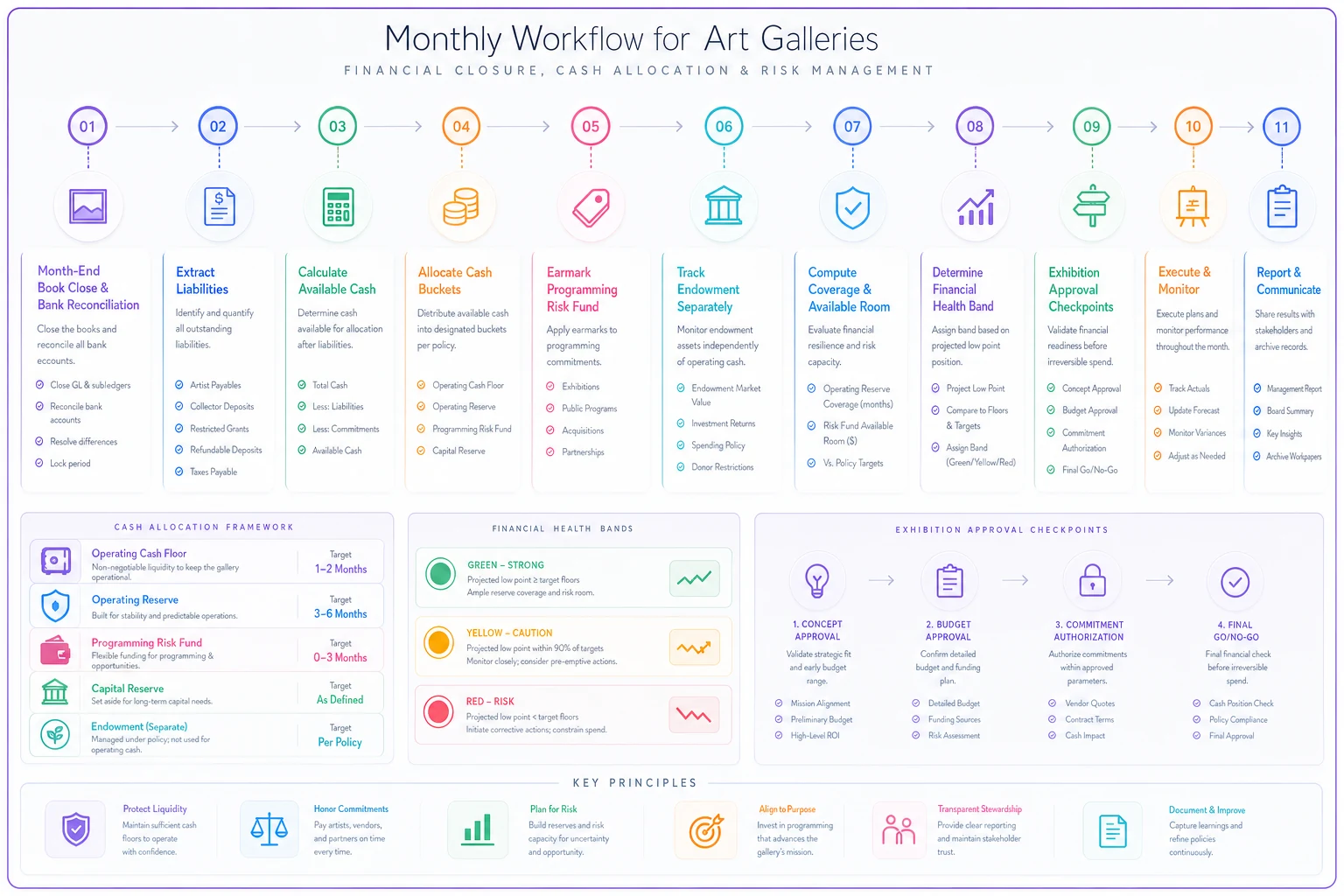
Keep it straightforward so a stretched team can run it.
Two numbers matter from there: operating reserve coverage in months of fixed costs, and available room in the risk fund after earmarks. Those two, plus the 3–6 month cash forecast showing the projected low point, set the band. The band goes on whatever document the curatorial team uses to track the exhibition pipeline. Any show approaching its irreversible-spend date gets checked against the current band, and if it fails, it goes back to the director and curator for resequencing or rescoping before anything gets signed.
Things break at the handoffs. The bookkeeper calculates the band but nobody tells the curators. Or the curators know the band, but an artist contract gets signed on a Friday because the artist happened to be in town. Or the artist payables figure lags because sales records live in a different system from the books, so available cash looks better than it is for about three weeks of every month.
This is where operational software with some AI automation earns its keep. It doesn't decide anything. It handles the dull connective work. When consignment records, sales, the exhibition pipeline, and the books live in one AI-assisted operational platform, it can calculate artist payables automatically and recompute the band as transactions come in instead of once a month. It can flag a contract waiting for signature when the band has shifted since the show was approved, or warn when two approved shows together are about to over-earmark the risk fund. The gallery still makes the decisions. It just stops making them on stale numbers.
What changes as the gallery grows
The right version of this depends a lot on scale, and galleries tend to adopt it either too early or too late.
Founder-run, one space, one show at a time. The reserve is often a number in the founder's head, sometimes partly sitting in a personal account. That's the real risk at this stage: gallery money and personal money mixed together, so you can't tell whether the gallery is solvent or the founder is subsidizing it. You don't need five layers yet. You need a separate account for artist payables, so that money is physically out of reach, and a simple rule that a minimum operating reserve stays in place before any new production commitment.
Small team, a board or advisors, three to six shows a year. The full layered structure starts paying off here. Several people now make commitments: curator, director, sometimes a development lead. Without written bands, each of them commits against the same pot of money without knowing what the others have promised. The monthly workflow above becomes necessary at this stage.
Multiple spaces, overlapping shows, regular fair presence. Two things change. Correlated risk becomes the main concern: a soft quarter hits every show and the fair at the same time, so the risk fund has to be sized at the pipeline level, and the "two largest downsides" rule might need to become three. And seasonality gets sharper, since more fairs and overlapping productions make the cash low points deeper and more predictable. Greenlighting against the projected low point is essential at this size.
One pattern keeps showing up as galleries grow: the operating reserve target gets set once and never updated. A gallery that set a 4-month target when fixed costs were $25k a month still thinks $100k is "four months" three years later, when fixed costs are closer to $40k. Recalculate the target every budget cycle against current fixed costs.
Real scenario: a commercial gallery with a project space
Business: A commercial gallery in a mid-sized city. It runs a main space plus a smaller project room, has about six staff, does two fairs a year, and has fixed costs of roughly $46k a month.
The problem: Coming into September, the gallery had one savings account holding about $210k. On that basis it greenlit three fall shows, including one with a significant new production, plus its usual winter fair. Nobody had separated out the roughly $70k in that balance owed to artists from summer sales. Two collectors paid secondary-market invoices late, one by more than two months. By mid-January, available cash was down to about three weeks of fixed costs.
To cover it, the gallery delayed two artist payouts by about six weeks and sold several secondary-market works at discounts of roughly 15–20% to raise cash quickly. One of the two delayed artists left the gallery the following year and said directly that the late payment was part of why.
What they changed: They moved artist payables into a separate account, split the remaining cash into layers, and set a 5-month operating reserve target because they rely heavily on fairs. They built a risk fund sized on their fall and spring pipeline, and adopted band rules tied to the projected January low point.
The following year: In September the gallery was in amber. One fall show was rescoped to work from existing pieces rather than a new commission. The large production moved to spring, and the gallery kept a smaller fall slot with lower production costs. The January low point came in at roughly 2.3 months of fixed costs. Not comfortable, but it meant no delayed payouts and no discounted fire sales. Total sales were roughly flat year over year, so the improvement didn't come from a revenue jump. It came from not leaking money at the worst moment.
By spring the risk fund was rebuilt to around $40k, which let them greenlight the large production with real cushion behind it. The director's later comment was that the program got more ambitious once there was a structure telling them when ambition was affordable.
When this actually makes sense
The full layered system makes sense when more than one person commits the gallery's money to programming. It also fits galleries with a predictable cash low point in the year, and any gallery handling significant artist payables or restricted funds. For a nonprofit with a board, a written reserve policy with bands and withdrawal rules is close to essential, since funders and auditors increasingly ask for one anyway.
It also fits if your program mixes low-risk and high-risk shows. The bands let you keep doing the risky ones, at the right time.
When this is a bad idea
If your total available cash is under about a month of fixed costs, spending energy on five layers and an endowment policy is mostly paperwork. Get the operating reserve to something real first. In that position, the only allocation rule that matters is "no new irreversible commitments without near-full committed funding."
It's also a bad idea to set the bands so strict that the gallery never leaves red. If the policy means you can't take any curatorial risk for three years, it's miscalibrated. Lower the committed-revenue thresholds a bit, or build a smaller risk fund faster, so the program doesn't stagnate. A gallery with a perfect reserve and a dull program isn't in a stronger position. It's just failing more slowly.
Who should NOT do this (yet)
A few types of gallery should hold off on the full version, or skip parts of it. These are the ones where the system tends to cause more trouble than it solves:
-
Galleries trying to raise an endowment before they have an operating reserve. Donor-restricted endowment gifts lock up cash you may need. Build the operating buffer first. Fundraising for an endowment while the gallery is three weeks from missing payroll also tends to raise questions with the very donors you're asking.
-
Galleries planning to wind down or close within a couple of years. Different rules apply. Focus on clearing artist payables and honoring commitments, not building long-term reserves.
-
Galleries that accept endowment gifts with restrictions they can't administer. If a donor wants an endowment fund only for acquisitions from one specific region or medium, and that doesn't fit your program, a polite no is better than a fund you'll be bound to forever.
None of this means you're locked out for good. It just means the order matters, and for these galleries the first steps are the unglamorous ones: separate the artist money, stabilize the operating buffer, and clean up the paperwork before taking on anything long-term.
A checklist for drafting your reserve policy
Use this as a working list when you sit down to write the policy. Most of it comes straight from the sections above, and if you can't tick an item, that's usually where the policy has a hole.
-
Available cash is calculated monthly as balances minus artist payables, collector deposits, restricted funds, refundable deposits, and tax collected
-
Artist payables are kept in a separate account, or at minimum tracked separately every month
-
Operating reserve target is set in months of fixed costs and recalculated every budget cycle
-
Programming risk fund is sized to the pipeline (combined downside of the riskiest shows), with earmarks for approved shows
-
Capital reserve has a written asset schedule, and its contribution is budgeted as an expense line
-
Endowment vs quasi-endowment is clearly distinguished, with a written spending rule and state- or country-specific legal review
-
Band thresholds (red/amber/green/stretch) are defined, with both downside caps and committed-revenue requirements
-
Bands are checked against the projected cash low point, not the current balance
-
"Irreversible spend" is defined for your gallery (artist fees, fabrication deposits, shipping, print)
-
Withdrawal authority is written for each layer, including dollar limits and notification timelines
-
Emergency draw protocol defines what counts as an emergency and who ratifies it
-
Surplus waterfall order is set in advance, and a deficit automatically triggers a replenishment plan and pipeline review
-
Internal loans from endowment funds are banned, or require a vote, a schedule, and standing reporting
-
Band status is visible to curators, not only to finance
Don't try to get every line perfect in the first draft. A policy that covers the first half of this list and actually gets used beats a complete one that sits in a shared drive.
Pulling it together
Most galleries already treat reserves as important. The gap is connecting reserves to programming decisions without needing a crisis meeting every time. A solid gallery reserve and endowment strategy does that in three moves: separate the money that isn't yours, split what's left into layers with different jobs, and let the health of those layers set the bar each show has to clear.
The first year of a policy like this will be imperfect. Your downside estimates will be off, a band threshold will turn out too strict or too loose, and somebody will find a reason the rules shouldn't apply to their show. That's normal. Review it after each season closes: which shows hit their downside case, whether the risk fund was sized right, whether the January low point landed where the forecast said it would. Adjust from there.
If you only do one thing this month, calculate available cash the honest way, with artist payables and restricted money subtracted, and compare it to the number you've been using in programming conversations. For a lot of galleries, the gap between those two numbers explains most of the last few hard winters.
Ready to elevate your gallery operations?
Join 500+ galleries using Artioly to streamline operations, boost visitor engagement, and increase art sales.