

Every gallery that starts renting out its space runs into the same wall eventually. The corporate bookings look like free money at first — a law firm wants your main room for a client reception, a tech startup needs a launch venue, a nonprofit wants your gallery for their annual gala. You quote a number, they pay it, and suddenly there's an extra few thousand dollars in the bank.
Then the wine gets spilled on the reclaimed oak floor. A frame gets bumped during a caterer's setup. Your Thursday-through-Saturday programming gets squeezed because the rental crowd needed three days to load in, run the event, and strike. Your registrar spends half a week rehanging work that was taken down for a "quick" corporate dinner.
The rental revenue is real. But so is the damage to your actual reason for existing. Most galleries get the math wrong here — they treat venue hire as pure margin and forget it competes directly with the exhibition calendar, the artwork on the walls, and the sanity of a two- or three-person team.
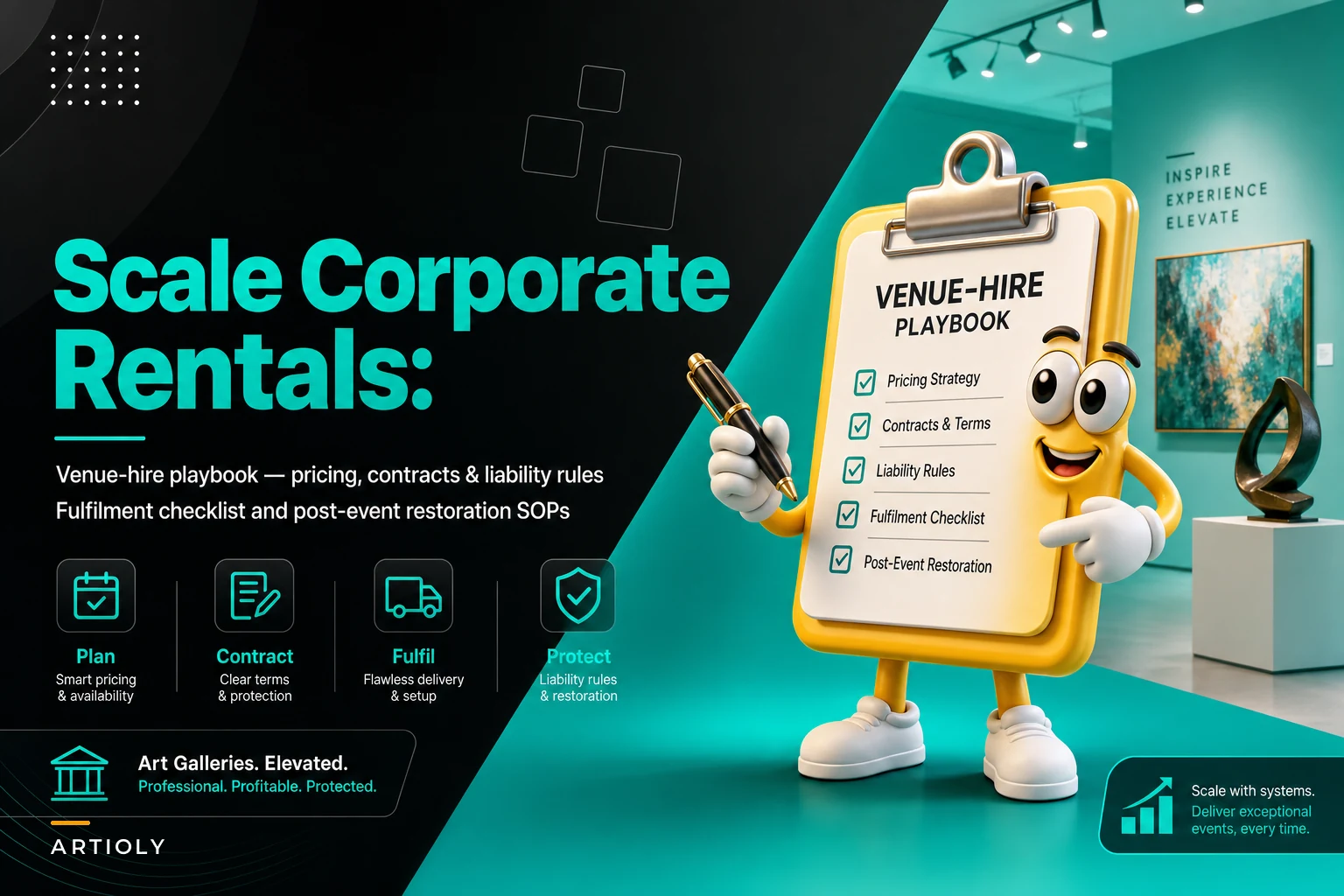
This playbook is built around one goal: scaling rentals as a genuine revenue line without letting them cannibalize your programming or expose you to liability you never priced in.
Why galleries underprice rentals and overexpose themselves
The core problem isn't that galleries charge too little per event. It's that they price the room instead of the disruption.
A typical scenario: a gallery quotes $1,500 for an evening rental because that's roughly what the coworking space down the street charges. What the quote ignores — the exhibition had to come down early, a staff member burned six hours babysitting the event, the floors needed professional cleaning afterward, and the insurance certificate the client provided didn't actually cover damage to hung artwork.
The result is a booking that grossed $1,500 and cost the gallery somewhere north of $900 in staff time, cleaning, lost programming days, and risk exposure — before you even count the scuffed wall that took a Saturday to repair.
The underpricing usually comes down to three habits:
-
Flat pricing. One number for every event, regardless of headcount, catering, alcohol, or how much art has to move.
-
No liability floor. No minimum insurance requirement, no security deposit, no damage schedule agreed in advance.
-
Ignoring the programming cost. Nobody assigns a dollar value to the exhibition days lost or the install labor wasted.
You can't fix a rental program by charging more per hour. You fix it by building a system that prices risk, protects the walls, and protects the calendar — in that order.
Build tiered pricing around risk, not square footage
The single biggest upgrade most galleries can make is moving from one flat rate to a tiered structure that scales with how much the event actually disrupts the space and how much liability it introduces.
Never miss a key exhibition detail again.
Artioly helps you organize, promote, and manage every exhibition effortlessly.
- Unified exhibition scheduling
- Artist and visitor notifications
- Inventory and sales tracking
No credit card required
Think in tiers defined by three variables: headcount, whether alcohol and full catering are involved, and how much artwork has to be moved or protected. A quiet daytime board meeting for 20 people is a completely different animal from a 120-person cocktail reception with a DJ and passed hors d'oeuvres.
Here's a workable tier structure you can adapt:
| Tier | Event type | Guests | Alcohol / catering | Artwork handling | Typical base fee | Deposit |
|---|---|---|---|---|---|---|
| A | Daytime meeting / seated talk | Up to 30 | None or coffee service | Work stays hung, no rigging near art | $600–$900 | $500 |
| B | Evening reception, light catering | 30–70 | Wine/beer, passed apps | Some work relocated, rest protected | $1,400–$2,200 | $1,500 |
| C | Full corporate event / gala | 70–140 | Open bar, full catering, music | Room cleared or heavily protected | $3,500–$6,000+ | $3,000+ |
A few things worth noticing here. The deposit scales faster than the base fee because the risk scales faster than the revenue. A Tier C event isn't twice as risky as a Tier B — it's more like four or five times as risky once you add an open bar and a hundred-plus people moving around fragile work.
The artwork handling column is also where galleries quietly lose money. If a client wants the walls cleared, that's not a courtesy — it's install labor, storage handling, and a rehang afterward. Bill it as a separate line item. Galleries that run rentals profitably almost always break out labor, cleaning, and security as explicit add-ons rather than folding them into a single number that looks competitive but bleeds margin.
There's a real relationship between how you price rentals and how you price everything else. If you've already built a rule-based pricing matrix for your artwork, the same discipline applies here — price against your actual cost structure and break-even math, not against what the venue across town charges.
When flat pricing is actually fine
Tiering isn't always worth the overhead. If you only do three or four rentals a year and they're all similar — small daytime talks, no alcohol, no artwork moved — a single clean rate is easier to quote and administer. Tiering earns its keep once you're doing a dozen or more events annually across a range of sizes. Below that volume, the complexity costs more than it saves.
The liability and insurance rules that actually protect you
This is the section most galleries skip until something breaks. Then they discover the client's "event insurance" covered their catering equipment but explicitly excluded damage to the property they rented — including, especially, the artwork on the walls.
The non-negotiables for any rental above Tier A:
-
Certificate of insurance (COI) required before the event. The client provides proof of general liability coverage, typically $1M per occurrence, with your gallery named as additional insured. No COI, no event. This isn't paperwork theater — it's the thing that stands between you and a lawsuit if a guest slips and falls.
-
Damage schedule agreed in writing. Before the event, both parties sign off on a document listing repair and replacement values for floors, walls, lighting, and — critically — the artwork that remains on-site. Ambiguity here is where disputes live.
-
Separate artwork rider. Standard event insurance rarely covers fine art. Either the client carries a rider for the value of work on-site, or you contractually require all consigned and high-value work to be removed and relocated at the client's expense. Pick one. Never leave it undefined.
-
Security deposit held, not just quoted. The deposit should be collected in advance and returned only after the post-event walkthrough. A deposit you have to chase after the damage is done is not a deposit — it's a wish.
-
Alcohol clause. If liquor is served, specify who holds the liquor liability and whether a licensed bartender is required. In many jurisdictions, an unlicensed pour at your address can put the liability on you.
The pattern worth internalizing: your contract should assume something will go wrong and define exactly who pays. Galleries that write contracts assuming everything goes fine are the ones eating repair costs out of pocket and quietly deciding rentals "aren't worth it."
Who should NOT be renting their space out
Be honest about this. If your gallery currently has irreplaceable consigned work hung salon-style across every wall, if you have no way to relocate art quickly, or if you're a solo operator with no bandwidth to supervise a load-in — rentals will hurt you more than help you. Some spaces genuinely aren't built for it, and forcing a rental line onto a fragile operation is how you end up with a damaged loan piece and a very uncomfortable conversation with an artist.
The fulfilment checklist: what has to happen before, during, and after every booking
A rental isn't a transaction, it's a small production. The galleries that scale rentals without chaos treat each one as a repeatable sequence with clear owners for every step.
Here's the fulfilment checklist that covers the full arc:
-
Two weeks before
-
COI received and verified, gallery named as additional insured
-
Signed rental agreement with damage schedule and deposit paid
-
Artwork handling plan confirmed (what moves, what's protected, who does the labor)
-
Catering and vendor list collected, with load-in/load-out times
-
Staff assigned as on-site supervisor for the event
-
Day before
-
Artwork relocated or protected per the plan
-
Baseline condition photos taken of floors, walls, and any art remaining on-site
-
Floor protection and wall barriers installed where needed
-
Vendor access confirmed, keys/codes prepared
-
Day of
-
On-site supervisor present for load-in, event, and strike
-
Guest count monitored against the tier agreement
-
Spills and incidents logged in real time (photo + note)
-
Immediately after
-
Walkthrough with client before they leave, compared against baseline photos
-
Any damage documented and acknowledged in writing on the spot
-
Deposit return timeline confirmed
The step people skip most often is the baseline condition photos. Without a before picture, every post-event damage dispute becomes your word against theirs — and clients who've already left have very little incentive to agree they scratched your floor. Ten minutes of photos the day before saves you the entire argument.
The other quiet failure is not assigning a single named supervisor. When "the team" is watching the event, nobody is. One person owns the room for the duration, full stop.
Assign one named on-site supervisor per booking and log their contact in the booking record ahead of the event.
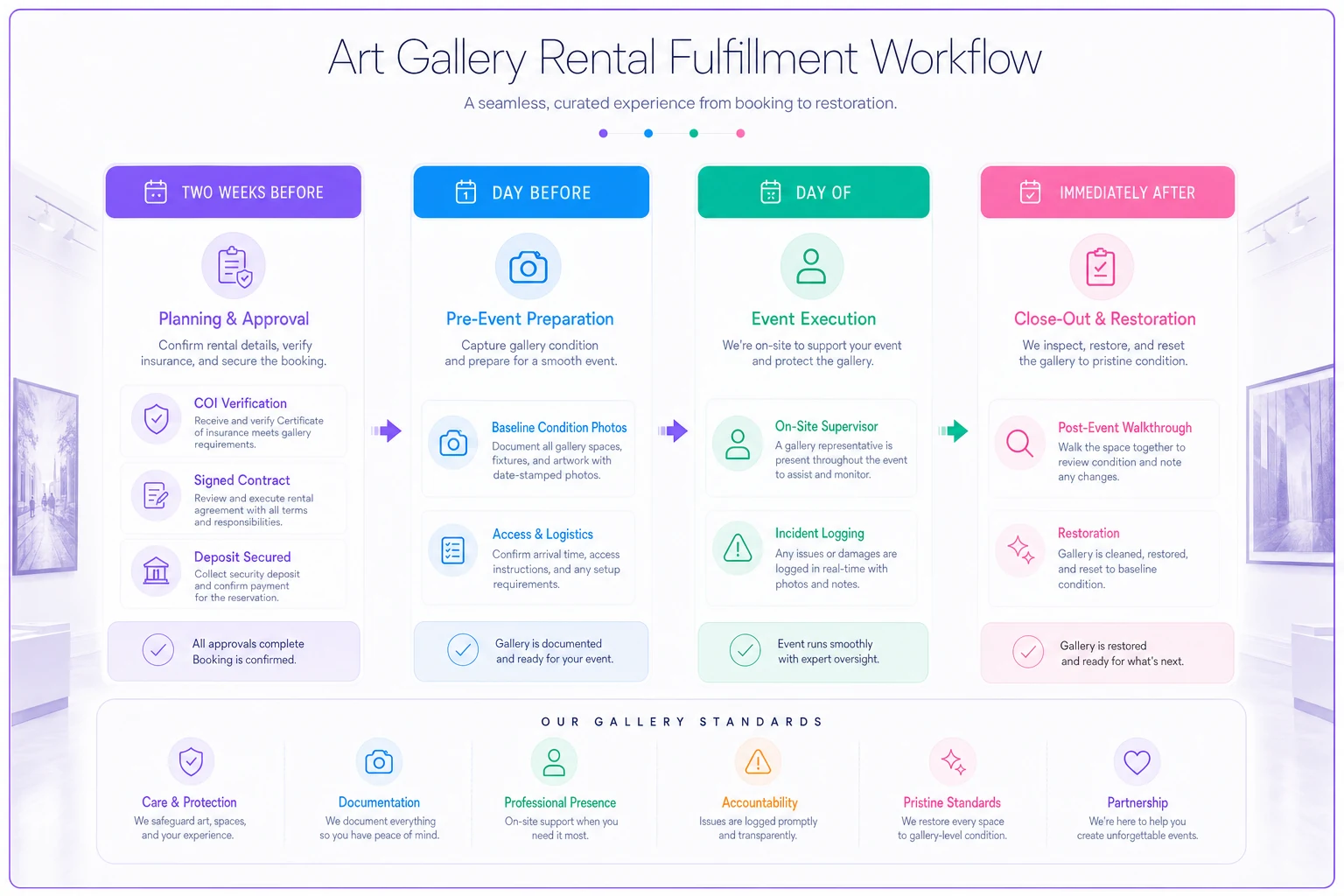
This illustrates the repeatable sequence your team runs for every booking.
The post-event restoration SOP that protects your programming
This is where rentals connect directly to your exhibition calendar. The restoration SOP determines whether your Tuesday opening actually happens on Tuesday or gets pushed because the space is still trashed from Saturday's gala.
Restoration is a defined sequence, not "clean up whenever someone gets to it." The standard flow:
-
Immediate strike (event night or next morning). Vendors remove all equipment, furniture, and catering. This should be contractually the client's responsibility with a hard deadline — not something you discover at 9am Monday.
-
Damage assessment against baseline. Walk the space with your day-before photos. Log every discrepancy. This is what your deposit deductions are based on.
-
Deep clean. Floors, glass, restrooms. Budget for professional cleaning on Tier C events — a hundred people and an open bar leave a mess that a staff mop won't fix.
-
Wall and surface repair. Patch, sand, touch-up paint. This is the step that eats the most calendar time because paint needs to cure before you rehang.
-
Rehang and re-install. Artwork returns to position, lighting re-aimed, labels replaced. Verify against your install documentation from before the event.
-
Final walkthrough and reset. Space confirmed exhibition-ready. Deposit reconciled and returned minus any documented deductions.
The critical planning move: build the restoration window into your calendar before you accept the booking. A Saturday Tier C event does not free up the space on Sunday. Realistically it frees up the space Tuesday or Wednesday once you account for strike, cleaning, paint cure, and rehang. Galleries that book a rental on a Friday and schedule an opening the following Monday are setting themselves up to either rush the restoration or delay the show.
This restoration discipline is really an extension of the same operational thinking behind turning your openings into a smooth front-of-house flow — a well-run space and a well-run event both come down to knowing exactly who does what and in what order.
A real scenario: the gallery that stopped losing money on its own space
A mid-sized commercial gallery in a walkable arts district — two full-time staff, one part-timer, rotating exhibitions every six to eight weeks. They'd been doing occasional rentals for a couple of years, flat rate of $1,800 an event, maybe eight or nine bookings a year.
On paper that was roughly $15k in annual rental revenue. In reality, once they actually tracked the numbers, the picture was uglier. Two events had caused floor and wall damage that came out of pocket — around $2,600 combined — because deposits were never collected. Staff overtime around events wasn't billed. And two exhibition openings had been pushed back by a few days because the space wasn't restored in time, which cost them momentum and at least one soft-committed sale.
They rebuilt the program around three changes: tiered pricing, so the big cocktail events got quoted at $3,800–$4,500 instead of a flat $1,800; mandatory COIs and deposits, so damage stopped coming out of their own budget; and a restoration window blocked into the calendar before any booking was confirmed, so programming never got squeezed again.
The following year they did roughly the same number of events — around ten — but rental revenue came in near $34k. Damage costs dropped to nearly nothing because deposits covered the two minor incidents that did happen, and not a single opening got delayed. Same space, same volume, roughly double the net contribution, and the exhibition calendar was actually protected instead of quietly sacrificed.
The lesson isn't "charge more." The money was already there — it was leaking through unpriced risk and lost programming days, and closing those leaks was worth more than any rate increase.
Keeping the whole thing organized as volume grows
Once you're running a dozen or more rentals a year alongside a full exhibition schedule, the coordination itself becomes the bottleneck. COIs living in someone's email, deposit statuses tracked on a whiteboard, restoration windows that only exist in one person's head — that's how a well-designed rental program slowly turns back into chaos.
A shared operational system earns its place here. Not because software makes decisions for you, but because it keeps every booking's checklist, insurance status, deposit, condition photos, and restoration deadline in one place your whole team can see. Gallery management platforms with built-in workflow automation can flag a missing COI two weeks out, alert you when a restoration window overlaps an install date, or hold a booking in "unconfirmed" until the deposit clears — the routine coordination that otherwise falls through the cracks when three people are juggling shows, sales, and events at once.
The point isn't to run your rental program for you. It's to make sure the pricing tiers, liability rules, fulfilment steps, and restoration SOPs you just built actually get followed every single time, even during a busy install week when everyone's stretched thin.
The bottom line for your calendar
A rental program is worth building only if it funds your programming rather than fighting it. That happens when you price the disruption instead of the square footage, require the insurance and deposits that put damage risk where it belongs, run every booking through a repeatable fulfilment checklist, and block the restoration window into your calendar before you ever say yes.
Do those four things and venue hire becomes one of the more reliable revenue lines a small gallery can run. Skip any of them, and you're renting out the thing that matters most — your walls, your art, and your calendar — for less than it costs you.
A rental program is worth building only if it funds your programming rather than fighting it. That happens when you price the disruption instead of the square footage, require the insurance and deposits that put damage risk where it belongs, run every booking through a repeatable fulfilment checklist, and block the restoration window into your calendar before you ever say yes.
Do those four things and venue hire becomes one of the more reliable revenue lines a small gallery can run. Skip any of them, and you're renting out the thing that matters most — your walls, your art, and your calendar — for less than it costs you.
Ready to elevate your gallery operations?
Join 500+ galleries using Artioly to streamline operations, boost visitor engagement, and increase art sales.