



Last month, a Chelsea gallery lost track of a $45,000 sculpture. Not physically lost—they knew it was sitting in storage. They just couldn't answer basic questions: was it consigned or owned? When did the insurance period end? Who authorized the 30% discount some previous assistant had scribbled in an email?
Why most small galleries are flying blind on inventory
This wasn't a storage problem or a staffing problem. It was an artwork lifecycle governance problem.
Small galleries handle anywhere from 200 to 800 works a year, each moving through multiple states—acquisition, cataloging, exhibition, sale negotiation, shipping, sometimes deaccession. Each state needs different metadata, different approvals, different documentation. Without clear governance, you're running blind.
Why small galleries struggle with artwork lifecycle management
The typical small gallery runs with 2-4 full-time staff managing inventory worth somewhere between $500k and $3 million. Unlike museums with dedicated registrars and collection managers, gallery staff wear every hat. The same person photographing new acquisitions might also handle condition reports, update the website, and coordinate shipping that afternoon.
Never miss a key exhibition detail again.
Artioly helps you organize, promote, and manage every exhibition effortlessly.
- Unified exhibition scheduling
- Artist and visitor notifications
- Inventory and sales tracking
No credit card required
That creates a real mismatch. Each artwork needs roughly 15-20 discrete data points across its lifecycle—provenance, dimensions, edition numbers, insurance values, consignment terms, exhibition history, pricing tiers, shipping specs. Multiply that by hundreds of works and you're looking at thousands of data points that need to stay accurate and actually findable.
Most galleries default to spreadsheets, shared drives, and memory. It holds together up to around 150 active works. Past that threshold, things start breaking. Duplicate inventory numbers, missing consignment end dates, murky pricing authority, and that moment when a collector asks about a piece and nobody can locate the high-res images.
The real cost isn't just confusion. Galleries without proper lifecycle governance typically see:
-
15-20% of consignment periods expire without any review
-
Several insurance claims rejected annually because documentation is incomplete
-
Roughly $8,000-12,000 in rushed shipping costs from last-minute coordination
-
Noticeably longer sales cycles because provenance or edition info is missing when it matters
The real cost isn't just confusion. Galleries without proper lifecycle governance typically see:
The five critical lifecycle states every gallery must track
Certain lifecycle states become obvious when you look across galleries of different sizes. Not academic categories—operational states that determine what actions staff can take and what information they actually need.
State 1: Acquisition/Intake
Whether purchased, consigned, or donated, every work enters through acquisition. Required metadata includes source documentation, initial condition assessment, ownership terms, insurance requirements, and intake photography. The handoff checkpoint: can a new staff member understand the terms and obligations from the paperwork alone?
State 2: Available Inventory
Works ready for sale or exhibition. This state needs complete cataloging—professional photography, accurate descriptions, pricing tiers, edition information, any restrictions. The checkpoint: could you create a catalog entry or web listing in under five minutes from the available information?
State 3: Reserved/Hold
When collectors express serious interest or works are selected for exhibitions. Critical metadata shifts to reservation terms, hold deadlines, approval requirements, and communication logs. The checkpoint: if the primary salesperson is out, can another staff member clearly explain the status and next steps to the interested party?
State 4: In Transaction
Active sales, loans, or transfers. Documentation gets dense here—invoices, shipping arrangements, insurance riders, condition reports, payment schedules. The checkpoint: could you reconstruct the entire transaction from documents alone if the person handling it left tomorrow?
State 5: Post-Transaction
Sold works needing final documentation, unsold consignments approaching term limits, works flagged for deaccession. Metadata here focuses on closing paperwork, artist resale rights, final locations, and keeping the relationship intact. The checkpoint: can you generate accurate consignment statements and sales reports without manual calculation?
Building your metadata framework: what actually matters
The temptation is to track everything. One gallery had 47 fields in their inventory spreadsheet. Nobody ever filled them all out. Half contained outdated information. The complexity just paralyzed the operation.
Start with non-negotiables for each state:
Acquisition metadata minimums:
-
Unique inventory number (non-recycling)
-
Source and date
-
Ownership type and terms
-
Initial valuation
-
Basic condition notes
-
Location code
Available inventory additions:
-
Full dimensions and medium
-
Exhibition history
-
Publication references
-
Price points (retail/trade/net)
-
Installation requirements
-
Reproduction rights status
Transaction-state additions:
-
Responsible staff member
-
Key dates and deadlines
-
Approval chain
-
Special handling notes
-
Payment terms
-
Shipping specifications
The framework should answer three questions instantly: What can we do with this work? Who needs to approve actions? What are our obligations?
Lightweight handoff checkpoints that prevent dropped balls
A lot of galleries rely on senior staff memory to track artwork status. That breaks down during busy periods, staff transitions, or when volume spikes. You need explicit handoff points that don't require lengthy meetings or elaborate documentation.
The intake-to-inventory handoff:
-
High-res images uploaded (minimum 3 views)
-
Consignment agreement or purchase invoice filed
-
Inventory number physically attached
-
Location logged in system
-
Insurance coverage confirmed
Require a photo of the inventory label attached to the work before marking it available.
One gallery cut intake errors by around 80% just by requiring a photo of the inventory label attached to the actual work before marking it available.
The reservation handoff:
-
Document who authorized the hold
-
Set an expiration date (even on informal holds)
-
Note any special terms discussed
-
Assign follow-up responsibility
-
Log it in a shared system, not someone's personal email
The shipping handoff:
-
Photograph the work in packing materials
-
Document box dimensions and weight
-
Confirm insurance coverage amount
-
Verify delivery requirements
-
Set up a return/condition report protocol
None of these are complex. They're five-minute checks that prevent five-hour problems.
Role-specific checklists for gallery teams
Different roles interact with artwork at different points in the lifecycle. "Everyone does everything" creates gaps and overlaps. Clear role definition improves both efficiency and accountability.
| Role | Frequency | Key Responsibility |
|---|---|---|
| Gallery Assistant/Registrar | Daily/Weekly/Monthly | Holds expiry, location audits, consignment flags, insurance checks |
| Sales Associate | Per interaction | Availability check, interest logging, written confirmation |
| Director/Owner | Weekly/Monthly/Quarterly | Transaction review, deaccession approvals, velocity analysis |
| Preparator/Handler | Per move | Handling requirements, install documentation, condition notes |
Small galleries often resist role definition, thinking it creates silos. What actually happens is the opposite—clear responsibilities make handoffs cleaner.
KPIs that actually indicate operational health
Most galleries track sales metrics and not much else. The operational indicators that predict future problems tend to get ignored. Meaningful KPIs for lifecycle governance focus on flow and accuracy, not just revenue.
Inventory velocity metrics:
-
Average days in each state
-
Percentage of works stuck in one state for over 90 days
-
Consignment renewal rate
-
Deaccession timeline (decision to removal)
Data quality metrics:
-
Percentage of works with complete metadata
-
Frequency of duplicate inventory numbers
-
Time to locate a specific work (physical and in records)
-
Documentation gaps discovered mid-transaction
Operational efficiency metrics:
-
Average time from intake to available
-
Percentage of rushed shipping requests
-
Staff hours spent on inventory reconciliation
-
Number of "where is this?" inquiries per week
When these numbers improve, everything else follows. Better operational systems reduce cascade failures that drain time and money.
Common failure points in gallery lifecycle management
The exhibition scramble:
Three weeks before an opening, nobody can find high-res images for the catalog. The works exist, they were photographed—but the files are scattered across personal folders, old hard drives, or some intern's laptop from last summer. This isn't really an image problem, it's a lifecycle documentation problem. Exhibition operations need clear checkpoints that include metadata verification before things get urgent.
The phantom hold:
A collector mentioned interest six months ago. The work shows as "reserved" in the spreadsheet. Nobody remembers who reserved it or whether that person is still interested. Meanwhile, three other collectors have asked. This happens when reservation states lack expiration dates and clear ownership.
The insurance gap:
A work sells. Insurance needs updating. Three months later, during transit to another exhibition, damage happens. The work was never removed from the policy, but the new owner wasn't added as beneficiary. Claim denied. This pattern repeats because post-transaction metadata updates keep getting deprioritized.
The consignment surprise:
An artist emails asking about works from a two-year-old consignment. The agreement expired eight months ago, but nobody caught it. Now you're negotiating from a weak position, possibly owing storage fees or return shipping. Systematic tracking would have flagged this 60 days before expiration.
Creating your implementation timeline
Overhauling artwork lifecycle governance feels overwhelming, but you don't need to transform everything at once. A phased approach over 12-16 weeks can establish working systems without disrupting ongoing operations.
Weeks 1-2: Current state assessment
-
Count total works in each state
-
Identify metadata gaps
-
Document existing processes
-
Note pain points and delays
Don't try to fix anything yet. Just get a clear picture.
Weeks 3-4: Design core framework
-
Define your five states clearly
-
Establish minimum metadata requirements
-
Create role assignments
-
Set up basic tracking
Keep it simple. A well-organized spreadsheet beats a complex system nobody uses.
Weeks 5-8: Pilot with new acquisitions
-
Apply framework to incoming works only
-
Test handoff checkpoints
-
Refine metadata requirements
-
Adjust role responsibilities as needed
Starting with new inventory avoids the overwhelming task of retrofitting existing works while letting you prove the system actually works.
Weeks 9-12: Gradual retrofit
-
Update 10-15 existing works weekly
-
Prioritize active or high-value inventory
-
Clean up obvious errors
-
Build documentation habits
Weeks 13-16: Full implementation
-
Apply to all inventory
-
Establish regular audits
-
Train all staff on the processes
-
Start tracking KPIs
Galleries that succeed with implementation treat it like any exhibition project—deadlines, responsibilities, clear outcomes.
A visual workflow can help the team follow the phases and handoff checkpoints.
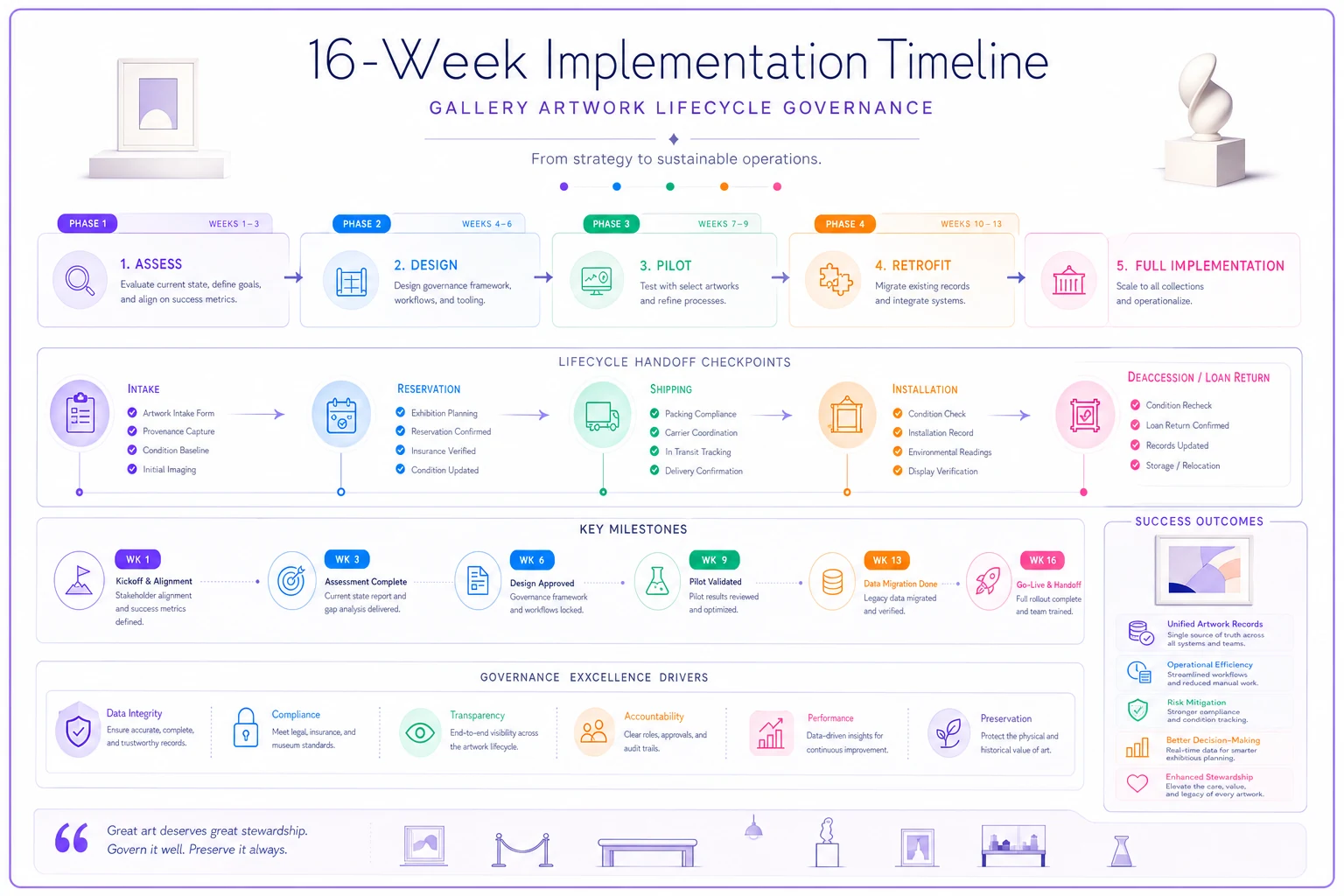
A simple diagram helps teams follow the phased rollout and handoff checks.
Technology and automation in lifecycle management
Spreadsheets hit their limit around 200 active works. Past that, you need structured systems. The gallery software landscape is fragmented though—collection management tools built for museums, inventory trackers missing sales features, CRMs that don't handle consignments properly.
Modern operational software can bridge these gaps. AI-powered platforms can extract metadata from documents automatically, flag consignment expirations before they become problems, route approval requests, and maintain audit trails without anyone having to remember to do it. This isn't about replacing human judgment—it's about automating the repetitive tracking that humans consistently miss when they're busy.
| Lifecycle State | Manual Pain Point | What Automation Handles |
|---|---|---|
| Acquisition/Intake | Missing fields, no reminders | Auto-extract terms from agreements, flag incomplete records |
| Available Inventory | Outdated pricing, scattered images | Centralized asset library, pricing tier validation |
| Reserved/Hold | Phantom holds, no expiry tracking | Auto-expiry alerts, assignment logging |
| In Transaction | Documentation gaps, approval delays | Audit trails, approval routing, milestone tracking |
| Post-Transaction | Missed consignment renewals | Auto-flag 60 days before expiry, generate statements |
When a consignment agreement uploads, for example, the system can pull out key dates, payment terms, and restrictions, then automatically create a review task 60 days before expiration. When condition reports get filed, it can flag significant changes and notify the right people. These automations prevent the small oversights that compound into real problems.
The key is finding tools that actually understand gallery operations, not generic inventory management software. The right platform handles the full lifecycle—from artist studio to collector wall—with role-based permissions, automated reminders, and integration with your existing tools. It should make your processes better, not force you into rigid workflows designed for some other kind of business.
A practical example: 200-work gallery transformation
A contemporary gallery in Denver was dealing with exactly these issues. They managed roughly 180-200 works across painting, sculpture, and works on paper. Two full-time staff plus the owner handled everything from artist relations to shipping.
Their system: Excel for inventory, Gmail for correspondence, Dropbox for images, memory for everything else. They spent around 15 hours a week just answering internal questions about artwork status. Consignment renewals were consistently missed. One incident with a misplaced $28,000 painting during an art fair nearly cost them an important artist relationship.
Over four months, they put a lightweight lifecycle governance system in place. Nothing fancy—clear states, required metadata, simple handoffs, weekly KPI reviews. They moved from Excel to an operational platform that could track states, automate reminders, and keep proper histories.
-
Administrative time dropped by roughly 40%
-
Zero missed consignment renewals
-
Average sales cycle shortened from about 6 weeks to 4
-
One water damage claim was approved in full because documentation was complete
-
Staff said they felt "in control" for the first time
The owner's observation was that the biggest change wasn't the technology—it was finally having processes that everyone actually followed. The software just made those processes sustainable.
Making lifecycle governance stick
Galleries that maintain good lifecycle governance treat it as core operations, not administrative overhead. They assign clear ownership—usually a gallery manager or registrar who sees this as their primary responsibility, not something tacked onto everything else they're doing.
They also maintain the system actively. Weekly audits catch small errors before they compound. Monthly reviews surface process improvements. Quarterly deep-dives reveal patterns. It's not about perfection—it's about consistent, incremental improvement.
Most importantly, they connect governance to business outcomes. When staff understand that good metadata means faster sales, fewer shipping emergencies, and better artist relationships, compliance improves on its own. When you can show that organized inventory directly affects commission checks, even sales-focused staff start paying attention.
Moving forward with your governance system
Artwork lifecycle governance isn't about building museum-quality documentation systems. It's about knowing where things are, what you can do with them, and what obligations you have. It's about preventing the late-night panics before international art fairs and the embarrassing moments when you can't answer basic questions about works you're supposedly representing.
Start with one state. Pick acquisition if you want immediate impact—every improvement there ripples through the entire lifecycle. Or start with transaction states if sales chaos is the bigger problem right now. Build momentum with small wins before trying to tackle your entire inventory.
A gallery operating at 80% governance efficiency will outperform one operating at 30%, even if neither reaches museum standards. Focus on sustainable systems your actual team can maintain—not theoretical best practices that collapse the moment things get busy.
Good lifecycle governance becomes invisible when it works. Staff stop asking "where is this?" and "what's the status?" and start focusing on relationships, sales, and curation. That's when you know the system is doing its job—when it enables the real work instead of becoming the work itself.
Good lifecycle governance becomes invisible when it works. Staff stop asking "where is this?" and "what's the status?" and start focusing on relationships, sales, and curation. That's when you know the system is doing its job—when it enables the real work instead of becoming the work itself.
Ready to elevate your gallery operations?
Join 500+ galleries using Artioly to streamline operations, boost visitor engagement, and increase art sales.