

Three months ago, a gallery in Brooklyn accepted what looked like a perfect estate collection. Nineteen modernist paintings, impeccable condition, reasonable pricing. The executor had all the right paperwork — or seemed to. Six weeks later, the FBI showed up. Two of the works had been looted from a Belgian museum in 1943. The gallery lost $180,000, faced a federal investigation, and spent another $45,000 on legal fees.
This happens more than you'd think. Not always Nazi loot — sometimes it's stolen contemporary work, forged documents, or murky ownership chains that blow up months after you've already sold pieces to collectors.
The problem isn't that galleries skip provenance checks entirely. Most do some level of checking. The issue is that small galleries run abbreviated checks that miss critical red flags. You're racing to secure inventory, competing with other dealers, working with tight budgets. Full forensic provenance research can run $2,000–$8,000 per work. You can't do that for every acquisition when you're evaluating dozens of potential purchases each month.
The resource trap that creates exposure
Small galleries face a brutal equation. Deep provenance research requires specialized databases — IFAR, Art Loss Register, FBI's NSAF — that cost thousands annually. Hiring provenance researchers runs $150–$300 an hour. Meanwhile, you're constantly evaluating estate lots, dealer inventories, and direct artist submissions.
So you end up doing surface-level checks. Googling the artist, running obvious database searches, trusting documentation that looks legitimate. That creates real blind spots.
The most dangerous acquisitions often look the cleanest. Professional art thieves and money launderers know how to build convincing paper trails. They target smaller galleries specifically because they know deep investigation isn't happening. A dealer in Miami once told me they'd unknowingly handled three pieces from the same theft ring over eighteen months — different sellers, different stories, believable documentation each time.
What makes this worse is that liability doesn't disappear with ignorance. Even if you had no idea a work was stolen or misattributed, you're still on the hook for returns, legal costs, and reputation damage. Insurance rarely covers full losses from provenance issues, especially if you can't demonstrate you followed industry-standard checking procedures.
Red flag indicators that actually matter
Clear patterns emerge around which warning signs predict real problems versus normal market friction.
Never miss a key exhibition detail again.
Artioly helps you organize, promote, and manage every exhibition effortlessly.
- Unified exhibition scheduling
- Artist and visitor notifications
- Inventory and sales tracking
No credit card required
Timing red flags: Sellers pushing for immediate decisions usually have reasons. Legitimate estates move slowly. Legitimate collectors understand due diligence takes time. When someone needs a decision within 48 hours on valuable work, there's almost always a backstory.
Fresh import paperwork combined with a cagey seller often signals laundering. The work just arrived from overseas, paperwork looks proper, but the seller deflects questions about previous ownership — "privacy concerns" or "family sensitivity." Sometimes legitimate. Usually not.
Documentation patterns that reveal issues: Photocopied certificates of authenticity mean nothing. Real certificates have security features, embossing, or verifiable registration numbers. If someone only has photocopies, the originals either don't exist or are held by the actual owner.
Gaps in exhibition history for supposedly significant works are immediately concerning. A major piece by a known artist should have some record between creation and now. When thirty years of history get explained with "private collection," you're looking at either stolen work or an attribution problem.
Pay attention to linguistic inconsistencies in documentation too. European documents with American spelling, recent paperwork using outdated institutional names, certificates with fonts that didn't exist when they were supposedly created. Forgers often nail the visual presentation while missing details like these.
Seller behavior: Reluctance to provide prior sale documentation isn't about privacy — it's about not having clean history. Every legitimate transaction creates records. When sellers claim they "lost" purchase receipts or "can't remember" where something was bought, they're usually hiding problematic origins.
Multiple relatives claiming ownership comes up constantly with estates. One heir wants to sell, another thinks grandma promised it to them, and you're suddenly in the middle of family warfare. Even with proper executor documentation, other heirs can create legal nightmares down the road.
Sellers shopping the same collection to multiple galleries simultaneously are looking for whoever asks the fewest questions. Good inventory doesn't require shotgun approaches. When three galleries are all evaluating the same collection in the same week, something's off.
Sample inquiry templates that get real answers
Generic questions get generic lies. Specific, technical questions force sellers to either provide real information or reveal they can't.
"Thank you for considering us for these works. To begin our standard evaluation process, please provide:
-
Original purchase receipts or invoices (photos of originals, not copies)
-
Any correspondence with the artist or their estate regarding these works
-
Previous insurance appraisals or valuations with company letterhead
-
Export permits if works originated outside the US
-
Details of any previous consignment arrangements, even if unsuccessful
For estate sales specifically: court documentation appointing executor, death certificate, and written confirmation that all heirs have been notified of the proposed sale.
We'll also need to verify the works against standard databases, which typically takes 5–7 business days.
This template immediately filters serious sellers from problematic ones. Legitimate sellers might not have everything but will explain why reasonably. Problematic sellers either disappear or start making excuses.
"We're evaluating works attributed to [Artist Name] from your collection. As part of our authentication process:
-
Has the estate's authentication board reviewed these pieces?
-
Can you provide their catalog raisonné numbers?
-
Were these purchased directly from the artist or through which galleries?
-
Have any condition issues been addressed since original purchase?
-
Are you aware of any similar works by this artist being questioned or disputed?
Please note we'll be contacting the estate directly to verify any claimed authentication.
Mentioning direct estate contact often triggers immediate revelations about attribution problems.
"For our records and insurance requirements:
-
Has clear title been established through probate?
-
Are there any liens, loans, or partial ownership claims?
-
Have these works been offered elsewhere in the past year?
-
Has any previous sale fallen through? If so, why?
-
Can you provide contact information for the attorney handling the estate?
We'll need written confirmation that no other parties have ownership claims before proceeding.
Clear stop/go decision rules
Provenance decisions can't be maybes. You need binary rules that take emotion and competitive pressure out of the equation.
| Immediate stop conditions | Proceed with caution conditions | Green light conditions |
|---|---|---|
| Any discrepancy between claimed history and database records means full stop. If a seller says the work was in their family for fifty years but it appears in a 2018 auction catalog, you're done. Don't let them explain. Honest mistakes don't happen with ownership timelines. | Works from Eastern European collections pre-1990 need extra scrutiny but aren't automatic stops. Many legitimate collections were built during Soviet times through complex but legal channels. You need additional documentation but can proceed if the paper trail makes sense. Contemporary works where the artist recently died create authentication challenges. Estates take years to organize, and authentication boards might not exist yet. With strong primary market documentation — gallery invoices, studio records — you can move forward with appropriate pricing adjustments for authentication risk. Celebrity estate sales attract forgeries but also contain genuine work. Focus on pieces with photo documentation showing them in the owner's home, insurance records, or purchase records from known galleries. | Direct artist or authorized gallery documentation with verifiable contact information allows quick progression. Call the gallery, verify the invoice, confirm with the artist's studio if they're alive. Primary market documentation rarely lies. Established auction house provenance from major houses — Christie's, Sotheby's, Phillips — within the last ten years provides reasonable comfort. These houses have been burned enough to run serious checks. Not perfect, but good enough for most situations. Museum deaccession with proper documentation is actually ideal. Museums document everything obsessively and follow AAMD deaccessioning guidelines. The paperwork will be overwhelming but bulletproof. |
Any discrepancy between claimed history and database records means full stop. If a seller says the work was in their family for fifty years but it appears in a 2018 auction catalog, you're done. Don't let them explain. Honest mistakes don't happen with ownership timelines.
Missing export documentation for works from Italy, Greece, Peru, Egypt, or Iraq kills the deal immediately. These countries have aggressive repatriation programs. Even if the work left legally decades ago, without proper paperwork, you're exposed to seizure.
When authentication boards won't respond or explicitly refuse to authenticate, stop. Some estates have backlogs, but outright refusal means they know something. The Basquiat authentication committee dissolved partly over liability concerns — if relevant boards won't touch something, neither should you.
Works from Eastern European collections pre-1990 need extra scrutiny but aren't automatic stops. Many legitimate collections were built during Soviet times through complex but legal channels. You need additional documentation but can proceed if the paper trail makes sense.
Contemporary works where the artist recently died create authentication challenges. Estates take years to organize, and authentication boards might not exist yet. With strong primary market documentation — gallery invoices, studio records — you can move forward with appropriate pricing adjustments for authentication risk.
Celebrity estate sales attract forgeries but also contain genuine work. Focus on pieces with photo documentation showing them in the owner's home, insurance records, or purchase records from known galleries.
Direct artist or authorized gallery documentation with verifiable contact information allows quick progression. Call the gallery, verify the invoice, confirm with the artist's studio if they're alive. Primary market documentation rarely lies.
Established auction house provenance from major houses — Christie's, Sotheby's, Phillips — within the last ten years provides reasonable comfort. These houses have been burned enough to run serious checks. Not perfect, but good enough for most situations.
Museum deaccession with proper documentation is actually ideal. Museums document everything obsessively and follow AAMD deaccessioning guidelines. The paperwork will be overwhelming but bulletproof.
Quick verification workflow that catches most problems
You can't run perfect provenance on everything, but you can build a systematic workflow that catches most issues in under two hours per work.
First 15 minutes: Database quick-check Start with the FBI's National Stolen Art File (free, requires registration). Then check INTERPOL's Stolen Works of Art database (also free). These catch obvious problems immediately. Most galleries skip these because the interfaces are clunky, but they're essential first stops.
Next 30 minutes: Digital archaeology Google Image search reveals more than most people expect. Upload clear photos and see where else the work appears online. Stolen works often surface in multiple marketing attempts. You'll also catch when the same piece is being shopped to multiple buyers at once. Check auction databases — Artnet, ArtPrice, LiveAuctioneers — for prior sales. Compare catalog descriptions carefully. Dimensions should match exactly. Condition notes should align with what you're seeing. Any discrepancy requires explanation. Search court records in the seller's jurisdiction. PACER for federal cases, state court websites for local matters. Look for bankruptcy, divorce, estate disputes — anything suggesting contested ownership.
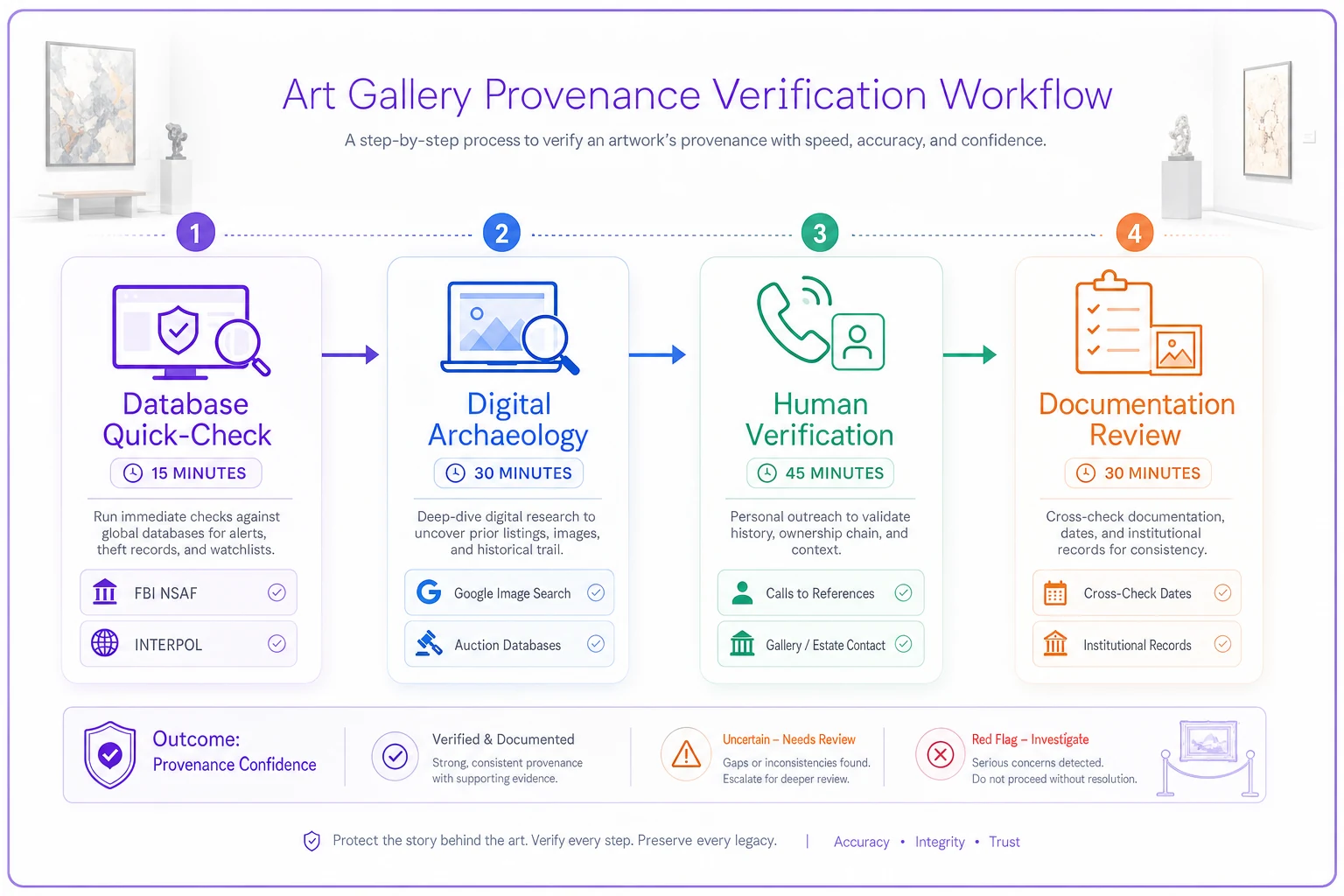
Here's a simple visual you can follow when training staff or documenting your process.
Next 45 minutes: Human verification Call references but ask technical questions. Don't just verify the seller's identity. Ask about specific condition issues, framing history, storage. People lying about ownership won't have consistent details on any of that. Contact the artist's gallery or estate directly — and find the contact information independently, don't use what the seller provides. Many galleries will informally verify works they've sold even without a formal authentication process. Check with local gallery associations or dealer networks. The art world is surprisingly small. Someone usually knows if a collection is problematic, and those informal networks catch things databases miss entirely.
Final 30 minutes: Documentation review Compare all provided documents for internal consistency. Dates should align. Names should be spelled consistently. Letterheads should match the period when documents were supposedly created. Verify institutional affiliations. If an appraisal comes from a university professor, check whether they actually worked there when the document was dated. Museums mentioned in provenance should have records of the exhibitions being claimed. Build a simple provenance chain. Each ownership transfer should make logical sense — geography should track, timing should work. When you map it out visually, gaps and problems become much easier to spot.
What AI-powered tracking actually prevents
Provenance due diligence generates a lot of information. Emails with sellers, database search results, phone call notes, verification documents — scattered across different systems, folders, inboxes.
Operational software helps here. Rather than tracking provenance research across spreadsheets and email threads, centralized platforms keep every verification step in one place. You can see what's complete, what's pending, and who's responsible for follow-up. When the FBI shows up asking about a piece you evaluated six months ago, you have documented proof of your due diligence process.
AI automation handles the repetitive parts well. Automated email templates for standard inquiries. Alerts when auction databases list similar works. Document scanning that flags date or name inconsistencies across multiple files. Workflow automation that ensures every acquisition goes through the same verification steps regardless of who's handling it — which matters a lot when staff turns over or you're in a busy stretch.
The pattern matching is useful too. Same photo appearing with different sellers. Documentation language that matches across supposedly unrelated sales. Seller behavior that mirrors previous problematic acquisitions. These are things that get missed when you're managing it all manually.
Over time, the software builds institutional memory around what's worked and what hasn't — which sources were reliable, which authentication boards respond quickly, which documentation patterns proved problematic. Your verification process gets faster and more accurate without adding headcount.
For more on managing acquisition logistics and documentation, see our posts on short-term financing for international acquisitions and building solid condition reporting workflows.
Common verification mistakes that create liability
The insider recommendation trap A respected collector or dealer vouching for something doesn't eliminate your verification obligation. Professional reputation doesn't transfer legal liability. Some of the worst provenance disasters come through trusted sources who themselves got deceived.
One gallery in San Francisco lost around $400,000 on paintings recommended by a board member who'd bought them from a "family friend." The friend turned out to be a sophisticated forger who'd spent years building false credibility. The board member was devastated, but the gallery bore the financial loss.
Authentication versus provenance confusion A work can be completely authentic and still have ownership problems. Conversely, perfect provenance doesn't guarantee authenticity. These are separate investigations requiring different expertise.
Galleries often get authentication letters and stop there. Authentication boards confirm the artist created the work — not who legitimately owns it. You need both pieces.
The partial provenance acceptance "The owner had it for twenty years" isn't provenance. It's just recent history. You need to trace ownership back to the artist or at minimum to a legitimate public sale.
Stolen works often sit in collections for decades before resurfacing. The statute of limitations doesn't apply to stolen property. Twenty years of quiet ownership means nothing if the work was stolen twenty-one years ago.
Digital documentation trust PDFs are easy to forge. Digital certificates, email confirmations, online authentication — all can be fabricated in minutes. Always verify digital documents through independent channels.
A dealer once showed me a perfect-looking PDF certificate from a major authentication board. Fonts were right, language was correct, signature looked real. A single phone call revealed the board had never seen the work. Someone had modified a legitimate certificate from a different piece.
Building repeatable verification systems
Creating systematic provenance verification requires more than a checklist. You need workflows that hold up under real-world pressure — when you're evaluating multiple collections while managing exhibition schedules and cash flow.
Start by establishing minimum standards based on value tiers. Works under $10,000 might get basic database checks and seller verification. Works between $10,000 and $50,000 add auction database searches and reference checks. Above $50,000 triggers full verification including paid database searches and independent authentication.
Document everything in a standardized format. Create templates for recording verification attempts, including unsuccessful ones. "Called authentication board three times, no response" is valuable documentation if problems surface later. Courts care more about demonstrated good-faith effort than perfect results.
Establish clear value-based minimum checks so intake staff can triage acquisitions quickly and consistently.
Establish clear handoff points in your verification process. Initial intake, database checking, documentation review, and final approval should involve different people when possible. Fresh eyes catch discrepancies that familiarity misses.
Build relationships with verification resources before you need them. Register for databases during slow periods. Establish contacts at authentication boards. Connect with provenance researchers. When you're racing to secure an important collection, you can't be learning how to access the FBI database for the first time.
Train your entire team on red flags. The person doing initial intake might catch behavioral warnings before formal verification even begins. Art handlers might spot condition issues that contradict claimed history. Everyone should know what triggers escalation to deeper investigation.
And accept that some deals should die. The pressure to acquire inventory — especially when cash flow is tight — makes it tempting to overlook minor concerns. Provenance problems compound over time. The work you're nervous about today becomes the legal nightmare disrupting your business next year.
Provenance due diligence isn't about becoming paranoid or walking away from good inventory. It's about building systematic processes that catch real problems before they destroy your business.
The galleries that survive long-term aren't necessarily the ones with the most resources for verification. They're the ones with clear procedures, who stick to their stop/go rules even under pressure, and who document everything thoroughly.
You'll miss some deals being careful. You'll watch competitors grab collections you walked away from. Sometimes they'll profit from risks you wouldn't take. Other times, you'll watch them dealing with legal nightmares you avoided. Over time, systematic verification protects more than your finances — it protects your reputation, your collector relationships, and your ability to sleep at night.
The art market has always required balancing opportunity with risk. But with increasing scrutiny from law enforcement, aggressive repatriation campaigns, and sophisticated forgery operations, the cost of provenance failures keeps climbing. Small galleries can't afford forensic-level research on everything, but they also can't afford to skip verification. The solution is prioritized, systematic checking that catches most problems within your actual resource constraints.
Every gallery needs its own provenance due diligence checklist adapted to the types of work you handle, your risk tolerance, and your available resources. Start with the templates and workflows here, then modify based on what you learn from each acquisition. Build that verification muscle memory now, before you're staring at a collection that could make your year — or end your business.
Ready to elevate your gallery operations?
Join 500+ galleries using Artioly to streamline operations, boost visitor engagement, and increase art sales.