

Most small galleries treat volunteers and interns as a favor economy. Someone's art-school niece needs internship credit, a retired collector wants to help with openings, a grad student offers to catalog the back room in exchange for a resume line. The arrangement is casual, verbal, and works fine — right up until a volunteer posts an unreleased exhibition image on Instagram, or an intern quits three weeks in and takes the only knowledge of your loan-tracking spreadsheet with them.
The problem isn't that volunteers are unreliable. It's that galleries almost never build the thin layer of governance that makes unpaid and low-paid help actually usable. No onboarding sequence, no clear task ownership, no confidentiality terms, no image-use rules, no way to tell if someone is actually doing a good job. And when you have three volunteers rotating through a front desk that handles real sales conversations, "no system" gets expensive fast.
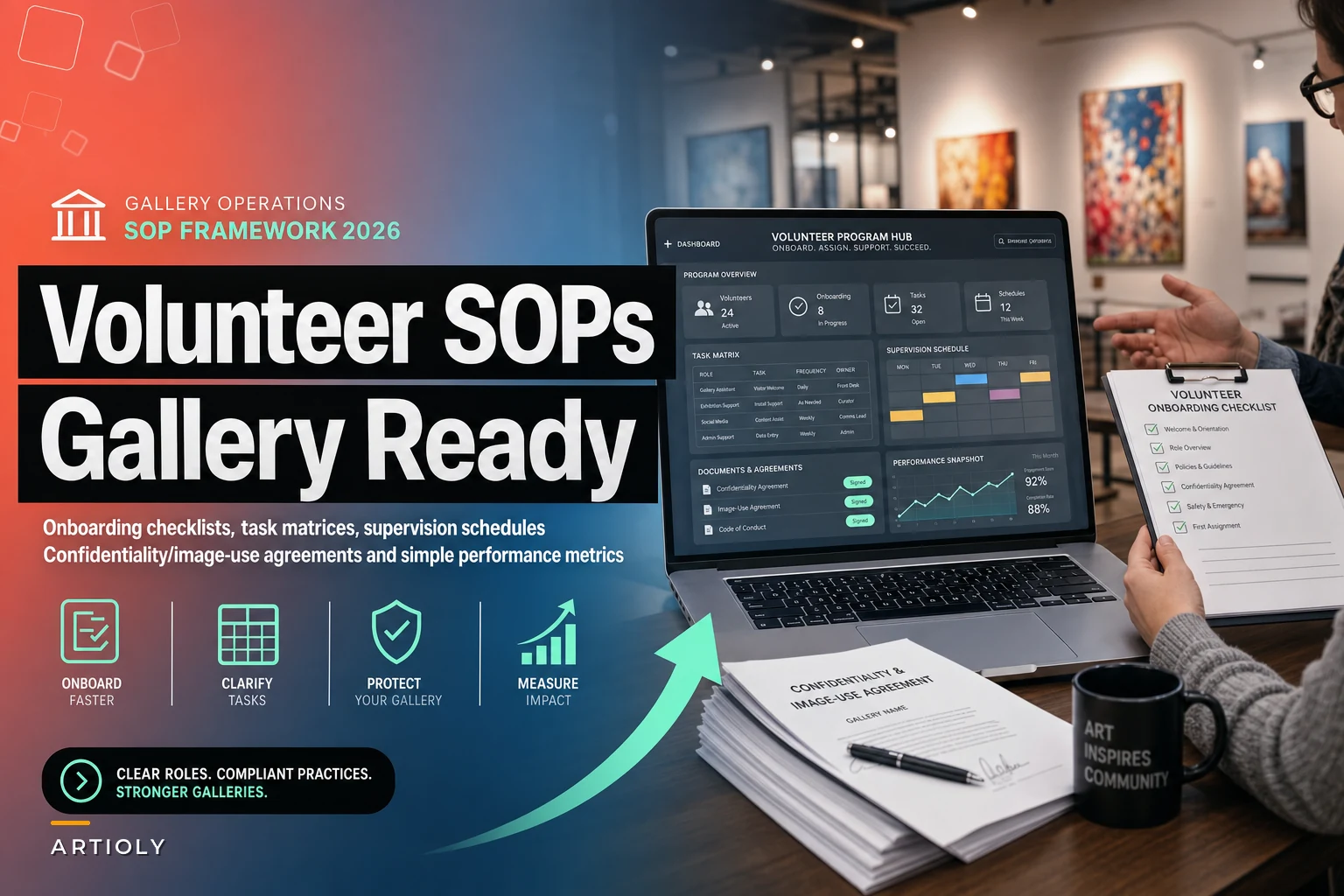
This is a walk through a gallery volunteer program SOP that stays HR-lite — no bloated employee handbook — but covers the five things that actually cause trouble: onboarding, who-owns-what task matrices, supervision scheduling, confidentiality and image-use agreements, and a couple of performance metrics that are honest enough to be useful.
Why the casual approach quietly costs you
There's a pattern that shows up in galleries running on volunteer help. The founder or curator becomes the single point of knowledge. Every volunteer question routes back to them — where's the condition report template, can I give this collector a discount, is it okay to photograph the install, who confirms the artist's shipping details. The volunteer is technically "helping," but each one adds interruptions instead of removing work.
A typical example: a gallery brings on two interns for a summer program. No structured onboarding, so the curator spends roughly the first two weeks answering the same questions on repeat and correcting small mistakes — a mislabeled inventory entry here, a collector emailed with the wrong price there. By the time the interns are genuinely useful, the summer is half over. The gallery got maybe six productive weeks out of a twelve-week program.
The confidentiality gap is the one that actually keeps people up at night. Volunteers hear pricing, see collector names, learn which artist is quietly leaving the roster, and handle images of works that are under embargo until an art-fair reveal. Without a signed agreement, none of that is protected. Image-use is its own landmine — a volunteer who shoots great phone photos of an install and posts them may have just published a work the artist hadn't cleared, or used an image the gallery doesn't have reproduction rights to.
None of this requires a legal department. It requires a handful of documents and a repeatable process.
Onboarding: the first day should be boring, not improvised
The single highest-leverage fix is a structured first-day sequence. Not a binder. A checklist that gets every new volunteer or intern to the same baseline before they touch anything client-facing.
Never miss a key exhibition detail again.
Artioly helps you organize, promote, and manage every exhibition effortlessly.
- Unified exhibition scheduling
- Artist and visitor notifications
- Inventory and sales tracking
No credit card required
-
Signed paperwork first — confidentiality agreement, image-use agreement, and a one-page role description that says what they will and won't be doing
-
Systems access — logins for whatever tools you use, plus a clear note on what they should not have access to (usually financials and full collector contact exports)
-
The "who to ask" map — a single sheet naming who supervises what, so questions don't all pile onto the founder
-
A guided walk-through of the gallery's inventory and where physical works live, including storage and packing areas
-
Front-of-house basics — how to greet a visitor, when to hand a conversation to a staff member, and what they're allowed to say about price and availability
-
One shadowing shift before any solo shift
That last point matters more than people expect.
A volunteer who shadows one shift before working alone makes far fewer of the small, reputational mistakes — quoting the wrong price, mishandling a fragile piece, giving a collector information that should have come from the curator. If you already have a strong front-desk flow, your onboarding should point straight to it; the logic in a good on-site conversion and front-of-house playbook is exactly what volunteers need before they're left alone with a room full of visitors during an opening.
The task matrix: kill the "I thought they were doing that" problem
The most common volunteer failure isn't a dramatic mistake. It's a dropped task that nobody realizes was dropped. Two interns both assumed the other was updating the sold-works list. A volunteer thought condition photos were the registrar's job. The opening runs and nobody printed the price list.
A task matrix fixes this by making ownership explicit. It's a simple grid: tasks down one side, people across the top, and a marker for who's Responsible, who Approves, and who's just kept Informed. You don't need formal RACI language — you need the gallery to be able to look at one sheet and know that Maya owns inventory updates, the curator approves any pricing changes, and the front desk is informed but doesn't touch it.
A stripped-down version for a gallery running two interns and three rotating volunteers:
| Task | Owner | Approves | Backup |
|---|---|---|---|
| Inventory entry & label updates | Intern A | Registrar | Intern B |
| Condition photos before install | Registrar | Curator | Intern A |
| Front-desk visitor greeting | Volunteer (on shift) | — | Any staff |
| Collector inquiry follow-up | Curator | Curator | Intern B |
| Opening setup (price lists, signage) | Intern B | Gallery manager | Volunteer |
| Social image posting | Gallery manager | Curator | — |
Notice what's not delegated. Collector follow-up and social posting stay with staff or require approval. That's deliberate. The matrix isn't only about assigning work — it's about drawing a bright line around the tasks where a volunteer mistake becomes a client, artist, or legal problem.
Supervision schedules: the gap nobody plans for
Task ownership means nothing if the owner is standing there with no one to ask when something unexpected comes up. The predictable failure is the Saturday afternoon shift where two volunteers are covering the floor and every staff member is off. A collector wants to negotiate. A delivery arrives early. A work needs to come off the wall. The volunteers either freeze or improvise — and improvising is where the expensive mistakes live.
Build a supervision schedule that guarantees every volunteer shift has a named escalation contact, even if that contact is remote. Not "call if there's a problem." Specifically: this named person is on-call for this shift, here's how to reach them, and here's the short list of decisions you must escalate rather than make yourself.
-
Any request for a discount or price change
-
Any collector who wants to place a hold or reserve a work
-
Anything involving moving, packing, or handling a work
-
Press or anyone asking questions on the record
-
A visitor complaint or incident
Everything else, they handle. This is the balance you want — enough autonomy that the volunteer is actually useful, enough guardrails that they can't accidentally commit the gallery to something. Galleries that skip this step tend to swing between two bad states: micromanaging every volunteer decision, or leaving them fully exposed. The escalation list is the middle path.
Confidentiality and image-use: the two agreements you can't skip
These are the documents that protect you, and they're short. You don't need a lawyer to draft a fifty-page NDA. You need two clear, one-page agreements that a volunteer signs before day one.
The confidentiality agreement should cover, in plain language:
-
Pricing, discounts, and sales figures are not to be shared
-
Collector identities and contact information stay inside the gallery
-
Unreleased exhibitions, artist news, and acquisition plans are confidential
-
The obligation continues after their time at the gallery ends
The image-use agreement cuts both ways, and this is the part galleries consistently forget. It covers what the volunteer can photograph and post, and what rights the gallery has to any images the volunteer creates. If an intern shoots your install and you later want those photos on your website, you want it in writing that the gallery can use them. And you want an explicit rule: nothing gets posted to a personal account, and nothing featuring an unreleased or embargoed work gets photographed at all without sign-off.
A realistic image-use clause names the specifics: no posting works before the public opening, no tagging collectors, no photographing storage or handling areas, and any gallery-purposed images belong to the gallery. It takes one paragraph and prevents the exact scenario where a well-meaning volunteer's Instagram story becomes a conversation with an angry artist.
Simple performance metrics that don't pretend volunteers are employees
You can't run a formal performance review on someone donating their time. But "no metrics at all" means you can't tell a genuinely helpful volunteer from one who's quietly creating more work than they remove. The trick is keeping the signals light, observable, and mostly about reliability rather than output.
-
Reliability — did they show up for scheduled shifts, on time? This is the single most predictive signal of whether the relationship works.
-
Task completion without rework — of the tasks they own, how many needed to be redone or corrected? You're not counting formally; you're noticing the pattern.
-
Escalation judgment — are they escalating the right things and handling the rest, or either escalating everything or nothing?
For interns specifically, add a short mid-program check-in — a fifteen-minute conversation at the halfway point about what's working and what they want to learn. It catches a bad fit early, before you've sunk a whole program into it.
A real scenario
A two-person contemporary gallery ran a summer program with three interns and a rotating pool of five opening-night volunteers. Before any of this was in place, the curator estimated she was losing close to a full day a week to volunteer questions, correcting inventory errors, and cleaning up small front-desk missteps. One intern had posted a preview image of a show two weeks early, which meant an awkward call with the artist and a scramble to take it down.
They put in a lightweight version of everything above — a one-page onboarding checklist, a task matrix taped inside the office door, signed confidentiality and image-use agreements, and a named on-call contact for every shift. The build took maybe an afternoon of the curator's time plus a couple hours drafting the agreements.
The change wasn't dramatic on paper, but it was real. Interns hit useful productivity in roughly the first week instead of the third. The repeated question load dropped noticeably — the "who to ask" map absorbed most of it. No more surprise social posts. When a Saturday collector wanted to negotiate, the volunteer knew exactly who to text instead of guessing. The gallery got something like nine or ten genuinely productive weeks out of the twelve-week program instead of six.
Where a shared operational system quietly helps
The reason this governance falls apart in most galleries isn't that owners don't know they need it — it's that the documents live in someone's email, the task matrix is a printout that's already out of date, and there's no single place a volunteer can look to see their shift, their tasks, and who to escalate to.
Having your onboarding checklists, task ownership, schedules, and signed agreements sitting inside one operational platform — instead of scattered across paper and inboxes — makes the difference between a system that survives past the first month and one that doesn't. When a new volunteer's checklist, the current task matrix, and the escalation contact for their shift are all in the same place they already log into, the founder stops being the single point of knowledge. That's the whole point. The governance should run without you standing over it.
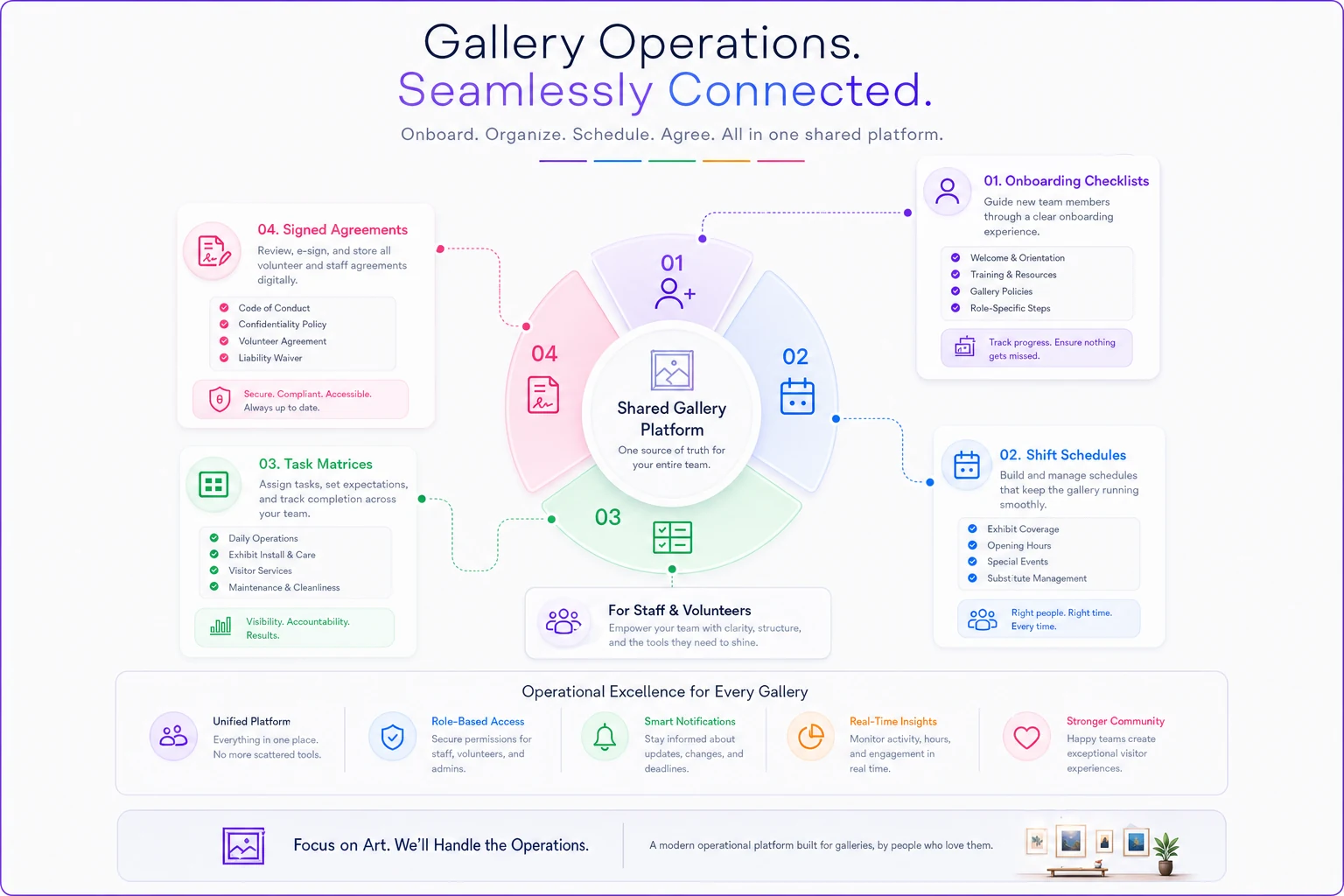
A simple diagram like this makes the connections obvious at a glance.
When a new volunteer's checklist, the current task matrix, and the escalation contact for their shift are all in the same place they already log into, the founder stops being the single point of knowledge. That's the whole point. The governance should run without you standing over it.
When to build this — and when it's overkill
Not every gallery needs all five components on day one. If you bring on one volunteer for occasional opening help, the confidentiality agreement and a short escalation list are probably enough. The full matrix and metrics start earning their keep once you're running two or more people at once, especially interns on a fixed program where ramp-up time actually costs you something.
Where this becomes counterproductive: don't build an enterprise HR process for a program that's genuinely tiny and stable. If the same trusted volunteer has covered your Thursday openings for three years, wrapping them in a task matrix and mid-program reviews is bureaucracy for its own sake. Match the governance to the actual size and turnover of your program.
Galleries that get this right treat volunteer governance as part of their broader operational hygiene, not a separate HR project. It sits alongside the other systems that keep a small, founder-run gallery from quietly falling apart — the same logic behind a compact playbook for avoiding common operational failures. Volunteers and interns can genuinely extend what a two-person gallery can do. They just need enough structure to turn donated time into reliable capacity instead of a steady stream of small fires.
Volunteers and interns can genuinely extend what a two-person gallery can do. They just need enough structure to turn donated time into reliable capacity instead of a steady stream of small fires.
Ready to elevate your gallery operations?
Join 500+ galleries using Artioly to streamline operations, boost visitor engagement, and increase art sales.