



Almost nobody tells you this about representing artists: the contract is rarely where the relationship breaks. The breakdown happens in the year and a half after signing, when the document sits in a drawer — or a Google Drive folder nobody opens — while the actual relationship gets managed by memory, goodwill, and whoever happens to answer the email that day.
The clause said royalties get paid within 30 days of a cleared sale. Then a piece sold at an art fair, the payment cleared into a different account, the show coordinator who handled it left, and now it's day 52 and the artist is texting asking where their money is. Nothing in that sequence was malicious. Nobody broke the contract on purpose. The contract just never got linked to the moments where it actually mattered.
That gap — between what the paper says and what the operation does day to day — is the whole problem. Strong artist relationship governance isn't about better clauses. It's about connecting those clauses to specific checkpoints in the relationship lifecycle so the right person does the right thing at the right moment, without needing to remember the fine print.
The lifecycle is the real contract
Think of every artist relationship as a sequence of stages, not a single agreement. Roughly:
Onboarding → Exhibition/consignment → Sales reporting → Payments and royalties → Retrospective review → Renewal or exit
Each stage has contract language governing it. The consistent failure — across galleries of almost every size — is that the contract gets written as one static block, but the relationship gets lived out in stages that each have their own owner, their own paperwork, and their own way of going wrong.
Onboarding is handled by the director. Sales reporting gets handled by whoever's at the desk during a fair. Royalties get processed by a bookkeeper who's never read the consignment terms. Retrospectives just don't happen. So you've got a single legal document being interpreted by four different people who never talk to each other about it.
The fix is to stop treating the contract as a document and start treating it as a set of triggers. Every clause should map to a moment where someone has to act. If a clause can't be tied to a checkpoint and an owner, it's decorative.
[Contract signed] ↓ [Onboarding data captured — commission split, tax docs, payment method, discount authority] ↓ [Works consigned — condition recorded, insurance value confirmed, custody documented] ↓ [Sale occurs — artist notified within 3 business days, full data trail captured at point of sale] ↓ [Payment issued within contractual window — formula, discount, split all logged] ↓ [Quarterly statement sent — all activity summarized] ↓ [Annual retrospective — performance review, terms check, renewal or exit decision]
Every arrow in that sequence is a handoff. Every handoff is a potential failure point if no one owns it.
This flow maps the contract clauses to concrete checkpoints and owners across the lifecycle.
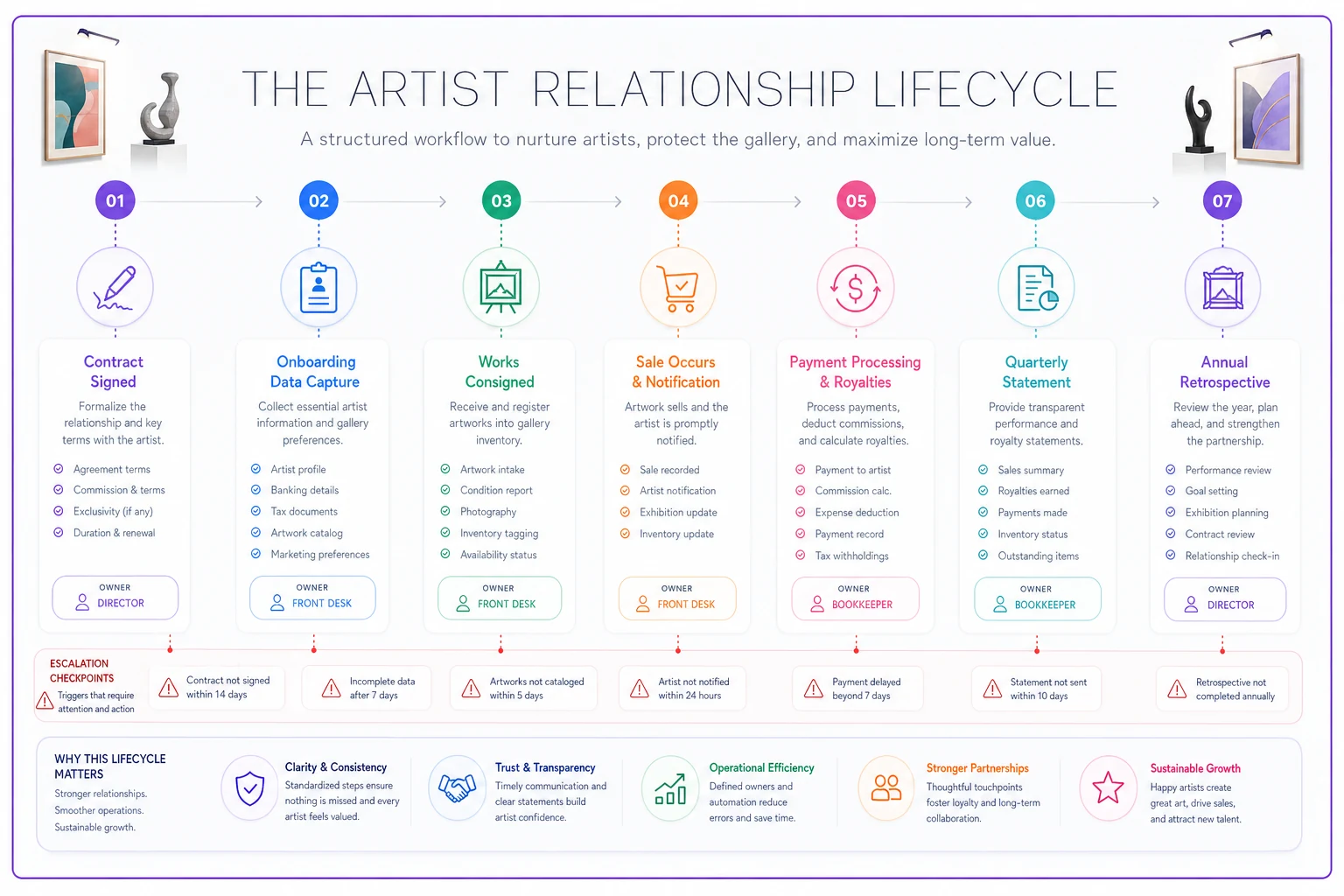
Treat each arrow as a checkpoint with an owner and a deadline.
Where it actually breaks, stage by stage
Onboarding
Never miss a key exhibition detail again.
Artioly helps you organize, promote, and manage every exhibition effortlessly.
- Unified exhibition scheduling
- Artist and visitor notifications
- Inventory and sales tracking
No credit card required
The contract gets signed, but the operational data never gets captured alongside it. Nobody records the agreed commission split in the system, the artist's preferred payment method, their tax details, the reproduction rights, or who's authorized to approve discounts on their behalf. Six months later, someone offers a collector a 15% discount on a piece the artist never agreed to discount, and now you're eating the difference or having an uncomfortable phone call.
Onboarding isn't complete when the contract is signed. It's complete when every clause has a corresponding field filled out in your system of record. A signature with no structured data behind it is a dispute waiting for a trigger.
Exhibition and consignment
This is where physical custody meets contractual obligation, and it's shockingly under-documented in most galleries. Who's liable if a piece is damaged during install? What's the agreed insurance value versus retail price? When does the consignment clock start? If you've ever had an artist assume you were covering full replacement value while your policy covered wholesale, you already know this gap. The small-gallery consignment governance checklist and clause library covers that ground in more detail — the core principle is the same: a clause only protects you if it's connected to a checkpoint someone actually hits.
Sales reporting
A piece sells. The clause says the artist gets notified within some window and a sales report follows. But sales happen in a rush — an opening, a fair, a walk-in on a Saturday. The sale gets logged, eventually, but the notification to the artist slips. The artist finds out their work sold from an Instagram post or another collector before they hear it from you.
That single lapse damages trust more than a late payment does. Late money is a logistics problem. Finding out secondhand feels like being cut out. Sales reporting isn't a courtesy — it's a governed checkpoint with a deadline, and it needs an owner who isn't also running the front of house during an event.
Royalties and payments
Even galleries with clean sales records get tangled here because royalties — especially resale royalties — require pulling data from multiple points in time and applying the right split to the right sale. A miscalculation isn't dishonesty. It's usually a formula applied to the wrong number: retail vs. net, pre-discount vs. post-discount. The scheduling and ledger approach to artist payments and resale royalties goes deep on the mechanics, but the consistent takeaway is this: payment disputes are almost always data provenance problems, not honesty problems. If you can't show the artist the exact chain — sale price, discount, split, deductions — you'll lose the trust argument even when you're mathematically right.
Retrospectives
Almost nobody does these, which is exactly why relationships drift and end badly. There's no scheduled moment to sit down and ask whether the year worked for both parties, how the pieces sold, whether the terms are still fair. Without a retrospective, small resentments compound silently until the artist leaves, and you find out when their new gallery makes the announcement.
What changes as you scale
When you're a two-person gallery, none of this needs a formal system. The founder remembers everything, handles onboarding personally, processes payments themselves. The contract-to-lifecycle link lives in one person's head and works fine.
The breakage starts at a specific point: when the number of active artist relationships exceeds what one person can hold in working memory and handoffs start happening between staff. Usually that's somewhere around 12–20 represented artists plus consignments, or when you bring on your second or third employee. Suddenly the person who onboarded the artist isn't the person reporting the sale isn't the person cutting the check.
| Stage of gallery | How governance lives | Primary failure mode |
|---|---|---|
| Solo / founder-run | In the founder's head | Founder burnout, single point of failure |
| 2–4 staff, ~15 artists | Informal handoffs, shared drive | Dropped notifications, inconsistent data entry |
| 5+ staff, 25+ relationships | Ad hoc systems, some spreadsheets | Payment disputes, missed retrospectives, terms drift |
| Multi-location or high volume | Formal playbook required | Total breakdown without codified checkpoints |
The mistake galleries make is waiting until the third or fourth row to build the system. By then you're not preventing disputes — you're cleaning them up. The right time to codify the contract-to-checkpoint links is just before you hire the person who'll be doing the handoffs.
Building escalation pathways — the part most people skip
A checkpoint tells you what should happen. An escalation pathway tells you what happens when it doesn't. That's the difference between a governance framework and a wish list.
For every checkpoint, you need three things defined in advance:
-
The deadline — artist notified of sale within 3 business days, for example
-
The primary owner — who's actually responsible for hitting that deadline
-
The escalation trigger and path — what happens if the deadline passes, and who it goes to
Without the third one, deadlines are aspirational. With it, a missed sales notification automatically becomes the director's problem on day 4 instead of a surprise blowup on day 30.
A simple escalation logic that works for most galleries:
-
Level 0 — On track Owner completes the task within the window. No action needed.
-
Level 1 — Slipped Deadline missed by a small margin. Automatic reminder to the owner, cc'd to a supervisor.
-
Level 2 — At risk Deadline missed significantly, or an artist has reached out asking. Escalates to the director with full context attached.
-
Level 3 — Dispute Artist has expressed dissatisfaction or made a claim. Triggers a defined response protocol, including pulling the relevant contract clause and the full data trail.
The value isn't in the levels themselves — it's that escalation becomes automatic and depersonalized. No one has to be the bad guy chasing a colleague. The system flags it. That matters a lot in small teams where everyone's friendly and nobody wants to play enforcer.
A sample lifecycle calendar
The calendar is where the abstract playbook becomes something you can actually run. This is a starting template for a single represented artist over a 12-month cycle — adjust the cadence to your program.
At onboarding (Day 0–14):
-
Contract signed and stored with structured data captured (commission split, tax docs, reproduction rights, discount authority, payment method)
-
Kickoff conversation documenting expectations and communication preferences
-
Artist added to the sales-reporting and payment workflows
Ongoing (throughout the cycle):
-
Sales notification to artist within 3 business days of any cleared sale
-
Sales report and payment issued within the contractual window (typically 30 days)
-
Monthly inventory reconciliation of consigned works
Quarterly:
-
Statement of all activity — pieces sold, pieces on view, pending payments — sent to the artist
-
Internal check that all payments and royalties are current
Semi-annual:
-
Condition and location audit of all consigned inventory
-
Review of any commissioned work milestones (the gallery-side briefs and milestone payment gates framework pairs well here)
Annual:
-
Formal retrospective
sales performance, what worked, terms review
-
Renewal or exit decision with a clear timeline
-
Contract terms updated if anything changed
Capture commission split and payment method at onboarding to avoid later disputes.
Writing this out isn't about rigidity. It's that when a task has a home on a calendar and an owner attached, it stops depending on someone remembering.
When a formal framework is overkill — and when it's non-negotiable
If you represent four artists and handle everything yourself, building a multi-level escalation system is a waste of a weekend. A shared checklist and a decent calendar are plenty.
This becomes non-negotiable when:
-
Staff are handing off tasks to each other across the lifecycle
-
You're managing 15+ active artist or consignment relationships
-
You handle resale royalties or complex split structures
-
You've already had a payment or notification dispute, even a minor one
-
You're planning to grow and don't want to rebuild the operation mid-flight
It's a bad idea when:
-
You're solo with a handful of relationships and no near-term growth plans
-
You'd build the system but not actually enforce it
That last point matters more than people admit. A half-followed framework is worse than none — it creates false confidence. Everyone assumes the checkpoint is covered and stops paying attention. The worst outcome isn't having no system. It's having a beautiful policy document nobody follows.
A real scenario
A mid-sized contemporary gallery — five staff, around 30 active artist and consignment relationships — kept running into the same problem twice a year: royalty and payment disputes that ate days of back-and-forth and left at least one or two artists quietly unhappy each cycle.
The pattern was always the same. A sale would happen, get logged inconsistently, and the payment would go out based on whatever number someone pulled at the time. When an artist questioned it, nobody could quickly reconstruct the exact sale price, the discount applied, and the split used. Rebuilding that trail took hours per dispute, and by then the relationship damage was done regardless of who was actually right.
They didn't fix it by rewriting contracts. They fixed it by linking each clause to a checkpoint with an owner and a deadline, and by requiring that every sale capture the full data trail at the moment of sale — not reconstructed after the fact. Notification went from "eventually" to a hard 3-day rule with escalation if missed.
The result over the following year wasn't dramatic in a headline sense. Disputes dropped to almost none. The ones that did come up got resolved in an afternoon instead of a week because the data trail was already there. Two artists who'd been quietly drifting renewed, both specifically mentioning that they finally felt kept in the loop. The time saved on dispute cleanup was real, but the retained relationships were worth considerably more.
Where software fits (and where it doesn't)
You can run all of this on a calendar, a shared drive, and disciplined people. Plenty of galleries do. The framework is what matters, not the tooling.
That said, the failure points above — dropped notifications, inconsistent data capture at point of sale, escalations that depend on someone remembering to follow up — are exactly the kind of repetitive coordination work that AI-powered operational software handles well. When your platform automatically flags a sale that hasn't triggered an artist notification, or surfaces the full data trail behind a payment so a dispute takes minutes to resolve instead of hours, you've removed the human-memory dependency that causes most of these breakdowns when things get busy.
The software doesn't replace the relationship. It just makes sure the boring, critical checkpoints don't get skipped. Get the framework right first, though. Software applied to a broken process just breaks faster.
The takeaway
Artist relationships don't usually end over one big betrayal. They erode through a series of small, avoidable gaps — a sale the artist heard about too late, a payment nobody could explain clearly, a year that passed without a real conversation. Every one of those is a checkpoint that existed in the contract but never got connected to a moment, an owner, and a deadline in the actual operation.
Governance is just that connection made deliberate. Map every clause to a lifecycle stage. Give every stage an owner and a deadline. Build escalation paths so slips surface automatically instead of exploding later. Put it on a calendar so nothing depends on memory. Do that consistently, and most disputes never get the chance to start — which is a much better position than being excellent at resolving them.
Governance is just that connection made deliberate. Map every clause to a lifecycle stage. Give every stage an owner and a deadline. Build escalation paths so slips surface automatically instead of exploding later. Put it on a calendar so nothing depends on memory. Do that consistently, and most disputes never get the chance to start — which is a much better position than being excellent at resolving them.
Ready to elevate your gallery operations?
Join 500+ galleries using Artioly to streamline operations, boost visitor engagement, and increase art sales.