


Most galleries don't have a staffing problem. They have a role clarity problem that only looks like a staffing problem when the calendar gets busy.
What that looks like in practice: the same three people run everything. The director sells, writes wall text, handles the framer, chases press, and reconciles consignment payments. During a quiet month, that's manageable. During install week for a major show—layered on top of an art fair booth and a collector dinner—the whole thing collapses. Nobody misses a task because they're lazy. They miss it because six overlapping responsibilities all peak on the same week and belong to the same person.
Gallery organizational design capacity planning is about separating what work exists from who does it and when it spikes. When you get this right, you stop reacting to every busy season like it's a surprise, and you stop hiring full-time people to cover problems that only exist eight weeks a year.
This isn't about org charts for their own sake. It's about mapping the actual load, deciding which work needs a permanent owner versus a seasonal hand versus an outside vendor, and writing handoffs clean enough that a temp can pick up a task without a 40-minute explanation.
Start with role archetypes, not job titles
Job titles lie in small galleries. "Gallery Manager" means something completely different in a two-person operation than in a twelve-person one. So instead of titles, think in archetypes—clusters of work that behave similarly and need similar skills. Across small and mid-size galleries, most work sorts into six archetypes:
-
The Closer — sales conversations, collector relationships, negotiation, follow-up. High judgment, high trust, almost never delegable to a temp.
-
The Coordinator — logistics, shipping, install scheduling, framer and vendor wrangling, calendar management. Highly delegable if the process is documented.
-
The Curator/Program lead — show concepts, artist selection, checklist decisions, hang design. Core intellectual work, not a capacity valve.
-
The Registrar — inventory, condition reports, consignment tracking, provenance records. Precision work that punishes shortcuts but can be trained.
-
The Communicator — press, social, newsletters, event invites, membership updates. Bursty and seasonal by nature.
-
The Operator — bookkeeping, contracts, payroll, insurance, the boring backbone that keeps the doors legally open.
The insight most owners miss: these archetypes don't scale at the same rate. Closer work scales roughly with sales volume. Coordinator work scales with number of shows and shipments, which spikes brutally around openings. Communicator work spikes even harder—three weeks before an opening it might consume 70% of someone's time, then near zero the week after.
When one person holds three archetypes that all peak on the same date, you get the chaos. That's the pattern worth naming, because once you see it, you know exactly where to add temporary capacity instead of just feeling overwhelmed.
The 30/90/180 capacity model
The reason galleries over-hire—or burn out—is that they plan capacity in one timeframe. Usually "this week is insane." A better approach uses three horizons at once. Each answers a different question.
Never miss a key exhibition detail again.
Artioly helps you organize, promote, and manage every exhibition effortlessly.
- Unified exhibition scheduling
- Artist and visitor notifications
- Inventory and sales tracking
No credit card required
30-day capacity — the load horizon. Your rolling six-week view of committed work. Openings, fair deadlines, shipping windows, invoice cycles. The 30-day view tells you when you'll physically run out of hands. Most galleries can feel this coming two weeks out but don't quantify it, so they don't act until they're already underwater.
90-day capacity — the staffing horizon. This is the window where you can still adjust who's working without a permanent hire. Ninety days is enough lead time to line up a freelance registrar, book a part-time install crew, or bring back a returning intern. If you only see problems at 30 days, you're stuck with expensive last-minute fixes.
180-day capacity — the structural horizon. This is where you decide whether a recurring crunch is actually a role that needs to exist. If the same gap shows up in your 30-day view four times across six months, that's not a seasonal spike—that's an unstaffed function pretending to be an emergency.
In real terms: a gallery with four shows a year sees its Coordinator and Communicator archetypes spike around each opening. At 30 days out, they feel the pain. At 90 days, they should be booking seasonal help. At 180 days, they should notice this happens every single show and decide whether a permanent quarter-time coordinator is actually cheaper than four rounds of freelance scramble.
| Horizon | Question it answers | Typical action | What breaks if you ignore it |
|---|---|---|---|
| 30 days | Where will we run out of hands? | Triage tasks, cut scope, pull an all-nighter | Missed deadlines, burnout, dropped follow-ups |
| 90 days | Who do we need working? | Book freelancers, schedule interns, reassign | Last-minute vendor premiums, no coverage |
| 180 days | Is this a role, not a spike? | Restructure, add part-time function | Chronic firefighting, staff turnover |
Living entirely in the 30-day horizon keeps galleries in a constant state of expensive improvisation. Everything feels urgent, nothing feels planned, and every solution costs a premium because it's booked at the last minute.
The outsourcing decision matrix
Once you know your archetypes and your spikes, the next question is what to keep in-house versus delegate to seasonal staff versus hand to an outside vendor entirely. A lot of owners filter on cost first. That's the wrong starting point.
-
High relationship risk + low process maturity → Keep it. This is your Closer and Curator work. You can't outsource judgment that lives in your head and touches your most important relationships.
-
High relationship risk + high process maturity → Delegate carefully, internally. Collector onboarding or membership fulfillment—sensitive, but documented enough to hand to a trained staffer with clear guardrails.
-
Low relationship risk + high process maturity → Outsource freely. Shipping coordination, framing, image capture, bookkeeping. If the process is clean, an outside vendor often does it better and cheaper than you.
-
Low relationship risk + low process maturity → Document first, then decide. Don't outsource chaos—you'll just pay someone to be confused on your behalf.
That last quadrant is where most bad outsourcing decisions come from. A gallery hands off its inventory tracking to a freelancer without a documented process, the freelancer invents their own system, and now nobody can find anything after they leave. The problem wasn't the outsourcing. It was outsourcing before the process was ready to hand off.
This connects directly to how you build your standard procedures in the first place. If you've read our compact small-gallery playbook for founder-run teams, you'll recognize the theme: documentation isn't paperwork, it's what makes delegation possible without losing control.
Task-level SLAs: the piece almost everyone skips
Roles tell you who. Capacity models tell you when. But what actually prevents dropped balls during a busy season is a service-level agreement at the task level—a plain-English answer to "how fast does this need to happen, and what's the fallback if it doesn't?"
Galleries rarely write these down, and it shows. A collector emails about a piece on Friday afternoon during install week, and the reply goes out Tuesday because everyone assumed someone else had it. No agreed response window, no clock, no owner.
-
Collector inquiry about available work — respond within 4 business hours, owner: Closer, backup: director.
-
Press request for images/info before an opening — respond same day, owner: Communicator, backup: coordinator.
-
Incoming condition report on a delivered work — logged within 24 hours of receipt, owner: Registrar.
-
Consignment payment due to artist — processed within the contracted window, no exceptions, owner: Operator.
-
Post-opening sales follow-up — initiated within 48 hours while interest is warm, owner: Closer.
The point isn't rigidity. When a seasonal staffer or intern steps in, they inherit a clear expectation instead of guessing. An SLA is what turns "help me during the opening" into actual, useful help rather than someone standing around waiting to be told what to do.
Map these SLAs to your seasonal calendar and something useful emerges: you can see which promises get harder to keep during a spike. If your collector-inquiry SLA is 4 hours but your Closer is also managing install during opening week, that SLA will break unless you've delegated the install coordination or brought in support. The SLA reveals the staffing gap before it embarrasses you in front of a collector.
Mapping SOP handoffs to seasonal staffing
This is where the whole system connects. Archetypes for the work, capacity horizons for the timing, a decision matrix for keep/delegate/outsource, and SLAs for the promises. The handoff is the moment a task moves from one person to another—and handoffs are where small galleries bleed time and quality.
A clean handoff needs a documented SOP behind it. Not a novel—a checklist someone can execute cold. The test is simple: could a returning intern run this task from the document alone, without interrupting the director? If not, it's not delegable yet, no matter how badly you need to hand it off during crunch.
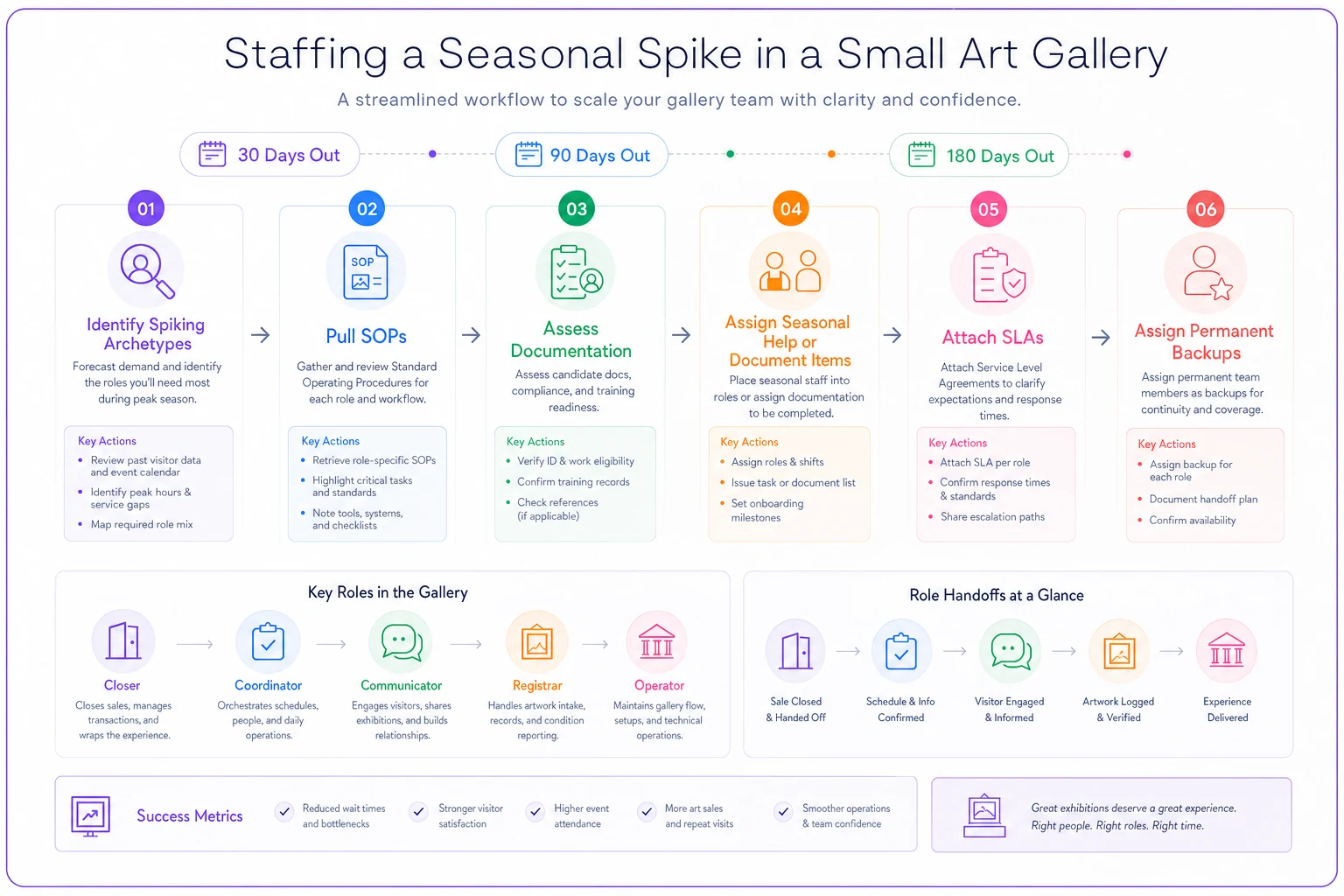
Practical sequence for staffing a seasonal spike without a hiring cycle:
-
Identify the spiking archetypes from your 30/90-day view (usually Coordinator and Communicator around openings).
-
Pull the SOPs those archetypes own and check which are documented well enough to hand off.
-
For documented SOPs, assign seasonal help—interns, freelancers, returning part-timers.
-
For undocumented SOPs, either keep them in-house this cycle or spend the 90-day window documenting them so they're delegable next time.
-
Attach the relevant SLAs to each handed-off task so the temporary person knows the clock.
-
Assign a permanent backup to every seasonal handoff, so a dropped ball has somewhere to land.
Visual guide to the sequence above.
Rehire the same seasonal coordinator when possible—the onboarding cost falls dramatically.
Galleries that run smooth openings aren't the ones with the most staff. They're the ones who documented their coordinator and communicator SOPs before the busy season, so seasonal hands could actually reduce load on the core team instead of adding supervision overhead. Interns and part-timers are a big part of this, and they only work when the onboarding is real. Our volunteer and intern program SOP covers the task matrices and legal basics that make seasonal help a genuine capacity lever rather than a well-meaning liability.
Which SOPs to staff vs. delegate: a working template
A quick reference for sorting your gallery's recurring work. Adjust to your own operation, but the logic holds.
| SOP / Task | Archetype | Staff (permanent) or Delegate (seasonal/vendor)? | Why |
|---|---|---|---|
| Sales conversations & negotiation | Closer | Staff | High judgment, high relationship risk |
| Show concept & checklist | Curator | Staff | Core intellectual work |
| Install scheduling & vendor coordination | Coordinator | Delegate (seasonal) | Documentable, spikes hard |
| Shipping & framing logistics | Coordinator | Outsource/vendor | Low relationship risk, mature process |
| Condition reporting & inventory logging | Registrar | Delegate (trained seasonal) | Trainable with clear standards |
| Press outreach & image dispatch | Communicator | Delegate (seasonal) | Bursty, calendar-driven |
| Newsletter & event invites | Communicator | Delegate/outsource | Templated, repeatable |
| Bookkeeping & payroll | Operator | Outsource (vendor) | Specialized, low relationship risk |
| Consignment payment processing | Operator | Staff (or tightly supervised) | High trust, dispute risk |
| Collector follow-up & stewardship | Closer | Staff | Relationship-defining |
The pattern is consistent: work you keep in-house clusters around judgment and relationships. Work you delegate or outsource clusters around documented, repeatable process. The middle band—Registrar and Communicator work—is delegable only if you've done the documentation first. That middle band is where most of your seasonal leverage actually lives.
Budgeting seasonal capacity without hiring cycles
The financial version of this is straightforward. You don't want to carry a twelve-month salary to cover an eight-week spike. But you also can't afford to scramble for last-minute freelancers at premium rates four times a year.
The fix is to budget capacity as a line item tied to your calendar, not as headcount. Walk your 180-day view, mark the spikes, and pre-commit a seasonal capacity budget to each one.
A typical small gallery pattern: four shows a year, each generating roughly a three-week Coordinator and Communicator spike. Instead of hiring a full-time coordinator at $45k–$55k annually, they budget for seasonal coverage—a returning freelance coordinator for install weeks, a part-time comms helper for the three weeks before each opening, an outside shipping coordinator on a per-project basis. The all-in seasonal cost might land somewhere around $14k–$20k for the year. A fraction of the full-time load, and it flexes if a show gets cancelled or a fair falls through.
The key discipline is booking in the 90-day window, not the 30-day one. Freelancers cost more and are harder to reach when you call two weeks out. Planning a quarter ahead gets you first-choice people at normal rates. That single shift—moving the booking decision from 30 days to 90—often saves more than any other change you'll make.
One caveat worth stating: this only works if your program calendar is stable enough to forecast. A gallery that reshuffles its entire exhibition schedule every quarter can't budget seasonal capacity cleanly, because the spikes keep moving. If that's you, the first fix isn't staffing—it's committing to a program calendar you can actually plan against.
When this makes sense—and when it doesn't
When it makes sense: You have a recurring program (three or more shows a year), predictable spikes, and a core team that's clearly overloaded during openings but underutilized between them. That gap between peak and trough is exactly what this kind of planning solves.
When it's a bad idea: If you're a genuinely two-person gallery doing one or two shows a year, this level of structure is overkill. Document your handoffs, sure, but you don't need a 180-day capacity model to run a handful of events. The complexity has to earn its keep.
Who should not do this yet: Galleries with no documented SOPs at all. If nothing is written down, seasonal staff can't take load—they can only ask questions, which makes your busy season worse, not better. Documentation comes first. Capacity planning is what you build on top of it. If your systems are still ad hoc, our gallery technology adoption roadmap for small teams is the sensible starting point before layering on this kind of structure.
A real scenario
A three-person contemporary gallery ran four shows a year plus one fair. Every opening cycle followed the same arc: the two weeks before install, the director stopped selling to run logistics and press, and the whole team worked evenings. Collector follow-ups after openings routinely slipped by a week or more, and a couple of warm leads went cold because nobody circled back in time.
They didn't add a full-time person. Instead they mapped their archetypes, saw that Coordinator and Communicator load was crushing the Closer role during exactly the weeks selling mattered most, and built a 90-day booking habit. A returning freelance coordinator handled install logistics. A part-time comms contractor covered press and invites for the three weeks before each opening. Post-opening follow-up got a task-level SLA—48 hours, owned by the director, backed up by the coordinator.
The change wasn't dramatic on paper. The director stayed in front of collectors during opening weeks instead of chasing the framer. Follow-ups went out on time. Seasonal capacity spend ran around $16k across the year—well below a hire—and the biggest win was harder to quantify: the openings stopped feeling like emergencies. Same volume of work. It just had owners, timing, and a plan behind it.
Bringing it together
The chaos small galleries feel during busy seasons is almost never a shortage of people. It's a shortage of structure—roles that blur together, spikes nobody forecasted, handoffs nobody documented, and promises to collectors that no one explicitly owned.
Gallery organizational design capacity planning fixes this by separating the layers. Archetypes clarify the work. The 30/90/180 model gives you time to react at the right cost. The decision matrix tells you what to keep versus delegate versus outsource. SLAs turn vague help into accountable coverage. And documented SOP handoffs make seasonal capacity actually usable instead of a supervision burden. You don't need a bigger team to run calmer openings. You need to see your load before it arrives, decide what only you can do, and build clean enough handoffs that everyone else can pick up the rest. Do that, and the busy season stops running you—and starts being something you planned for.
You don't need a bigger team to run calmer openings. You need to see your load before it arrives, decide what only you can do, and build clean enough handoffs that everyone else can pick up the rest. Do that, and the busy season stops running you—and starts being something you planned for.
Ready to elevate your gallery operations?
Join 500+ galleries using Artioly to streamline operations, boost visitor engagement, and increase art sales.