

Most galleries handle a reputation problem the same way: the owner finds out through a text or a tagged post, panics for about an hour, calls one trusted person, and writes something on the fly they'll regret within 48 hours. Sometimes it works out. More often it creates a second problem on top of the first one.
Reputation damage in the art world rarely comes from the initial event. A misattributed work, an artist accusing you of late payment, a collector claiming they were misled, a staff member posting something inflammatory — none of those sink a gallery on their own. What sinks galleries is the response: the contradictory statements, the deleted posts that get screenshotted, the artist who felt abandoned because nobody called them for three days.
Gallery reputation governance is the unglamorous infrastructure that turns a chaotic scramble into a coordinated process. It's not about spin. It's about knowing, before anything happens, who decides what, who says what, who talks to whom, and how legal and board considerations get folded in without everything grinding to a halt. This is the piece most small galleries skip because it feels like something only museums with communications departments need. Then a crisis hits and they realize they're improvising the org chart during the fire.
Here's how the whole system connects — and where it tends to break.
Why galleries specifically get this wrong
Galleries carry a strange combination of risk factors most small businesses don't. You have three constituencies with wildly different interests who all watch each other closely: press, artists, and collectors. Something that reassures one of them can enrage another.
Say a work in your current show turns out to have a provenance gap. Your instinct might be to quietly pull it and move on. But the artist wants a public statement defending the work. The collector who was about to buy it wants discretion and a refund conversation. A journalist smells a story. And your board — if you have one — wants to know why nobody told them before it hit Instagram. Four different "right answers," and if you satisfy them in the wrong order, you create lasting damage with the constituency you handled last.
The second reason galleries struggle: the founder usually is the brand. When the owner's personal reputation and the institution's reputation are the same thing, there's no natural separation between "the gallery's position" and "how I personally feel right now." That collapse is exactly what produces the emotional 11pm email that becomes Exhibit A later.
The third reason is scale mismatch. A five-person gallery has no communications lead, no general counsel on retainer, and no formal board process — but it can absolutely generate a crisis that's the same size as one a major institution would face. The event doesn't scale down to match your staff.
What tends to separate the organizations that survive reputational hits from the ones that don't isn't headcount. It's whether someone did about two days of unglamorous planning before anything happened.
The four systems that have to connect
Reputation governance isn't a single document. It's four interlocking systems, and the failures almost always happen at the seams between them — not inside any one of them.
Never miss a key exhibition detail again.
Artioly helps you organize, promote, and manage every exhibition effortlessly.
- Unified exhibition scheduling
- Artist and visitor notifications
- Inventory and sales tracking
No credit card required
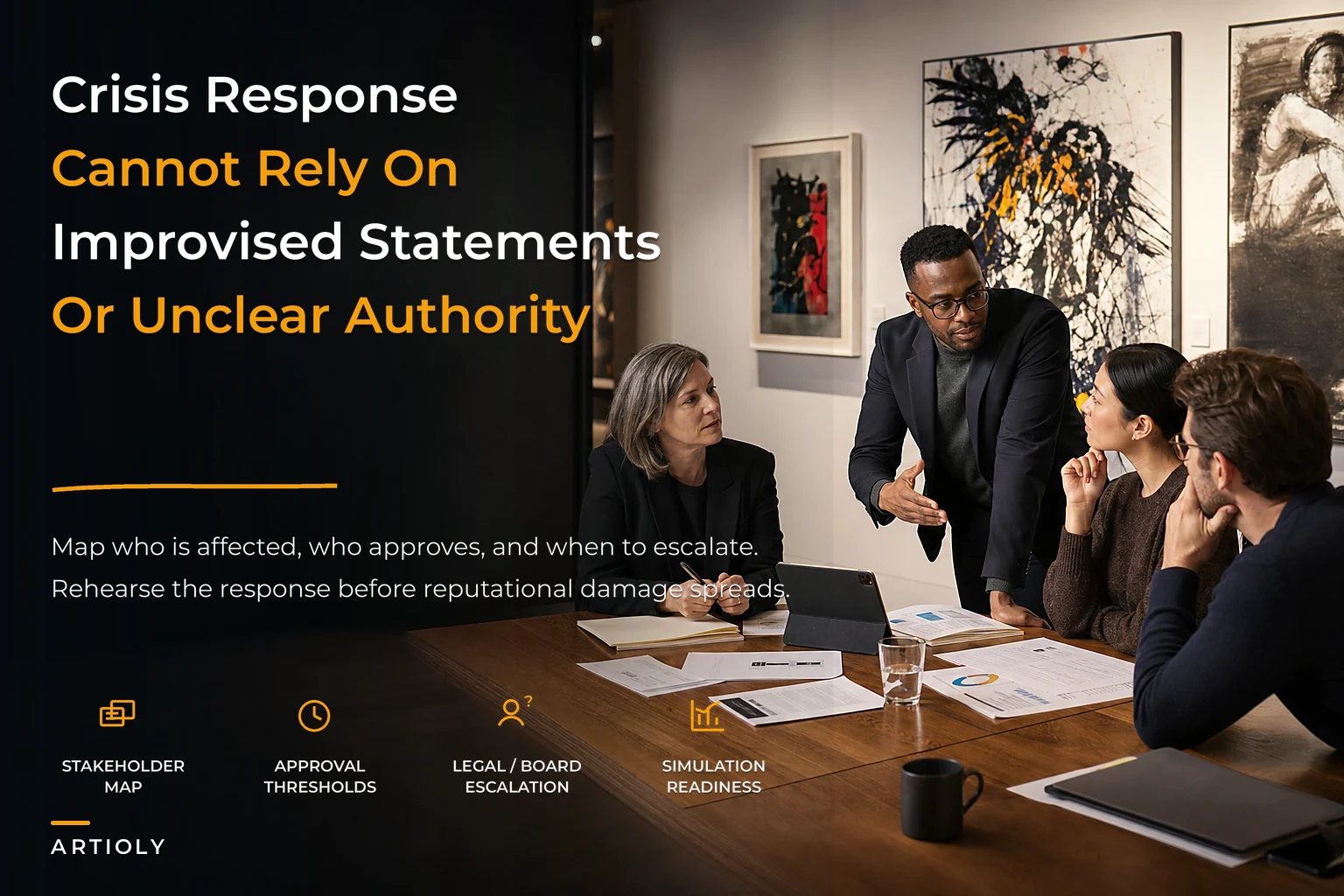
1. Stakeholder mapping — knowing who cares, who has power, and who you owe a direct conversation before they read about it publicly.
2. Decision and approval thresholds — knowing which situations the front desk can handle alone, which need the director, and which cannot go out the door without legal or board sign-off.
3. Communication assets — pre-drafted, role-based runbooks and statement templates so nobody is composing from a blank page at the worst possible moment.
4. Escalation paths — the specific triggers that move a situation from "internal note" to "call the lawyer" to "convene the board."
When these connect, a problem flows through the organization without spinning out. When they don't, you get the classic small-gallery failure: the intern who answered the press email, the director who didn't know it happened, the artist who found out from the journalist, and the board chair who read about it in the paper.
Stakeholder mapping: do this while it's calm
You cannot build a contact and priority list mid-crisis. The mapping has to exist in advance, and it has to be specific about sequence — who gets contacted first, second, third.
| Stakeholder group | Typical concern | Contact sequence | Who owns the relationship |
|---|---|---|---|
| Directly affected artist | Being defended, being informed first | Immediate, before any public statement | Director personally |
| Directly affected collector | Discretion, financial resolution | Immediate, private channel only | Director or senior sales |
| Broader artist roster | "Am I safe here? Is this handled?" | Within 24h, if event is public | Director |
| Key collectors / patrons | Confidence, no surprises | Proactive brief if event goes public | Senior sales |
| Press / journalists | Accurate, quotable, timely info | Only through designated spokesperson | One named person only |
| Board / trustees | Governance oversight, liability | Per escalation threshold | Director to chair |
| Staff & front-of-house | Consistency, not being ambushed | Before public, so they don't freelance | Operations lead |
The single most common mistake here is contacting press before the affected artist. It feels efficient — get the statement out, control the narrative. But an artist who learns about "their" situation from a reporter will remember that for the rest of your relationship, and roster trust is fragile. The relationship you protect first should almost always be the one most directly wounded. If you want to go deeper on why artist trust is so structurally easy to break, we've written about the mechanics of that in our governance framework for artist relationships.
Approval thresholds: the part everyone skips
This is where the real operational value lives, and it's the least fun to set up.
-
Tier 0 — Routine. A mildly annoyed customer, a small factual correction, a scheduling complaint. Front-of-house handles it using standard language. No escalation. Just logged.
-
Tier 1 — Sensitive but contained. A single unhappy collector, a minor negative review, a question from a local reporter about the gallery generally. Escalates to director awareness. Director decides whether to respond and how.
-
Tier 2 — Reputational. An accusation involving an artist, a disputed sale, a press inquiry about a specific incident, anything touching money or authenticity. No public statement without director and review against pre-approved templates. Legal is put on notice.
-
Tier 3 — Institutional. Legal exposure, potential litigation, allegations of misconduct, anything involving safety or a named individual's conduct. Nothing goes out without legal review and, where a board exists, chair notification. This is where fiscal and governance discipline overlaps with reputation — the same board oversight logic we cover in the broader gallery risk-management framework.
The thing most people miss: the threshold isn't just about who approves — it's about who is allowed to stop the clock. A good system gives even junior staff the explicit authority to say "I need to check before I respond" without feeling like they're failing at their job. In real operations, disasters usually happen because someone felt pressure to answer now rather than admit they needed to escalate.
Templated statements and role-based runbooks
You do not want to be writing from scratch at hour one. But you also don't want canned corporate mush that reads like it came from a bank. The goal is scaffolding — a template that gives you structure and safe language, which you then fill with the specifics.
-
Acknowledgment that a concern has been raised (without confirming or denying the substance)
-
A statement of the gallery's process (that you take provenance seriously and are reviewing)
-
What you are not saying yet and why (pending review, out of fairness)
-
A single point of contact
-
No speculation, no blame, no promises about outcome
That's it. Five components. The version you send at 9am is 80% pre-written; you're only adding the specific work, the specific timeframe, and the contact name.
Runbooks then assign the human choreography around that statement. A role-based runbook is a one-page document per role that answers: when this type of thing happens, what is my job in the first two hours? The front desk runbook says "do not comment, take the person's contact, notify director, log it." The director runbook says "confirm the tier, alert legal if Tier 2+, call the affected artist within 60 minutes, draft from template X." The spokesperson runbook says "you are the only voice to press, here is the approved holding line, do not go off-script even if baited."
This is the same operational discipline that matters around media generally — building repeatable systems so press interaction doesn't consume the whole team every time. If you want the proactive, non-crisis version of that, the earned-media operations pack for openings covers the day-to-day machinery that makes crisis comms easier because you already have relationships and habits in place.
Escalation paths where comms, legal, and board actually meet
Reputation, legal, and governance are usually treated as separate concerns even in galleries that don't have formal departments. The whole point of a governance pack is to wire them together so a communications decision never accidentally creates a legal problem, and a legal decision never quietly torches a relationship.
The workflow, in plain terms, runs like this:
An event surfaces and gets logged by whoever caught it. Someone assigns a tentative tier. If Tier 2 or above, two things fire in parallel: legal is notified to assess exposure, and the director begins stakeholder contact starting with the most-affected person. Legal's job at this stage is narrow — flag anything that must not be said publicly (admissions, characterizations of a named person, financial specifics). The director's job is to keep the human relationships intact while that assessment happens. Only once legal has flagged constraints does the templated statement get finalized. If it's Tier 3, the board chair is looped before anything external happens, because at that level the institution's liability and the director's individual authority start to diverge.
Here's a quick visual of that workflow.
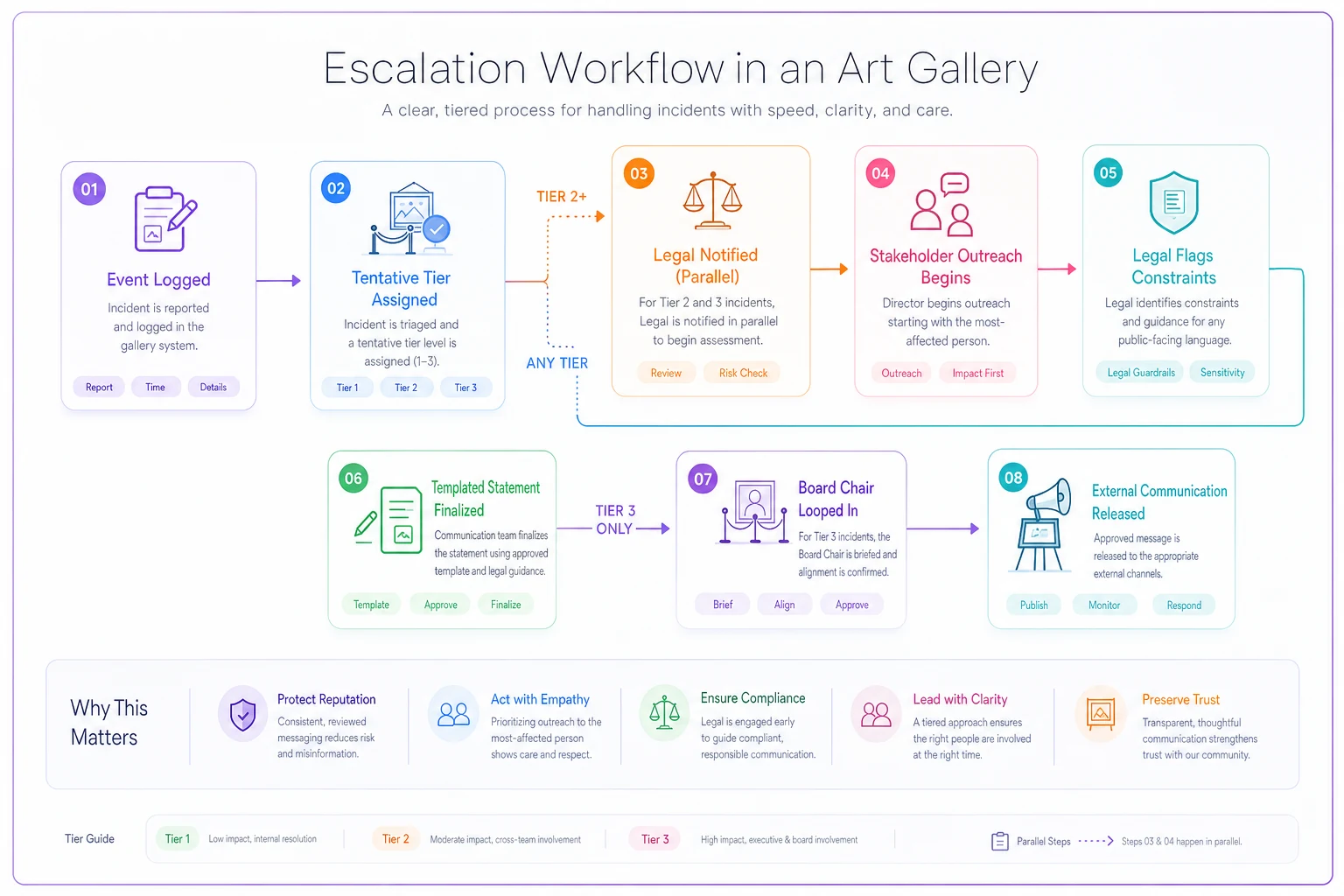
The mistake that quietly wrecks this: treating legal review as a gate that stops everything, including the private, human phone calls. Legal review should constrain public language. It should almost never stop you from picking up the phone to tell an affected artist "we know, we're on it, here's what happens next." Galleries that freeze all contact while waiting for a lawyer end up legally clean and relationally destroyed.
Simulation exercises: the step everyone means to do and never does
A governance pack that lives in a folder is worthless. The organizations that respond well are the ones that actually ran the drill at least once.
A simulation doesn't need to be elaborate. Take 90 minutes, invent a plausible scenario — "a collector publicly accuses us of selling them a misattributed print" — and walk the team through it in real time. Who gets the first call? What tier is this? Who drafts? Who does NOT talk? What does the front desk say if someone walks in and asks about it?
-
Nobody knew who the designated spokesperson was
-
Two people assumed the other one was calling the artist
-
The template existed but nobody knew where it lived
-
The board chair's actual availability didn't match the escalation assumption
-
Staff didn't feel authorized to say "no comment" and defaulted to nervous overexplaining
Run one drill a year, plus a short version whenever you onboard new staff, to keep the muscle alive.
What surfaces in these exercises is almost always the same set of gaps: the items above. The value isn't the perfect scenario — it's finding the coordination gaps while the stakes are zero.
When formal governance makes sense — and when it's overkill
When it makes sense: You represent living artists with public profiles. You handle secondary-market sales where authenticity and provenance disputes are plausible. You have a board or institutional funders who expect oversight. You've grown past the point where the owner personally touches every transaction. Or you've already had one near-miss and got lucky.
When it's lighter-touch: A very small gallery selling primarily emerging local work at accessible price points, with no board and no secondary-market activity, genuinely can run a stripped-down version — a stakeholder list, a two-tier threshold, and one holding-statement template. Building a Tier 3 board-escalation process when you have no board is theater.
Who should not over-invest: If you're a founder-run space doing a handful of shows a year with tight, trusted relationships, don't spend three weeks building runbooks for scenarios that can't realistically happen to you. Map your actual risks first. The governance should match your real exposure, not an imagined institutional version of yourself.
A real scenario
A mid-sized commercial gallery — around eight staff, a roster of roughly 20 artists, some secondary-market activity — had a situation where a former studio assistant publicly claimed one of their represented artists had misrepresented the authorship of a series. The gallery had works from that series in inventory, two under active offer to collectors.
The first time something smaller had happened to them, about a year earlier, the response took around four days to stabilize: contradictory messages went out, one collector walked, and the artist felt thrown under the bus. Something in the range of $30k in pending sales evaporated, and the artist relationship took months to repair.
This time they had a governance pack. The event was tiered within an hour. The director called the artist first — before any public word — and legal was put on notice in parallel. The two collectors under offer got a private, honest heads-up the same afternoon rather than finding out online. A holding statement went out the next morning using a pre-built template, with a single named contact. Press inquiries all routed to that one person.
The outcome wasn't magic — one collector still paused their purchase. But both artists stayed. No contradictory statements went out. The board chair was informed early enough that there was no governance panic. And the whole thing was effectively stable in under 48 hours instead of dragging for a week. The difference wasn't better luck. It was that the sequence had already been decided when everyone was calm.
Where the systems tend to break as you grow
The governance failures shift as a gallery scales.
Very early on, the failure is no process at all — the founder handles everything by instinct. That works until it spectacularly doesn't. In the middle stage — the real danger zone — the founder is still trying to personally handle crises the way they did when there were three staff, but there are now twelve people and any of them can trip a wire. That mismatch, where authority is still centralized but exposure has multiplied, is where most reputational disasters actually happen.
As you get larger, the risk inverts: too many people feel entitled to speak, roles blur, and the problem becomes coordination rather than a lack of it. Different stage, different failure, but the fix is the same underlying discipline — clear stakeholder maps, explicit thresholds, pre-built assets, and drilled escalation paths that connect comms to legal to governance.
Reputation isn't protected by having good instincts under pressure. Almost nobody has good instincts under pressure. It's protected by making the decisions in advance, writing them down, and rehearsing them once — so that when the text comes in at 9pm, the org already knows what to do, and you get to be the calm one instead of the person writing something they'll regret before morning.
Ready to elevate your gallery operations?
Join 500+ galleries using Artioly to streamline operations, boost visitor engagement, and increase art sales.