
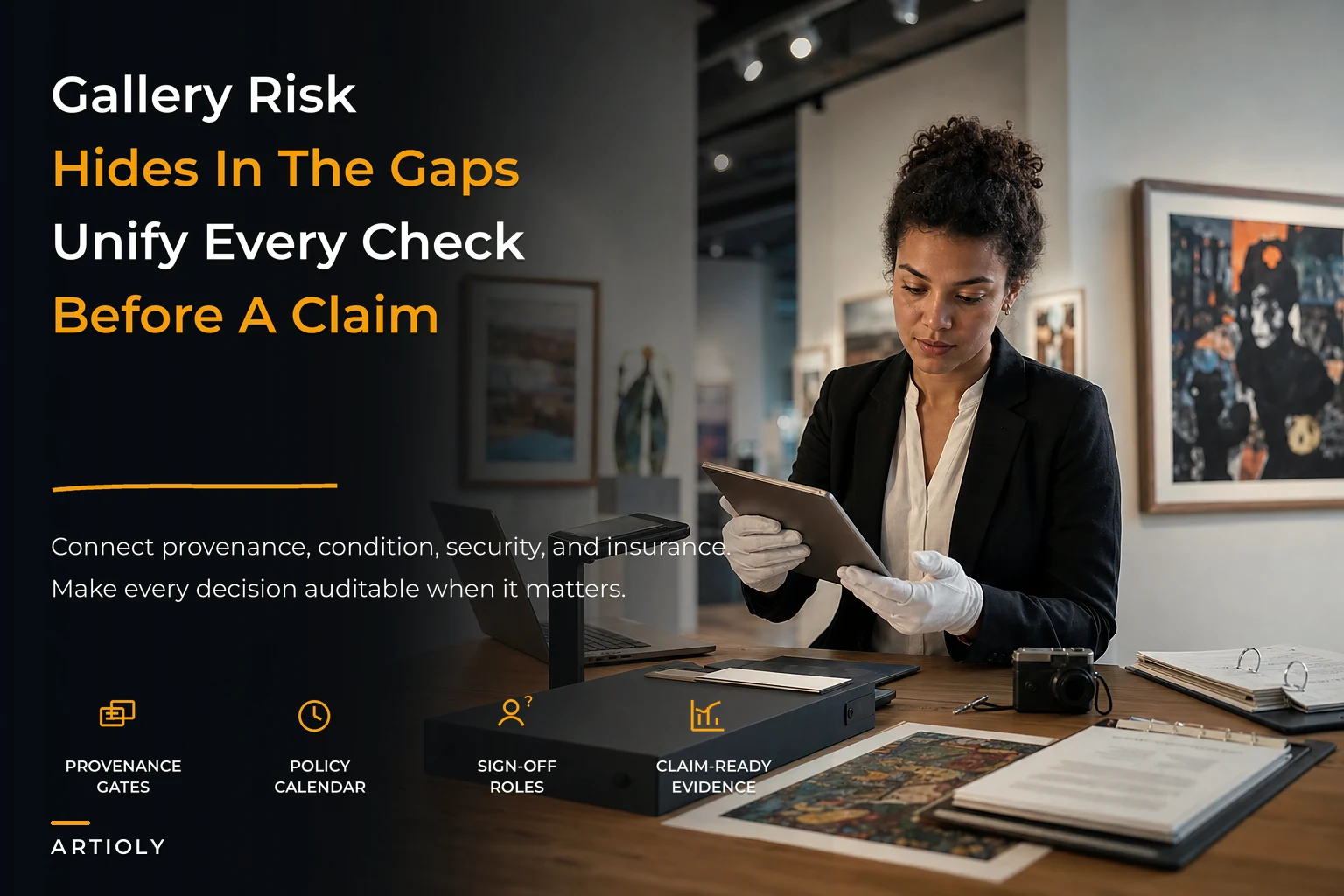

Most small galleries don't have a risk problem. They have a fragmentation problem.
The provenance file lives in one person's inbox. The condition photos sit on a phone that hasn't been backed up since the last opening. The security protocol is "we lock the door and hope." And when an insurer or a lender asks for documentation, three people scramble for two days to assemble something that should have taken twenty minutes.
Nobody planned it this way. It happens because each of these things — provenance, condition, security, incident reporting — got solved separately, by whoever happened to be dealing with that problem on that day. The result is a set of disconnected habits that look like a risk framework from the outside but collapse the moment a claim, an audit, or a loan agreement puts real pressure on them.
This article is about building the connective tissue: a gallery risk management framework that an insurer or a serious lender would actually recognize as coherent. Not a binder that sits on a shelf. A working system with a risk matrix, provenance gates, condition and security protocols, incident packets that assemble themselves, and a quarterly calendar where every task has a name attached to it.
Why galleries end up with risk theater instead of risk management
There's a version of risk management that exists purely to reassure the founder. It looks like activity — spreadsheets, PDFs, a folder named "Insurance" — but it can't survive contact with a real event.
-
Who signed off on the last acquisition's provenance, and where is that decision recorded?
-
If a work were damaged tonight, could you produce a baseline condition report from before it entered the building?
-
When did your alarm response and key-holder list last get reviewed against your current insurance policy?
If any answer is "let me check" or "that's probably in an email," the framework isn't real. It's a collection of good intentions that hasn't been assembled into anything an underwriter can rely on.
This isn't a competence issue. Small galleries run lean, and the people doing this work are curators and directors, not compliance officers. The problem is that risk work is intermittent — you only feel the gap when something goes wrong — so it never gets the same recurring attention as sales or programming. Nobody builds a system around a task they only think about twice a year.
What tends to happen across small operations is that the fragmentation gets worse as the gallery grows, not better. More shows, more loans, more consignments, more people touching the objects — and the informal habits that worked at five artists completely break at twenty-five.
The five layers that have to connect
A risk framework isn't one document. It's five layers, and the value comes almost entirely from how they link to each other. A condition report is useless if you can't tie it to the incident that damaged the work. A provenance decision is worthless if the person who approved it can't be identified later.
Never miss a key exhibition detail again.
Artioly helps you organize, promote, and manage every exhibition effortlessly.
- Unified exhibition scheduling
- Artist and visitor notifications
- Inventory and sales tracking
No credit card required
Here's how the layers stack, and what each one is actually responsible for:
| Layer | Core question it answers | What breaks without it |
|---|---|---|
| Tiered risk policy matrix | How much scrutiny does this object or activity require? | Everything gets treated the same — low-value prints get the same due diligence as a $40k loan, so nothing gets done well |
| Provenance due-diligence gates | Should this work be in the building at all? | Title disputes, restitution claims, unsellable inventory |
| Condition & security protocols | What state is it in, and how do we protect it? | No baseline for damage claims; unclear liability |
| Incident & reporting packets | What do we hand the insurer when something happens? | Slow, incomplete claims; denied coverage |
| Quarterly compliance calendar | Who keeps all of this current, and when? | The whole system rots quietly until an event exposes it |
The mistake most galleries make is building layers three and four in isolation — they get religious about condition reports but never connect them to a risk tier that tells them which works even need the detailed treatment. So they either over-document everything and burn out, or under-document the works that actually matter.
Start with the tiered risk matrix — it's what makes everything else affordable
Here's the insight that changes how the whole framework runs: you cannot apply the same rigor to every object. A gallery handling 300 works a year does not have the hours to write a full provenance memo and a museum-grade condition report for every framed edition print worth $600.
The tiered matrix solves this by scoring incoming works and activities on two axes — roughly, financial and reputational exposure and complexity and fragility — and assigning a tier that dictates how much process each one triggers.
-
Tier 1 (light touch) Lower-value, unproblematic works from known sources. Basic provenance check, standard photo documentation, standard handling. Most of your inventory.
-
Tier 2 (standard diligence) Mid-value works, first-time artists or sources, anything traveling. Documented provenance gate, full condition report, security notes, named sign-off.
-
Tier 3 (enhanced diligence) High-value works, complex or mixed-media pieces, anything with a gap in ownership history, international loans, or works entering under a carnet. Deep provenance investigation, conservator-reviewed condition report, elevated security, mandatory director sign-off.
The reason this matters operationally: the tier determines the cost of handling an object. Without tiers, galleries either apply Tier 3 effort to everything (unsustainable) or Tier 1 effort to everything (dangerous). The matrix is what makes a serious framework survivable for a team of four.
Record the reason a work landed in a given tier so you can justify choices to insurers later.
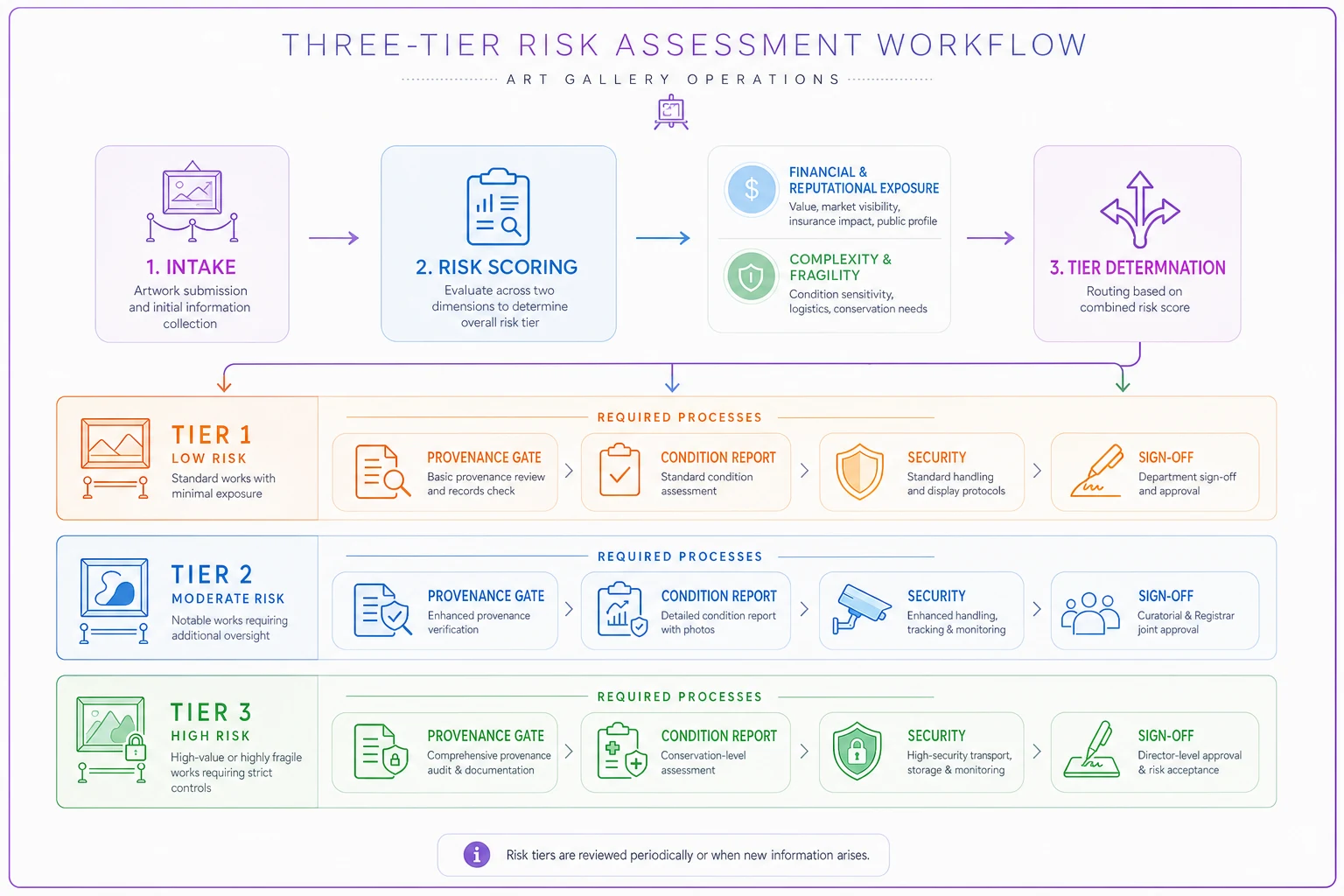
One pattern worth flagging — a lot of galleries set the tiers and then never revisit why a work landed in a given tier. Record the reason. When an insurer asks why a work got light-touch treatment, "our matrix scored it Tier 1 because X and Y" is a defensible answer. "It felt fine" is not.
Provenance gates: making "no" a step in the process, not an argument
Provenance is where the biggest, slowest disasters live. A title problem doesn't announce itself at intake — it surfaces years later when you try to sell the work, or when a claimant appears. By then you've built a show around it, promised it to a collector, and have real money tied up.
The fix isn't more research effort in the abstract. It's turning provenance into a gate — a defined checkpoint that a work has to pass through before it moves to the next stage, with a named person responsible for clearing it. If the gate isn't cleared, the work doesn't advance.
This is worth doing properly, and it pairs directly with a structured due-diligence approach — the kind laid out in our prioritized provenance due-diligence checklist. The framework's job is to make sure that checklist actually gets run, gets recorded, and gets signed — not left as a task someone meant to finish.
-
A trigger tied to the risk tier. Tier 1 gets a basic source and ownership check. Tier 3 triggers a full chain-of-ownership investigation, database checks, and often outside counsel.
-
A defined evidence standard. What documents count? Bills of sale, exhibition history, published references, correspondence. Vague acceptance criteria produce vague protection.
-
A named clearer. One person owns the yes/no decision for each tier. The director doesn't need to clear Tier 1 works, but nobody should be able to clear their own Tier 3 acquisition.
-
A recorded outcome. Cleared, cleared-with-conditions, or rejected — with a date and a signature. This record is what an insurer or buyer's counsel will eventually ask for.
The common failure here is soft gates — where the "check" happens but there's no formal pass/fail, so borderline works drift through on momentum. If the gate can be overridden by enthusiasm, it isn't a gate.
Condition and security: the baseline that decides who pays
The single most expensive gap in most small galleries is the missing baseline condition report. If a work is damaged and you can't prove its state before it entered your care, you're negotiating a claim from a position of weakness — and often absorbing costs that weren't yours.
Condition reporting deserves its own disciplined workflow, especially for fragile and mixed-media pieces where "damage" is genuinely ambiguous. The mechanics of that are covered in detail in our step-by-step condition reporting workflow. Inside the risk framework, the key is when it fires: the tiered matrix should automatically require a condition report at intake for every Tier 2 and Tier 3 work, and again at every custody change — inbound loan, outbound loan, install, deinstall, return.
-
Physical Key-holder list, alarm codes and who has them, response procedure, review dates. This list goes stale fast as staff and volunteers turn over.
-
Environmental Light, humidity and temperature ranges for sensitive works, and who monitors them.
-
Access Who can be alone with the inventory, and who signs works in and out during install and deinstall — the highest-risk moments in a gallery's calendar.
-
Digital Where the condition photos, provenance files and valuations live, and who can access or alter them.
The connective point: condition and security records only have value if they're linked to the object and time-stamped. A folder of undated photos proves nothing. The framework's job is to make each record traceable to a specific work at a specific moment — because that linkage is exactly what a claim turns on.
Incident and reporting packets: assemble before the emergency, not during it
When something actually goes wrong — a work is damaged in transit, a piece goes missing during an install, water gets into the store room — the quality of your outcome is decided in the first 48 hours. That's precisely when everyone is stressed, improvising, and forgetting steps.
The answer is a pre-built incident packet template so that responding to an event means filling in a known form, not inventing a process. An insurer-ready packet pulls together, in one place:
-
The incident description
what, when, where, who was present
-
The affected work's file
baseline condition report, provenance record, valuation
-
Post-incident condition documentation with photos
-
The custody chain at the time — who had the work and under what agreement
-
Any relevant loan, consignment or carnet paperwork
-
The named responder and the timeline of actions taken
Most of this packet already exists if the earlier layers are running. The condition baseline, the provenance record, the valuation — they were created at intake. The incident packet is really just an assembly step. That's the entire payoff of building the framework as connected layers: when the bad day comes, you're collecting, not creating.
This matters enormously for anything moving across borders, where an incident on an international loan drags in customs paperwork too. If you're regularly handling loans under a carnet, the incident packet should slot straight alongside the documents in our customs and ATA carnet checklist — because a damaged work on a carnet is both an insurance event and a customs event, and you do not want to be reconstructing either under time pressure.
The quarterly compliance calendar: what keeps it from rotting
Here's what actually kills risk frameworks: they get built once, celebrated, and then quietly decay. The key-holder list goes out of date. The insurance schedule no longer matches the inventory. Nobody's tested whether the alarm response still works. Eighteen months later the "framework" is a fossil.
The fix is unglamorous and completely essential: a quarterly compliance calendar with named role assignments and sign-off templates. Every recurring task gets an owner and a due date, and completion is signed off, not assumed.
-
Q1 — Policy and coverage review. Match the insurance schedule against current inventory and valuations. Confirm high-value works are correctly listed. Owner: Director.
-
Q2 — Security and access audit. Update key-holder list, alarm codes, review environmental controls, confirm digital access permissions. Owner: Operations lead.
-
Q3 — Provenance and condition file sweep. Spot-check that Tier 2 and 3 works have complete, signed records. Close any gaps found. Owner: Registrar/curator.
-
Q4 — Incident readiness test. Run a tabletop walkthrough of the incident packet against a hypothetical event. Update templates based on what was missing. Owner: Director and operations lead.
Each of these ends in a dated sign-off — a one-line record that says the review happened, who did it, and what changed. That sign-off trail is, quietly, one of the most persuasive things you can show an underwriter. It demonstrates that your framework is maintained, not just documented.
Assign tasks to a person, not "the team." Shared responsibility is no responsibility. Every line on the calendar needs exactly one name.
Where centralized software earns its place — and where it doesn't
You can run a version of this framework on spreadsheets and shared folders, and plenty of small galleries do. It works right up until the linkages start to matter — until you need the condition report, the provenance record, and the valuation for one specific work pulled together in an hour because an insurer is on the phone.
That's where a centralized system stops being a nice-to-have. The real value of AI-assisted operational software here isn't anything flashy — it's that records live in one place, tied to the object, so the incident packet assembles from files that already exist rather than a frantic hunt across inboxes and phones. Automated reminders keep the quarterly calendar from slipping. The risk tier attached to a work automatically flags which documentation is still missing. Sign-offs are captured with a name and a date instead of a verbal "yeah, I checked that."
Be honest about when it doesn't make sense though. If you handle a handful of Tier 1 works a year and never lend internationally, a well-run set of shared folders and a disciplined calendar will do fine. Building elaborate systems around a low-risk operation is its own kind of waste. The tooling should match the tier of the risk, exactly like everything else in this framework.
What changes when the layers actually connect
A mid-sized contemporary gallery — roughly 20 represented artists, handling somewhere around 250 to 300 works a year including several international loans each season — is a good example of how this plays out in practice. Before building a connected framework, their risk work was scattered: provenance in email, condition photos on two different phones, a security policy that lived in the director's head, and no incident procedure at all.
The break came when a mixed-media work was damaged during a deinstall. They had no baseline condition report. The claim dragged on for months, and they ended up absorbing a repair cost in the low four figures that a proper baseline would almost certainly have shifted to the carrier — plus the staff time, which was arguably worse.
Afterward they built the tiered matrix, made condition reports mandatory at every custody change for Tier 2 and 3 works, moved everything into one centralized record tied to each object, and put a named quarterly calendar in place. The next time a work was damaged in transit, the incident packet was assembled and sent to the insurer inside a day. The claim was paid without a fight.
Nothing about the second event was more sophisticated than the first. The difference was purely that the documentation already existed and was connected.
The through-line
The reason a gallery risk management framework works — when it works — is that risk isn't actually five separate problems. It's one problem viewed from five angles, and the value is almost entirely in the linkages between them. The tier decides the effort. The provenance gate decides what enters. The condition and security records establish the baseline. The incident packet assembles from those baselines. The quarterly calendar keeps every piece of it alive.
Any one of those layers, built alone, gives you a false sense of security. Built together, with a name attached to every gate and every review, you get something an insurer will actually stand behind — and, more importantly, something that protects the objects and the relationships your gallery is built on. Start with the matrix, connect the layers, and put a date on the calendar.
Ready to elevate your gallery operations?
Join 500+ galleries using Artioly to streamline operations, boost visitor engagement, and increase art sales.