


Most galleries don't plan programming three years ahead. They plan the next two shows carefully, sketch the third, and leave the rest of the calendar as a vague intention: "something with the ceramics people," "maybe a group show in summer." Then an artist's studio floods, a fair invitation lands, a collector dangles a solo show, and the calendar fills itself through reaction instead of decision.
This works until it doesn't. The moment you commit to a slot, you've committed cash, wall space, staff hours, and opportunity cost you can't get back. A gallery running six to eight shows a year is making dozens of resource bets, and almost none of them go through a consistent decision process. That's the gap this post is about: treating your calendar as a portfolio you actively manage, with real rules for what gets in, what gets cut, and how you balance risk across the whole thing instead of show by show.
A real gallery programming portfolio strategy isn't about predicting the future. It's about building a decision framework and a set of governance gates so that when the floods and fair invitations arrive, you already know how to weigh them.
Why calendars drift instead of getting planned
The drift happens for structural reasons, not because owners are lazy.
Programming decisions are emotional. You like the artist. You believe in the work. Saying no feels like a betrayal, and saying yes feels like loyalty. When the decision gets framed as a relationship question, the financial and operational questions never get asked out loud.
The feedback loop is also brutally slow. You commit to a show 12–18 months out and don't learn whether it worked until months after it closes, once sales reconcile and press lands. By then you've already committed the next three slots. There's no tight signal telling you "that category of show keeps losing money" because the data arrives too late to act on.
And every show gets evaluated in isolation. The question is always "will this show work?" rather than "does this show belong in a balanced calendar?" A calendar of six experimental solo shows by emerging artists might be artistically coherent and financially suicidal. You'd never notice if you're only looking at shows one at a time.
The galleries that scale past the founder's personal taste are consistently the ones who stopped treating the calendar as a sequence of favors and started treating it as a balanced book of bets—some safe, some speculative, deliberately mixed.
Segment the portfolio before you score anything
Not all shows are the same kind of thing. They're not even close. Different shows play different roles in your business, and you should fund and judge them by different rules.
A workable segmentation for a commercial gallery looks like this:
| Segment | Role in the portfolio | Primary success metric | Target share of calendar |
|---|---|---|---|
| Anchor shows | Pay the bills. Established artists, reliable collectors. | Net margin, sell-through | 30–40% |
| Growth bets | Build the next generation of anchors. Mid-career, rising demand. | Collector acquisition, price progression | 25–35% |
| Reputation plays | Press, institutional attention, curatorial credibility. May lose money on purpose. | Press reach, museum/curator attendance | 15–20% |
| Experiments | Test new mediums, formats, audiences. High failure rate expected. | Learning, pipeline discovery | 10–15% |
The share percentages matter more than they look. A gallery with 70% reputation plays and experiments is running an art project, not a business, and will burn through reserves. A gallery with 90% anchor shows is coasting and will slowly lose relevance as its roster ages. The segmentation forces a conversation about balance that otherwise never happens.
One pattern worth naming: galleries almost always over-weight reputation plays in their self-image and under-fund anchors in their planning. They think of themselves as cutting-edge, then quietly rely on the same three sellable artists to cover payroll. Naming the segments honestly fixes that mismatch.
Risk-weighted ROI, not raw ROI
Most planning falls apart right here. Galleries that do try to run numbers usually compare expected revenue against cost and rank shows by projected profit. The problem is that a projected $40k profit from a brand-new experimental artist is not the same as a projected $40k from an artist who's sold out their last three shows. The confidence is completely different, and raw ROI ignores that entirely.
Risk-weighting fixes it. Multiply your expected return by a confidence factor, then compare that across shows.
A practical version: Risk-weighted ROI = (Expected net contribution × Confidence factor) ÷ Total resource cost
-
Expected net contribution = projected sales margin + ancillary revenue (editions, catalogue, licensing) − direct show costs
-
Confidence factor = your honest probability the projection holds, from 0.3 (total unknown) to 0.95 (near-certain)
-
Total resource cost = direct cash costs + a loaded value for staff hours and wall-time opportunity cost
If you've already built out an exhibition financial model and break-even math, you're most of the way there. Risk-weighting is a layer on top of that model, not a replacement for it. The confidence factor is the new ingredient—and it's where discipline matters, because the temptation is always to inflate confidence for artists you personally love.
A quick worked example across three candidate shows:
-
Show A (anchor) Expected net $55k, confidence 0.85, resource cost $30k. Risk-weighted ROI = (55 × 0.85) ÷ 30 = 1.56
-
Show B (growth bet) Expected net $48k, confidence 0.55, resource cost $28k. Risk-weighted ROI = (48 × 0.55) ÷ 28 = 0.94
-
Show C (reputation play) Expected net $12k, confidence 0.70, resource cost $35k. Risk-weighted ROI = (12 × 0.70) ÷ 35 = 0.24
On raw profit, A wins easily and C looks like a disaster. But C isn't scored on profit—it's a reputation play, judged on press and curator attendance. The risk-weighted number just tells you how much cash drag it creates, so you can decide whether the reputation upside justifies carrying a 0.24. Different segments get different thresholds, which is where the gates come in.
Numeric greenlight and cancel thresholds
A governance gate is only real if it has a number attached. "We'll reconsider if it's not looking good" is not a gate. "We cancel if presales are under 20% of break-even at T-minus-90-days" is a gate.
Set thresholds per segment, because the whole point of segmentation is that an anchor show and an experiment should not be clearing the same bar.
Sample thresholds (adjust to your own cost base):
Greenlight to commit (at proposal stage):
-
Anchor
risk-weighted ROI ≥ 1.3
-
Growth bet
risk-weighted ROI ≥ 0.8 and identifies at least 3 realistic new-collector targets
-
Reputation play
approved only if it fits within the annual "reputation budget" cap (see below) and has a named press/institutional goal
-
Experiment
approved only if total downside is capped under a set dollar figure, e.g. $8k
Mid-cycle checkpoint (roughly T-minus-90-days):
-
Presales or firm collector interest ≥ 25% of break-even for commercial segments
-
Production on schedule, no unresolved loan or shipping risk
-
If below threshold
trigger a documented review, not an automatic cancel
Cancel / rescope trigger:
-
Presales under 10% of break-even at T-minus-60 with no credible pipeline
-
Cost overrun projected above 20% of approved budget
-
Key work or artist commitment falls through with no equivalent replacement
The reputation budget cap is what keeps the whole system honest. Decide at the start of the year how much net loss you're willing to absorb across all reputation plays and experiments combined—something like $40k–$60k for a mid-sized commercial gallery. Every money-losing show draws from that pool. When the pool is empty, you're done approving losers for the year, no matter how exciting the pitch. This connects directly to how you think about reserves and a multi-year fiscal roadmap—the reputation budget is a line item that roadmap has to fund.
The uncomfortable part: most galleries never cancel a committed show, even when every signal says they should. The cancel thresholds exist precisely because, in the moment, you will talk yourself out of pulling the plug. A pre-agreed number removes that negotiation.
Staffing buckets: the constraint everyone forgets
Cash is the obvious constraint. Staff capacity is the one that quietly wrecks calendars. A show you can afford to fund is not the same as a show you have the hours to deliver well.
Budget staff capacity in buckets the same way you budget cash. Figure out your realistic annual delivery capacity in "show-equivalents," where one show-equivalent is the labor load of a standard solo show. Then price each show type against that.
A rough loading model:
-
Standard solo show 1.0 show-equivalent
-
Group show (5+ artists) 1.6–1.8 (more coordination, more condition reports, more installs)
-
Institutional loan show 1.5 (carnets, condition reporting, insurance admin)
-
Simple editions/works-on-paper show 0.6
-
Off-site or fair booth 1.2–1.5 depending on logistics
Track show-equivalents monthly against capacity so you can see staffing pressure before it becomes a quality problem.
If your team can realistically deliver 7.0 show-equivalents a year at quality, a calendar of six group shows—roughly 10.5 equivalents—is going to break something. Usually the stuff that doesn't scream, like collector follow-up and condition documentation. What breaks at scale is rarely the opening itself. It's everything downstream that gets starved.
Growth bets and experiments are often more labor-intensive per dollar of revenue than anchors, because the systems aren't built yet. A calendar tilted toward growth needs more slack in the staffing buckets, not less. Galleries that scale their ambitions without scaling their capacity end up delivering everything at 80%, which is worse than delivering fewer things well.
A multi-year calendar template that actually holds
A three-year calendar isn't a locked schedule. It's a structure with firm near-term slots and deliberately loose far-term slots, each pre-tagged by segment so you're filling a shape rather than reacting to whoever asks first.
A workable structure for a gallery running eight slots a year:
-
Year 1 (firm) All eight slots named and committed, each tagged by segment, each with a signed-off risk-weighted ROI and a budget. Mix should hit your target shares.
-
Year 2 (framed) Six of eight slots have a segment and intended artist tier assigned, maybe half with named artists. Two slots left open on purpose for opportunities and for shows promoted up from the experiment tier.
-
Year 3 (shaped) Only the segment mix is locked—e.g. three anchors, three growth bets, one reputation play, one experiment. Specific artists mostly unassigned. This is a container, not a plan.
The discipline is in the tagging. Even three years out, you know you owe yourself three anchor slots in 2027. That stops you from waking up in late 2026 realizing your sellable artists are all booked elsewhere and your anchor revenue just evaporated.
A scenario that shows why this matters: a gallery gets a surprise invitation to a strong fair, 14 months out. Without a framed calendar, they say yes on instinct and quietly cannibalize a growth-bet slot to fund it. With a framed calendar, they see the fair counts as roughly 1.3 show-equivalents and draws from the growth-bet segment—so they make the swap consciously, knowing exactly which collector-acquisition goal they're trading away. Same decision, completely different quality of reasoning.
Keeping the whole thing coordinated as you grow
All of this—segments, risk weights, thresholds, staffing buckets, the rolling three-year shape—generates a surprising amount of information that has to stay current and connected. The risk-weighted ROI changes as presales come in. The staffing buckets shift when a show gets rescoped. The reputation budget depletes with every money-losing approval.
A platform that tracks each slot's segment, live presales against break-even, staffing load, and remaining reputation budget turns the T-minus-90 checkpoint into a glance instead of an archaeology project. Here's a simple depiction of that workflow.
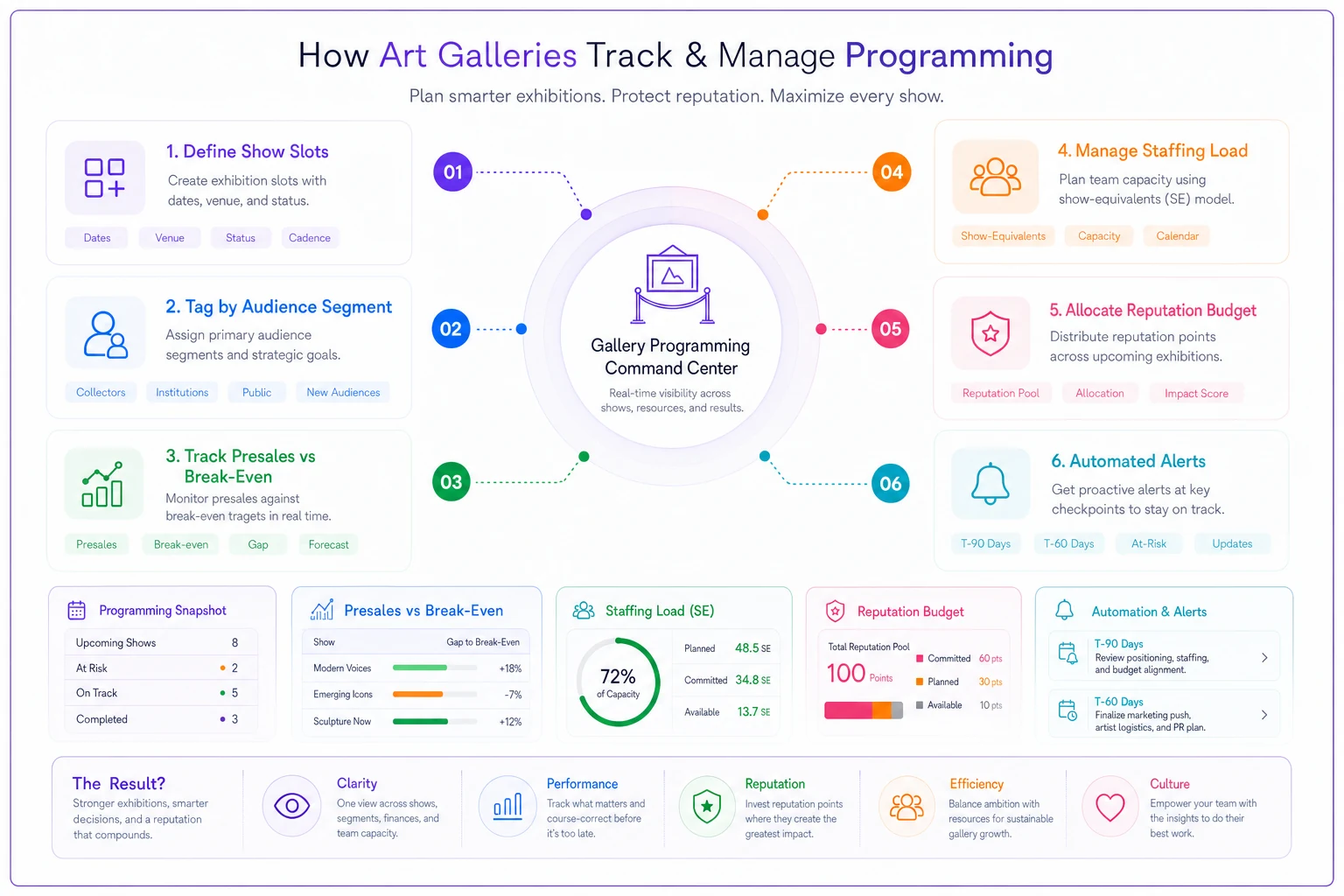
When this lives across a wall calendar, three spreadsheets, and the founder's memory, the gates stop firing because nobody's looking at the right number at the right moment. This is the practical case for keeping programming decisions in a shared operational system rather than scattered documents—not because software makes the decisions, but because the thresholds only work if the current numbers are visible to whoever's making the call.
AI-assisted operational tools can flag when a show crosses a cancel trigger or when next year's anchor share has drifted below target, so the review happens on schedule instead of after the money's already spent. The judgment stays human; the bookkeeping and the alerts don't need to.
A real scenario
A two-person commercial gallery, around eight shows a year, roughly $700k–$800k in annual sales. Their calendar had quietly drifted to five growth bets and experiments against three anchors, and they'd absorbed about $55k in programming losses over 18 months without ever deciding to. Nobody chose that mix—it accumulated.
They did two things. First, they segmented the next two years and set a target of four anchors minimum per year. Second, they set a cancel threshold—under 10% of break-even in firm interest at T-minus-60—and for the first time, actually enforced it on one struggling show. They rescoped it from a full solo into a smaller two-person presentation that cut the exposure by around $12k.
The shift wasn't dramatic in revenue—total sales moved up modestly over the following year. The real change was that net programming contribution swung from mild losses to roughly break-even-plus, and the owners stopped funding losers by accident. When a strong growth bet came along mid-year, they had both the reputation budget room and the staffing slack to take it, because the rest of the calendar was balanced on purpose. That's the quiet win: not a revenue explosion, but decisions that stopped happening to them.
When this framework makes sense—and when it doesn't
A few honest lines about where this applies.
When it's worth building: You're running six or more shows a year, you've got at least one other person involved in programming, and you've committed to a show you later regretted but couldn't unwind. If programming decisions already cause tension between artistic ambition and payroll reality, the gates give that tension a structured place to resolve.
When it's overkill: If you do two or three shows a year and the founder is the entire team, a full segmentation-and-threshold system is more process than you need. A simpler version—just the reputation budget cap and a single presale checkpoint—captures most of the value without the overhead.
Who should not do this mechanically: Anyone tempted to let the risk-weighted ROI number make the call. It's a decision aid, not a decision. A 0.24 reputation play that lands a museum acquisition can be worth more than three clean anchors, and no formula captures that. The framework exists to make sure you're choosing to carry that bet—with eyes open and budget allocated—not drifting into it.
The connective tissue across all of this is that programming decisions are financial decisions wearing artistic clothing, and the galleries that last are the ones that look at both at once. If you've already worked through revenue diversification to lower exhibition risk, the portfolio approach to programming is the same logic pointed at your calendar instead of your income streams: spread the bets, size the risk, and never let any single slot be big enough to sink the year.
Bottom line
Your calendar is the single biggest set of bets your gallery makes, and most galleries place those bets one favor at a time without ever stepping back to see the whole book. Segment the portfolio so different shows are judged by different rules. Risk-weight the returns so confidence counts, not just projected profit. Attach real numbers to your greenlight and cancel gates so decisions survive the emotional moment. Budget staff capacity in buckets, not just cash. And hold a rolling three-year shape so opportunities get absorbed on purpose instead of cannibalizing whatever slot was weakest.
None of this removes the art from programming. It just makes sure the gallery is still standing in three years to keep making it.