

Most small galleries treat conservation like a fire alarm. Nobody thinks about it until something is actively wrong — a bloom of mold on a canvas back, a warped panel that wasn't warped last season, a sculpture with a hairline crack that suddenly runs the length of the base. By the time it's visible, you're not doing maintenance anymore. You're doing damage control, and damage control is where the budget goes sideways.
The frustrating part is that almost none of it is unpredictable. A collections stewardship framework is really just the practice of deciding, on purpose and in advance, how much attention each object deserves, when it gets checked, who checks it, and what money is set aside before anything goes wrong. Galleries that skip this aren't being reckless — they're just running lean, and stewardship is the thing that gets pushed to "next quarter" until next quarter never comes.
This isn't about turning your back room into a museum lab. It's about building a repeatable cycle that a single registrar — or a registrar plus a part-timer — can actually run, and that survives staff turnover, a busy exhibition calendar, and the inevitable year where money is tight.
Start by admitting not every object deserves the same attention
The single biggest mistake is applying uniform care to a non-uniform collection. Everything gets the same environmental check, the same neglect, the same nothing. A $2,000 photographic print on stable paper and a $40,000 mixed-media work with degrading plastics are treated identically — which means either you're overspending attention on things that don't need it, or, far more often, you're under-protecting the pieces that will cost you most if they fail.
Risk tiering fixes this. Sort every object into a small number of tiers based on two things: vulnerability (how likely it is to deteriorate) and consequence (what it costs you if it does, financially and reputationally). A robust old bronze is low vulnerability. A 1970s polyurethane foam piece is a ticking clock. A consigned work you don't even own but are contractually responsible for might be high consequence even if it's physically stable.
| Tier | Typical objects | Monitoring frequency | Preventive action |
|---|---|---|---|
| Tier 1 (Critical) | Fragile, unstable materials, high-value, or contractually sensitive loans/consignments | Monthly visual + quarterly detailed | Documented condition checks, climate priority, conservator on retainer |
| Tier 2 (Elevated) | Mid-value works, sensitive media (works on paper, textiles) | Quarterly | Rotation limits, light exposure tracking |
| Tier 3 (Standard) | Stable materials, moderate value | Twice yearly | Basic dusting, handling protocol |
| Tier 4 (Low) | Robust, low-value, easily replaceable | Annual spot check | Storage hygiene only |
The tiers aren't permanent. A Tier 3 object going on a six-week loan under variable transport conditions temporarily jumps tiers. That movement between categories is exactly the kind of thing that falls through the cracks when tiering lives in someone's head instead of a system.
If you haven't nailed down how objects move through your gallery in the first place, the tiering will keep drifting out of date. The lifecycle side of this is worth getting right first — we cover it in our artwork lifecycle governance playbook, because you can't steward what you can't reliably track.
What breaks as the collection grows
A gallery holding 40 objects can run stewardship on memory and goodwill. The director more or less knows every piece. At 150, that stops working, and the failure is gradual enough that nobody notices until a specific type of loss starts repeating.
Never miss a key exhibition detail again.
Artioly helps you organize, promote, and manage every exhibition effortlessly.
- Unified exhibition scheduling
- Artist and visitor notifications
- Inventory and sales tracking
No credit card required
The patterns are consistent:
-
The "who was supposed to check this" gap. Responsibility is assumed, never assigned. Three people think someone else is monitoring the print flat files. Nobody is.
-
The rotation blind spot. Light-sensitive works get displayed, come off the wall, go into storage, and then get pulled again six months later — with no record that they've already had heavy exposure. Cumulative light damage is invisible until it's permanent.
-
The consignment liability tail. Works you're storing for artists or collectors sit in the racks for years. You're responsible for them, but they're not in your maintenance calendar because they're "not really yours."
-
The deferred-maintenance snowball. Skipping a minor intervention this year turns a $400 conservator visit into a $3,500 treatment two years later. This is the most expensive pattern and the easiest to fall into, because doing nothing feels free right up until it isn't.
In practice, the breakdown usually shows up during an exhibition install. Someone pulls a work, notices it's degraded, and now the show is short a piece with two weeks to opening. That's not a conservation problem — it's a stewardship-cadence problem that finally became visible under deadline pressure.
The maintenance calendar is the backbone, not the checklist
People hear "preventive maintenance calendar" and imagine a spreadsheet of tasks. That's the output, not the point. The real function of the calendar is to convert your risk tiers into a repeating rhythm that doesn't depend on anyone remembering anything.
A workable annual cycle looks like this:
Monthly — Tier 1 objects get a quick visual pass. Not a full condition report, just eyes on the piece: any new bloom, movement, pest evidence, or environmental oddity. Ten minutes per object, logged.
Quarterly — Tier 1 gets a documented condition check; Tier 2 gets its visual pass. This is also when you review environmental data — did the storage room spike in humidity during that heat wave in August? Quarterly is the natural cadence for catching slow trends before they become events.
Twice yearly — Tier 3 review, plus a full reconciliation of what's on display versus what's in storage versus what's out on loan. This reconciliation is where "lost" objects get found and where rotation exposure gets tallied.
Annually — Everything gets touched at least once. Tiers get reassessed. The conservator (retained or ad hoc) reviews your Tier 1 list and flags anything trending toward intervention. Budgets get reset based on what the year actually revealed.
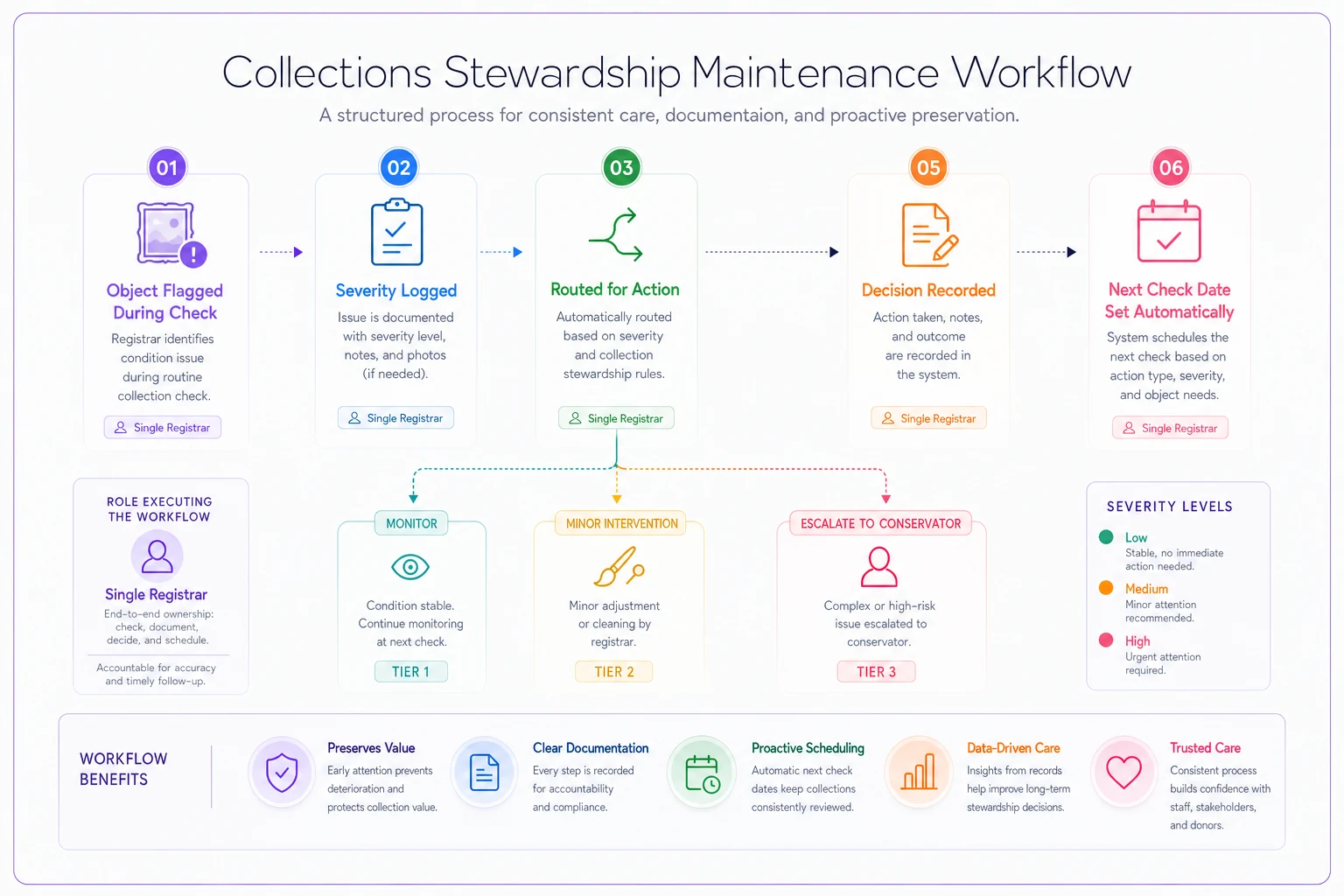
The workflow that ties it together is straightforward but has to be enforced: object flagged during check → severity logged → routed to either "monitor," "minor intervention," or "escalate to conservator" → decision recorded → next check date set automatically. Nothing can be flagged and then quietly forgotten, which is how most damage compounds.
Here's the workflow in practice.
For the actual mechanics of documenting condition — especially for fragile and mixed-media works where a vague note is worse than no note — our condition reporting workflow covers the level of detail that holds up when a dispute or insurance claim lands on your desk.
Splitting the money: CAPEX vs OPEX buckets
Stewardship dies when it competes with programming for the same undifferentiated pool of money. Every time. If conservation and the spring exhibition are drawing from one "operations" line, conservation loses, because the exhibition has a date and conservation doesn't.
OPEX (recurring, predictable):
-
Routine monitoring labor
-
Consumables (archival materials, silica gel, pest monitoring supplies)
-
Environmental system running costs
-
Conservator retainer or per-visit fees for routine checks
CAPEX (larger, episodic, planned):
-
Major conservation treatments
-
Storage upgrades (racking, climate equipment, display cases)
-
One-time reframing or remounting of a group of works
The distinction matters because it changes how you defend the spend. OPEX is a fixed cost of holding a collection — you argue it once, then it's baseline. CAPEX gets planned against your risk register: the Tier 1 objects trending toward intervention become next year's CAPEX line, forecast a year ahead instead of surprising you.
Design your board-facing budget lines so OPEX is untouchable month-to-month while CAPEX is reviewed annually against the Tier 1 forecast.
A useful rule of thumb: a meaningful slice of what you spend holding a collection needs to be stewardship OPEX that never gets raided for exhibitions. Even a modest reserve — a few thousand dollars set aside annually for the "we found something" scenarios — is the difference between an inconvenience and a crisis.
A real scenario: the print collection that almost cost a five-figure treatment
A small contemporary gallery — around 120 objects, one registrar splitting time with front-of-house — had never tiered its collection. Works on paper lived in flat files that hadn't been fully reviewed in over two years. No maintenance calendar; checks happened when someone happened to be pulling something.
During a routine install, the registrar noticed foxing and early mold spotting across several prints in one drawer — humidity had crept up in that corner of storage after an HVAC adjustment nobody had connected to the collection. Three works were affected. One was a Tier 1-value edition.
Because it was caught mid-crisis rather than through scheduled monitoring, the treatment estimate came in around $4,000–$5,500 across the affected works, plus the storage fix. Had the environmental drift been caught at the quarterly review — which would have flagged the humidity trend well before it reached the paper — the intervention would have been closer to $600–$900 in preventive stabilization and a dehumidifier.
They rebuilt the program afterward. Tiered the collection over one cycle. Put Tier 1 works on a monthly visual pass and the whole works-on-paper group on quarterly humidity logging. The following year, two objects got flagged early and handled cheaply. The registrar's summary was blunt: the calendar didn't add work, it just moved the work earlier, where it was cheaper.
Building it in one cycle: the templates a registrar can actually adopt
The reason stewardship frameworks fail on paper is that they're designed for institutions with three-person registration departments. A small gallery needs something a single person can stand up in one annual cycle. Here's a realistic rollout:
-
Inventory reconciliation first. You cannot tier what you can't confirm you have. Reconcile the physical collection against your records before anything else — location, ownership status, and current condition baseline for each object.
-
Assign tiers. Score each object on vulnerability and consequence, drop it into one of the four tiers. Don't overthink borderline calls — you'll reassess annually anyway.
-
Build the calendar from the tiers. Each tier already implies a frequency. Populate the recurring schedule and assign an owner to every recurring task. "Owner" is a person, not a department.
-
Create three templates a quick visual-check form, a full condition report, and an intervention-decision log. Keep the visual check to under ten fields — anything longer won't get done.
-
Split the budget. Set your OPEX baseline and your CAPEX forecast against the Tier 1 objects most likely to need work.
-
Set the KPI cadence. Review the numbers quarterly (see below), reassess tiers annually.
Your stewardship KPIs shouldn't be elaborate. A handful that actually get looked at:
-
% of scheduled checks completed on time (this is your early-warning metric — when it drops, everything else is about to)
-
Number of objects flagged and unresolved past their decision date
-
Preventive vs reactive spend ratio (you want this trending toward preventive over time)
-
Objects moving up a tier vs down (tells you whether the collection is stabilizing)
This is where a collections management platform with AI-assisted scheduling earns its place — not in doing conservation, but in making sure the cadence never quietly collapses. Automatically generating the next check date when one closes out, surfacing objects whose decision dates have passed, flagging environmental readings that break a threshold, rolling flagged items into a budget forecast. For a one-person registration function, the difference between "the system reminds me" and "I have to remember" is what keeps the whole framework alive past the enthusiastic first quarter.
When this framework is overkill — and when it's non-negotiable
Not every gallery needs the full four-tier structure on day one.
When a lighter version makes sense: If you're holding under 50 mostly stable objects and everything turns over quickly through sales, two tiers and an annual reconciliation will do it. Building elaborate cadence for a fast-moving inventory is wasted motion.
When the full framework is non-negotiable: The moment you're holding significant consigned or loaned works, works with unstable modern materials, or a permanent collection that's part of your identity, informal stewardship becomes a genuine liability. Contractual responsibility for objects you don't own is the clearest trigger — you can be liable for deterioration you never monitored.
Who should not try to do this at once: A gallery mid-relocation, or one without a confirmed inventory, should not start tiering. Reconcile first. Tiering an inventory you can't verify just produces a confident-looking document that's wrong.
One more thing worth connecting: stewardship starts before an object even enters the collection. What you acquire determines what you'll be responsible for maintaining for years — which is why the front-end discipline in our provenance due-diligence checklist and the back-end stewardship framework here are really two ends of the same responsibility.
The shift worth making
Conservation surprises aren't accidents of bad luck. They're the predictable result of running a collection on attention that's uneven, undocumented, and unfunded. The galleries that avoid five-figure treatment bills aren't spending more on conservation — they're spending earlier, on the right objects, on a rhythm that doesn't depend on anyone's memory.
A stewardship framework built around risk tiers, a maintenance calendar, separated budget buckets, and a light KPI cadence is entirely within reach for a small team running one annual cycle. The work doesn't increase. It just moves to where it's cheaper and calmer — before the object fails, instead of after. Quiet, boring, on-schedule stewardship is what a well-run collection looks like from the inside.
Conservation surprises aren't accidents of bad luck. They're the predictable result of running a collection on attention that's uneven, undocumented, and unfunded. The galleries that avoid five-figure treatment bills aren't spending more on conservation — they're spending earlier, on the right objects, on a rhythm that doesn't depend on anyone's memory.
A stewardship framework built around risk tiers, a maintenance calendar, separated budget buckets, and a light KPI cadence is entirely within reach for a small team running one annual cycle. The work doesn't increase. It just moves to where it's cheaper and calmer — before the object fails, instead of after. Quiet, boring, on-schedule stewardship is what a well-run collection looks like from the inside.
Ready to elevate your gallery operations?
Join 500+ galleries using Artioly to streamline operations, boost visitor engagement, and increase art sales.