

Most galleries don't fail to scale because the work isn't good enough. They stall because the operation that worked at the neighborhood level quietly becomes the thing holding them back. The founder who hand-sold every piece, wrote every press email, and personally knew every collector hits a ceiling — and instead of redesigning the engine, they just push harder on the one they already have.
Scaling a gallery from local to national visibility isn't a marketing problem. It's a sequencing problem. You have to grow four capabilities — curation, sales, PR, and collections — roughly in step, while your funding model and governance quietly evolve underneath them. Grow one too fast and the others can't keep up. A gallery that lands national press before its collections and fulfillment systems can handle out-of-state buyers will burn that attention and never get it back.
This is a map for doing it in the right order. Not a list of growth hacks — a look at how the pieces connect, what breaks when they don't, and what actually needs to change at each stage.
Think in capabilities, not revenue targets
The usual way people think about scaling is revenue: hit $X, then do the next thing. That's backwards. Revenue is the output. Capability is the input. When a gallery jumps revenue without building the underlying capability, you get the familiar mess — a sold-out show the team can't fulfill cleanly, an artist roster bigger than the sales operation can support, a mailing list that grew 3x but converts worse than it did at a quarter the size.
The four capabilities worth tracking:
-
Curation — your program's coherence, your pipeline of artists, your point of view. At local scale this is the founder's taste. At national scale it has to become a repeatable argument other people can defend.
-
Sales — not just closing, but the whole machine
pricing discipline, placement strategy, collector matching, and the ability to sell someone you've never met in person.
-
PR — moving from "we send announcements" to "critics, fairs, and institutions take our calls."
-
Collections — the unglamorous backbone. Inventory, provenance, condition, logistics, archiving. This is almost always the capability that lags, and it's the one that quietly caps how big you can get.
What most owners miss: these four don't scale at the same speed or cost. Curation and PR can jump fast — a single strong show or a well-placed review can double your visibility in a season. Sales and collections scale slowly, because they're built on systems and trust, not moments. The whole art of scaling is keeping the fast movers from outrunning the slow ones.
The milestone matrix
Here's the shape of it across three broad stages. Treat the stage names loosely — most galleries live between them, not neatly inside one.
| Capability | Local (established neighborhood gallery) | Regional (known in your metro + nearby markets) | National (collectors and press engage regardless of geography) |
|---|---|---|---|
| Curation | Founder-driven taste; 6–10 shows/yr | Defined program thesis; guest curators; waitlist of artists | Multi-year programming arc; artists approach you; institutional dialogue |
| Sales | Founder closes most sales in person | Dedicated sales lead; remote/viewing-room sales working | Sales team with territories; placement strategy across markets |
| PR | Local listings, opening announcements | Regional press relationships; occasional national mention | Critics on speed-dial; fair presence; institutional press |
| Collections | Spreadsheet or basic archive; founder knows everything | Structured inventory system; condition + provenance discipline | Full lifecycle governance; multi-location logistics; audit-ready records |
| Funding | Cashflow from sales; founder reserves | Retained earnings + modest line of credit | Staged external capital or strong reserve-backed program |
| Governance | Sole owner, informal | Advisory input; documented roles | Formal board or structured ownership; defined risk controls |
| Team | Founder + 1–2 generalists | 4–7 with specialized roles | 10+ with departmental structure |
Look down the collections column. That's where most ambitious galleries are thinnest relative to where they want their other columns to be. A gallery with national-level PR ambitions and local-level collections infrastructure is an accident waiting to happen.
Stage one: local — build the thing that can be copied
At the local stage your whole operation lives in the founder's head, and honestly, that's fine for now. The mistake isn't being founder-dependent. The mistake is staying that way while telling yourself you're about to scale.
The real work at this stage is making the invisible visible. Every judgment call the founder makes — why this artist, why this price, which collector gets first look — needs to start getting written down. Not as bureaucracy. As the raw material for everything that comes next.
What to lock in before you try to grow:
-
A pricing logic you can explain to someone else without improvising
-
An inventory record that isn't just a spreadsheet one person understands
-
A basic collector record — who bought what, when, at what price, and why they came back
-
A shows calendar planned at least 12–18 months out
-
Clean separation between gallery cash and personal cash
A typical example looks like this: a gallery doing roughly $400k–$600k a year, six shows, one founder plus a part-time assistant. The founder is the curator, the salesperson, the press contact, and the registrar. It works — until two of those roles need attention the same week, which they always eventually do. The opening is Thursday, a collector wants a condition report on a piece shipping to another state, and a writer just asked for images on deadline. One person, three jobs, all urgent. That week is the first real signal you're ready — or not — to scale.
Funding and governance here are simple on purpose. You're running on sales cashflow and whatever reserve you've built. Governance is you. The one thing worth starting early is a genuine fiscal plan — not just a budget, but a view of reserves and the multi-year picture. The thinking in this fiscal roadmap for small galleries matters more than people expect at this stage, because the decisions you make about reserves now determine whether you can fund the next stage from inside the business or have to go raise money on someone else's terms.
Sample budget shift at this stage: your first real investment usually isn't marketing — it's the registrar/archive function. Spending roughly $8k–$15k setting up proper inventory, imaging, and records before you grow is boring, and it's the highest-leverage money you'll spend. It's the capability that'll bottleneck everything later if you skip it.
Stage two: regional — where coordination replaces heroics
This is the hardest transition, and the one most galleries get wrong. Going regional means you can no longer run on individual heroics. The founder physically cannot be in the loop on everything, so the question becomes: does information flow through systems, or does it still flow through one person's memory and inbox?
Here's what breaks at this stage, almost universally.
The founder hires a sales lead but doesn't hand over the collector relationships cleanly, so the sales lead is selling blind — they don't know that the collector who seems lukewarm actually buys big every two years, because that pattern lives in the founder's head. Sales stall and everyone blames the hire.
Or: PR suddenly works. A regional review lands, traffic spikes, out-of-market inquiries come in. But the viewing-room and remote-sales process isn't built, so warm leads go cold while someone figures out shipping quotes and condition reports by hand. You got the attention and couldn't convert it.
Or the quiet one: the program expands to more artists and shows, but collections governance doesn't keep pace. Works get consigned, moved, loaned, returned — and the records lag reality. Six months later nobody's quite sure what's where, what's sold, what's still on consignment and whose it is.
The fix across all three is the same: the business needs a shared operational spine so curation, sales, PR, and collections are all looking at the same information. This is the stage where a canonical data model and KPI hierarchy stops being a nice-to-have. When your sales lead, your registrar, and your founder are all working from the same record of an artwork's status, price history, and collector interest, coordination stops depending on who happened to be in the room.
Role changes at this stage are the real budget story:
-
First specialized hire — sales or registrar. Which one depends on your bottleneck. If you're leaving money on the table at openings, hire sales. If your records are a liability, hire the registrar. Don't hire both at once hoping to figure it out.
-
Fractional PR, not full-time. At regional scale you need relationships and bursts of activity, not a daily press machine. A fractional or contract PR person at roughly $2k–$4k a month gets you further than a junior full-timer.
-
Founder shifts from doing to deciding. The painful one. The founder's job becomes curation, key relationships, and setting the rules others execute — not executing.
Sample regional budget sketch for a gallery pushing toward $1M–$1.5M in annual sales:
-
Sales lead
roughly $55k–$75k base plus commission
-
Registrar / collections (can be part-time initially)
$35k–$50k
-
Fractional PR
~$30k–$45k/year
-
Systems and tooling
$10k–$20k/year
-
Programming and production
variable, but now planned as a portfolio, not show-by-show
Funding shifts from pure cashflow to retained earnings plus maybe a modest line of credit to smooth the gaps — because at this stage you're spending on shows and shipping months before the revenue lands. Governance should start getting real too: even an informal advisory group of two or three people who'll actually tell you the truth is worth more than a formal board you ignore.
When regional scaling is actually a bad idea
Not every gallery should push past local, and pretending otherwise is how good galleries blow up. Hold position if:
-
Your program depends so heavily on the founder's eye that it can't survive delegation — and the founder genuinely doesn't want to delegate it
-
Your reserves can't cover 6–9 months of the higher fixed cost base you're about to take on
-
Your collections records are still a mess. Scaling on a broken inventory foundation just makes the eventual reckoning bigger.
There's no shame in running an excellent, profitable, founder-run gallery forever. The failure is scaling the cost structure without scaling the capability underneath it.
Stage three: national — governance becomes the product
At national scale, the thing that makes or breaks you isn't talent or even money. It's whether the organization can make good decisions without the founder in every one. That's governance, and at this stage it's not paperwork — it's the operating system.
Curation now has to be an argument the institution can defend, not just a founder's instinct. That means guest curators, multi-year programming arcs, and a point of view consistent enough that a critic or a museum can actually engage with it. Sales becomes a team with real structure — people responsible for specific markets or collector segments, working placement strategy, not just closing whoever walks in. PR means you're in the national conversation: fair presence, critics who return your calls, institutional relationships. And collections becomes genuinely complex — multiple locations, works in transit, loans, consignments, long-term storage — all of which has to be audit-ready, because at this scale a provenance gap or a lost condition report isn't an embarrassment, it's a lawsuit.
What has to be true before you commit to national scaling:
-
[ ] Each of the four capabilities has a named owner who is not the founder
-
[ ] Collections records are clean enough to pass an outside audit
-
[ ] You can close and fulfill a sale to a collector in another state without the founder touching it
-
[ ] Pricing, consignment terms, and artist payments run on documented rules, not case-by-case negotiation
-
[ ] You have a funding plan that survives a flat or down year
-
[ ] Decision rights are written down — who can approve a show, a price exception, an acquisition, a new artist
-
[ ] Risk controls exist for the obvious exposures
insurance, loan agreements, consignment liability, cash reserves
That last cluster is where staged funding and governance meet. National-scale galleries generally fund growth one of two ways: strong reserve-backed programming (you've saved enough that the business funds its own expansion) or staged external capital.
Staged funding and what you give up
-
Debt (line of credit, term loan). You keep full control. You take on fixed obligations that don't care whether the show sold. Fine if your cashflow is predictable, dangerous if it's lumpy — and gallery cashflow is almost always lumpy.
-
Equity / partner capital. You give up some control and upside, but you share the downside risk and gain a partner who's motivated to help. The trap is taking equity from someone who wants returns on a timeline the art market won't deliver.
-
Patron or founding-collector capital. Common in this world and underrated — supporters who fund expansion in exchange for access, early placement, or soft governance input rather than hard equity. Lower pressure, but set expectations in writing or it curdles into resentment.
-
Reserve-funded (self-financed). Slowest, safest, keeps everything yours. If you built reserves properly in earlier stages, this is often the smartest path.
The principle that keeps you out of trouble: match the funding's risk profile to the capability you're funding. Fund slow-scaling, infrastructure-heavy things (collections systems, reserves) with patient money — your own retained earnings or patient patron capital. Fund fast-return things (a fair booth, a specific show with strong pre-sales) with short-term capital you can pay back quickly. Galleries get wrecked when they fund a slow, uncertain capability with impatient money.
Governance has to carry real weight by now. A board or structured ownership isn't about looking legitimate — it's about having a body that enforces the risk controls when the founder, in the heat of a great opportunity, wants to skip them. The whole point of governance is to be the thing that says "not yet" when the founder's enthusiasm is about to outrun the operation's capacity. The framework in that same governance and fiscal roadmap scales naturally into this stage.
A real scenario: the gallery that scaled PR before collections
A commercial gallery — call it a regional operation doing around $1.2M a year, four full-time staff — landed a strong national review off a breakout show. Inquiries roughly tripled over the next few weeks, a good chunk from out-of-state collectors and a couple of institutions.
Here's what went wrong. Their collections and sales infrastructure was still local-grade. Inventory lived across a spreadsheet and the founder's memory. There was no clean remote-sales process — every out-of-state inquiry needed hand-built shipping quotes, condition reports dug out or recreated, provenance details chased down. The two-person sales effort got swamped. Response times on warm, high-intent leads stretched from hours to over a week.
The cost wasn't just the sales they lost in that window, though that was real — several pieces that should have moved didn't. The bigger cost was reputational. An institution that inquired got a slow, disorganized response and simply moved on, and that relationship doesn't reopen easily.
They spent the next eight months or so doing the unglamorous rebuild — proper inventory system, documented condition and provenance for the whole active roster, a real viewing-room and remote-sales workflow, and a registrar hire. Call it $40k–$60k all in, plus a lot of founder time. The painful part: most of that could have been built before the press hit, for less money and zero lost opportunity, if they'd read their capability gaps honestly.
The lesson isn't "don't chase press." It's that your capabilities have to scale roughly together. PR that outruns collections and sales doesn't create growth — it creates a very public demonstration of your weakest link.
How the four capabilities actually connect
It helps to trace one artwork through a scaled gallery, because that's where the connections become obvious.
Here's a simple visual of that workflow.
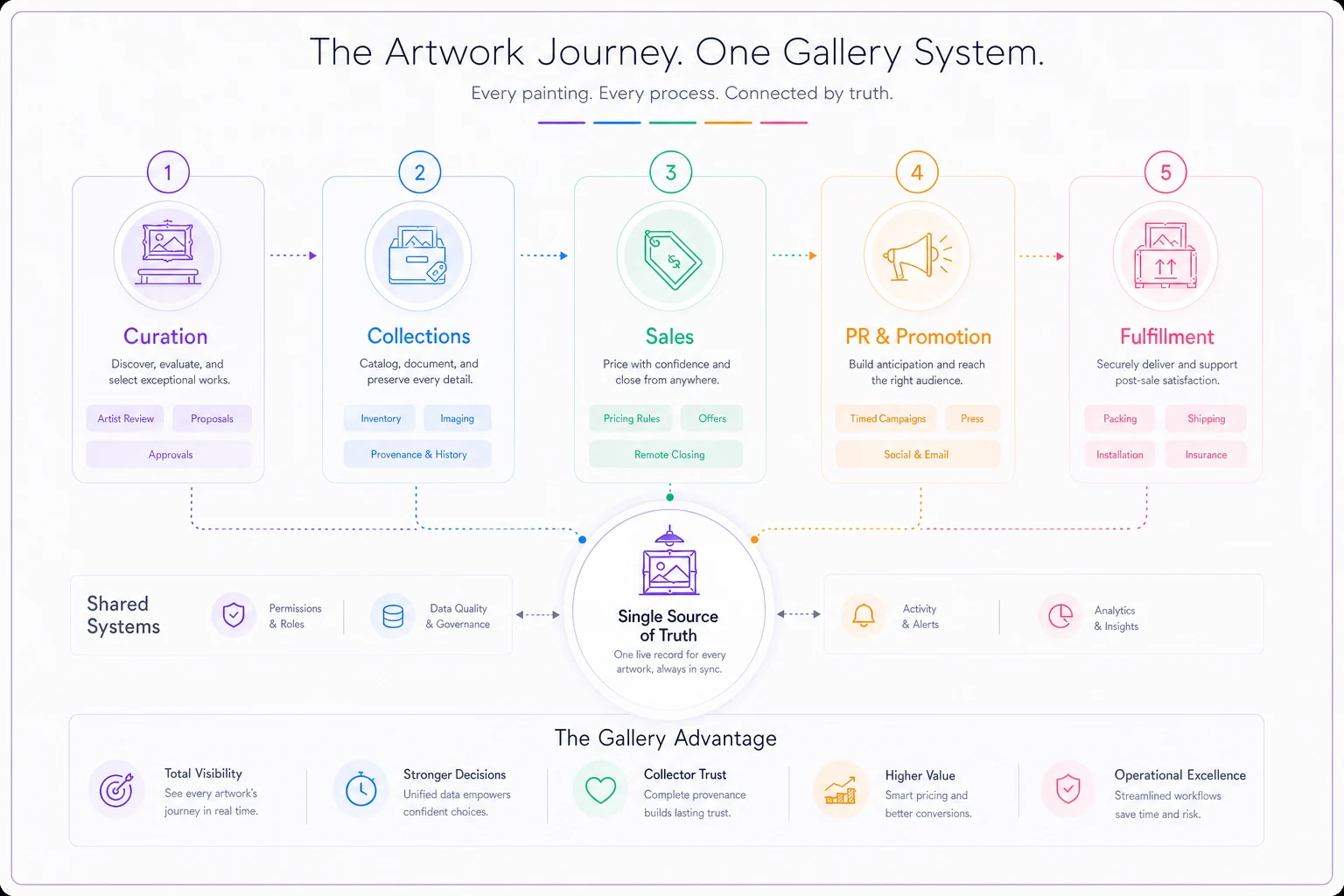
A curator commits to an artist (curation). The work comes in and gets logged — images, condition, provenance, consignment terms — into the shared inventory (collections). A price gets set by the pricing rules, not by improvisation (sales governance). The show gets placed in the programming calendar and the PR push is timed to it (PR). An out-of-state collector inquires; the sales lead pulls up the complete record instantly — status, price history, the collector's past buying pattern — and closes remotely (sales + collections + collector data). The piece ships with a proper condition report; records update; the artist payment schedule triggers on the documented terms.
Use a single inventory record that everyone can access — it stops most coordination failures.
At local scale, one person holds all of that in their head and it works. At national scale, if any link in that chain depends on someone's memory or a one-off manual effort, the whole thing jams under volume. The galleries that scale cleanly are the ones where that chain runs on shared systems and documented rules — where information moves without a human having to carry it from one function to the next.
That's also why a deliberate approach to tools matters. You don't buy software to look modern; you buy it to make that chain run without heroics. The sequence in a technology adoption roadmap for small teams is useful precisely because adopting the right system at the wrong stage — or ten disconnected tools instead of a connected spine — creates its own coordination tax. The goal is one reliable source of truth that curation, sales, PR, and collections all draw from, so the gallery can grow visibility without the operation fracturing underneath it.
Reading your own stage honestly
The single most useful thing you can do is stop measuring yourself by revenue and start measuring by capability gaps. Line up your four columns. If curation and PR are reaching for the national row while sales and collections are stuck at local, you don't have a growth opportunity — you have a risk, and the next big break could hurt you more than it helps.
Scaling a gallery from local to national visibility is really the discipline of keeping four capabilities, a funding model, and a governance structure moving in rough step with each other. Not perfectly in sync — that never happens — but close enough that no single part outruns the ability of the others to support it. The galleries that make the jump aren't the ones with the best single show or the luckiest review. They're the ones that built the backbone before they needed it, so that when the attention finally came, they could actually hold it.