


Most founder-run galleries have a single point of failure, and everyone in the building knows exactly who it is. It's the person whose name is on the door, who knows which collector will buy the big piece before the fair, who remembers that one artist's contract has a weird resale clause, and who personally approves anything over a certain dollar amount. That person is also usually the one who hasn't taken a real vacation in three years.
The gallery's entire operation lives in that one head, and nobody has written any of it down. When that founder gets sick, burns out, wants to retire, or dies — and galleries have been forced to close over all four — the institution doesn't just lose a leader. It loses its memory, its relationships, and in a lot of cases its ability to keep operating past the next 60 days.
Succession isn't a document you write once and file. It's a system that quietly captures knowledge, builds people into bigger roles over time, and gives your board a clear set of triggers for when they need to step in. The galleries that handle leadership transitions well almost always started two or three years before the transition actually happened.
Why founder-run galleries break differently than other small businesses
A restaurant can replace a head chef. A law firm has partners who all hold client relationships. A founder-run gallery concentrates three very different kinds of value in one person, and they don't transfer the same way.
There's relational capital — the collectors who buy because they trust the founder's eye, the artists who signed because of a personal conversation at a studio visit ten years ago.
There's tacit operational knowledge — the pricing instincts, the "we don't show that artist because of what happened in 2019," the informal payment terms with the framer.
And there's institutional authority — the person who can actually say yes or no on a consignment, a discount, or a six-figure acquisition.
Founders tend to protect all three without realizing it. Not out of ego, usually, but because delegating relationship work feels risky and writing down tacit knowledge feels like busywork when there are shows to install. So the gallery grows, revenue climbs, the team gets to five or eight people — and the dependency on the founder stays exactly where it was on day one.
The pattern that keeps coming up: a gallery doing roughly $1.5M–$3M a year, three to six staff, and zero documented process for what happens if the founder is out for more than a week. The business looks healthy. It's actually extremely fragile.
The thing nobody captures: knowledge that lives in relationships
Before you can build a succession plan, you have to accept that most of what matters in your gallery isn't written anywhere. A good succession system is really a knowledge-capture system running continuously in the background — not a scramble that starts when the founder announces they're leaving.
Knowledge-capture artifacts are the specific documents and records that move knowledge out of someone's head and into a form the next person can use. For a gallery, the ones that matter most are:
-
Collector relationship dossiers — not just a CRM record, but context. Why does this collector buy? Who introduced them? What have they passed on and why? What's the actual relationship temperature right now?
-
Artist relationship histories — the handshake agreements, the sensitivities, the promises made verbally that aren't in the contract but absolutely need honoring.
-
Pricing and discount logic — the founder's actual decision rules, written as rules. "We hold firm on primary-market work under $25k; we'll go to 10% for a museum or a repeat collector buying their third piece."
-
Vendor and production relationships — the framer, the shipper, the art handler, the printer who does rush jobs. Terms, contacts, and who to call when something goes wrong.
-
Institutional memory landmines — the disputes, the people you don't work with, the past conflicts a new leader could walk straight into.
The mistake isn't failing to document. It's documenting the easy stuff (contact lists, SOPs for installing a show) and skipping the hard stuff (why decisions actually get made). Anyone can reconstruct a packing checklist. Nobody can reconstruct twelve years of knowing which collector gets offended if you don't call them first.
Make recording why decisions were made part of the post-decision workflow (voice memo or a line in a shared doc) so judgment accumulates over time.
A practical habit that works: after any significant decision — a pricing call, a declined consignment, a tricky artist conversation — the founder spends three minutes recording why. Voice memo, a line in a shared doc, whatever actually gets used. Over a year this builds into the real operating manual, the one that captures judgment instead of just procedure. That kind of connective tissue is what makes everything else in your small-gallery operational playbook survive a leadership change.
Role ladders: building the pipeline before you need it
A succession plan that names a single successor is a bet, not a system. The better approach is a role ladder — a defined progression that shows how someone moves from gallery assistant to sales associate to director, with clear responsibilities and authority at each rung.
Role ladders do two things at once. They give your team a reason to stay and grow (galleries lose good people to boredom and invisible ceilings more than to pay), and they create a bench of partly-ready successors instead of one irreplaceable person and a cliff behind them.
Here's what a simplified ladder looks like for a mid-size commercial gallery:
| Rung | Owns | Authority threshold | Succession readiness |
|---|---|---|---|
| Gallery Associate | Front of house, basic inventory, visitor logging | None on pricing/consignment | Learning the system |
| Sales Associate | Assigned collector relationships, quotes within set range | Discounts to 10%, sales under $15k | Holds some relational capital |
| Senior Associate / Registrar | Consignment intake, condition, artist logistics | Approves standard consignments, sales under $40k | Operational backbone |
| Director | Programming input, key collector accounts, team management | Most decisions below founder tier | Viable interim leader |
| Founder / Principal | Final authority, vision, top-tier relationships | Everything | The role being planned for |
The point isn't the exact titles — galleries vary wildly. The point is that each rung carries explicit authority thresholds, so delegation is a defined act, not a vague "handle it." When a sales associate can approve a 10% discount without texting the founder, two things happen: the founder stops being a bottleneck, and the associate starts building the judgment they'll need higher up.
A common failure: galleries create titles but never move authority with them. You end up with a "director" who still can't approve a $12k sale without checking in first. That's not a pipeline — it's a costume. The authority column is the part that actually builds successors.
If you're bringing early-career people into the bottom rungs, the same logic applies downward. Clear responsibilities and documented onboarding matter just as much for juniors, which is why your volunteer and intern program SOPs should connect to this same ladder rather than sit off to the side as a separate thing.
When role ladders don't make sense
If you're a two-person gallery, a formal ladder is overkill. What you need instead is a documented "if I'm hit by a bus" file and one trusted outside person — an accountant, a lawyer, a board member — who can access it. Ladders start earning their keep around four or five staff, when natural progression paths stop being obvious and good people start wondering where they go next.
The board's job: thresholds for intervention
For nonprofit galleries, the board owns succession legally and practically. For commercial galleries with an advisory board or even a single trusted advisor, the principle still applies: someone outside the founder needs defined authority to act when the founder can't.
The problem is that most boards are passive until a crisis, then suddenly have to make enormous decisions with no framework. A board-aligned succession policy fixes this by defining intervention thresholds in advance — the specific conditions that move the board from oversight to action.
Useful thresholds to write down:
-
Planned absence over 2 weeks → interim authority activates, no board vote needed.
-
Unplanned absence over 2 weeks (illness, emergency) → board chair notified, interim plan triggered, 90-day template begins.
-
Founder signals intent to retire/exit → board initiates formal succession process on a defined timeline.
-
Founder incapacitation or death → emergency continuity plan activates immediately; board chair assumes decision oversight.
-
Financial or reputational crisis tied to the founder → board convenes within a set window with authority to appoint interim leadership.
Each threshold should name who acts, what authority they get, and what the first 72 hours look like. The galleries that survive sudden transitions are the ones where nobody had to ask "wait, who's allowed to sign this?" These thresholds also shouldn't live in a separate document from your reserve policy and board responsibilities — they belong in the same place, which is covered in more depth in the governance traps and 3–5 year fiscal roadmap.
Interim continuity: the 90-day and 180-day templates
When a leader leaves — planned or not — the first six months decide whether the gallery stabilizes or spirals. Two templates do most of the work.
The 90-day continuity template is about stabilization and reassurance. Nobody should be reinventing the gallery in the first quarter. The goals are narrow:
-
Keep the current program on schedule — shows already booked ship and install as planned.
-
Protect existing relationships. Contact top collectors and key artists personally within the first two weeks so they hear it from the gallery, not the rumor mill.
-
Freeze non-essential decisions. No new artist signings, no major pricing changes, no big strategic pivots during the first 90 days unless genuinely urgent.
-
Confirm cash position and upcoming obligations
payroll, rent, artist payments, fair deposits.
-
Interim leader runs a weekly check-in with the board chair.
The 180-day template shifts from stabilization to direction. By now you know whether the interim arrangement is working, whether a permanent successor is emerging internally, or whether you need to look outside. This is when the board decides on the actual leadership path and when you start making the forward-looking calls you deliberately froze in the first 90 days.
A realistic failure to avoid: trying to make permanent decisions in month one. A gallery whose founder stepped back suddenly for health reasons tried to rebrand, reprice, and re-pitch three artists in the same quarter — and lost two of them. Those artists read the chaos as instability and took meetings elsewhere before the interim director even got to them. The 90-day freeze exists specifically to prevent a transition from becoming a self-inflicted crisis.
Communication scripts: what you say, and when
Transitions are won or lost on communication. The second a key collector or artist senses instability, they start hedging — artists take meetings with other galleries, collectors wait to see if the program holds. Having scripts and sequencing prepared in advance means the message is calm, consistent, and fast.
You don't need polished PR copy. You need honest, specific, prepared language so that under stress nobody improvises something they'll regret. A few principles:
-
Tier your contacts. Top-tier collectors and anchor artists hear from the interim leader directly, by phone, first. Mid-tier gets a personal email. General mailing list gets a brief, warm announcement last — never first.
-
Lead with continuity, not loss. The message is "here's how we're continuing to serve you," not a eulogy for the founder's role.
-
Name a specific contact. Every artist and major collector should know exactly who their new point of contact is. Ambiguity reads as abandonment.
-
Control the timing. Draft the announcements before they're needed. In a sudden transition you may have hours, not days, before the news travels on its own.
The sequencing matters as much as the words. A collector who finds out about a founder's departure from a mass email they received at the same time as everyone else feels like a transaction. The same collector who gets a personal call feels like a relationship worth keeping.
A real scenario: the transition that almost didn't happen
A commercial gallery doing somewhere around $2.2M annually, four staff, run tightly by its founder for about fifteen years. No succession plan — the founder figured retirement was a decade off. Then a serious health diagnosis compressed the timeline to a few months.
What they had going for them: a senior associate who'd been handling registrar work and had quietly built relationships with maybe a third of the collector base. What they didn't have: any documented pricing logic, no artist relationship histories, and an advisory board that had never been asked to make a real decision.
The first 90 days were rough. The senior associate stepped into an interim director role but spent weeks reconstructing basic information — which collectors to call, what discount the founder would have offered, which artists had informal promises outstanding. Two artists wavered. One soft-committed to another gallery before the interim director got to them, simply because the call came three weeks too late.
What turned it around was discipline. They froze all non-essential decisions, protected the booked program, and ran a tight weekly check-in with the board chair. By month five the gallery had stabilized at roughly 85–90% of prior sales volume, retained most of the roster, and the senior associate moved into the permanent director role. The founder stayed on in a limited advisory capacity — which mattered enormously, because that's when the knowledge capture that should have happened over years finally got done, under pressure, in a handful of months.
The lesson isn't that they recovered. It's that nearly all of the pain was avoidable. A two-year head start on knowledge capture and a defined interim authority threshold would have turned a near-crisis into a routine handoff.
Where the system usually falls apart
The failure points cluster in predictable places:
-
The founder is the whole CRM. Relationship context lives in memory, not records. When they leave, the relationships effectively leave too.
-
Delegation without authority. Senior staff do the work but can't make the calls, so they never build decision-making judgment and aren't ready to lead.
-
A board that's decorative. Never asked to decide anything, then handed the biggest decision in the gallery's history with no framework.
-
No documented decision logic. Procedures get written down; judgment doesn't. The next leader inherits the "how" but not the "why."
-
Reactive communication. No prepared scripts, no contact tiering — the message goes out late and uneven, and relationships quietly erode.
-
Treating succession as a one-time document. Written once, filed, never updated as the team and roster change.
These failures are interlocking. A thin CRM makes communication scripts harder to execute. A decorative board makes intervention thresholds meaningless. Delegation without authority means your 90-day interim leader isn't actually ready when they're needed. Succession is a system precisely because fixing one piece in isolation doesn't help much.
How software quietly reduces the risk
None of this requires software to work — galleries ran successful transitions long before anyone had dashboards. But the single biggest vulnerability, knowledge locked in one person's head, is exactly the kind of problem where the right operational setup makes a real difference over time.
When collector context, artist histories, pricing rules, consignment terms, and vendor relationships all live in a shared operational platform instead of the founder's memory, a transition starts from a very different place. A successor inherits a working record rather than a blank page. Authority thresholds can be built into actual approval workflows, so delegation isn't just a policy — it's how the system functions day to day. And the continuous capture of decisions and relationship notes — the part founders always skip because it's tedious — is far easier to sustain when it's part of the regular workflow rather than a separate chore nobody gets around to.
A simple workflow visualization can make it clearer how daily actions feed succession readiness.
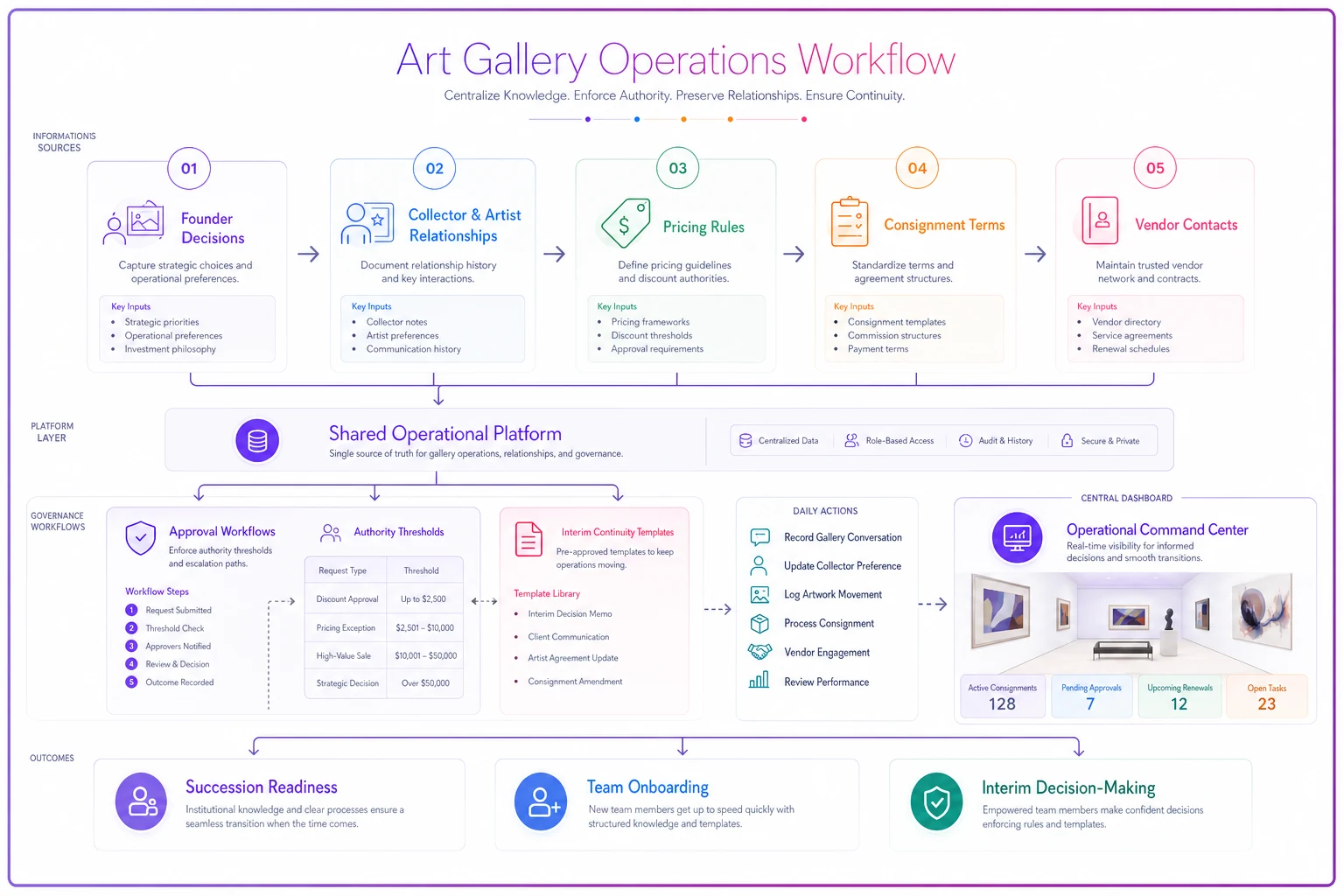
The galleries least damaged by a leadership transition tend to be the ones that already centralized their operational memory for ordinary reasons — running shows, tracking collectors, managing inventory — and discovered that same record was most of a succession plan already.
Where to start if you have nothing
You don't build this all at once. A reasonable sequence:
-
This month Write the emergency continuity one-pager. Who has authority if the founder is out tomorrow, and what do the first 72 hours look like?
-
This quarter Start the decision-logging habit and get top-tier collector and artist context out of the founder's head and into shared records.
-
This year Define role ladders with real authority thresholds, and move actual decisions down the ladder so successors build judgment through practice.
-
With your board Write intervention thresholds and the 90/180-day templates, and make sure the board has worked through them before they're actually needed.
The founders who handle this well aren't the ones with the most elaborate plans. They're the ones who accepted early that the gallery outliving their involvement is the goal — and who started transferring knowledge and authority while they were still around to make the handoff a conversation instead of a scramble.
The founders who handle this well aren't the ones with the most elaborate plans. They're the ones who accepted early that the gallery outliving their involvement is the goal — and who started transferring knowledge and authority while they were still around to make the handoff a conversation instead of a scramble.