



Most galleries treat licensing like found money. A publisher emails about using an image on a book cover, someone negotiates a one-time fee, an invoice goes out, and everyone moves on. Six months later a hotel group wants the same artist's work for a lobby print run, and the whole thing starts from scratch — new email thread, new ad-hoc price, new clause copied from a half-remembered contract.
That's not a licensing program. That's a series of accidents that happen to generate revenue.
Galleries that turn licensing into something dependable do one thing differently: they treat it as a pipeline with stages, scored partners, and renewal mechanics — the same way a good sales team treats a book of accounts. The art is the same. The difference is governance. Once you build that governance, a licensing deal stops being a one-off and becomes an asset that pays again next year without you chasing it.
This covers the whole machine — how deals enter, how they're priced, how rights get tracked, how partners get evaluated, and how renewals get engineered instead of hoped for.
Why one-off licensing stays one-off
The reason most gallery licensing never compounds has almost nothing to do with demand. The demand is often there. It's the operational memory that's missing.
Walk into a typical small gallery and ask three questions: Which images are cleared for commercial licensing right now? What did we charge the last three licensees for similar usage? When does each active license expire and who's responsible for the renewal conversation? In most cases, nobody can answer all three without digging through email or an inbox folder nobody has opened since spring.
When that information lives in people's heads and scattered threads, every deal becomes a custom project. Custom projects don't scale. They eat the director's time, they get priced inconsistently, and they expire silently — which is the quiet killer. A license that lapses without a renewal nudge is pure lost revenue, because the demand didn't disappear, you just forgot to re-sell.
There's also a rights problem underneath all of this. You can't license what you haven't cleared. Plenty of galleries have discovered mid-negotiation that the artist contract never granted commercial reproduction rights, or granted them for editorial use only, or said nothing about territory. If your rights picture is fuzzy, your pipeline will constantly stall at the worst possible moment — when a buyer is ready to pay.
The pipeline: thinking in stages, not deals
The first shift is to stop thinking in individual deals and start thinking in stages that an opportunity moves through. A workable licensing pipeline for a small gallery usually looks like this:
Never miss a key exhibition detail again.
Artioly helps you organize, promote, and manage every exhibition effortlessly.
- Unified exhibition scheduling
- Artist and visitor notifications
- Inventory and sales tracking
No credit card required
-
Inbound / sourced — a request arrives, or you proactively pitch an image to a known buyer type.
-
Rights check — confirm the work is cleared for the intended use, territory, and duration.
-
Scoped & priced — define exactly what's being licensed and apply a pricing rule, not a gut number.
-
Contracted — issue terms from a clause library, negotiate, sign.
-
Active / delivered — files delivered, usage live, payment schedule running.
-
Renewal window — a defined period before expiry where you decide to renew, renegotiate, or sunset.
-
Renewed or closed — the loop either repeats or the opportunity is formally retired.
The value of writing these stages down isn't bureaucratic. It's that each stage has a different owner, a different risk, and a different thing that can break. When you can see which stage a deal is stuck in, you can actually fix the bottleneck. "We have twelve requests sitting in rights check for three weeks" is a solvable problem. "Licensing feels disorganized" is not.
Worth noting: galleries that formalize the rights check as its own gate tend to close faster, not slower. It feels like adding friction. In practice it removes the mid-negotiation collapse that kills momentum, because you never quote a deal you can't actually deliver.
Treat rights check as its own gate — it speeds deals by preventing mid-negotiation collapse.
A quick visual can make it obvious where deals pile up across those stages.
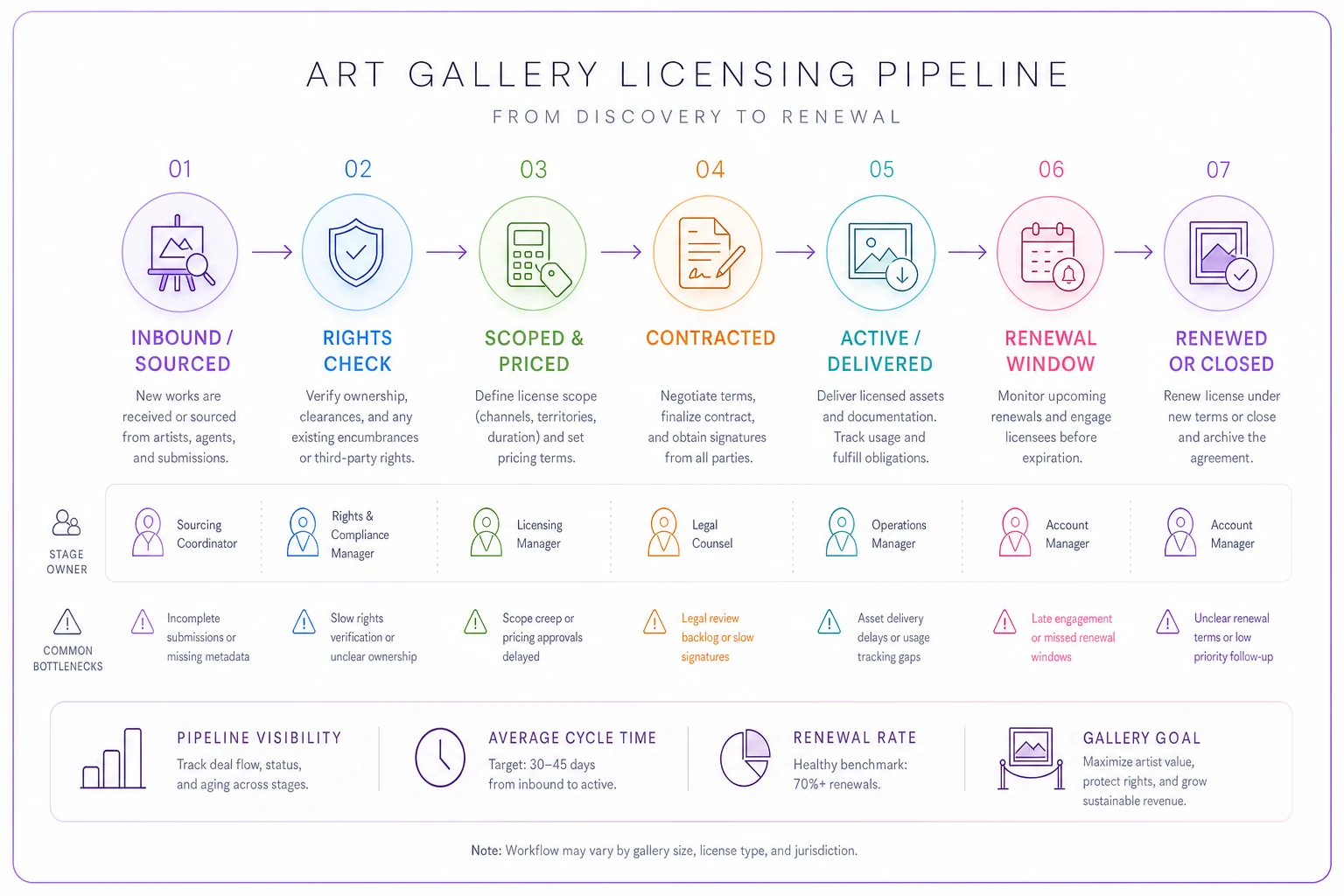
That visual helps teams point to the exact stage that needs fixing instead of describing a vague problem.
Pricing heuristics that stop the guessing
Inconsistent pricing is where most of the money leaks. One licensee pays $400 for a two-year regional print run; another pays $1,500 for roughly the same thing because the person negotiating that day felt bolder. Over time, this damages you reputationally too — buyers talk, and licensees who learn they overpaid don't renew warmly.
The fix is a small set of pricing heuristics that anyone on the team can apply. You're not building a rigid price list; you're building a defensible logic. A usable structure multiplies a base rate by factors for usage scope.
A usable structure multiplies a base rate by factors for usage scope.
| Factor | Low | Medium | High |
|---|---|---|---|
| Usage type | Editorial / single article (×1) | Marketing / web campaign (×2) | Product / packaging / merch (×3–4) |
| Reach | Local or single outlet (×1) | Regional / mid-circulation (×1.5) | National / mass (×2.5) |
| Duration | 1 year (×1) | 2–3 years (×1.6) | Perpetual (×3+) |
| Exclusivity | Non-exclusive (×1) | Category-exclusive (×1.75) | Fully exclusive (×2.5) |
A mid-circulation regional magazine wanting a one-year editorial use lands near your base rate, while a product company wanting exclusive packaging rights nationally for three years lands at a multiple several times higher — and now you can explain why, which is what makes the number stick in negotiation.
Two things people consistently get wrong here. First, they underprice exclusivity. Exclusivity doesn't just add value to the buyer, it removes every other licensing opportunity for that image for the term. Price it like the opportunity cost it is. Second, they forget the artist's cut when setting the base rate, then get squeezed later. Build the royalty split into your floor so the gallery's margin survives. If you don't already run a clean ledger for this, a proper scheduling and ledger system for artist payments and resale royalties is what keeps these splits from turning into disputes down the line.
Partner scorecards: not every licensee deserves a renewal
This is where the "repeatable revenue" part actually gets engineered. The goal isn't just to license more — it's to identify which licensees are worth cultivating into recurring relationships and which are genuinely one-and-done.
A partner scorecard is a simple rubric you fill in for each licensing partner, ideally updated at every renewal window. What tends to work across small arts organizations is scoring on four or five dimensions:
-
Payment behavior — do they pay on time, or do you chase every invoice?
-
Usage compliance — do they stay inside the licensed scope, or do you catch them using images outside the agreed terms?
-
Revenue size & trajectory — is this a growing account or a flat one?
-
Strategic fit — does their brand help or hurt the artist's positioning?
-
Renewal likelihood — based on their usage pattern, will they want this again?
Partners who score high on payment and compliance but low on revenue might be worth a gentle upsell. Partners who pay well but constantly stretch their usage rights need tighter contracts, not more access. And the partner who scores poorly across the board — late payments, scope creep, no strategic value — is a relationship you let lapse without guilt.
The insight most galleries miss: a scorecard turns renewal decisions from emotional ("they've been with us for years") into operational ("their compliance score dropped and revenue is flat, so we renegotiate or exit"). That objectivity is what lets a small team manage a growing book of partners without it becoming a popularity contest.
IP monetization rules: deciding what you'll license before anyone asks
Reactive galleries decide licensing terms deal-by-deal. Galleries with a real strategy set their IP monetization rules in advance, which does two things: it speeds up every negotiation, and it protects the artists whose work you represent.
A monetization ruleset answers questions like:
-
Which works are never licensed for commercial/product use (signature pieces, works the artist has restricted)?
-
Which categories are off-limits entirely (political, alcohol, anything the artist has vetoed)?
-
What's the minimum fee you'll accept — your floor — regardless of how small the buyer is?
-
Who has sign-off authority at each dollar threshold?
-
How is the split structured, and is it the same for every artist or negotiated per contract?
Writing these down prevents two classic failures. The first is the rushed yes — someone accepts a flattering request that later embarrasses an artist and torches the relationship. The second is the slow no — a legitimate opportunity dies because nobody felt authorized to approve it. Clear thresholds and sign-off rules kill both.
This is closely tied to how you handle fees and approvals operationally. If you haven't built the underlying workflow yet, this gallery-first SOP for capturing image licensing revenue safely walks through the fee structures, clauses, and approval gates that make these rules enforceable rather than aspirational.
Contract lifecycle and renewal governance
A license isn't done when it's signed. The signed contract is the start of the part that actually generates recurring revenue — if you govern it.
Effective date → Payment milestones → Mid-term compliance check → Renewal window opens → Decision made → Renewed or sunset.
The renewal window is the single most valuable mechanic here, and it's the one most galleries don't have. Set it to open a fixed period before expiry — 60 to 90 days works for most licensing terms. When that window opens, a specific person gets a specific task: pull the partner scorecard, decide the stance (renew as-is, renew with a price increase, renegotiate scope, or let it lapse), and initiate the conversation.
Why 60–90 days matters: leverage. If you reach out the day a license expires, you're negotiating from weakness — the usage already stopped or is about to, and the buyer knows you need the renewal more than they do. Reaching out early, while the relationship is live and the buyer still values the work, is when price increases actually land.
A realistic renewal playbook for a single partner:
-
Window opens 90 days out — scorecard is reviewed.
-
If the account is healthy and growing, open with a modest increase (often 8–15%) justified by usage expansion.
-
If compliance has been a problem, renew only with tightened scope language from your clause library.
-
If strategic fit has eroded, offer a short bridge term or decline cleanly.
-
Log the outcome and reset the next renewal window regardless of result.
That last step — resetting the window even on a renewal — is what makes the revenue repeatable. The deal never falls off the radar again.
A real scenario
A small contemporary gallery representing around a dozen living artists was doing licensing purely reactively — maybe six to eight deals a year, each negotiated from scratch, averaging somewhere in the $500–$900 range. No tracking, no renewal process. A couple of lucrative licenses had quietly expired the previous year without anyone noticing until the buyers simply stopped appearing.
They built three things over a quarter: a cleared-rights list covering which images could actually be licensed and for what, the pricing heuristic table above, and a renewal calendar with a 75-day window on every active deal.
The pricing structure alone shifted their average — once staff could justify numbers instead of guessing low, typical deals moved into the roughly $900–$1,400 band for comparable usage. The bigger change came from renewals. Of the active licenses they'd previously have let lapse, most renewed when someone actually reached out during the window, several with a small increase attached. Within about a year, what had been maybe $5k–$6k of scattered one-off licensing turned into a book closer to $14k–$17k — and a meaningful chunk of that was now renewing revenue they could roughly forecast rather than hope for.
Nothing exotic happened. They didn't license more famous work or find bigger buyers. They just stopped losing the deals they already had.
When this makes sense — and when it doesn't
Build this out when: you're fielding licensing requests more than a handful of times a year, you represent artists whose work has clear commercial appeal, and you're losing track of what's licensed to whom. The governance pays for itself fast once you have enough volume to leak revenue.
Hold off when: you get one licensing inquiry a year and your rights situation is genuinely simple. A full pipeline and scorecard system is overkill for a trickle — you'll spend more time maintaining the system than you'd lose by handling each deal manually.
Who should NOT do this: galleries whose artist contracts don't clearly grant reproduction rights. Don't build a licensing machine on top of unclear rights — you'll just industrialize your legal exposure. Fix the rights clauses in your artist agreements first, then build the pipeline on solid ground.
Where the whole thing connects
Licensing doesn't sit in a silo. It touches your rights records, your artist agreements, your royalty ledger, and your pricing logic all at once — which is exactly why it breaks when those things live in separate spreadsheets and inboxes.
The practical foundation is a system where cleared-rights status, licensing history, and renewal dates live alongside the artwork records themselves, so a scoped deal, an expiry alert, and the artist's split are all looking at the same source of truth. Galleries that keep this fragmented find that the pipeline, scorecards, and renewal windows degrade back into guesswork within a year. If you're evaluating where this data should live, this practical decision matrix for selecting artwork archive software is a useful place to start thinking about the underlying structure.
The real outcome of all this isn't a bigger licensing fee on any single deal. It's that licensing stops being a surprise. You know what's cleared, you know what it's worth, you know who's licensing it, and you know when to go back and ask again. That predictability is the whole point — a gallery licensing partnerships strategy only becomes an asset when the revenue shows up again next year without you reinventing the process to get it.
Ready to elevate your gallery operations?
Join 500+ galleries using Artioly to streamline operations, boost visitor engagement, and increase art sales.