


Most galleries don't actually have a collection problem. They have four separate problems — acquisitions, conservation, loans, and deaccession — each handled by a different person, with different criteria, in different places. Acquisitions get decided over dinner. Conservation gets decided when something cracks. Loans get decided when a museum emails. Deaccession almost never gets decided at all, because nobody wants to be the one who signs off on letting something go.
The result is a collection that grows by accident and deteriorates by neglect, while the gallery slowly loses track of why it owns half of what it owns.
A long-term collection strategy isn't about having opinions on each of those four things. It's about wiring them into one governance loop where a decision in one area automatically changes the priorities in another. An acquisition should raise a conservation flag. A conservation cost should feed a deaccession review. A loan request should trigger a risk assessment that either protects or exposes the work. When those connections are missing, every decision looks reasonable on its own and the portfolio still rots.
This is the system view — how the whole thing works, and more usefully, where it breaks.
Why these four decisions drift apart
The separation happens for understandable reasons. Acquisition is exciting and gets the founder or senior curator's attention. Conservation is boring and expensive and gets deferred. Loans feel like validation, so people say yes fast. Deaccession feels like admitting a mistake, so people avoid it.
In real operations, the drift usually starts with record-keeping. The acquisition gets logged in one system — or a spreadsheet, or someone's memory. The condition report lives in a folder. The loan agreement sits in email. The valuation is in an appraiser's PDF from four years ago. No single record ties a work's cost, condition, risk, and strategic fit together, so nobody can see the full picture of any individual piece, let alone the whole collection.
The pattern worth naming: a collection without unified governance always optimizes for the most emotionally rewarding decision and ignores the most financially important one. Acquiring feels good. Deaccessioning feels bad. So galleries accumulate holding costs they never planned for and defer the conservation that would have protected value.
If your inventory foundation is shaky, this all gets worse — governance decisions are only as good as the records underneath them. Getting that base right is its own project, the kind of stage-by-stage artwork lifecycle governance work that makes everything downstream possible.
What breaks at scale
A collection of 40 works runs fine on instinct. One person remembers the condition of each piece, where it is, and roughly what it's worth. Governance is informal because it fits in one head.
Never miss a key exhibition detail again.
Artioly helps you organize, promote, and manage every exhibition effortlessly.
- Unified exhibition scheduling
- Artist and visitor notifications
- Inventory and sales tracking
No credit card required
At somewhere around 150–300 works, that collapses. Not gradually — it collapses at specific pressure points:
-
Conservation becomes reactive instead of scheduled. You stop catching deterioration early and start paying emergency rates to fix damage that a $400 intervention would have prevented a year ago.
-
Loans create uninsured exposure. Someone says yes to a loan without checking the work's fragility tier or whether the borrower's climate control matches the medium's needs.
-
Acquisitions duplicate strengths and ignore gaps. Without a priority framework, you buy more of what you already have too much of.
-
Deaccession backlog grows invisibly. Works that no longer fit, can't be shown, and cost money to store just sit there, quietly draining the budget.
The underlying failure is coordination. Four decisions, four decision-makers, no shared ledger of what each work costs to keep, costs to fix, and earns or justifies by staying. At scale, you can't govern what you can't see across all four dimensions at once.
The unifying idea: a risk-tier spine
What connects acquisitions, conservation, loans, and deaccession is risk. Not price. Not sentiment. Risk — specifically, the combination of a work's financial value, its physical fragility, and its strategic importance to the collection's purpose.
Once you assign every work a risk tier, the four decisions stop being separate judgments and become outputs of the same classification. The tier tells you how hard to vet an acquisition, how often to inspect for conservation, whether to approve a loan, and what the deaccession bar should be.
| Risk tier | Financial value | Fragility | Strategic fit | Conservation cadence | Loan posture | Deaccession bar |
|---|---|---|---|---|---|---|
| Tier 1 — Core | High | Any | Defines the collection | Inspect every 6 months | Rarely loan; strict borrower terms | Almost never; board-level only |
| Tier 2 — Strategic | Medium–high | Medium | Supports a known strength | Annual inspection | Loan with conditions | High bar; committee review |
| Tier 3 — Flexible | Medium | Low–medium | Useful but not essential | Every 18–24 months | Loan freely with standard terms | Standard review; candidate pool |
| Tier 4 — Review | Low or unclear | Any | Weak or redundant fit | On-demand only | Loan to offset storage | Active deaccession candidate |
The point of the table isn't the exact thresholds — adjust those to your collection. The point is that one classification drives all four workstreams. A work's tier is the single field that keeps the decisions coordinated.
Acquisition policy: the entry gate that protects everything downstream
Most galleries treat acquisition as the fun part and skip the gate. But every work you bring in commits you to decades of holding cost, so the acquisition policy is where governance either starts strong or never starts at all.
A workable acquisition gate asks four questions before anything is committed:
-
Strategic fit — Which existing strength does this deepen, or which deliberate gap does it fill? "It's beautiful" is not an answer.
-
Provenance and risk — Does the ownership history clear your due-diligence bar? This is non-negotiable and should never be rushed because a deal feels urgent. A disciplined provenance due-diligence checklist belongs inside the acquisition gate, not as an afterthought.
-
Conservation forecast — What will this cost to keep in good condition over 10 years? A fragile mixed-media piece might carry a maintenance liability several times its purchase price.
-
Provisional tier assignment — Where does it land on the risk spine, and does that tier have room in the budget?
The mistake that comes up most often: galleries evaluate acquisitions on price and desirability but never on carrying cost. A work bought for $6,000 that needs climate-controlled storage and a conservation touch every two years can quietly cost more over a decade than a $15,000 piece that just hangs there stably. The acquisition gate is where you catch that — or where you don't.
Conservation prioritization: scheduling instead of firefighting
Conservation is where the lack of unified governance shows up as hard cash. Reactive conservation — fixing things after they visibly degrade — routinely costs three to five times what scheduled, preventive care would have.
The tier spine solves the prioritization problem directly. Tier 1 works get frequent inspection because the downside of losing them is catastrophic. Tier 4 works get inspected only when needed, because you may be deaccessioning them anyway. You stop spreading conservation attention evenly and start concentrating it where value and fragility intersect.
-
Rank by fragility × value, not by age or visibility. The oldest-looking work isn't always the most at-risk; a recent mixed-media piece with unstable materials often is.
-
Budget conservation per tier, not per crisis. Allocate a fixed annual pool to Tier 1 and 2 preventive care before any emergency spending.
-
Log every intervention against the work's record. A conservation history that lives in the work's file — not in a conservator's inbox — is what lets you spot a piece that's becoming a money pit.
A conservation history that lives in the work's file — not in a conservator's inbox — is what lets you spot a piece that's becoming a money pit.
That last point connects straight to deaccession: when a single work has absorbed repeated interventions and keeps degrading, the conservation ledger is your evidence for a deaccession review. If you've built a collections stewardship framework already, the prioritization layer sits neatly on top of it.
Loan-committee rules: saying yes without creating exposure
Loans are where galleries get burned by their own enthusiasm. A loan feels like recognition, so the instinct is to accept quickly. But a loan moves a work out of your control, into a transit and display environment you don't manage, often insured at a value nobody re-checked.
-
Tier 1 — Default no. Approve only with the founder/board, a current valuation, full condition report, and borrower climate verification.
-
Tier 2 — Conditional yes. Requires updated condition report, insurance at current value, and a borrower facility report.
-
Tier 3 — Standard yes. Normal loan agreement, standard insurance, condition report on exit and return.
-
Tier 4 — Encouraged. Loaning these out can offset storage cost while you decide their future.
Two rules prevent most disputes. First, no loan ships without a fresh condition report and a matching return inspection — that's your entire defense if something comes back damaged. Second, insurance value must be re-confirmed within the loan window, not pulled from an old appraisal. A work valued at $8,000 four years ago might be worth double now, and a wall-to-wall policy at the stale number leaves you badly exposed if it's lost in transit.
Donor interactions: governing the gifts, not just accepting them
Donated works are where good governance quietly falls apart, because turning down a gift feels rude and accepting one feels generous. But a donated work carries every cost a purchased one does — storage, conservation, insurance — without the deliberate decision that an acquisition gets.
Run donations through the same acquisition gate. A gift that doesn't fit the strategy, can't clear provenance, or carries a heavy conservation forecast should be declined or redirected gracefully, not absorbed by default. The awkward conversation at the point of offer is far cheaper than the decade of carrying cost plus the eventual awkward deaccession.
Where donor relationships genuinely matter is in restriction terms. A gift with a never-sell or always-display clause permanently constrains your governance. Those strings should be negotiated, documented, and tier-flagged at the moment of acceptance — because a restricted work is effectively locked at a high tier regardless of its actual strategic value, and that trade-off should be made consciously, not discovered later.
Principled deaccession governance: the decision nobody wants to make
Deaccession is the release valve that keeps the whole system healthy, and it's the one galleries avoid hardest. The avoidance is understandable and also expensive — every work you keep that no longer earns its place is money that can't go toward works that would.
Principled deaccession means the decision is driven by documented criteria, not by someone's mood or a sudden cash need. The criteria should be visible and consistent:
-
The work has sat in Tier 4 across two or more review cycles.
-
Its conservation ledger shows repeated spend with declining condition.
-
It's strategically redundant — you hold stronger examples of the same thing.
-
It cannot be shown or loaned, so it generates only cost.
The governance safeguards matter as much as the criteria, because deaccession done carelessly damages reputation and donor trust. A defensible process looks like this:
-
Nomination — any staff member can flag a candidate, with reasons logged against the work's record.
-
Committee review — the deaccession committee checks criteria, restrictions, and provenance before anything proceeds.
-
Restriction clearance — confirm no donor terms or legal constraints block the release.
-
Method and proceeds rule — decide the disposal method in advance, and commit proceeds to a restricted fund (acquisition or conservation), never to operating cash. This single rule is what separates principled deaccession from quietly selling the collection to pay the rent.
-
Documentation — record the full rationale so the decision is defensible years later.
That proceeds rule is worth protecting above everything else. The moment deaccession money starts covering payroll, governance is finished — every future sale becomes suspect.
How the loop actually runs: a workflow
The four workstreams only stay coordinated if they feed each other on a schedule. Here's how it runs in practice:
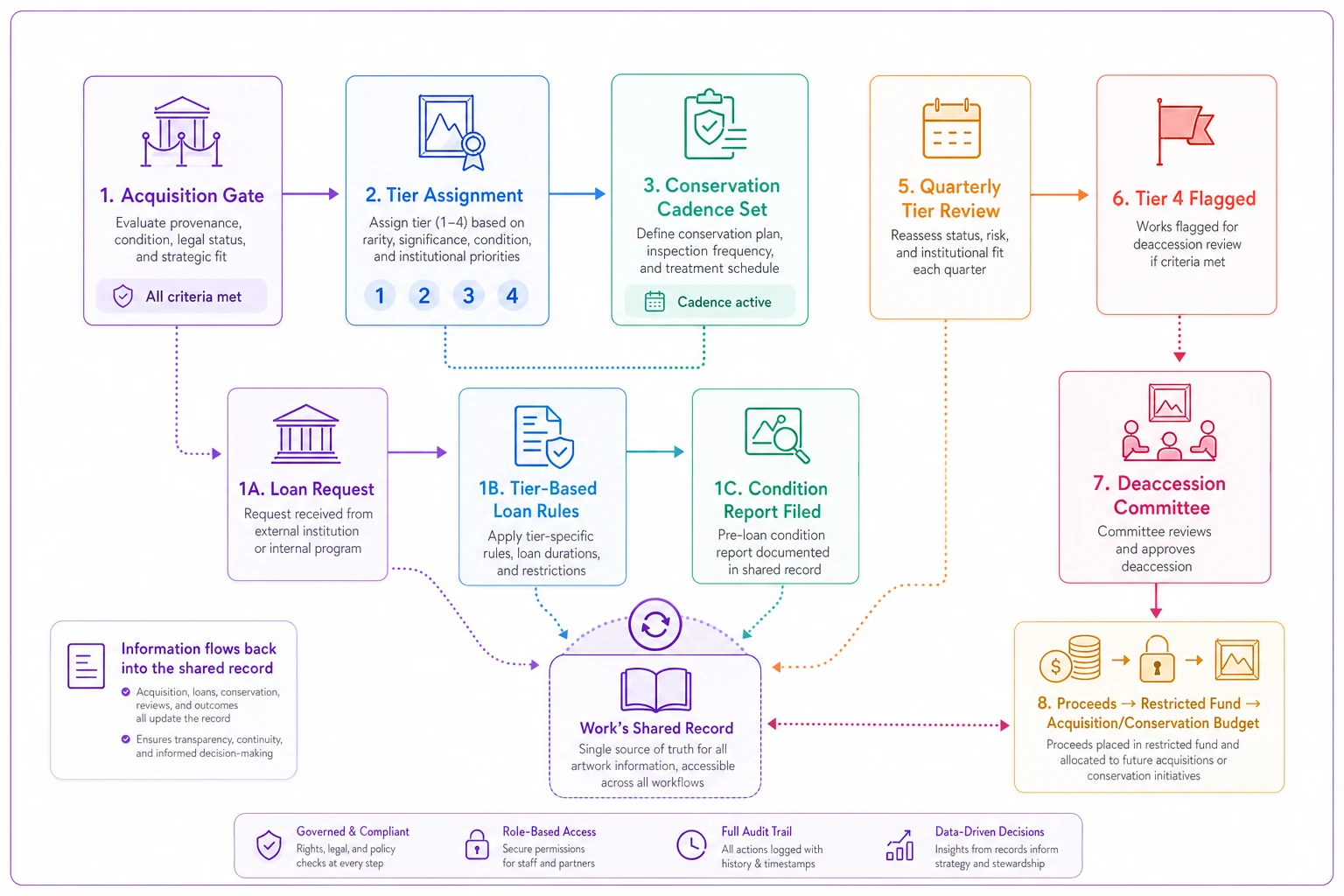
A work enters through the acquisition gate, gets a provisional tier, and that tier sets its conservation cadence. Each scheduled inspection updates the work's condition record. When condition declines or spend accumulates, the tier gets re-evaluated — maybe dropping from Tier 2 to Tier 3, or into Tier 4. A loan request runs the work against its current tier's loan rules, and the loan's condition reports feed back into the conservation record. Quarterly, the review cadence looks at everything in Tier 4, pulls deaccession candidates, and routes any proceeds back into the acquisition or conservation budget — which funds the next cycle.
That's the whole system: entry, classification, maintenance, exposure control, and release, all driven off one shared tier and one set of records. Break any link — skip the tier assignment, keep conservation in a separate folder, approve loans without checking tier — and the loop stops closing.
KPI review cadence: keeping the system honest
A governance system that isn't measured drifts back to instinct within a year. You don't need a dashboard with forty metrics — you need a handful that reveal whether the loop is closing.
Useful metrics to track on a set rhythm:
-
Collection composition by tier — is Tier 4 growing faster than you're deaccessioning? That's accumulation outpacing release.
-
Preventive vs. emergency conservation ratio — if emergency spend is rising, your cadence isn't catching problems early enough.
-
Conservation cost concentration — which works are absorbing disproportionate spend? Those are deaccession candidates.
-
Loan return condition rate — are works coming back in the condition they left? A declining rate means your loan rules are too loose.
-
Deaccession throughput — are candidates actually moving through the committee, or piling up unreviewed?
Review tier composition and conservation ratios quarterly; loan and deaccession metrics can run on a longer cycle. The cadence matters more than the frequency — a governance review that happens reliably every quarter beats an exhaustive one that happens once and never again.
Budget mapping across risk tiers
The budget is where governance becomes real, because priorities you don't fund aren't priorities. Map spending to tiers so the money follows the risk:
-
Conservation budget — the bulk goes to Tier 1 and Tier 2 preventive care. Tier 4 gets near-nothing; you're not investing in works you may release.
-
Acquisition budget — target deliberate gaps and Tier 1/2 strengths, not opportunistic buys. A portion should be reserved for works that deepen what already makes the collection distinctive.
-
Storage and insurance — tier your coverage so Tier 1 gets the best climate control and current-value insurance, while Tier 4 sits in standard conditions pending review.
-
Deaccession proceeds — ring-fenced into a restricted fund that refills the acquisition and conservation pools.
The insight most galleries miss: holding cost is a budget line even when nobody writes it down. Storage, insurance, and baseline conservation for every work accrue whether or not you've accounted for them. Tier-based budgeting makes that invisible cost visible, which is exactly what forces the deaccession discipline that keeps the collection lean.
A real scenario
A mid-sized commercial gallery with around 220 works in its holdings had no unified governance. Acquisitions were the director's call, conservation happened when something broke, loans were approved by email, and deaccession hadn't happened in years. Emergency conservation was eating roughly $9k–$12k a year, almost all of it reactive — damage that scheduled care would have caught early.
They built the tier spine over about two quarters. Classifying everything surfaced close to 50 works sitting in what became Tier 4 — redundant, unshowable, and quietly costing storage and insurance. Conservation budget got redirected toward preventive care on Tier 1 and 2, and a quarterly review finally moved a batch of Tier 4 works through a deaccession committee, with proceeds locked into a restricted acquisition fund.
Within a year, emergency conservation dropped to roughly a third of what it had been, because the expensive surprises mostly stopped happening. The deaccession proceeds funded two gap-filling acquisitions the director had wanted for years. The collection didn't get bigger — it got sharper, and noticeably cheaper to hold.
Where the records live
None of this works if the data is scattered across spreadsheets, email, and someone's memory. The entire loop depends on one thing: every work having a single record that carries its tier, cost, condition history, loan status, and strategic rationale together. When those fields live in one place, the connections run automatically — a conservation entry updates the record that a deaccession review reads; a tier change flags the loan rules that apply.
Modern collection management platforms, particularly ones with AI-assisted workflows, help here by keeping these fields linked and surfacing patterns a human reviewer would likely miss — the work whose conservation spend is quietly climbing, the Tier 4 candidates aging past their review cycle, the loan whose insurance value hasn't been refreshed. The technology isn't the strategy. It's what stops the four workstreams from drifting apart again the moment attention moves elsewhere.
Pulling it together
A collection governed well is one where acquisition, conservation, loans, and deaccession are the same conversation, driven by one risk classification and one shared set of records. The galleries that struggle aren't the ones making bad individual decisions — they're the ones making four separate decisions that never talk to each other.
Start with the tier spine, because it's the connective tissue everything else hangs on. Then fund the tiers honestly, review on a steady cadence, and treat deaccession as the normal release valve it should be rather than the taboo it usually becomes. That's what turns a pile of accumulated objects into a collection you actually govern — one that gets stronger every cycle instead of just heavier.
Start with the tier spine, because it's the connective tissue everything else hangs on. Then fund the tiers honestly, review on a steady cadence, and treat deaccession as the normal release valve it should be rather than the taboo it usually becomes. That's what turns a pile of accumulated objects into a collection you actually govern — one that gets stronger every cycle instead of just heavier.
Ready to elevate your gallery operations?
Join 500+ galleries using Artioly to streamline operations, boost visitor engagement, and increase art sales.